
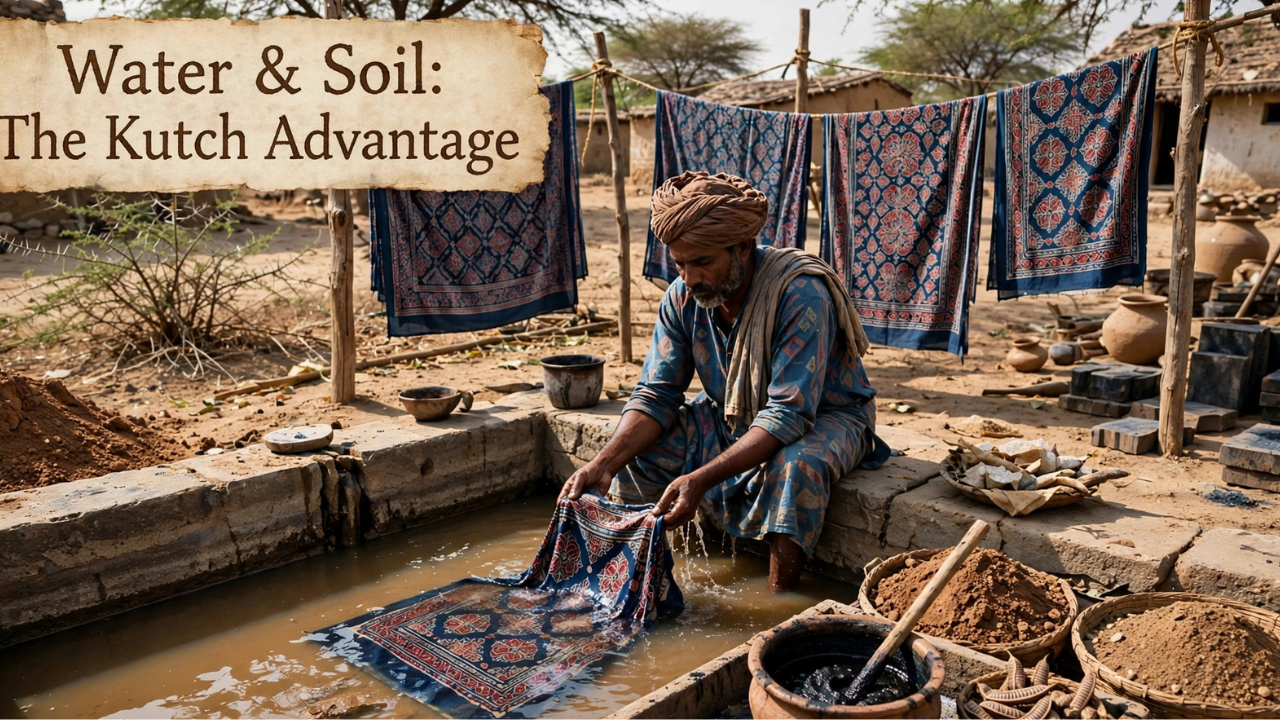
Imagine an Ajrakh artisan preparing two batches of fabric using the same printing blocks, the same dye recipe, and the same working method. The finished colours still show a difference. What could explain that change?
The answer may involve several factors, including the natural colorant, fabric preparation, temperature, and water quality. Textile making rarely depends on one ingredient alone. Even water that appears clean can contain dissolved substances that influence how certain materials behave.
This question becomes particularly interesting in Kutch, where dry weather and varied groundwater conditions shape everyday resource management. The region’s water sources do not all share the same chemical composition. Some contain more calcium and magnesium, while others may carry higher concentrations of dissolved salts.
For traditional Ajrakh production, these differences create a useful opportunity to understand the relationship between geography and craftsmanship. Water supports fabric preparation, printing, dyeing, and washing, while the surrounding soil and geology help determine its composition.
The keyword Kutch water natural dyeing Ajrakh connects these environmental factors with a living textile tradition. Rather than treating the landscape as a magical ingredient, we can examine how its conditions influence the decisions artisans make.
The result is a more complete understanding of Ajrakh: a craft in which natural materials, local circumstances, and human experience work together.
Geographic Terror: The Environment Behind the Craft
A textile’s regional identity often develops through a combination of materials, working conditions, community knowledge, and inherited techniques. Geographic terror offers a way to explore this connection between place and production.
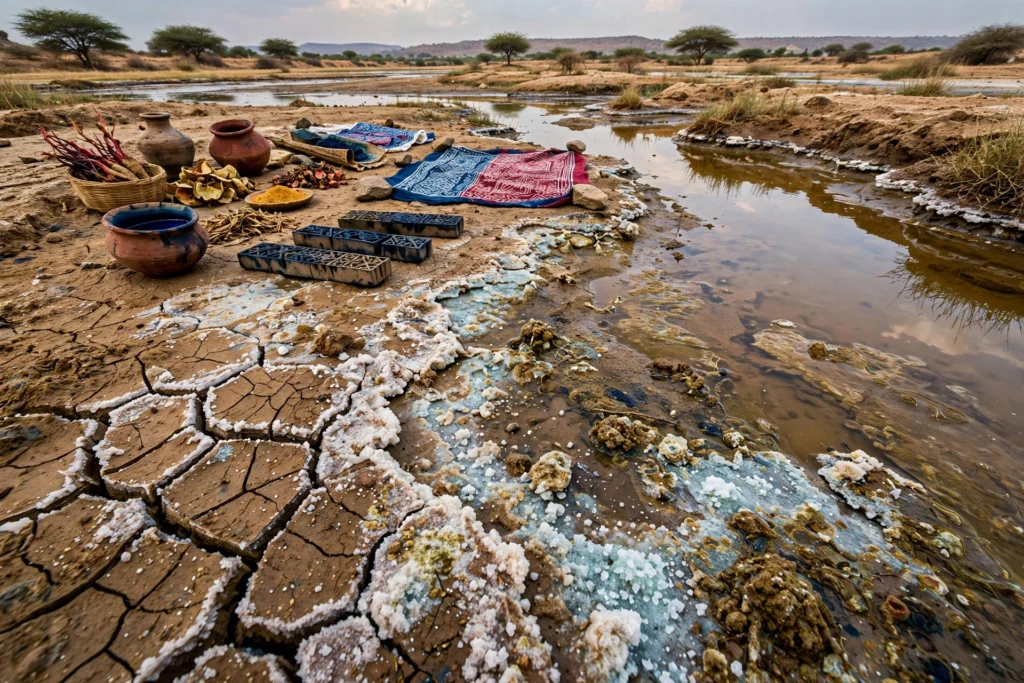
In Kutch, the relationship begins with the land itself. Rainfall patterns influence water availability, geological materials affect groundwater composition, and local conditions shape the practical choices available to textile makers.
These factors do not produce identical results across the region. Two artisans may work in different locations and encounter different water conditions, even when they follow similar traditional methods.
The Journey from Rainfall to Groundwater
When rain reaches the ground, some water runs across the surface while some enters the soil. As water moves through underground layers, it may dissolve minerals from rocks and sediments.
The composition of groundwater depends on the materials it encounters and the conditions under which it moves and collects. Consequently, the water drawn from one well may differ from water obtained elsewhere.
These differences matter because textile processing depends on the properties of the water used. Dissolved minerals can affect certain cleaning agents and dye ingredients, while elevated salt concentrations may create different challenges.
An artisan who understands the behaviour of a local water source can make more informed production decisions. This knowledge becomes particularly valuable when a familiar method begins to produce unexpected results.
Dry Conditions and Resource Decisions
Kutch’s arid environment makes the management of water an important practical concern. Textile production can involve multiple washing and rinsing stages, so workshops must consider both water availability and suitability.
Hot weather can also affect evaporation and drying. When water evaporates from a solution, dissolved substances may become more concentrated. This change can influence a process if the concentration of particular ingredients moves beyond the intended range.
Artisans must therefore consider the conditions surrounding their work rather than assume that every batch will behave exactly like the previous one.
The geographic character of Ajrakh comes from this interaction between the region and the people who practice the craft. Environmental conditions create the setting; skill and experience guide the response.
Hard Water: What Artisans Need to Understand
Water hardness mainly reflects the concentration of dissolved calcium and magnesium. These minerals can enter groundwater as water interacts with certain geological materials.
Hard water is not automatically unsuitable for textile work. Its effects depend on the process, the cleaning agents, and the ingredients used during dyeing.
When Cleaning Becomes Less Predictable
Fabric preparation plays an important role in printing. Depending on the textile and technique, artisans may need to remove dirt, processing residues, or other unwanted substances before applying printing materials.
Certain soaps and cleaning agents react with calcium and magnesium. These reactions can reduce cleaning efficiency or form deposits. If a cleaning process does not perform as expected, the fabric may require a different preparation approach.
However, hardness is only one possible cause of a problem. The condition of the fabric, the cleaning method, temperature, and other substances in the water can also influence the result.
For this reason, artisans should not assume that every variation in fabric appearance comes from hard water. Observing the process and testing the water can help identify the actual cause.
Does Hard Water Change Natural Colours?
The answer depends on the colorant and the surrounding chemical conditions.
Some natural dye compounds interact with metal ions. These interactions may influence colour development, while other dye systems respond differently. Mineral concentration, pH, temperature, and the presence of mordants can all affect the outcome.
Hard water does not always create a deeper shade, and soft water does not automatically guarantee a better result.
An artisan must consider the complete recipe and the behaviour of the specific materials. Understanding this distinction prevents oversimplified claims about the relationship between mineral-rich water and traditional dyeing.
Mineral Content: Looking Beyond the Water’s Appearance
Clear water does not necessarily have a low mineral content. Many dissolved substances remain invisible, which means appearance alone cannot establish whether water suits a particular textile process.
Mineral content includes a range of dissolved substances. Calcium and magnesium contribute to hardness, while sodium and chloride may contribute to salinity. Other ions can influence alkalinity or interact with selected ingredients.
The proportions matter as much as the presence of individual minerals. Different combinations can produce different chemical conditions.
Why Water Chemistry Matters During Preparation
Before an artisan develops the final pattern, the fabric may pass through several treatments. These stages prepare the textile to receive printing materials and colour.
If water interacts with a cleaning agent or processing ingredient, it can change the way that substance behaves. In some situations, the change may be small. In others, it may affect the consistency of the process.
A workshop that experiences recurring problems can begin by comparing its water source, preparation method, and production results. Recording these details helps identify patterns that memory alone may not reveal.
Testing can add useful evidence. Water hardness tests measure calcium and magnesium, while conductivity provides an indication of dissolved ions. Total dissolved solids estimates the amount of dissolved material, and pH testing measures acidity or alkalinity.
These measurements answer different questions. Textile makers should select tests that relate to the problem they want to investigate.
The Relationship Between Mordants and Minerals
Mordants help certain natural colorants develop an appropriate relationship with textile fibers. Their role varies according to the dye system, and not every natural colorant requires the same treatment.
The choice and concentration of a mordant can affect the final shade. Water chemistry may also influence some mordanting systems by changing the behaviour of dissolved ingredients.
This does not mean that every mineral in water acts as a useful mordant. Uncontrolled mineral content can create unwanted effects as readily as it can influence colour development.
Artisans need to understand which materials the process requires and which conditions support the intended result. That understanding combines technical knowledge with the practical experience of working repeatedly with natural colorants.
Salinity: When Dissolved Salts Become a Concern
Salinity describes the concentration of dissolved salts in water. It differs from hardness, although a water source may display both characteristics.
In parts of Kutch, groundwater salinity can present a challenge. The level varies by location, however, and we should not assume that every local water source has the same problem.
How Salts Influence Textile Processing
Dissolved salts can affect particular dye baths, cleaning agents, and other processing materials. The outcome depends on the ions present, their concentration, and the chemistry of the recipe.
Water that contains excessive salts may also complicate rinsing or contribute to unwanted residues. The artisan needs to consider the full process, including how the fabric moves from one treatment to another.
A change in dye performance does not automatically prove that salinity caused the problem. Natural colorants vary, fabric preparation can change, and processing conditions can shift.
A suitable water-quality assessment helps distinguish between these possibilities. It also gives textile producers a clearer basis for choosing appropriate process adjustments.
Managing Water Without Making Assumptions
A workshop can monitor water quality over time and record changes in the behaviour of its materials. These records may reveal a relationship between a changing water source and an inconsistent production result.
Where necessary, artisans can seek technical advice about testing and water treatment. Any intervention should suit the particular dyeing method and avoid introducing new substances that interfere with the process.
This approach respects traditional practice while recognizing that environmental conditions can change. It allows artisans to make decisions based on evidence instead of relying on general statements about regional water.
Ajrakh’s Natural Colours Depend on Controlled Processes
The relationship between water and colour becomes easier to understand when we examine the different dyeing methods used in traditional textile production.
Each colorant has its own properties. A process that supports indigo may not work in the same way for a plant-derived red. Artisans must therefore adapt their methods to the materials involved.
Indigo and the Blue Dye Vat
Indigo requires a reduction process before the pigment can enter the fiber effectively. Under suitable vat conditions, the blue pigment changes into a more soluble form.
After the textile takes up that form, exposure to oxygen allows the pigment to return to its blue, insoluble state. The process requires appropriate chemical conditions and careful management of the vat.
Water acts as the medium, but its presence alone does not create the desired blue. The reduction system, alkalinity, temperature, and other conditions all matter.
Minerals and dissolved salts may influence particular vat systems, but their effects depend on the recipe and water composition. Artisans need to maintain suitable conditions throughout the process.
Developing Red with Plant-Derived Colorants
Traditional textile dyeing also uses plant-derived colorants to create red shades. Madder, obtained from Rubia species, contains compounds that can contribute to red colour development.
The resulting shade depends on factors such as extraction, temperature, mordanting, fabric preparation, and the specific dye material. Water chemistry may influence some of these interactions, but it cannot predict the final colour on its own.
Artisans must also preserve the intended pattern as the fabric moves through printing and dyeing stages. Resist materials protect selected areas, while other parts of the textile receive colour.
This coordination demonstrates why Ajrakh requires more than a supply of natural dye. It demands control over materials, timing, and the sequence of treatments.
Soil and Water: A Relationship That Varies by Location
The chemistry of groundwater reflects a relationship between water movement, geological materials, and local environmental conditions.
As water passes through certain rocks and sediments, it may dissolve minerals. Groundwater can also collect dissolved salts under particular conditions. The resulting composition varies according to the source and its surroundings.
This variation matters in Kutch because artisans cannot assume that every well, bore well, or other source will behave identically during textile processing.
Soil and geology also help explain why environmental conditions differ across a region. However, the soil does not directly determine the quality of every finished textile. The water source, dyeing method, materials, and artisan’s decisions all influence the outcome.
Understanding this relationship gives us a more accurate way to discuss the regional character of Ajrakh. It connects the craft with the landscape without attributing every colour difference to a single natural factor.
What Traditional Experience Can Teach Modern Textile Producers
An experienced artisan often notices changes through the behaviour of materials. A cleaning stage may take longer, a dye bath may respond differently, or a finished textile may show a variation in shade.
These observations provide useful clues, but the artisan still needs to identify the reason behind the change.
Modern water testing can support this investigation. By measuring hardness, pH, conductivity, and dissolved solids, a workshop can compare different water sources and monitor changes over time.
Production records can make this information more useful. Recording the water source, dye recipe, processing conditions, and observed result helps the artisan understand which variables may influence consistency.
Scientific measurements do not replace traditional knowledge. They provide another way to investigate the materials that artisans already understand through experience.
This combination can help traditional textile businesses preserve their methods while responding to changing environmental conditions.
Responsible Water Use Supports the Future of Ajrakh
Water management matters beyond the immediate needs of dyeing. Textile production may generate wastewater containing colorants, salts, mordants, and other processing residues.
Natural dyes do not automatically make wastewater harmless. Workshops need appropriate methods to manage and treat wastewater according to the materials they use and the applicable environmental requirements.
Careful planning can also reduce unnecessary water use. Where technically appropriate, workshops may investigate whether selected water streams can serve another suitable production stage. They must account for accumulated residues and avoid reuse when water quality could compromise the textile or process.
Protecting local water resources supports the long-term continuity of craft communities. It also encourages businesses and consumers to consider the environmental responsibilities behind handcrafted textiles.
For Ajrakh, sustainability requires attention to materials, water, energy, and wastewater rather than reliance on the label of natural dyeing alone.
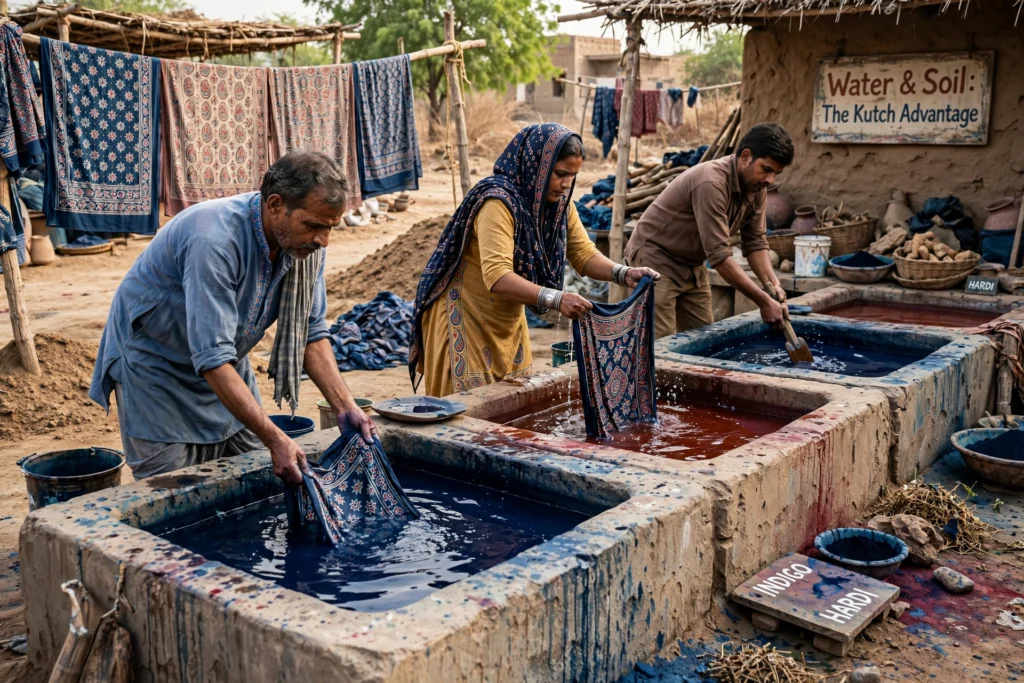
The Kutch Advantage: An Understanding Built Through Practice
The relationship between Kutch’s environment and Ajrakh cannot be reduced to one special mineral or one ideal type of water.
The region’s geology influences groundwater composition. Dry conditions shape water management. Hardness and salinity can affect selected processing stages, while the behaviour of natural colorants depends on their chemistry and the conditions in which artisans use them.
The artisan brings these elements together. Through preparation, printing, dyeing, and careful observation, the crafts person turns raw materials into a textile with a distinct pattern and character.
That is the deeper value of geographic terror in Ajrakh. The landscape forms part of the story, but people give the craft its continuity through knowledge, skill, and adaptation.
At Kancholika, understanding this relationship encourages us to appreciate handcrafted textiles beyond their visible design. It reminds us that every traditional craft involves choices about materials, techniques, and the environment in which people work.
The Kutch advantage lies not in assuming that nature always provides perfect conditions, but in recognizing how generations of artisans have learned to work thoughtfully with the conditions around them.