
Ajrakh carries the beauty of detailed patterns, deep indigo shades, earthy reds, and generations of textile knowledge. Behind every finished fabric, however, lies a process that deserves attention: dyeing. The materials used to create colour influence not only the appearance of a textile but also the way artisans handle it, how workshops manage wastewater, and what information buyers receive about the finished product.
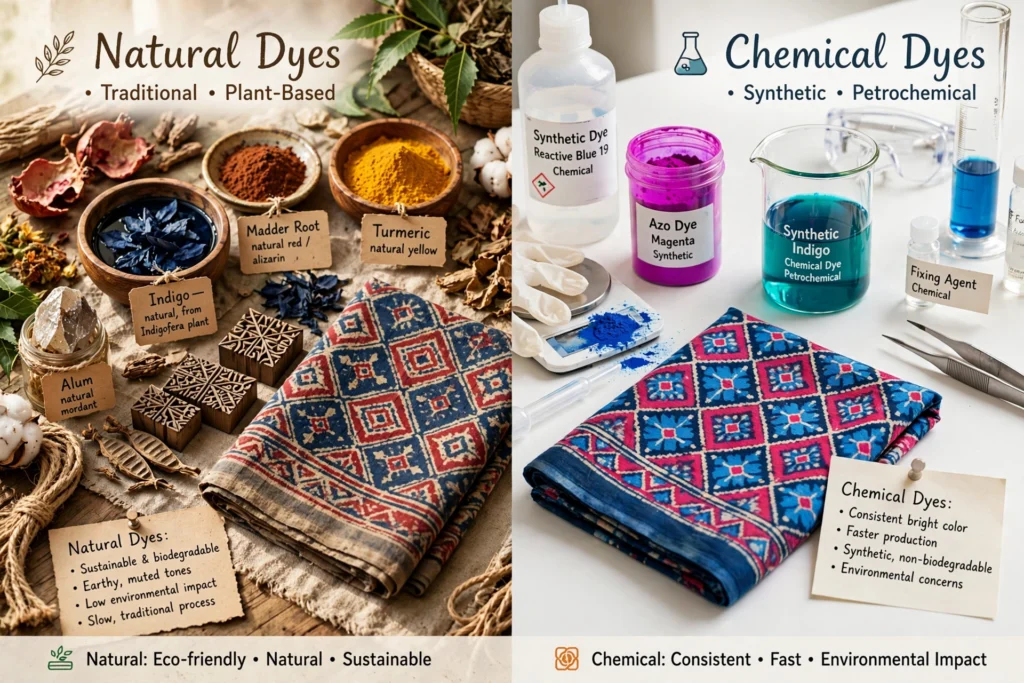
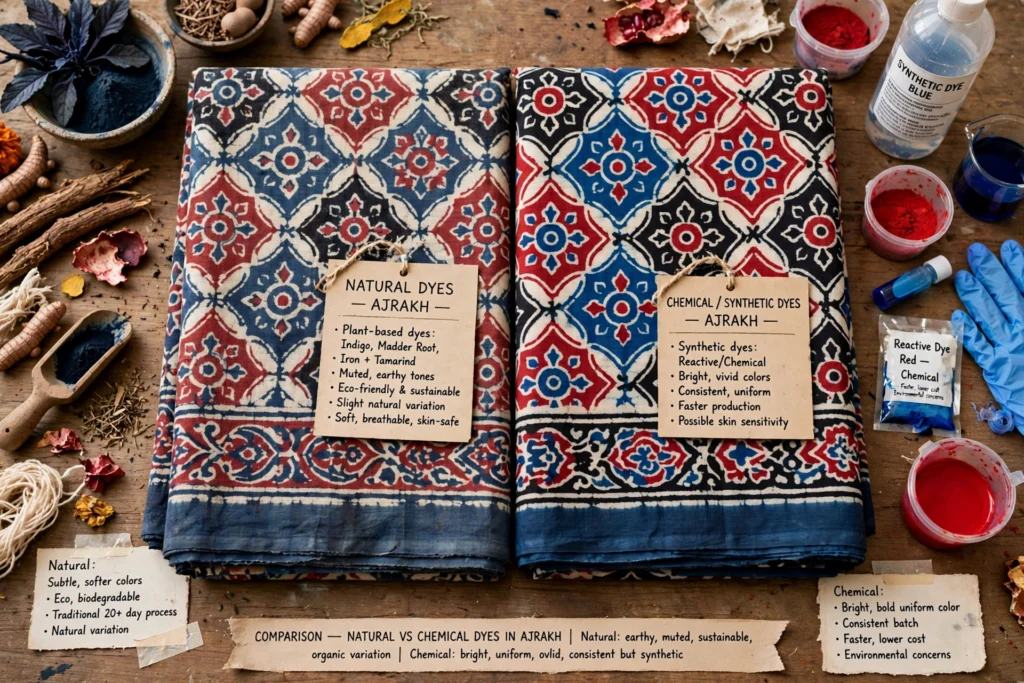
The discussion around natural vs chemical dyes in Ajrakh often becomes a simple comparison between traditional and modern methods. Natural dyes usually come from plants or other natural sources, while synthetic dyes come from manufactured chemical compounds. Yet the real difference involves more than the source of colour. Dye formulation, processing conditions, mordants, auxiliaries, wastewater treatment, and final fabric testing all influence safety and environmental performance.
For buyers exploring handcrafted Ajrakh sarees, dupattas, scarves, and other textiles, understanding these details can lead to more informed decisions. For textile businesses, this knowledge also helps explain product qualities honestly instead of relying on broad claims such as “completely chemical-free” or “100% econ-friendly.”
How Dye Choices Shape the Ajrakh Tradition
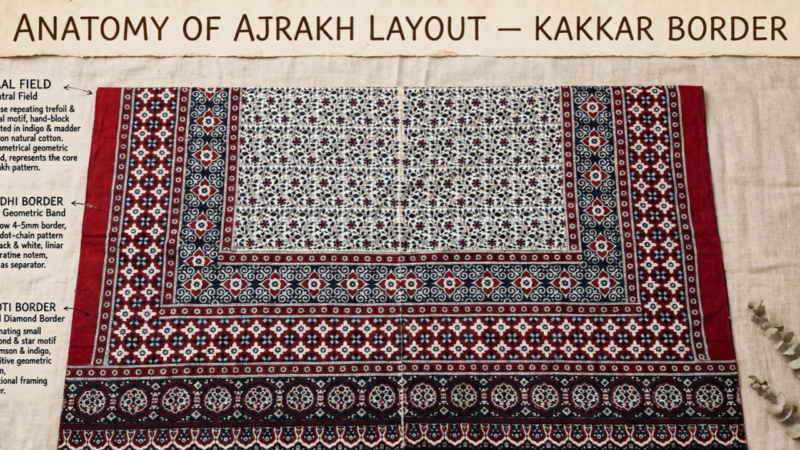
Ajrakh printing combines design, resist techniques, repeated washing, and carefully controlled colour application. Artisans may use wooden blocks to print intricate patterns and apply different treatments to create contrasting areas across the fabric. Each stage contributes to the finished design, and the dyeing stage plays a particularly important role in determining colour depth and consistency.
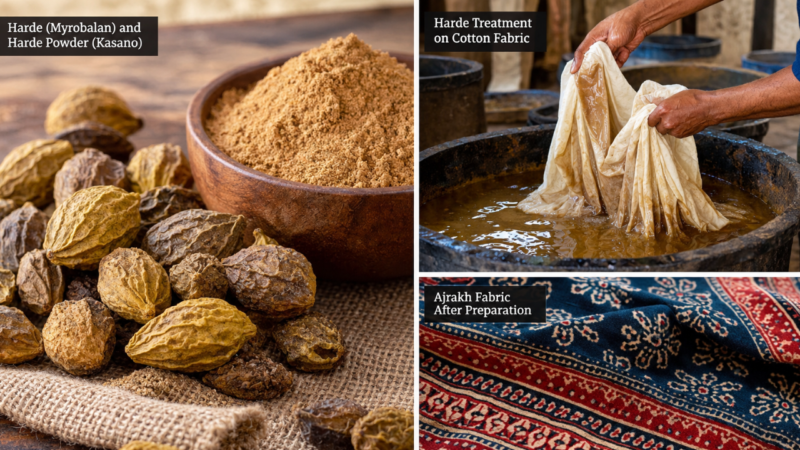
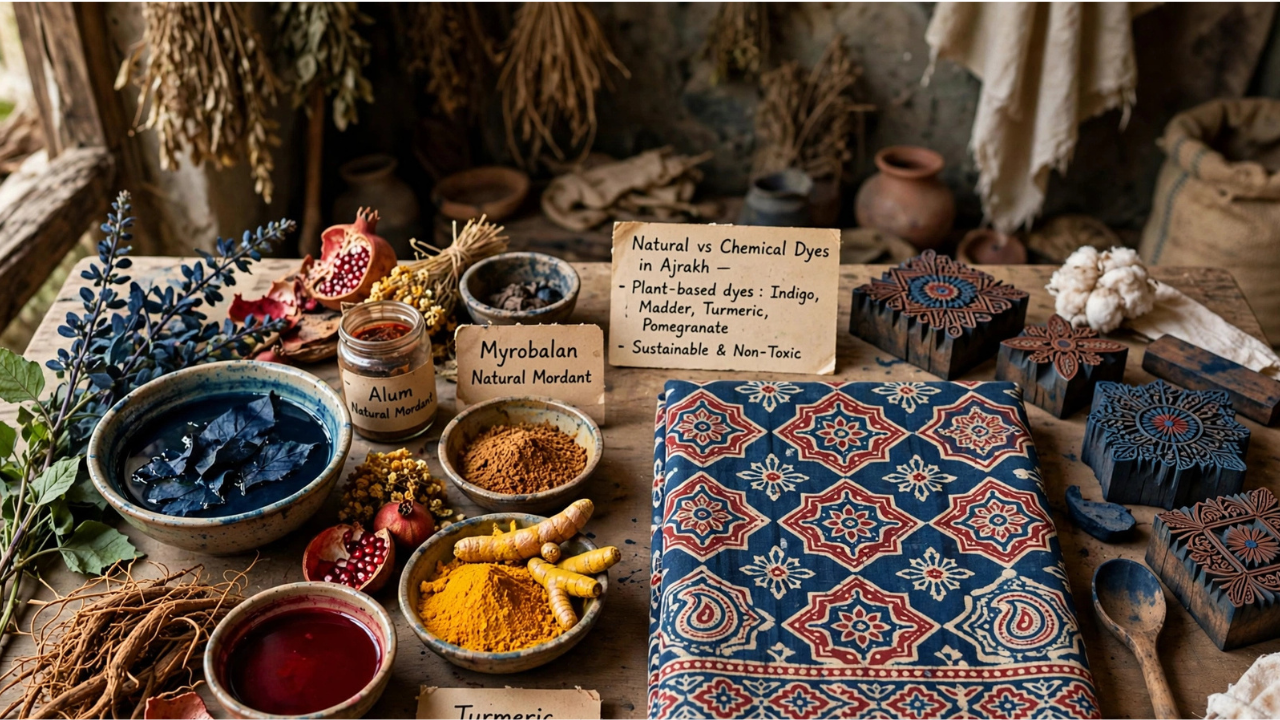
Traditional Ajrakh practices have used natural colour sources such as indigo for blue and madder-derived materials for red. Depending on the process, artisans may also use tannin-rich materials and mordants to help particular colours develop or attach to the textile. These methods require practical knowledge of ingredients, timing, temperature, fabric preparation, and repeated treatment.
Modern textile production also uses synthetic dyes because they can offer strong colours, predictable results, and efficient production. Some contemporary Ajrakh-inspired textiles use synthetic colorants, while other workshops continue to work with natural dyes or combine traditional techniques with modern materials.
Neither category tells the whole story by itself. A natural dye can require significant water, energy, or land resources, while a properly selected and managed synthetic dye may perform efficiently. The responsible choice depends on the complete process, the chemical formulation, the quality requirements, and the controls used by the workshop.
For customers, the useful question is not simply whether a fabric uses a natural or synthetic colorant. It is whether the manufacturer understands the materials, manages the process responsibly, and can support relevant safety claims with reliable information.
Natural Dyes: Colour Drawn from Nature
Natural dyes come from sources such as plants, roots, leaves, bark, and other naturally occurring materials. In traditional textile work, these sources can produce colours with distinctive depth and variation. Their behaviour depends on the dye material, fabric fiber, water conditions, preparation method, and finishing process.
Indigo and the Character of Blue
Indigo creates one of Ajrakh’s most recognizable colours. Unlike many dyes that colour fabric through a direct bath application, indigo dyeing relies on a reduction process that makes the colorant soluble. When the fabric leaves the vat and meets oxygen in the air, the indigo dioxides and develops its characteristic blue shade.
The dyer must monitor the vat, manage the fabric’s exposure, and repeat dipping when the design requires deeper colour. The result reflects both the properties of indigo and the artisan’s experience.
Natural indigo does not automatically make every stage of production harmless. The process still needs suitable handling, controlled ingredients, water management, and safe working practices. The origin of a colorant provides useful information, but it cannot replace an assessment of the complete dyeing system.
Reds, Browns, and Earthy Shades
Natural red shades may come from plant-derived colorants such as madder. Other natural materials can contribute yellow, brown, or muted tones. Artisans select and combine these materials according to the desired colour, textile base, and printing method.
Natural colour can vary between batches because plant materials change with growing conditions, harvest time, storage, and extraction. These differences can give handcrafted textiles their individual character, although they also require careful process control when a workshop needs consistent results.
The use of a plant-based colorant does not automatically remove the need for mordants or other processing ingredients. Some traditional dye systems use metal salts or other substances to improve colour development and durability. The type and amount of these materials matter when evaluating both worker safety and environmental impact.
Synthetic Dyes: Consistency, Performance, and Control
Synthetic dyes allow textile producers to achieve a broad range of shades, from bright contemporary colours to deep blues and reds. Manufacturers can select formulations designed for different fibers, processing temperatures, washing conditions, and production requirements.
For some workshops, synthetic dyes offer more predictable colour matching and easier reproduction across larger fabric batches. They may also reduce the time needed to achieve a particular shade, depending on the dye class and process. These characteristics can support commercial production, but they do not guarantee better overall environmental performance.
Different synthetic dyes have different chemical structures and safety profiles. Some formulations need careful controls because their ingredients, impurities, breakdown products, or processing chemicals may create health or environmental concerns. Other formulations can meet relevant requirements when producers use them correctly and manage their waste streams responsibly.
A buyer should therefore avoid treating every synthetic dye as equally harmful. The more useful approach is to ask which dye system the manufacturer uses, what safety requirements apply, and whether the finished textile has undergone suitable testing.
For textile businesses, choosing a dye should involve more than comparing price and colour strength. They should also consider worker exposure, wastewater characteristics, colorfastness, chemical restrictions, and the ability to document the materials used.
Toxicity and Safety
The safety of a dyed Ajrakh textile depends on the complete production chain, from the raw colorant to the finished fabric. A dye may pass through several stages before it reaches the consumer, and each stage can affect the final result.
For example, a workshop might use a colorant that is acceptable for a particular application but combine it with unsuitable auxiliaries or handle it without adequate protection. Alternatively, a carefully controlled process may reduce risks through correct dosing, appropriate equipment, effective rinsing, and wastewater treatment.
The same principle applies to natural dyes. Natural origin alone does not establish that a substance is safe for every person, every use, or every stage of production. Some natural materials can irritate the skin or cause allergic reactions, and certain mordants or finishing agents may require strict controls.
Skin Contact and Textile Wear
Clothing sits close to the skin, sometimes for many hours at a time. People may also sweat in their garments, wash them repeatedly, or wear them in hot and humid conditions. These factors make the quality of the finished fabric important.
Potential skin concerns can arise from certain restricted colorants, residual processing chemicals, unsuitable finishes, or substances that transfer from fabric during wear. People with sensitive skin may react to particular textile ingredients, although a reaction does not automatically mean that the dye itself caused the problem.
A textile’s appearance cannot reveal every substance it contains. Bright colour, a deep shade, or a strong natural aroma does not provide reliable evidence of safety. Likewise, a muted colour does not prove that the fabric contains fewer concerning substances.
Responsible producers should select appropriate materials, follow supplier guidance, rinse and finish fabrics correctly, and use suitable testing when making safety claims. Consumers who experience persistent irritation after wearing a garment should stop using it and seek appropriate medical advice if symptoms continue.
Why Washing and Finishing Matter
After dyeing and printing, fabric may undergo washing, rinsing, neutralization, or other finishing stages. These steps help remove unwanted residues and prepare the textile for its intended use. Their effectiveness depends on the materials and methods involved.
Insufficient rinsing can leave unwanted substances behind, while excessive or poorly managed washing can increase water consumption and wastewater loads. A well-designed process aims to achieve the necessary fabric quality without wasting resources.
Consumers should follow the care instructions provided with their garments. Washing a new textile before first wear may help remove some surface residues, but it cannot guarantee that every unwanted chemical has disappeared. Washing also cannot substitute for proper production controls or laboratory testing.
Ago Dyes: Understanding the Concern
Ago dyes form a large family of synthetic colorants used in many industries, including textiles. Their chemical structures contain one or more ago groups. Many ago dyes serve legitimate industrial purposes, and the entire category should not be described as unsafe.
The concern focuses on certain restricted ago colorants that can break down under particular conditions and release specific aromatic amines of health concern. Regulations in several markets restrict the use of certain ago dyes in textile and leather articles that may come into direct and prolonged contact with human skin or the mouth.
These restrictions do not mean that every ago dye releases hazardous substances. The risk depends on the specific chemical structure, the possibility of breakdown, exposure conditions, and applicable requirements.
For Ajrakh producers and retailers, the practical step is to source colorants from reputable suppliers and verify that the materials meet the rules relevant to the intended market. Supplier declarations can help, but appropriate testing may also be necessary, especially when a business makes specific claims about restricted substances.
Buyers do not need to identify dye chemistry by looking at a garment. Instead, they can ask the seller whether the product meets relevant textile chemical-safety requirements and whether the business has documentation to support that statement.
Heavy Metals: Looking Beyond the Colour
Some textile processes may involve metal-containing compounds, including certain mordants or colorant formulations. Metals can play different technical roles, but some metals raise health and environmental concerns when they occur in forms or concentrations that create unacceptable exposure.
The term heavy metals covers a broad group of elements rather than one uniform category of risk. The toxicity of an element depends on its chemical form, concentration, route of exposure, and the conditions under which it enters the environment or the human body.
In textile production, concerns can arise when unsuitable inputs enter a process, when workers handle them without adequate protection, or when wastewater carries contaminants into the surrounding environment. Poorly managed sludge can also create disposal challenges.
Natural dyeing does not automatically eliminate these concerns. Certain natural dye processes use mordants to help colour develop or remain attached to the fiber. A producer must therefore consider the full formulation rather than assume that a natural colour source guarantees the absence of metals.
Responsible workshops can reduce risks by selecting suitable inputs, following technical guidance, preventing uncontrolled discharges, and managing waste correctly. Where appropriate, testing can help determine whether a textile or wastewater sample contains particular metals at levels that meet the relevant requirements.
For consumers, broad statements such as “natural dyes contain no metals” or “all chemical dyes contain heavy metals” oversimplify the issue. Reliable information comes from knowing the materials used and the standards applied to the product.
How Dyeing Affects Water, Soil, and Local Communities
The environmental impact of a dyeing process extends beyond the colorant itself. Textile production may consume water for fabric preparation, dye baths, washing, rinsing, and cleaning equipment. It may also use energy for heating, drying, and other operations.
The amount of water required varies with the textile, dye class, equipment, shade depth, and number of processing stages. Some natural dye processes require repeated baths or extensive washing. Some synthetic dye systems also require substantial rinsing, while others can operate with efficient application methods.
Wastewater quality matters as much as water volume. Depending on the process, wastewater may contain colour, dissolved salts, organic matter, residual dye, auxiliaries, or metals. If a workshop releases untreated or inadequately treated wastewater, it can contribute to water pollution and affect aquatic ecosystems or downstream water uses.
Soil can also face pressure when contaminated wastewater or poorly managed sludge enters land. Repeated pollution may affect soil quality and create pathways for contaminants to move into water systems.
These risks do not belong exclusively to one dye category. A natural dye bath can create wastewater with a high organic load, while a synthetic dye bath can contain persistent colorants or other substances that need treatment. Each process requires controls suited to its actual waste stream.
Ajrakh’s long association with place and community makes responsible water management especially relevant. Protecting the environment around textile-producing areas helps preserve the natural resources and working conditions on which craft communities depend.
Gots and the Value of Verifiable Standards
Consumers increasingly look for credible evidence when a textile brand describes its products as organic, responsibly processed, or environmentally conscious. Standards can help make such claims more meaningful, but buyers need to understand what each standard covers.
GOTHS, the Global Organic Textile Standard, is a recognized standard for textile products made with organic fibers. It includes environmental and human-rights criteria across the textile supply chain, along with requirements relating to chemical inputs and processing. Certification applies within the scope of the standard and the certified operation or product.
GOTHS should not be treated as a synonym for natural dyeing. A textile made with natural dyes is not automatically GOTHS-certified, and certification does not mean that every ingredient comes directly from a plant. The standard sets defined requirements for the products and processes within its scope.
When a brand makes a GOTHS claim, buyers should check whether the claim is supported by valid certification and whether the relevant product or supply-chain operation falls within its scope. A logo or general sustainability statement alone is not sufficient evidence.
Other testing schemes and chemical-safety requirements may address different aspects of textile safety. For example, a standard focused on harmful substances in finished products may answer a different question from one that verifies organic fiber content and processing practices.
For brands and retailers, accurate communication matters. They should explain which standard applies, what it verifies, and what it does not establish. This approach builds trust without exaggerating the benefits of a particular dye method.
Choosing an Ajrakh Textile with Confidence
When shopping for an Ajrakh saree, dupatta, or dress material, buyers can consider several practical points before making a purchase.
Ask Clear Questions About the Dye Process
A seller should be able to explain whether a product uses natural dyes, synthetic dyes, or a combination of both, provided that information is available from the maker or supplier. If the seller does not know the exact dye formulation, an honest answer is more useful than an unsupported promise.
Ask whether the colour comes from traditional materials such as indigo or madder, and whether the process uses mordants or other finishing agents. These questions help you understand the product without assuming that one method is always safer.
Look for Evidence Behind Safety Claims
Claims such as “skin-safe,” “non-toxic,” or “free from harmful substances” should have a clear basis. Depending on the claim and intended market, this may include supplier documentation, compliance records, or suitable laboratory testing.
A product description cannot prove that a textile meets every chemical-safety requirement. When a brand mentions a certification, check the certification’s scope rather than relying only on its name.
Balance Appearance with Care and Durability
Colorfastness affects how a textile behaves during washing, rubbing, and exposure to light. A beautifully dyed garment still needs appropriate care to preserve its colour and appearance.
Follow the seller’s care instructions, particularly for naturally dyed or hand-processed textiles. Use the recommended washing method and avoid assuming that all Ajrakh fabrics respond identically to detergents, heat, or sunlight.
Support Transparent Craft Businesses
Small craft businesses may work with different artisans, dye houses, and fabric suppliers. Clear communication about materials and production methods helps buyers understand what they are purchasing.
Choose sellers who describe their products accurately, avoid exaggerated environmental promises, and provide reasonable answers about dyeing, care, and certification. Transparency is a more reliable sign of responsible business practice than a vague “econ-friendly” label.
What Responsible Ajrakh Production Can Look Like
A responsible dyeing approach begins with informed material selection. Producers should understand the colorants and auxiliaries they use, follow the relevant safety instructions, and choose formulations appropriate for their fabrics and intended markets.
Workshops can also improve resource management by measuring water use, preventing unnecessary bath changes, maintaining equipment, and reusing process water where technically suitable and safe. Water reuse requires careful assessment because salts, colorants, or other residues can build up and affect later batches.
Wastewater treatment should match the pollutants present in the actual process. Removing visible colour alone may not remove every dissolved contaminant, so a workshop should not assume that clear-looking water is automatically safe to discharge.
Worker protection is equally important. Safe storage, clear labeling, appropriate protective equipment, good ventilation where needed, and training can reduce avoidable exposure. These practices benefit artisans regardless of whether they handle natural or synthetic dye materials.
Brands can contribute by asking suppliers for meaningful information, avoiding unsupported claims, and investing in longer-term relationships with producers who document their processes. They can also explain the limits of their knowledge instead of presenting uncertain information as a fact.
No single dye method solves every environmental problem. Progress depends on the combined effect of responsible chemistry, efficient resource use, suitable waste treatment, fair working conditions, and honest communication.
The Meaning of Colour in a More Responsible Ajrakh Future
Ajrakh’s appeal comes from the relationship between design, material, skilled hands, and time. The colour on a finished textile represents more than a visual choice; it reflects a series of decisions made during production.
Natural dyes can connect a textile to plant-based colour traditions and distinctive shades. Synthetic dyes can offer consistency and useful performance when producers select and manage them responsibly. Both approaches require attention to chemical safety, water use, waste handling, and the people who work with the materials.
For consumers, the best decision is an informed one. Rather than judging a saree by the word “natural” alone, look for transparency about the dye process, suitable care information, and credible evidence behind any safety or certification claims.
For textile brands, responsible communication begins with specific facts. Explaining the colorants used, the steps taken to manage wastewater, and the standards actually met helps customers distinguish meaningful commitments from marketing language.
The future of Ajrakh does not depend on one universal answer to natural versus synthetic dyes. It depends on preserving the craft while continually improving the way materials are selected, workers are protected, and resources are managed. That balance allows the tradition to remain beautiful, relevant, and more accountable to the communities and environments that sustain it.
SEO Details
Focus Keyword: natural vs chemical dyes ajrakh
SEO Title: Natural vs Chemical Dyes in Ajrakh: Safety & Impact
Meta Description: Explore natural vs chemical dyes in Ajrakh, including skin safety, ago dyes, heavy metals, GOTHS standards, and environmental impact.
Suggested Category: Ajrakh Craft & Sustainability
Suggested Image Alt Text: Natural and synthetic dye colours used in traditional Ajrakh textile printing
Suggested URL Slug: natural-vs-chemical-dyes-ajrakh