
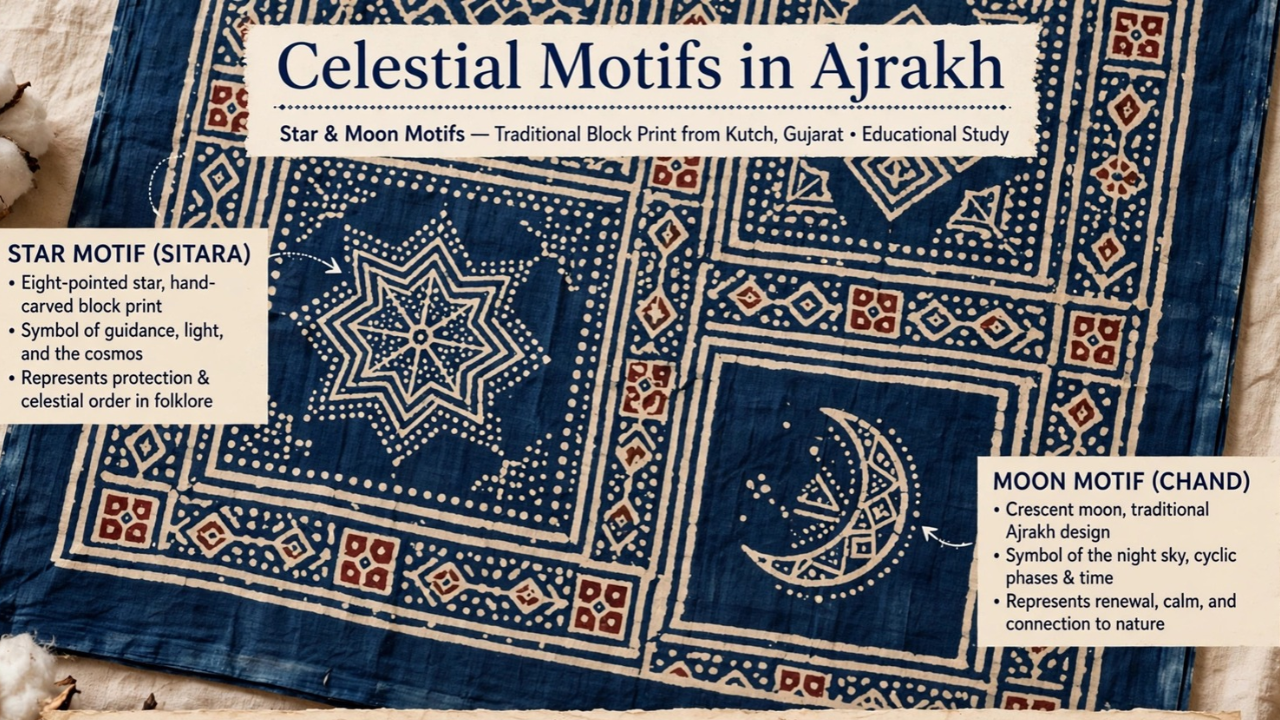
Ajrakh textiles capture attention through their deep colours, geometric patterns, and carefully repeated motifs. At first glance, these designs may look like decorative arrangements of dots, circles, lines, and symmetrical shapes. However, many traditional textile patterns also invite us to think about the natural world, including the sky, stars, moon, and wider cosmos.
Celestial motifs stars moon Ajrakh designs connect textile decoration with humanity’s long-standing fascination with the heavens. Across different cultures, people have observed the movement of celestial bodies, followed lunar cycles, and used the stars to understand direction and seasonal changes. These observations have influenced art, architecture, calendars, jewelry, and textiles.
Ajrakh printing belongs to a rich textile tradition associated with Kutch, Gujarat, and Sindh. Its characteristic geometry, repeated arrangements, and strong contrasts create patterns that can remind viewers of stars, celestial circles, and cosmic order. However, not every geometric motif represents an actual celestial object. Some patterns reflect the principles of symmetry, repetition, and balance that artisans have developed through generations.
Understanding celestial imagery in Ajrakh therefore requires both imagination and cultural awareness. We can explore what stars and moons symbolize, how geometric designs evoke the cosmos, and why these patterns continue to appeal to contemporary textile lovers.
Astronomy in Textiles
Astronomy examines celestial objects and phenomena, including stars, planets, the moon, and galaxies. Long before modern astronomical instruments existed, people watched the night sky to recognition recurring patterns and understand changes in their surroundings.
These observations shaped cultural traditions in many parts of the world. Communities used celestial cycles to organist calendars, mark seasonal events, and navigate landscapes and waterways. Artists also translated their fascination with the sky into visual forms.
Textile artisans rarely need to reproduce an astronomical object realistically. Instead, they can suggest celestial ideas through circles, radiating lines, symmetrical arrangements, and repeated points. A circular motif might remind someone of the moon, while a cluster of small shapes might evoke a field of stars.
Ajrakh printing offers an interesting setting for this visual interpretation because geometric organization plays a central role in many of its designs.
How Geometric Patterns Evoke the Night Sky
Ajrakh designs often feature repeated shapes arranged in balanced compositions. Artisans use dots, diamonds, circles, floral forms, and angular patterns to create rhythm across a fabric’s surface.
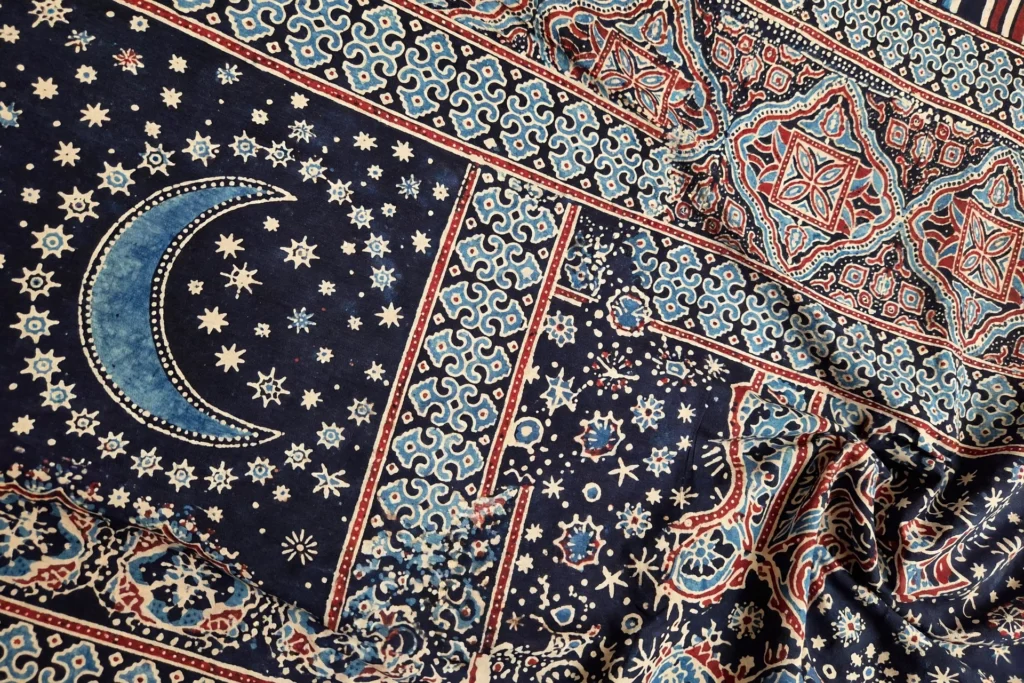
When these elements appear in dark indigo, black, white, and red, they can create a striking visual contrast. Small light-colored motifs against a dark background may remind viewers of stars scattered across a night sky.
Circular arrangements may suggest celestial discs, while radiating shapes can resemble rays of light. Repeated geometric forms can also create the impression of movement and continuity.
These interpretations depend on the individual pattern and the viewer’s perspective. A design that resembles a constellation to one person may look like a flower or a traditional geometric arrangement to another.
This distinction matters because Ajrakh’s identity comes from its textile heritage and printing techniques, not from a requirement that every motif represent an astronomical object.
The Connection Between Symmetry and Cosmic Order
People across many cultures have associated symmetry and regularity with harmony. The apparent movement of celestial bodies, recurring lunar phases, and seasonal cycles have encouraged people to look for order in the natural world.
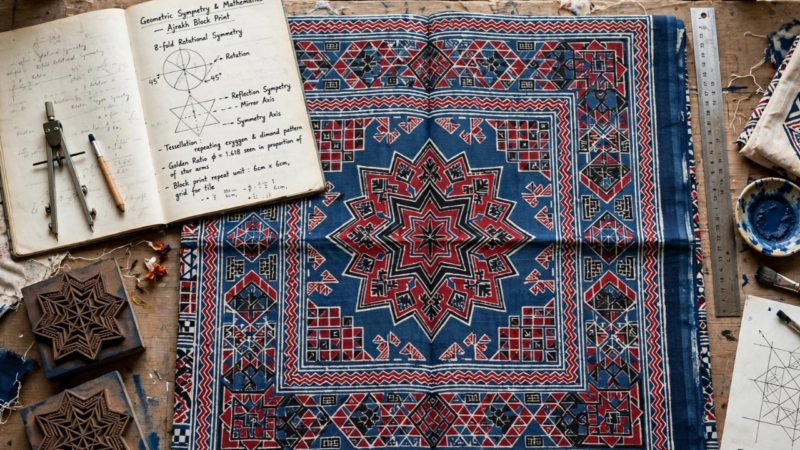
Textile artisans also rely on order to construct balanced designs. They repeat motifs, align borders, and arrange shapes so that each element contributes to the overall composition.
In Ajrakh, repeated blocks can create a strong sense of rhythm. A carefully aligned border frames the central pattern, while smaller details fill the spaces between larger shapes.
This structured arrangement can evoke the sense of balance that people associate with the cosmos. However, the resemblance does not necessarily mean that a particular design originated as an astronomical symbol. We should distinguish a modern visual interpretation from a documented historical meaning.
Stars in Ajrakh: Symbols of Light and Guidance
Stars have fascinated people for thousands of years. Their appearance in the night sky has inspired stories, navigation practices, seasonal observations, and artistic expression.
In many cultural traditions, stars can symbolize hope, guidance, aspiration, and continuity. Their small points of light often represent reassurance during darkness or the possibility of finding direction during uncertainty.
These meanings offer a useful way to interpret star-like motifs in contemporary Ajrakh textiles. Still, the symbolic meaning of an individual Ajrakh pattern depends on its documented history and cultural context.
Star Shapes and Repeated Motifs
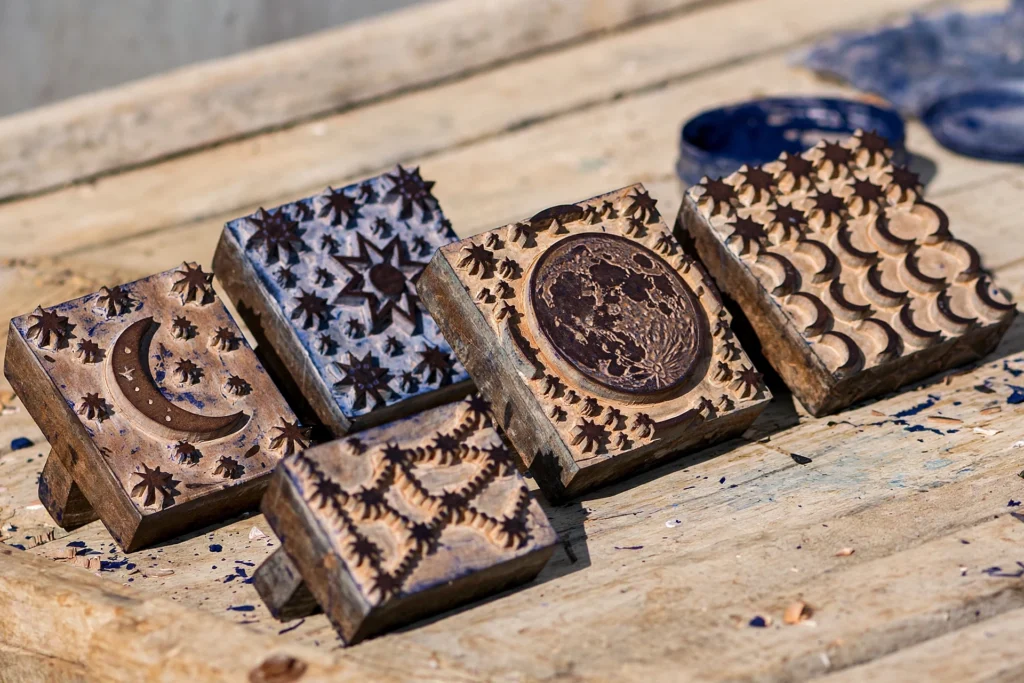
Star-like shapes can emerge from intersecting lines, pointed geometric forms, or arrangements of diamonds and triangles. When artisans repeat these shapes across a fabric, the pattern creates a sense of rhythm.
A small, repeated motif may produce a delicate visual effect, while a larger star-like design can become the main focal point of a textile.
The spacing between motifs matters just as much as their shape. Closely arranged elements create a dense pattern, while wider spacing gives each form more visual prominence.
Ajrakh’s careful use of repetition makes these relationships especially interesting. Artisans organist individual blocks into larger compositions, allowing small shapes to contribute to an elaborate overall design.
Stars as a Symbol of Hope
Many people interpret stars as reminders of hope and possibility. A star remains visible against the darkness, making it a natural metaphor for encouragement and direction.
Someone choosing an Ajrakh textile with star-like motifs might appreciate this meaning even if the original artisan designed the pattern primarily for its geometry.
For example, a scarf with repeated pointed motifs may feel appropriate as a thoughtful gift because the wearer associates its pattern with optimism. A cushion cover or wall textile with similar shapes may create a sense of calm, order, or wonder.
These associations belong to the viewer’s interpretation unless a specific historical source establishes a traditional meaning for that motif.
Stars and Navigation
Stars have helped travelers and navigators identify directions for centuries. People observed particular stars and constellations to guide journeys when familiar landmarks were unavailable.
This practical relationship between stars and direction has also encouraged symbolic interpretations of stars as guides.
In a contemporary textile context, star-like Ajrakh patterns can evoke the idea of finding one’s way or remaining connected to a larger world. Yet we should not assume that every star-shaped block in a traditional textile served as a navigation symbol.
The connection is best understood as a broader cultural association rather than a universal rule about Ajrakh motifs.
The Moon in Ajrakh: Cycles, Change and Renewal
The moon changes its visible shape throughout the lunar cycle. People observe the crescent, half-moon, and full moon as the moon moves through its phases.
These changes have influenced calendars, seasonal traditions, poetry, paintings, and decorative arts. In many cultures, the moon represents time, renewal, femininity, reflection, or the changing nature of life. The precise meaning varies between traditions and communities.
Moon-inspired imagery can add a gentle, contemplative quality to textile designs. Crescent shapes, circular forms, and repeated arcs may remind viewers of the lunar cycle, especially when designers arrange them against a dark background.
Crescent Motifs and New Beginnings
A crescent moon often appears in artistic and decorative imagery. Its curved shape can suggest a beginning, transition, or gradual development.
In contemporary design, crescent-like motifs may represent fresh starts, personal growth, or the movement from one stage of life to another.
The same visual form can also serve a purely decorative purpose. In Ajrakh, curved or angular shapes may form part of a larger geometric arrangement without carrying a specific lunar meaning.
Designers who want to present a textile as moon-inspired should therefore describe the interpretation accurately rather than automatically claim that the motif holds an established traditional meaning.
The Full Moon and Wholeness
The full moon appears as a complete illuminated disc. Many cultural traditions associate it with fullness, completion, celebration, or abundance.
Circular motifs can evoke similar ideas because the circle has no obvious beginning or end. Its continuous form often lends itself to interpretations of unity and completeness.
An Ajrakh design featuring concentric circles or balanced circular arrangements may remind viewers of the full moon. The resemblance can create an interesting connection between geometric art and celestial imagery.
However, circles also appear in floral, architectural, and abstract designs. Shape alone cannot establish the historical meaning of a motif.
Lunar Cycles and the Passage of Time
The moon’s phases provide a visible example of recurring change. People have used lunar calendars in various cultural and religious contexts, although calendar systems differ in how they account for lunar and solar cycles.
The idea of recurring cycles offers a meaningful way to appreciate repeated textile patterns. A motif appears, repeats, and returns across the fabric, creating visual continuity.
Ajrakh’s repeated designs can remind viewers of this rhythm. Each individual block contributes to a larger pattern, just as each lunar phase belongs to a recurring cycle.
This comparison offers a thoughtful interpretation of the textile without claiming that every repeated Ajrakh design directly represents the moon.
The Cosmos as a Source of Artistic Inspiration
The cosmos includes the stars, planets, moons, galaxies, and other objects and structures throughout space. Its enormous scale encourages questions about existence, time, movement, and humanity’s place in the universe.
Artists across different periods have represented these ideas through symbolic imagery, abstract patterns, and decorative arrangements. Textile designers can also use visual repetition and contrast to suggest cosmic depth.
Ajrakh’s geometric language provides opportunities for this interpretation. The interaction between large and small motifs can create a sense of expansion, while dark and light colours can suggest depth and contrast.
Indigo, Black and White: Colours That Suggest the Night Sky
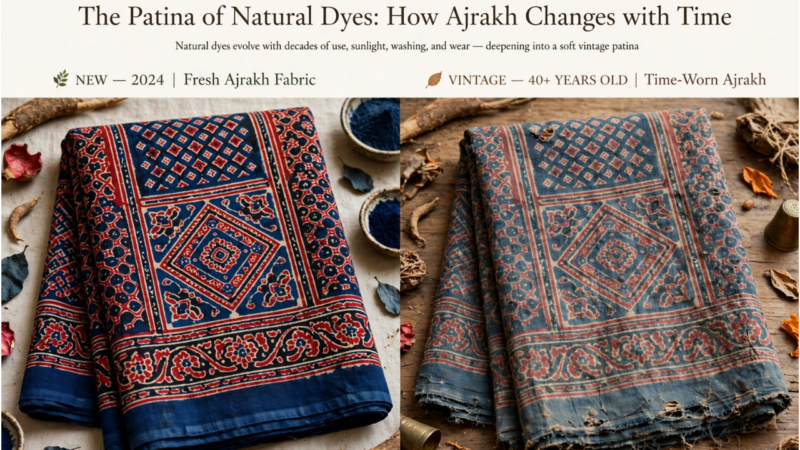
Ajrakh textiles often use combinations of deep indigo, black, white, and red. Traditional production may involve carefully controlled dyeing and resist-printing processes to create these contrasting colours.
Indigo can evoke the depth of a night sky, while white motifs may stand out like points of light. Black areas create contrast, and red introduces warmth and visual energy.
These colour associations depend on context. Indigo does not always represent the cosmos, and white motifs do not necessarily represent stars. Nevertheless, designers can intentionally use these colours to develop a celestial theme.
A contemporary collection might combine a dark ground with small repeated motifs to create a starry impression. Another design might use circular forms and contrasting borders to suggest lunar imagery.
Such approaches demonstrate how a traditional textile vocabulary can inspire fresh visual interpretations.
Repetition, Scale and Cosmic Depth
The appearance of depth often depends on the relationship between elements. Small motifs can recede visually, while larger shapes draw attention to particular areas.
Designers can use this principle to create a cosmic-inspired arrangement. Tiny repeated forms may suggest distant points of light, while larger circles or star-like shapes become visual anchors.
Ajrakh artisans already work with repetition, spacing, and carefully arranged borders. These techniques allow a pattern to remain visually connected from one edge of the textile to the other.
A well-balanced design avoids unnecessary clutter. It gives each motif enough space to remain visible while allowing the full composition to work as a unified surface.
How Ajrakh Artisans Create Detailed Celestial-Looking Patterns
Ajrakh’s visual complexity comes from planning, carving, printing, dyeing, and careful fabric preparation. The finished pattern reflects the relationship between the artisan’s design decisions and the technical demands of the process.
Wooden Blocks and Geometric Precision
Artisans carve wooden blocks to transfer specific shapes onto fabric. Different blocks may create outlines, repeated motifs, borders, or other parts of a design.
For patterns that resemble stars or celestial circles, precise alignment helps maintain consistency across the textile. Even small differences in block placement can change the appearance of repeated elements.
Artisans must consider the spacing between motifs, the dimensions of each block, and the relationship between different printed layers.
This work requires practice and careful attention. The final result depends not only on the shape of the block but also on the artisan’s control over placement and pressure.
Resist Printing and Colour Development
Traditional Ajrakh production can involve resist materials that protect selected areas from dye. Artisans apply the resist with blocks, then use suitable dyeing and washing stages to develop the intended pattern.
Repeated processes allow different colours and contrasting areas to emerge. The exact sequence depends on the design, materials, and workshop tradition.
This method can create strong geometric patterns that invite celestial interpretations. However, the printing process itself does not prove that a motif represents a star, moon, or cosmic object.
Craftsmanship and symbolism are related but distinct aspects of textile design.
The Role of Repetition in Traditional Design
Repetition gives many Ajrakh patterns their distinctive rhythm. Artisans arrange motifs across the fabric so that individual shapes form a continuous composition.
This technique also creates visual relationships between the center, surrounding details, and borders. A single shape may look simple on its own, yet repeated arrangements can produce a complex pattern.
The process resembles the way viewers recognition larger patterns in the night sky. Individual stars appear as points of light, while people connect them into familiar constellations.
This comparison helps explain why repeated geometric textiles can feel cosmic to a viewer, even when the design does not depict a specific constellation.
Celestial Motifs in Contemporary Ajrakh Fashion
Modern designers continue to explore traditional textile techniques in new settings. Celestial-inspired interpretations can bring together heritage printing, contemporary colour choices, and personal symbolism.
Sarees and Dupattas
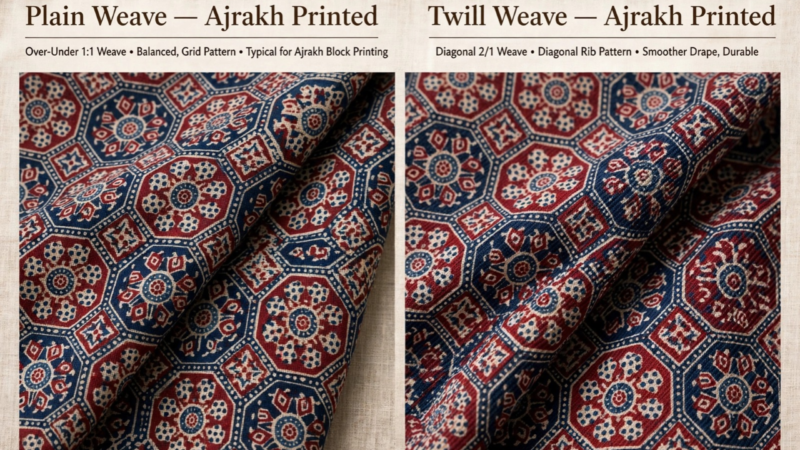
A saree or dupatta with star-like geometric motifs can combine traditional craftsmanship with a distinctive visual theme. Dark backgrounds and contrasting designs may create a dramatic appearance, while smaller repeated motifs can produce a more understated effect.
The suitability of a textile depends on its fabric, weight, drape, and the occasion for which someone intends to wear it.
Designers can also use borders to frame the central pattern, creating a balanced look that complements the overall arrangement.
Home Decor and Decorative Textiles
Celestial-inspired Ajrakh patterns can also suit cushion covers, table runners, wall hangings, and other decorative pieces.
Repeated motifs can create visual continuity across a room, while contrasting colours can introduce depth and interest.
When selecting decorative textiles, buyers should consider colour coordination, fabric durability, and care requirements. The symbolic interpretation adds another layer of appreciation but does not replace these practical considerations.
Meaningful Gifts and Personal Expression
People often choose patterns because they connect with a personal memory, belief, or aspiration. Someone who associates stars with hope may appreciate a textile featuring star-like forms. Another person may prefer moon-inspired designs because they evoke calmness or renewal.
These personal associations can make a textile feel meaningful without requiring the design to carry one fixed symbolic message.
The combination of traditional printing and individual interpretation allows Ajrakh textiles to remain relevant to different generations of buyers.
Appreciating Symbolism Without Losing Historical Context
When exploring celestial motifs stars moon Ajrakh designs, it helps to separate three ideas: documented cultural symbolism, the visual resemblance of a pattern, and a viewer’s personal interpretation.
Documented symbolism relies on credible historical or cultural evidence. Visual resemblance describes what a shape appears to represent. Personal interpretation explains what the design means to an individual.
These categories can overlap, but they are not interchangeable.
For example, a repeated pointed motif may look like a star. A modern designer may deliberately present it as a symbol of hope. However, that decision does not establish that the same motif historically carried that meaning in every Ajrakh tradition.
Respecting this distinction honors the artisans and communities that sustain the craft. It also encourages more thoughtful descriptions of handmade textiles.
Buyers can learn about a textile’s provenance, printing method, materials, and artisan background while appreciating the visual associations its patterns inspire.
A Timeless Connection Between the Sky and the Textile
Stars, moons, and the wider cosmos have inspired people to observe, imagine, and create. Their recurring forms offer artists a rich vocabulary for expressing ideas about guidance, change, harmony, and continuity.
Ajrakh printing provides a distinctive way to explore these themes through geometry, repetition, contrasting colours, and skilled handwork. Its patterns can evoke the night sky without needing to reproduce celestial objects literally.
The most rewarding way to appreciate these designs is to look at both their craftsmanship and their possible meanings. Notice how the artisan arranges the motifs, how the colours interact, and how repetition creates a sense of rhythm across the fabric.
Celestial imagery gives contemporary viewers another way to connect with Ajrakh textiles. At the same time, understanding the difference between traditional symbolism and personal interpretation helps preserve the cultural integrity of this remarkable craft.