
Ajrakh printing brings together traditional craftsmanship, carefully prepared fabrics, natural or synthetic dyes, and detailed geometric patterns. While people often focus on the colours and motifs of Ajrakh textiles, the fabric’s construction also plays an important role in the final result. The way threads cross each other can influence the surface texture, dye absorption, pattern definition, and overall appearance of a printed textile.
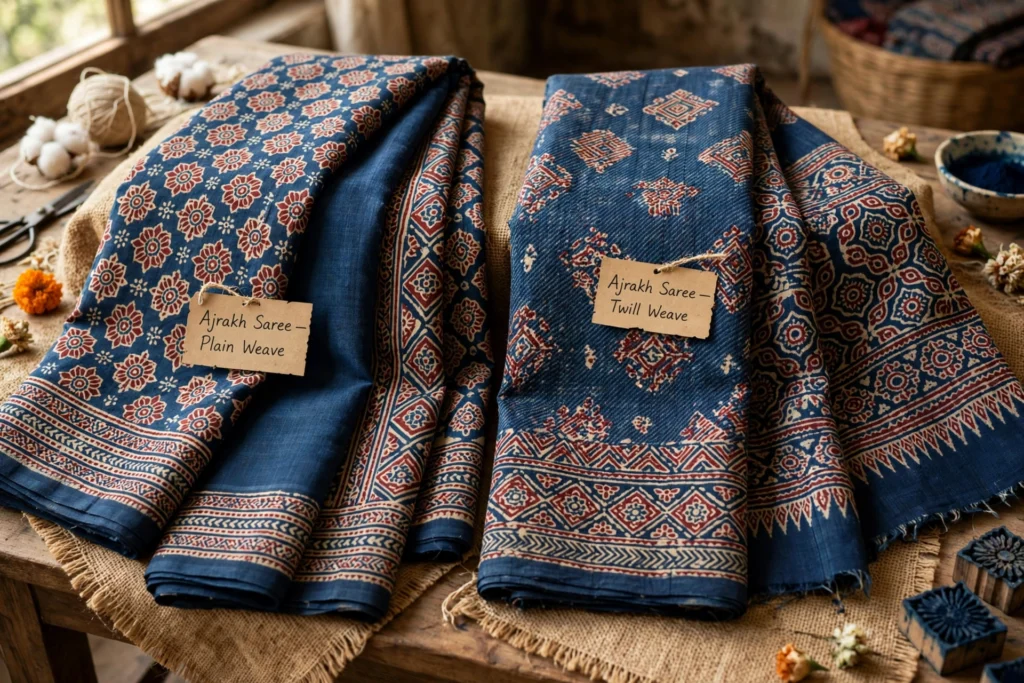
Two important fabric structures deserve attention: plain weave and twill weave. Both structures use warp and weft threads, but they arrange those threads differently. These differences affect how a fabric feels, how it responds to printing, and how its surface displays intricate Ajrakh designs.
Understanding plain weave twill Ajrakh printing helps textile enthusiasts and buyers appreciate why the same design may look different on two fabrics. It also helps designers and textile professionals choose a suitable base for their printing requirements.
Weave Structures: Understanding the Foundation of Ajrakh Fabric
Before examining how plain weave and twill influence Ajrakh printing, it helps to understand how weavers construct a fabric.
A woven textile forms when two sets of threads cross each other at right angles. The warp threads run lengthwise through the fabric, while the weft threads pass across its width. Their arrangement creates the weave structure.
The weaving pattern determines how frequently the threads intersect, how much of each thread remains visible on the surface, and how the fabric responds to handling. It also influences the texture, flexibility, thickness, and stability of the textile.
Plain weave and twill represent two common weaving structures, but they create noticeably different surfaces.
Plain Weave: A Balanced and Structured Surface
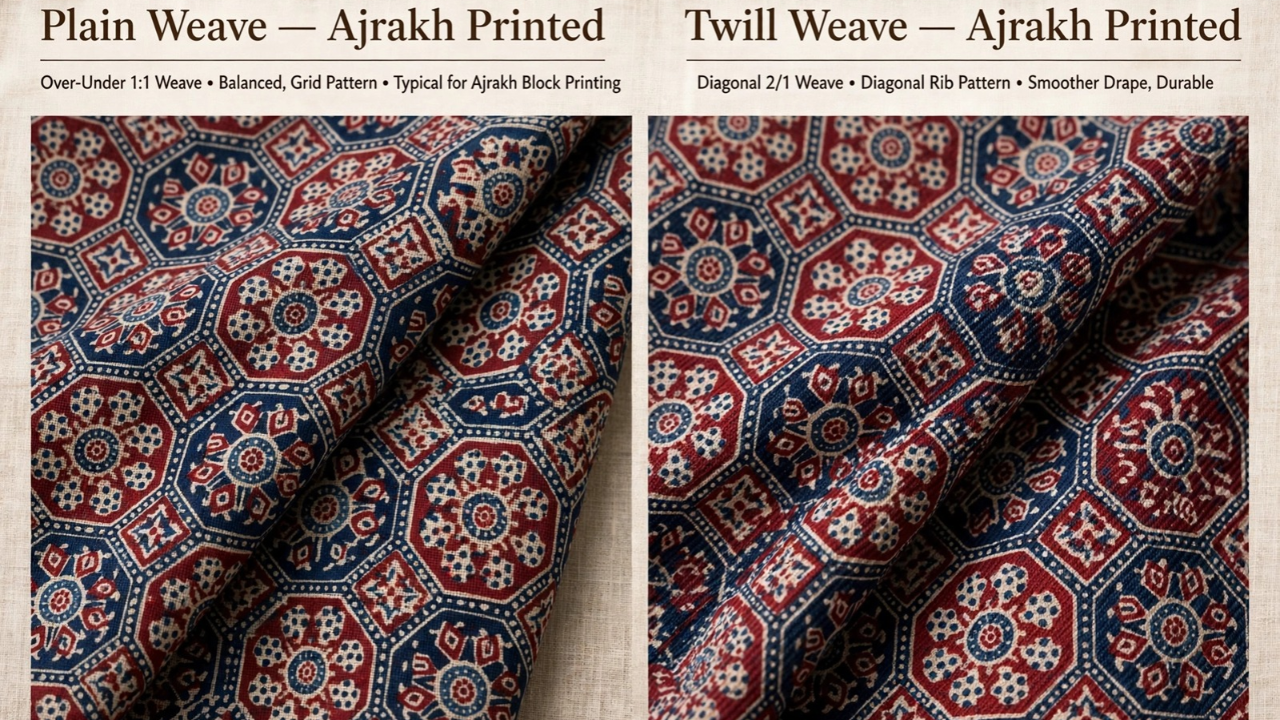
Plain weave follows a simple over-and-under pattern. Each weft thread passes over one warp thread and then under the next. The following row reverses this arrangement, creating a balanced structure.
This regular interlacing gives plain-weave fabrics a relatively even surface. The frequent intersections also help the fabric maintain its shape and provide a stable base for many printing applications.
Cotton poplin, cotton muslin, and several lightweight woven cotton fabrics commonly use plain weave, although their thread counts, yarn thicknesses, and finishing treatments can vary considerably.
For Ajrakh printing, a suitable plain-weave fabric can offer a practical foundation for detailed geometric motifs. Its surface may help artisans position wooden blocks consistently, while its construction can support repeated printing and fabric handling.
However, plain weave alone does not guarantee sharp prints. Yarn quality, surface preparation, fabric density, and printing technique also influence the outcome.
Twill Weave: A Surface with Diagonal Lines
Twill weave creates a different appearance by allowing each weft thread to pass over or under multiple warp threads before changing position in the next row. This arrangement produces characteristic diagonal lines across the fabric.
Denim, twill cotton, and certain woolen textiles illustrate this structure clearly. Depending on the weaving pattern and yarns, twill fabrics can feel softer, drape more fluidly, or offer greater resistance to abrasion than comparable plain-weave fabrics.
The diagonal surface gives twill a distinctive visual character. It can also affect the way a printed motif sits on the fabric, particularly when a design contains fine lines, small geometric details, or closely spaced borders.
Twill does not automatically absorb more dye than plain weave. Its response depends on factors such as fibre composition, yarn construction, fabric density, surface treatment, and the particular printing or dyeing method.
For Ajrakh applications, artisans and designers need to assess these factors before selecting a twill base for detailed printing.
How Warp and Weft Influence Ajrakh Printing
Warp and weft threads do more than hold a fabric together. Their arrangement creates the surface on which an artisan develops the printed design.
Warp Threads and Lengthwise Stability
Warp threads run along the length of the fabric. Weavers usually place them under tension during weaving, which helps establish the textile’s lengthwise structure.
Warp density affects the number of threads occupying a given area. A tightly constructed warp can create a compact surface, while a more open arrangement may leave greater spaces between yarns.
These differences can influence the way printing paste spreads across the fabric. A stable, evenly prepared surface can help an artisan maintain the intended position of a wooden block and repeat a motif with greater consistency.
However, a very dense structure may also limit the movement of printing paste into the textile, depending on the yarn and paste properties.
Weft Threads and Surface Appearance
Weft threads cross the fabric from side to side. Their thickness, spacing, and interaction with the warp help determine the textile’s texture and visual balance.
Uneven weft tension or variations in yarn thickness can create slight surface irregularities. These variations may affect the contact between a printing block and the fabric.
In traditional hand-block printing, artisans rely on careful placement and controlled pressure. A fabric that lies flat and maintains consistent dimensions generally makes this process easier.
Both plain weave and twill can provide suitable printing surfaces. The best choice depends on the relationship between yarn structure, fabric preparation, and the complexity of the intended design.
Plain Weave vs. Twill: Key Differences for Ajrakh Textiles
Although both structures use warp and weft, their construction creates different practical characteristics.
| Feature | Plain Weave | Twill Weave |
|---|---|---|
| Thread arrangement | Alternating over-and-under pattern | Interlacing creates diagonal lines |
| Surface appearance | Usually balanced and relatively uniform | Distinctive diagonal texture |
| Fabric stability | Frequent intersections often support a stable structure | Properties depend on twill pattern and fabric construction |
| Drape | Can range from crisp to soft | Often offers a fluid drape, depending on construction |
| Motif appearance | May provide a suitable base for fine geometric details | Diagonal texture can interact visually with printed motifs |
| Dye absorption | Depends on fibre, preparation, density, and dye system | Depends on fibre, preparation, density, and dye system |
| Printing suitability | Often suitable for detailed block printing | Can work well when the surface and design suit each other |
This comparison shows why we should not judge a fabric’s printing performance by its weave name alone. Two plain-weave cotton fabrics may respond differently to the same printing paste, just as two twill fabrics may produce different results.
A textile professional should evaluate the actual fabric rather than assume that one weave always performs better.
How Weave Structure Affects Ink and Dye Absorption
Ink and dye absorption play important roles in the appearance of printed textiles. However, the terms describe different processes.
In textile printing, artisans apply a colored printing paste or another color-bearing medium to selected areas of a fabric. Depending on the technique, the colour may remain concentrated near the surface or penetrate further into the yarns and textile structure.
Dyeing generally involves colorants interacting with or entering the textile fibers through a suitable dyeing process. Traditional Ajrakh production may combine resist printing, repeated dyeing, washing, and other preparation stages.
The weave influences these processes indirectly by affecting the fabric’s surface, porosity, yarn arrangement, and handling characteristics.
Surface Contact and Printing Paste
When an artisan presses a carved wooden block against a fabric, the block transfers printing paste to the areas that touch its raised design.
A relatively even surface can help the block make consistent contact. This can improve the definition of fine lines and small motifs when the artisan also controls paste consistency and printing pressure.
A more textured surface may create variations in contact. Some raised areas can receive colour more readily than recessed areas, although the actual result depends on the fabric and printing method.
Twill’s diagonal ridges may interact with a block-printed design in visually interesting ways. Nevertheless, a pronounced texture can make extremely fine details harder to reproduce consistently if the block cannot contact the surface evenly.
Fabric Porosity and Colour Penetration
Porosity describes the spaces within and between fibers and yarns that allow liquids or gases to move through a material. In woven textiles, yarn thickness, twist, thread spacing, and finishing treatments all contribute to this behaviour.
A more open fabric may allow printing paste or dye liquor to move through the structure more readily. A tightly constructed fabric may restrict that movement, depending on its finish and the properties of the liquid.
The relationship is not always straightforward. A fabric can feel smooth yet contain spaces within its yarns, while another may look textured but have a relatively compact construction.
For this reason, textile professionals should test both plain-weave and twill samples before selecting a base for Ajrakh printing.
Why Colorfastness Needs Separate Attention
A strong-looking print does not automatically indicate good colorfastness. Colorfastness refers to a textile’s ability to resist colour loss or transfer during exposure to conditions such as washing, rubbing, and light.
Weave structure can influence how the fabric handles printing and dyeing, but it does not independently determine colorfastness.
Fibre type, dye chemistry, mordanting, washing, dye fixation, and finishing all matter. Artisans must follow a suitable process for the particular fibre and colour system.
A well-constructed fabric still needs appropriate preparation and colour fixation to achieve reliable results.
Plain-Weave Cotton for Detailed Ajrakh Motifs
Plain-weave cotton often provides a practical starting point for evaluating detailed Ajrakh printing. Its regular thread arrangement can support consistent block placement when the fabric has suitable density, preparation, and surface quality.
Traditional Ajrakh designs frequently feature repeated geometric forms, intricate borders, dots, and carefully arranged floral elements. These patterns require accurate registration when artisans print multiple colours or apply resist paste in successive stages.
A suitable plain-weave base can help artisans maintain alignment and reproduce the intended pattern. Its performance still depends on how well the fabric absorbs the relevant preparation materials and printing paste.
Cotton also responds well to many traditional textile processes, although not every cotton fabric behaves identically.
Advantages of a Suitable Plain-Weave Base
- Consistent block contact: An even surface can help artisans transfer small details more reliably.
- Practical handling: A stable construction can make it easier to spread, align, and reposition fabric during printing.
- Versatile fabric options: Plain weave appears in different weights and densities, allowing designers to evaluate several bases.
- Clear pattern presentation: A relatively uniform surface can help geometric motifs stand out without strong diagonal texture competing visually with the design.
These advantages describe potential benefits rather than guaranteed outcomes. Poor preparation, uneven tension, excessive paste, or an unsuitable fabric finish can still produce blurred or inconsistent prints.
Twill Fabric for Contemporary Ajrakh Designs
Twill offers another option for designers who want to explore Ajrakh patterns on fabrics with a distinctive texture or drape.
Its diagonal ribs create a surface character that differs from plain weave. Depending on the fabric, twill may feel substantial, flexible, or soft. These properties can influence how the finished textile hangs and how the printed design appears when someone wears or displays it.
Designers may explore twill for scarves, garments, accessories, or contemporary textile pieces. They should first confirm that the particular fabric can support the required printing process.
How Diagonal Texture Changes the Visual Effect
Twill’s diagonal lines can interact with the straight edges and repeated geometry of Ajrakh motifs. This interaction may create additional visual depth, particularly in larger designs.
At the same time, small dots, narrow borders, and fine repeated elements may require more careful testing on a textured base. A block must make suitable contact with the fabric, and the printing paste must transfer consistently.
Designers should also consider whether the diagonal ribs complement the printed pattern or compete with it.
A bold motif may work well with a pronounced twill texture, while a very delicate pattern may benefit from a more uniform surface. The outcome depends on the scale of the design and the fabric’s actual construction.
Fabric Preparation Matters as Much as Weave
Ajrakh printing involves more than placing a wooden block on an untreated textile. Fabric preparation helps establish the conditions needed for printing, resist application, dyeing, and washing.
Traditional processes may include washing, scouring, bleaching or other preparation methods, mordanting, resist printing, dyeing, and repeated rinsing. The exact sequence varies according to the artisan, fabric, colour system, and intended design.
Scouring and Cleaning
Scouring removes unwanted substances such as oils, waxes, and other residues that can interfere with wet processing. Fabric manufacturers may also apply finishing agents that change how the textile interacts with liquids.
If these substances remain on the surface, they can cause uneven wetting or inconsistent colour development. A suitable cleaning process helps prepare the textile for subsequent treatments.
Both plain-weave and twill fabrics may need scouring. Their different constructions can affect how easily water and processing solutions reach the yarns, so the treatment should suit the specific material.
Mordanting and Dye Compatibility
Mordants help certain dyes form more stable associations with textile fibers. In traditional natural-dye processes, artisans select mordants according to the dye, fabric, and desired colour.
A mordant does not work identically with every dye or fibre. The artisan must choose compatible materials and follow an appropriate process.
Weave structure may influence liquid movement and handling during treatment, but the chemical relationship between dye, mordant, and fibre remains essential.
Resist Printing and Repeated Dyeing
Ajrakh artisans use resist materials to protect selected areas from colour during particular stages of the process. They may print a resist paste with carved wooden blocks before immersing the textile in a dye bath.
Repeated printing and dyeing require careful control. The fabric must retain suitable dimensions, and the resist must protect the intended areas effectively.
A plain weave or twill can work only when its construction, surface, and preparation suit the chosen method. Testing helps artisans identify problems before they commit to a full length of fabric.
Choosing the Right Weave for Different Ajrakh Designs
The right weave depends on the intended design, garment, printing method, and desired appearance. Instead of choosing a fabric based on a single feature, designers should evaluate the textile as a complete material.
For Fine Geometric Patterns
Plain weave can provide a useful starting point when a design includes small dots, narrow borders, repeated lines, or tightly arranged geometric motifs.
A smooth, evenly prepared surface can support precise block contact. Designers should still examine the actual thread density and surface quality before deciding.
For Textured Contemporary Garments
Twill may suit designs that benefit from a visible diagonal texture, a particular drape, or a more substantial fabric feel.
Larger motifs and simpler arrangements may work particularly well on some twill bases, but a carefully tested twill can also support more detailed designs.
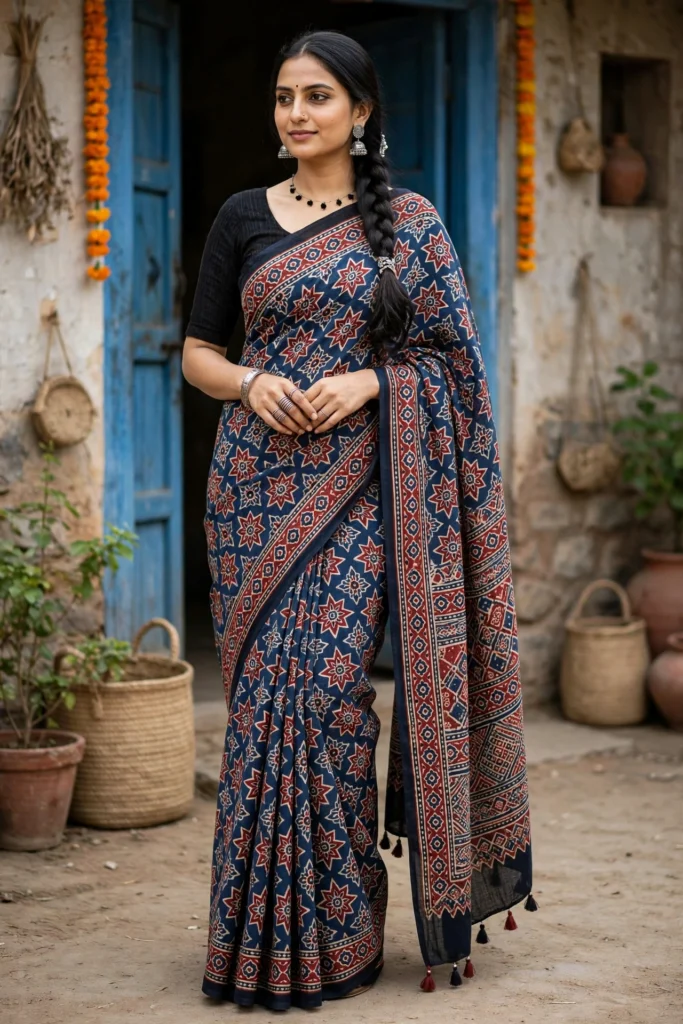
For Scarves, Sarees, and Everyday Textiles
The final use matters as much as the print itself. A saree requires a fabric that suits the intended drape, comfort, appearance, and care routine. A scarf may priorities softness and movement, while a structured garment may require greater body.
Neither plain weave nor twill guarantees a particular level of comfort or durability. Fibre composition, yarn quality, fabric weight, and finishing treatments all influence the finished textile.
How Textile Professionals Can Test Plain Weave and Twill
A small sample test provides a practical way to compare two fabric structures before printing a full design.
First, identify the fibre composition and examine the fabric’s weight, surface, and construction. If possible, obtain details about its finishing treatments and thread density.
Next, prepare both samples using suitable methods for the intended printing process. Apply the same design and use consistent printing conditions wherever possible.
Compare the samples using these criteria:
- Print definition: Examine whether the block transfers fine lines and small motifs clearly.
- Colour distribution: Look for uneven patches, excessive spreading, or inconsistent coverage.
- Surface interaction: Check whether the weave texture changes the visual appearance of the printed design.
- Fabric handling: Observe how easily each sample lies flat and maintains alignment.
- Wash performance: After appropriate processing and curing or fixation, assess colour retention using a suitable test method.
- Final appearance: Compare the drape, texture, and overall balance between the fabric and the motif.
Keep a record of the fabric type, preparation method, printing paste, dye system, and processing conditions. This information helps textile professionals understand which factors produced the differences.
A fair comparison requires consistent testing. If the two samples use different fibers or receive different preparation treatments, their results may reflect those differences rather than the weave alone.
Common Misconceptions About Plain Weave and Twill
Several assumptions can lead buyers and designers to misunderstand the relationship between fabric construction and Ajrakh printing.
Misconception 1: Twill always absorbs more dye.
Twill does not automatically absorb more dye than plain weave. Fibre properties, yarn construction, finishing, fabric density, and dye chemistry all affect colour uptake.
Misconception 2: Plain weave always produces sharper prints.
Plain weave can provide an even surface, but print clarity also depends on block design, pressure, paste consistency, fabric preparation, and the artisan’s technique.
Misconception 3: A thicker fabric always lasts longer.
Thickness alone does not determine durability. Fibre strength, yarn quality, weave construction, abrasion resistance, and care practices also influence a textile’s lifespan.
Misconception 4: The weave determines whether a fabric qualifies as authentic Ajrakh.
Weave structure alone cannot establish authenticity. Buyers should also consider the printing process, craftsmanship, materials, provenance, and whether the seller accurately describes the textile.
Understanding these distinctions helps buyers make informed choices without overlooking the skill and preparation behind a finished Ajrakh piece.
The Relationship Between Craftsmanship and Fabric Structure
Ajrakh printing demonstrates how material science and traditional craftsmanship work together. The artisan must understand the fabric, prepare it appropriately, apply printing blocks with care, and manage the stages that develop the final colours and patterns.
Plain weave offers a regular arrangement of warp and weft threads, while twill introduces diagonal lines through a different interlacing pattern. These structures influence surface contact, handling, texture, and the visual relationship between the printed motif and the base fabric.
Neither structure guarantees better results in every situation. A carefully prepared twill can produce an effective Ajrakh textile, just as a suitable plain weave can support intricate geometric designs.
For designers and textile enthusiasts, the most useful approach combines an understanding of weave structures with practical sample testing. By comparing print definition, colour distribution, fabric handling, and the final appearance, they can identify the base that best supports their creative goals.
The next time you examine an Ajrakh textile, look beyond its colours and motifs. Notice the direction of the threads, the character of the surface, and the way the fabric interacts with the printed pattern. These details reveal another layer of the craftsmanship that gives every textile its distinctive character.