
Ajrakh is known for its detailed geometric patterns, deep indigo shades, rich madder reds, and carefully arranged motifs. Among its many design elements, floral jaals bring a distinctive sense of rhythm and elegance to the fabric. These repeating patterns connect individual flowers, leaves, stems, and vines to create a continuous decorative surface.
The beauty of floral jaals lies in their ability to combine nature with geometry. A flower may appear delicate on its own, but when artisans repeat it across a textile, it becomes part of a larger design. This approach has parallels with Persian gardens, Islamic decorative arts, Mughal ornamentation, and other textile traditions that developed across South Asia and neighborliness regions.
Kutch, Gujarat, has a long history of textile craftsmanship and cultural exchange. Its location helped connect communities through trade, migration, and artistic contact. Over generations, artisans developed distinctive regional printing traditions while working within a broader world of decorative ideas.
Understanding floral jaals and Persian influence in Ajrakh means looking beyond individual flowers. It involves exploring how repeating patterns, plant-inspired forms, symmetry, and regional craftsmanship work together to create textiles that feel both traditional and visually expressive.
What Are Floral Jaals in Ajrakh?
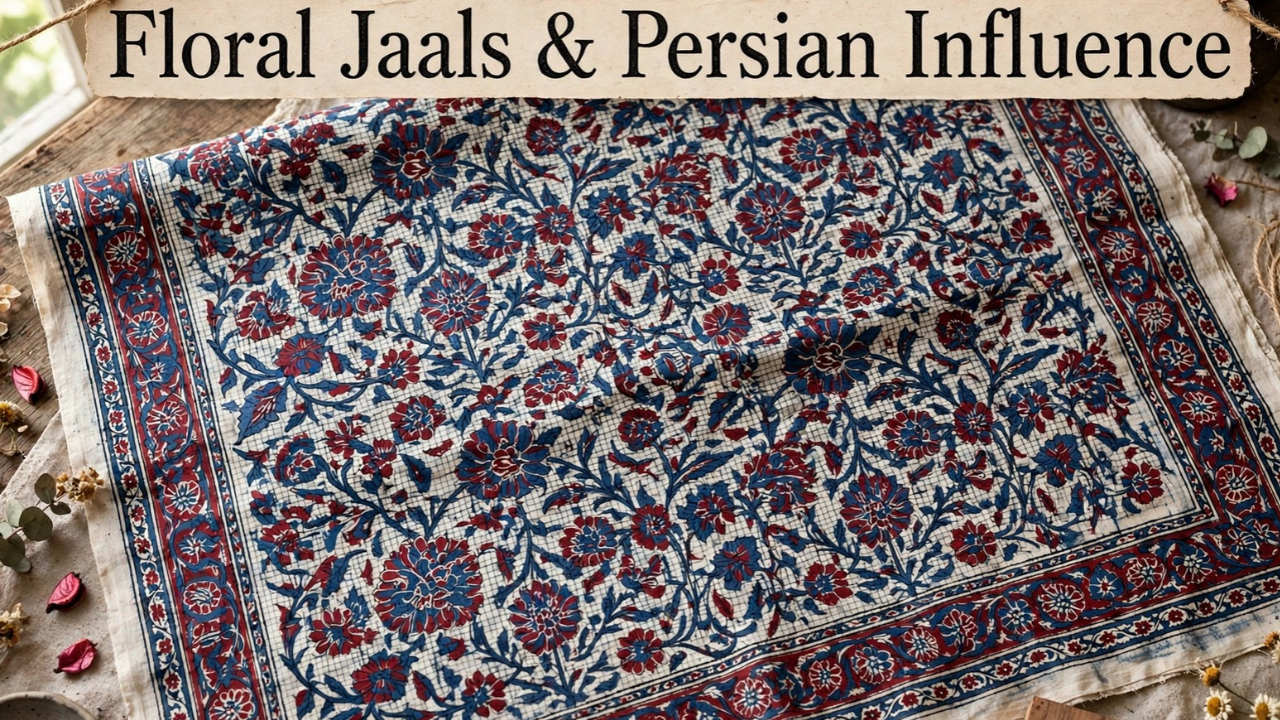
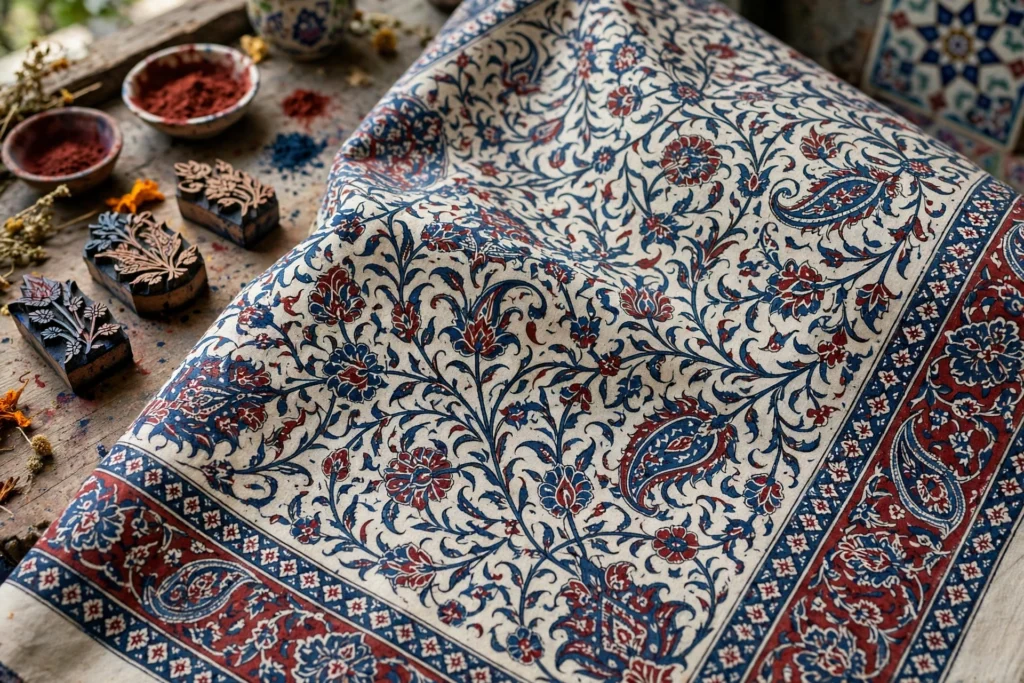
The word Baal commonly describes a net-like arrangement or an interconnected pattern. In textile design, a floral Baal features flowers, leaves, vines, and sometimes small geometric elements arranged across a fabric surface.
Instead of placing a single large flower in the center, a designer may repeat smaller botanical motifs throughout the textile. The motifs connect visually to create an all-over pattern.
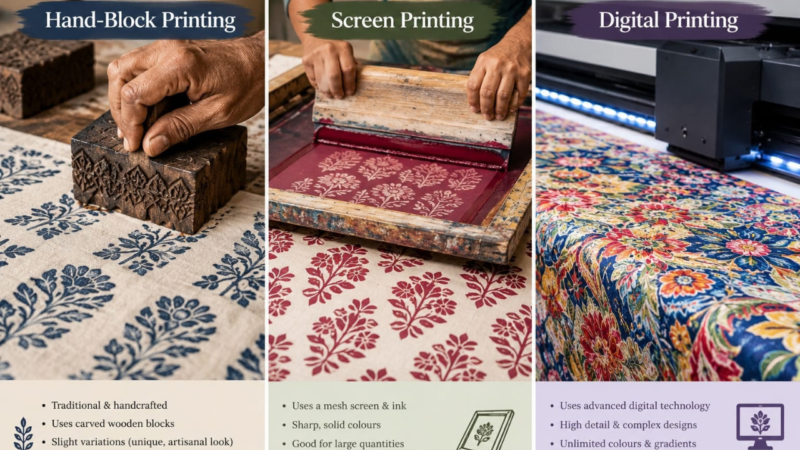
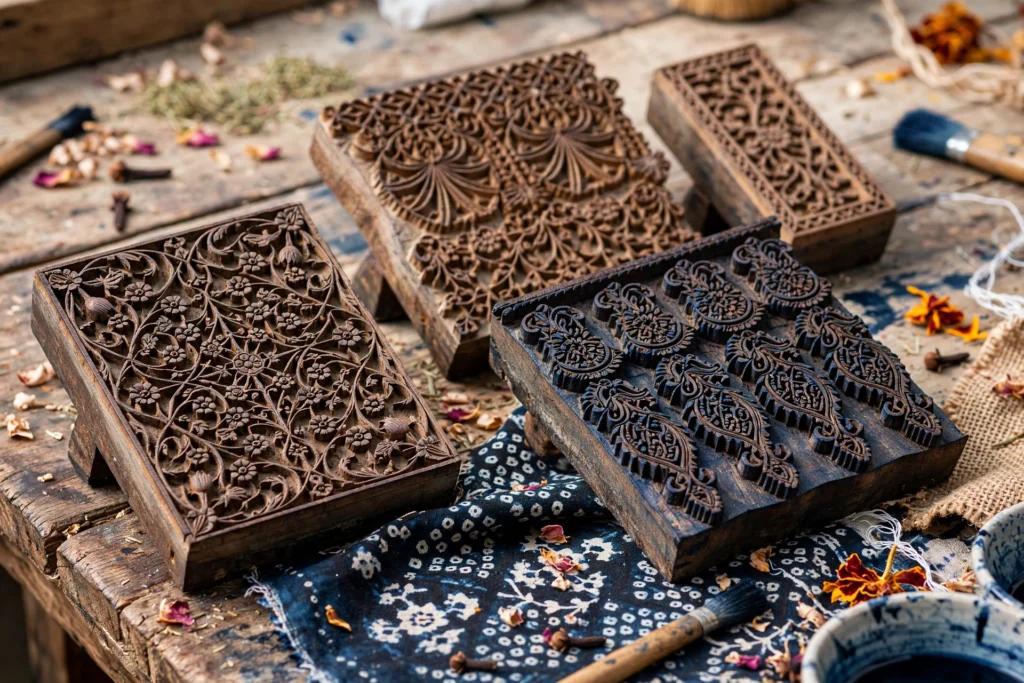
In Ajrakh, this arrangement can complement the technique of hand-block printing. Artisans use carved wooden blocks to transfer individual design elements onto cloth. By positioning the blocks carefully, they build a larger composition from repeated impressions.
Floral jaals can include several design characteristics:
- Repeating flowers: Small blossoms appear at regular intervals across the fabric.
- Interconnected vines: Curved stems and leaves create a flowing visual path.
- Balanced spacing: Empty areas help separate motifs and prevent the pattern from appearing crowded.
- Geometric organization: Repetition and alignment give the floral design structure.
- Decorative borders: Floral elements may work alongside geometric borders to frame the textile.
Not every Ajrakh pattern is a floral Baal, and not every interconnected floral design has a Persian origin. Artisans draw on a broad visual vocabulary that includes regional geometry, botanical forms, historical ornament, and contemporary design choices.
The final appearance depends on the artisan’s block design, the scale of the motifs, the fabric, and the colours used during printing.
Understanding Persian Floral Design
Persian art has a rich tradition of decorative patterns inspired by plants, gardens, flowers, and flowing stems. Floral ornament appears in Persian manuscripts, carpets, ceramics, architectural decoration, and textiles. Artists often organize botanical forms into balanced compositions that combine natural inspiration with careful geometry.
One important idea in Persian garden design is the relationship between order and nature. Gardens bring together pathways, water, plants, and enclosed spaces in a planned arrangement. Decorative arts sometimes translate this sense of structure into repeating floral compositions.
Persian-inspired ornament may feature:
- Curving stems that connect different flowers.
- Leaves arranged in balanced or alternating positions.
- Repeated blossoms that create a continuous surface.
- Symmetrical compositions and carefully controlled spacing.
- Stylized botanical forms rather than exact representations of living plants.
These characteristics offer useful comparisons when studying floral jaals in South Asian textiles.
However, a similar-looking flower or vine does not automatically prove direct Persian influence. Floral ornament developed in many cultures, and artists exchanged ideas across regions over centuries. Historians must examine specific designs, objects, dates, and documented connections before assigning a particular origin.
For Ajrakh, Persian decorative traditions provide a valuable context for understanding the wider history of repeating floral patterns, but regional craftsmanship remains central to the identity of the textile.
Imperial Influences
The Mughal period played an important role in the development of decorative arts across the Indian subcontinent. From the sixteenth century onward, Mughal courts supported architecture, manuscript painting, gardens, carpets, garments, metalwork, and other crafts. Persianate artistic traditions formed an important part of this cultural environment.
The term Persianate describes artistic and cultural traditions influenced by Persian language, literature, courtly practices, and visual culture. These traditions travelled across regions and interacted with local styles rather than remaining unchanged.
Mughal artists and craftspeople adapted different influences to suit the materials, tastes, and artistic practices of the Indian subcontinent. Floral ornament became especially prominent in several forms of Mughal art. Artists depicted flowering plants, arranged botanical forms in balanced compositions, and incorporated floral decoration into architectural surfaces and luxury objects.
Persian Art and the Mughal Court
Persian artistic traditions contributed to Mughal court culture through literature, painting, garden design, and decorative practices. Artists brought together botanical forms, flowing lines, symmetry, and detailed ornament in ways that influenced several areas of visual production.
Mughal art also developed through contact with Indian regional traditions and other artistic influences. Its decorative language was therefore not simply a copy of Persian art. It evolved through exchange, experimentation, and adaptation.
This distinction matters when studying Ajrakh. Floral patterns in Kutch belong to a regional craft tradition with its own materials, processes, and design knowledge. Persian and Mughal ornament can help explain the broader artistic environment in which related visual ideas circulated, but it would be misleading to attribute every floral Baal directly to imperial workshops.
How Artistic Ideas Reached Kutch
Kutch occupies a distinctive position in western India, with historical connections to Gujarat, Sindh, and wider trade networks. Merchants, traveling communities, craftspeople, and patrons helped move materials and ideas across regions.
Textile traditions rarely develop in complete isolation. Designs can travel through garments, printed cloth, imported objects, illustrations, workshop practices, and personal contact between communities. Once a design reaches a new region, local artisans may adapt it to suit their craft.
In Kutch, Ajrakh developed through specialised knowledge of block carving, resist printing, dyeing, washing, and colour preparation. These methods gave the textile its characteristic visual depth and technical complexity.
Cross-cultural contact may help explain why certain decorative ideas appear in different textile traditions. Yet establishing a direct historical link between a particular Mughal or Persian design and a specific Ajrakh block requires evidence beyond visual resemblance alone.
From Imperial Ornament to Regional Craft
Imperial art and regional craft differ in their settings, materials, and purposes, but they can share decorative principles. A court textile and a hand-printed Ajrakh cloth may both use repetition, balanced spacing, botanical motifs, and carefully designed borders.
Their production methods, however, may be very different. Court workshops could work with a range of expensive materials and specialised techniques, while Ajrakh artisans developed designs through the practical possibilities of carved blocks, dye baths, resist materials, and repeated printing.
This contrast makes Ajrakh particularly interesting. Its designs can be studied alongside wider artistic traditions without losing sight of the artisans who shaped the textile through local knowledge and experimentation.
The Arabesque Connection
The term arabesque describes a style of ornament built from flowing, interlaced, and often stylized plant forms. It commonly includes scrolling stems, leaves, tendrils, and repeating curves. Depending on the artistic tradition, arabesque patterns may also interact with geometric shapes and other decorative elements.
Arabesque ornament appears across many Islamic artistic traditions, including architectural decoration, manuscripts, ceramics, and textiles. Its history includes regional variation, and artists adapted the style to different materials and settings.
Floral jaals and arabesque designs can share several visual features:
- Continuous movement: A stem or vine guides the eye from one motif to another.
- Repetition: Similar forms appear throughout the composition.
- Interconnection: Flowers and leaves form a linked decorative system.
- Stylisation: Artists simplify natural forms to create a repeatable design.
- Visual balance: The arrangement distributes detail across the surface.
These similarities make arabesque a useful term when discussing certain floral designs. However, the terms are not interchangeable. A floral Baal describes an interconnected floral layout, while arabesque refers to a broader decorative style with its own artistic history.
A floral Baal can draw on regional botanical motifs without being an arabesque. Likewise, an arabesque pattern may contain stylized foliage without depicting recognizable flowers.
When describing Ajrakh, it is best to identify the visible features first and use historical labels carefully.
How Floral Jaals Work in Hand-Block Printing
The visual appeal of a floral Baal depends on more than its drawing. In Ajrakh, the design must also work with the practical requirements of hand-block printing.
Artisans carve patterns into wooden blocks, then use those blocks to print the design onto fabric. Each impression must align with the surrounding impressions so the repeated pattern appears continuous.
Designing the Repeat
A floral Baal usually begins with a repeat unit. This unit may contain one flower, several leaves, a connecting vine, or a combination of geometric and botanical elements.
The designer must decide how the unit will meet the next impression. A poorly planned repeat can leave unwanted gaps or create crowded areas. A well-designed repeat gives the fabric a consistent rhythm.
Some layouts place flowers in straight rows. Others arrange motifs diagonally or connect them through winding stems. The arrangement changes how the eye moves across the fabric.
Carving the Wooden Block
Once the design is ready, the artisan transfers it to a block and carves the required details. Small flowers, narrow stems, and fine leaves demand attention to the thickness and spacing of the carved lines.
The block must also suit the printing process. Excessively delicate details can be difficult to reproduce consistently, while crowded lines may lose clarity when the artisan applies the printing paste.
For this reason, a successful floral Baal balances decorative complexity with practical print ability.
Aligning Repeated Impressions
Repeat alignment is especially important for interconnected designs. When flowers and vines continue across the fabric, even a small shift can interrupt the visual flow.
Artisans rely on experience and careful block placement to maintain the pattern. Minor variations can occur in hand printing, but consistent alignment helps the design read as a connected whole.
The fabric, printing paste, pressure, and condition of the block can also affect the final impression.
Building the Colour Palette
Ajrakh often features indigo blues, madder reds, black, and white, although colour combinations vary across designs and production methods. These colours create strong contrasts that help small motifs remain visible.
A floral Baal printed in deep indigo may feel orderly and restrained. A red-and-black arrangement can create a stronger decorative effect, while contrasting light areas can make the floral forms stand out.
The colour palette also influences how much detail a viewer notices. Strong contrast can emphasis the overall pattern, while closer shades can create a more subtle surface.
The printing sequence and dyeing process determine how colours develop and interact with the fabric. The design must therefore work both as a drawing and as a practical textile pattern.
Floral Jaals Compared with Other Ajrakh Motifs
Ajrakh includes many kinds of patterns, and each creates a different visual experience.
Geometric motifs use shapes, lines, grids, and repeated arrangements. They can give a textile a structured, architectural appearance.
Floral jaals use interconnected botanical forms to create movement across the cloth. Their curves can soften the strict rhythm of a geometric layout.
Star-like motifs use radial shapes or pointed forms to create a balanced center. Depending on the design, they may resemble flowers or other stylized decorative forms.
Borders and bands organize the edges of the textile. They may feature geometric repeats, floral details, or combinations of both.
These categories can overlap. A floral Baal may include geometric elements, and a star-like motif may appear inside a larger botanical repeat. The distinction depends on the overall composition rather than one isolated shape.
This variety demonstrates how Ajrakh artisans use a shared printing tradition to produce textiles with different visual identities.
Why Repetition Matters in Textile Design
Repetition helps a textile feel unified. When an artisan repeats a flower or vine at regular intervals, the viewer begins to recognize a rhythm. The eye moves across the fabric, connecting individual motifs into a larger composition.
This principle appears in many artistic traditions, including Persian carpets, Mughal decorative arts, architectural ornament, and South Asian printed textiles. Similar principles do not mean that every design has the same origin; rather, they show how different cultures have explored the visual possibilities of repetition.
A floral Baal also changes with scale. Small motifs can create a fine, detailed surface, while larger flowers become more prominent. Dense arrangements may look elaborate, whereas wider spacing gives each element room to stand out.
The direction of the vines matters too. Curving stems can suggest movement, while symmetrical arrangements create a more formal impression. Designers use these choices to control the balance between detail and open space.
In Ajrakh, artisans must consider these visual principles alongside the limitations and possibilities of hand-block printing.
Floral Jaals in Contemporary Ajrakh Fashion
Floral jaals continue to offer possibilities for contemporary textile design. Designers can use them in sarees, dupattas, scarves, kurtas, shirts, jackets, and home furnishings. Their repeating structure allows them to work across both large and small fabric surfaces.
For sarees, an all-over floral Baal can create a coordinated appearance across the body, while a distinct border adds definition. A smaller repeat may suit a more understated look, whereas a larger botanical pattern can create a stronger visual statement.
For everyday clothing, designers may use simplified floral repeats that pair easily with plain fabrics. Home textiles can use larger patterns because cushions, table linen, and decorative panels provide space for motifs to stand out.
Contemporary designers may also combine floral elements with geometric borders or experiment with colour combinations. Such adaptations can introduce new visual effects while retaining a connection to traditional printing techniques.
However, a printed design should not be described as hand-block printed or naturally dyed unless its production method supports that claim. The appearance of Ajrakh-inspired ornament alone does not establish how a fabric was made.
Understanding the distinction helps customers appreciate both the visual design and the craftsmanship behind a textile.
How to Appreciate Floral Jaals When Choosing Ajrakh
You do not need specialist art knowledge to appreciate a floral Baal. A few simple observations can help you understand its design and construction.
Look at the repeat. Notice whether the flowers appear in rows, diagonals, or a continuous network of vines.
Observe the spacing. Check whether the motifs have room around them or form a dense decorative surface.
Examine the borders. See how the border relates to the central pattern. It may repeat the same flowers or introduce a contrasting geometric design.
Notice the colours. Observe how dark and light areas define the shapes and make individual motifs visible.
Look closely at the print. Hand-block printing may show small variations between impressions. These variations alone do not prove that a textile is handmade, so consider the seller’s production information as well.
Ask about the process. If craftsmanship matters to you, ask whether the fabric uses hand-carved blocks, what printing method the maker uses, and which dyes or colours the maker applies.
These details help you understand the textile as both a decorative object and a product of skilled work.
Preserving the Heritage of Floral Jaals
The heritage of Ajrakh depends on the knowledge and skills of artisans who design blocks, prepare fabric, manage dyes, and coordinate repeated printing stages. Preserving this knowledge requires more than copying traditional-looking motifs.
It also involves recognizing the people and communities who maintain the craft, documenting production methods, supporting skilled makers, and communicating accurate information about textile origins.
Cross-cultural history adds another layer to this understanding. Persian decorative traditions, Mughal court culture, and regional South Asian craft practices offer important contexts for studying repeating floral ornament. Yet these connections should not overshadow the independent development of local textile traditions.
Ajrakh’s identity comes from the combination of design, technique, materials, and community knowledge. Floral jaals become meaningful within this wider context because they show how artisans organize visual ideas into a distinctive printed surface.
For contemporary designers and textile enthusiasts, the most rewarding approach is to appreciate both the wider artistic connections and the specific craftsmanship that makes Ajrakh recognizable.
A Living Connection Between Art and Craft
Floral jaals demonstrate how a simple botanical form can become an elaborate textile pattern through repetition, symmetry, and careful placement. Their flowing vines and balanced flowers invite comparison with Persian ornament and Mughal decorative arts, while their use in Ajrakh reflects the distinctive skills of Kutch’s printing traditions.
These artistic connections are best understood as part of a broad history of cultural exchange rather than a single, direct line of influence. Persianate art, Mughal workshops, regional craft communities, and textile trade all contributed to a wider environment in which decorative ideas could circulate and evolve.
Ajrakh artisans transformed design principles into printed textiles through their knowledge of blocks, dyes, resist methods, and fabric preparation. Their work gives floral jaals a character that extends beyond their appearance.
When we look closely at an Ajrakh floral pattern, we see more than flowers repeated across cloth. We see a meeting point between design and technique, historical exchange and regional identity, and inherited knowledge and contemporary creativity.