
Ajrakh is often associated with deep indigo, rich reds, geometric layouts, repeated borders, and carefully balanced motifs. But when you see an Ajrakh-style fabric today, one important question can arise: Was it actually printed by hand, or was the design produced through screen printing or digital technology?
At first glance, the three methods can look surprisingly similar. A digitally printed fabric may reproduce an Ajrakh-inspired pattern with impressive clarity, while screen printing can create repeated motifs at a much faster pace than traditional block printing. Yet the production methods behind these fabrics are completely different.
Understanding that difference helps buyers make better choices. It also helps explain why a traditionally hand-block-printed Ajrakh textile requires more time, skill, and attention than a mass-produced printed fabric.
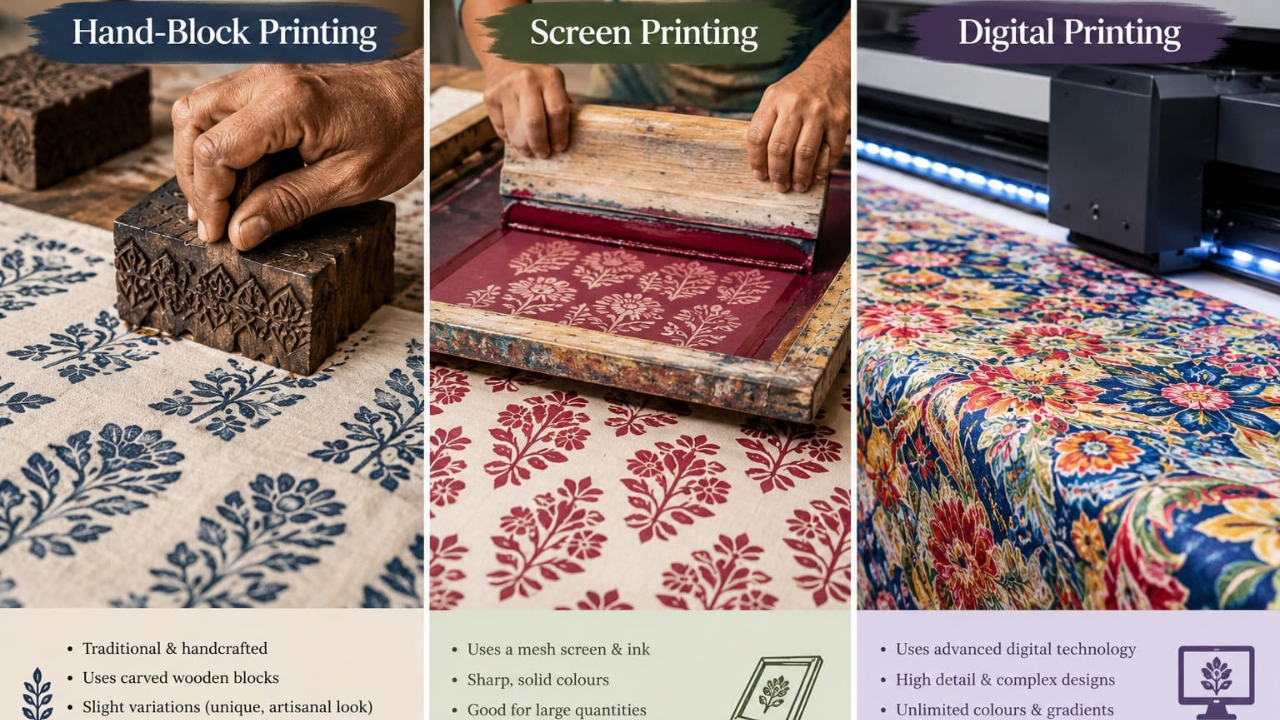
This comparison is not about declaring one method universally “better.” Each technique serves a different purpose. Hand-block printing preserves a hands-on craft tradition. Screen printing offers efficient repeat production. Digital printing provides speed, flexibility, and highly detailed reproduction.
The real question is: What are you looking at, and how can you tell how it was made?
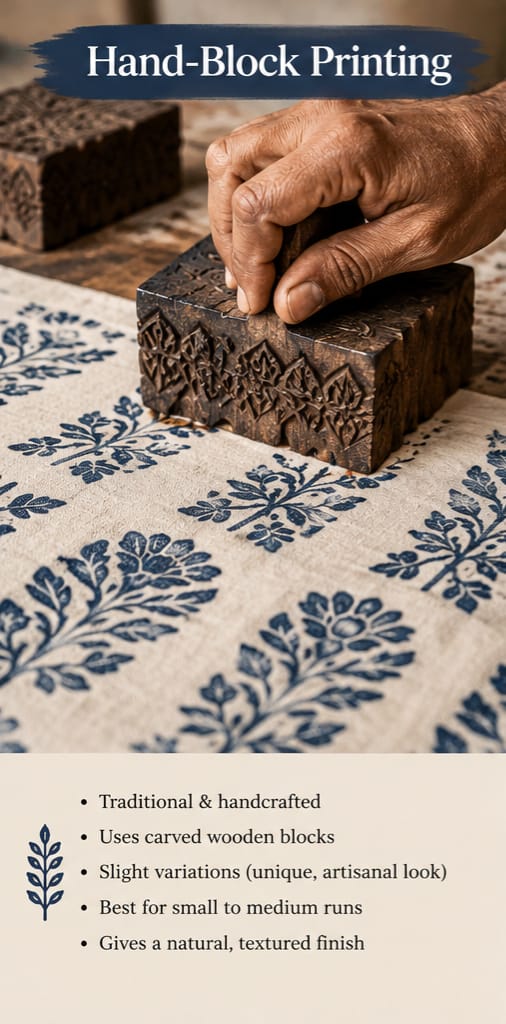
Production Method Contrast
The clearest difference between hand-block, screen, and digital printing comes from the way each method transfers a design onto fabric.
Hand-block printing
Traditional hand-block printing uses a carved wooden block. The artisan applies dye, pigment, or a resist mixture to the carved surface and presses the block onto the fabric.
The artisan repeats this movement across the textile.
That sounds simple until you consider everything that has to stay aligned.
The printer must manage:
- Block placement
- Pressure
- Color application
- Fabric movement
- Pattern alignment
- Border spacing
- Repeated impressions
- Color sequence
One small shift can change the appearance of a motif. Instead of hiding every variation, traditional printing often allows subtle differences to remain visible.
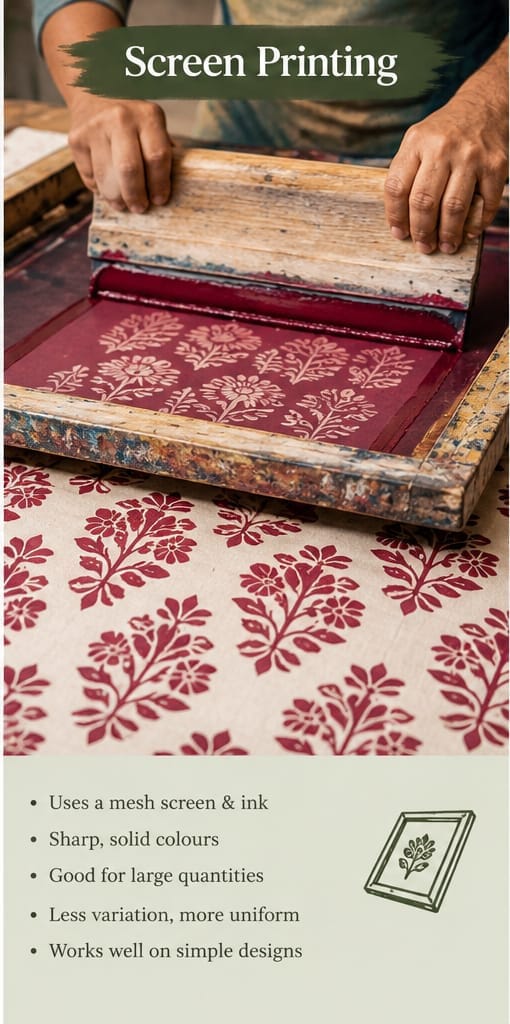
Screen printing
Screen printing uses a prepared mesh screen containing the required design. The printer places the screen over the fabric and pushes ink or printing paste across the surface with a squeegee.
The screen transfers the design to the fabric through open areas in the mesh.
This method allows manufacturers to produce repeated patterns more quickly than individual hand-block impressions. It also provides strong control over repeated placement.
However, the visual character differs from traditional block printing because the design does not come directly from a carved wooden block pressed by hand.
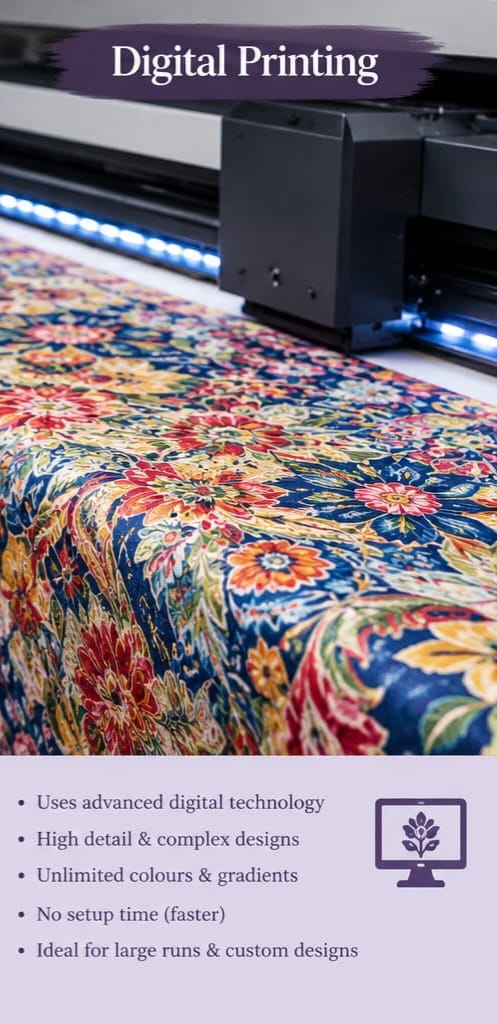
Digital printing
Digital printing removes the physical printing block and screen from the main printing stage.
A digital printer receives a computer-created design and applies color directly onto prepared fabric.
This approach allows manufacturers to reproduce:
- Fine details
- Complex illustrations
- Photographic elements
- Gradients
- Numerous colours
- Very small design details
Digital technology can reproduce an Ajrakh-inspired visual language without following the traditional printing process.
That distinction matters.
A fabric can look like Ajrakh without being traditionally block-printed Ajrakh.
The Hand-Block Method: Printing Through Touch
Traditional block printing creates a direct relationship between the artisan, the block, the color, and the fabric.
The artisan does not simply press a button and wait for a finished pattern. Every impression requires a physical action.
The printer picks up the block, positions it, presses it against the fabric, lifts it, checks the result, and moves forward.
The process becomes rhythmic.
Tap.
Press.
Lift.
Align.
Repeat.
That rhythm continues across large sections of cloth.
For a complex textile, the artisan may work with several blocks. Different blocks can perform different functions within the design. One may establish an outline, another may add a filled motif, while others contribute borders or supporting details.
This layered approach creates a visual structure that machines can imitate but do not reproduce through the same physical process.
Screen Print: A Different Kind of Precision
Screen printing also requires skill, but its precision comes from a different source.
Instead of carving a design into a wooden block and pressing that block repeatedly, the printer works with a prepared screen.
The screen controls where the printing material passes onto the fabric.
This makes screen printing particularly useful when a manufacturer needs to reproduce the same design across many meters of cloth.
The method can deliver consistent results and relatively quick production.
For buyers, however, the presence of a repeated pattern does not automatically mean the fabric came from hand-block printing.
A screen-printed textile can reproduce familiar Ajrakh-inspired motifs while following an entirely different production system.
Digital Sublimation and Digital Printing
Digital printing brings another major difference.
The design begins as a digital file rather than a carved physical block.
A designer can adjust the artwork on a computer before printing it onto fabric. They can change scale, colours, spacing, and individual elements without creating a new wooden block.
This flexibility makes digital printing attractive for modern textile production.
Digital sublimation, in particular, transfers color through a process that uses heat to move dye into suitable synthetic fabric surfaces. It is widely associated with polyester-based applications and detailed, full-color designs.
That makes it different from the traditional natural-dye and resist-printing systems associated with many forms of Ajrakh.
So when a fabric carries an Ajrakh-like pattern produced digitally, the appearance may resemble the craft, but the manufacturing process remains fundamentally different.
How Do You Tell a Machine Print from a Hand Block?
This is one of the most useful questions for a buyer.
You cannot always identify the production method from one visual clue. A good-quality screen or digital print can look extremely convincing.
Instead, examine several characteristics together.
Look Closely at Pattern Alignment
Hand-block printing relies on repeated physical placement.
Even highly skilled artisans may produce tiny differences between impressions.
Look closely at repeating motifs.
You may notice:
- Slight changes in spacing
- Tiny shifts in alignment
- Minor variations in pressure
- Small differences in color density
- Subtle irregularities around edges
These differences do not automatically indicate poor quality.
They can reveal the physical process behind the textile.
Machine-based printing generally aims for greater uniformity.
If every repeated motif appears almost perfectly identical and mechanically positioned, the fabric may have come from screen or digital production.
However, this clue alone cannot prove the method.
Manufacturers can deliberately introduce visual irregularities into machine-made fabrics, so always examine the textile as a whole.
Study the Edges of the Motifs
The edges of printed motifs can provide useful information.
Traditional block printing transfers color from a physical carved surface. Depending on the dye, paste, fabric, pressure, and printing conditions, the edges can show tiny variations.
Some areas may appear slightly softer or stronger than others.
Digital printing can produce extremely clean and controlled details because the printer follows a digital image.
Screen printing can also create clean repeated edges, although the final appearance depends on the mesh, ink, fabric, and printing setup.
Do not assume that a slightly uneven edge automatically means “handmade.” Look for a pattern of natural variation rather than one isolated imperfection.
Check the Reverse Side of the Fabric
Turn the textile over.
The reverse side can sometimes reveal how deeply the color has penetrated the fabric.
Traditional dyeing and printing processes can produce a different color presence on the reverse compared with some surface-printing methods.
The result depends heavily on the fiber, dye, paste, fabric preparation, and printing technique.
A digitally printed surface may appear much more concentrated on the face of the fabric, while the reverse can show comparatively limited color penetration.
Screen printing can also remain relatively surface-focused depending on the printing material.
This makes the reverse side useful for inspection, but it should not serve as your only test.
Repetition Tells a Story
Imagine looking at a one-meter section of fabric containing the same floral or geometric motif twenty times.
With hand-block printing, the artisan physically places the block twenty times.
The design therefore carries twenty separate impressions.
With screen printing, one prepared screen can reproduce the same motif repeatedly.
With digital printing, the machine can reproduce the design directly from the digital file.
The final pattern may appear similar, but the journey from design to fabric differs completely.
That journey is what buyers often overlook.
Feel the Surface
Touch can also provide clues.
Traditional Ajrakh may involve several processes, including resist application, dyeing, washing, drying, and finishing. These stages can influence the final hand feel of the textile.
A traditionally processed textile may develop a distinctive softness and character over time.
However, fabric feel varies according to fiber, finishing, washing, dyeing, and manufacturer practices.
A smooth fabric is not automatically digital.
A slightly textured fabric is not automatically handmade.
Use touch together with visual inspection and information about the production process.
Color Behaviour Can Offer Another Clue
Color is one of the strongest visual features of Ajrakh.
Traditional Ajrakh commonly uses deep shades created through carefully managed dyeing and printing processes. Indigo, madder-derived reds, resist techniques, and mordant-related processes can contribute to the final appearance.
Machine printing approaches color differently.
A screen printer can mix and apply prepared printing colours according to a chosen formula.
A digital printer can reproduce an enormous range of colours directly from digital artwork.
This means digital fabric can display gradients, photographic effects, and extremely complex color transitions that would require a completely different approach in traditional block printing.
When you see perfectly smooth color gradients inside a motif, ask whether the design reflects a traditional dyeing process or a digitally reproduced image.
The Role of the Wooden Block
The wooden block remains one of the strongest symbols of traditional hand-block printing.
A block is not simply a stamp.
An artisan first needs a design. A block carver then translates that design into wood while preserving the relationships between lines, spaces, and motifs.
The block must also work repeatedly.
Its shape, depth, handles, registration points, and carved areas all influence the printing process.
When the artisan finally uses the block, the carved geometry becomes part of a larger composition.
That physical connection disappears when the same visual pattern moves into screen or digital production.
Screen Print vs. Hand Block: What Changes for the Buyer?
For a customer, the most important difference is not simply appearance.
It is production method.
A hand-block textile represents a process involving physical blocks, artisan judgment, repeated impressions, and often several stages of color and resist work.
Screen printing focuses on transferring a prepared design through a mesh screen.
Digital printing focuses on reproducing a digital design directly through printing equipment.
All three can create attractive textiles.
The difference becomes important when a buyer expects a product described as traditionally hand-block printed.
A machine-produced textile should not be presented as handmade simply because it carries traditional-looking motifs.
Digital Can Imitate the Look, But Not the Process
Modern digital printing has become remarkably capable.
A designer can scan or recreate traditional-looking motifs and reproduce them across fabric with impressive consistency.
From a distance, the result may look almost identical to a traditional textile.
But appearance and process are two different things.
A digitally printed Ajrakh-inspired fabric does not become hand-block printed simply because its artwork resembles traditional Ajrakh.
This distinction protects both buyers and artisans.
It also gives customers a clearer understanding of what they are purchasing.
Why Hand-Block Printing Takes More Time
Hand-block printing slows production because each impression requires human movement.
The artisan cannot instantly cover a large fabric area with one command.
They must physically work across the cloth.
Complex designs add more stages.
Multiple colours can require multiple blocks or printing stages.
Resist techniques can introduce additional preparation and processing.
Drying and washing can also become important parts of the production schedule.
This explains why traditionally produced Ajrakh can require considerably more time than a digitally printed imitation.
The price therefore reflects more than the fabric itself.
It can include:
- Artisan labor
- Block preparation
- Dye and printing materials
- Fabric preparation
- Multiple printing stages
- Washing
- Drying
- Finishing
- Production risk
- Craft knowledge
When Perfect Uniformity Becomes a Clue
Look at a repeated border.
If every single motif has exactly the same position, thickness, spacing, and color density, the fabric may have gone through a highly controlled machine process.
Traditional hand-block printing can achieve impressive consistency, but human hands naturally introduce tiny differences.
Those differences become particularly visible when you compare several repeated sections side by side.
Again, this does not mean every imperfect textile is handmade.
Some machine prints intentionally imitate handmade variation.
The strongest approach combines visual examination with transparent information from the seller.
Ask the Seller the Right Questions
If you want to buy genuine hand-block-printed Ajrakh, do not rely only on photographs.
Ask direct questions.
For example:
“Is this fabric printed using carved wooden blocks?”
“How many blocks were used for the design?”
“Was the fabric screen printed or digitally printed?”
“Does the textile use traditional resist printing?”
“Which parts of the process were completed by hand?”
A knowledgeable seller should be able to explain the production method clearly.
Vague answers deserve more caution.
Handcrafted Does Not Mean Perfect
One common misunderstanding is that handmade fabric should look flawless.
Traditional printing does not work like a computer display.
The artisan interacts with the fabric physically.
The block can absorb color differently.
The fabric can shift slightly.
Pressure can change.
The printing paste can behave differently depending on conditions.
These small variations can create a textile with character.
Instead of asking whether every motif looks mechanically identical, ask whether the variations appear consistent with a real hand-printing process.
Comparing the Three Methods
Hand-block printing
Main tool: Carved wooden blocks
Process: Physical impressions made by hand
Strength: Craft character and traditional production
Variation: Natural differences may appear
Production speed: Relatively slower
Human involvement: Very high
Screen printing
Main tool: Mesh screen and squeegee
Process: Printing paste or ink passes through the screen
Strength: Efficient repeat production
Variation: Generally controlled and consistent
Production speed: Faster than individual block printing
Human involvement: Depends on the production setup
Digital printing
Main tool: Digital printer
Process: Computer-based artwork transferred onto fabric
Strength: Detail, color flexibility, and design freedom
Variation: Usually highly controlled
Production speed: Suitable for efficient production
Human involvement: Concentrated more in design and machine operation
The Value Behind the Printing Method
When someone buys a hand-block-printed Ajrakh textile, they are not simply buying a pattern.
They are buying a process.
They are paying for the artisan who understands how to place the block, the person who carved the block, the knowledge behind the color sequence, the preparation of the fabric, and the time required to complete the textile.
A screen print may offer excellent consistency.
A digital print may offer extraordinary detail.
Neither method is automatically inferior for every purpose.
But neither should be confused with traditional hand-block printing.
The production method gives the textile part of its identity.
Why This Difference Matters for Ajrakh
Ajrakh has a visual language that many modern manufacturers can reproduce.
Deep blue.
Rich red.
Geometric borders.
Floral forms.
Repeated motifs.
Symmetrical compositions.
These elements can travel easily from traditional craft into commercial printing.
But Ajrakh is more than a collection of visual motifs.
Its identity also comes from the knowledge and processes used to create the textile.
When artisans carve blocks, prepare fabric, apply resist, print repeated patterns, manage color stages, wash the cloth, and dry it, they participate in a long chain of textile knowledge.
A digital reproduction may borrow the appearance without carrying the same process.
That distinction deserves recognition.
A Better Way to Judge an Ajrakh Textile
Instead of asking only, “Does this look like Ajrakh?”, ask several questions:
How was the design transferred?
Was a wooden block used?
Was a screen used?
Did a digital printer create the pattern?
Can the seller explain the printing process?
Do repeated motifs show natural variation?
Does the reverse side support the claimed process?
Does the textile’s color and finish make sense for the described production method?
These questions help you move beyond appearance.
Choosing Based on What You Value
There is no single winner in the comparison between hand-block, screen, and digital printing.
Your choice depends on what matters to you.
Choose hand-block printing when you value traditional craft, artisan involvement, physical printing techniques, and the character created by handmade production.
Choose screen printing when you want repeated designs, consistent output, and efficient textile production.
Choose digital printing when you value highly detailed artwork, broad color possibilities, quick design changes, or complex digital patterns.
The important thing is transparency.
A customer should know what they are buying.
The Pattern Is Only the Beginning
An Ajrakh-inspired pattern can appear on many kinds of fabric today.
Some pieces come from traditional workshops.
Others come from screen-printing units.
Some use digital technology to recreate the visual language of Ajrakh.
The finished surface may look similar, but the story behind it can be completely different.
That is why learning to identify the production method matters.
Hand-block printing carries the movement of the artisan. Screen printing carries the efficiency of the screen. Digital printing carries the precision of the digital file.
When you understand these differences, you can look at an Ajrakh textile with a more informed eye.
And sometimes, the smallest irregularity in a repeated motif tells you something important: a human hand may have been there.