
An Ajrakh saree does not appear in its finished form after one printing session. The fabric moves through a chain of preparation, printing, coloring, washing, drying, and finishing stages before an artisan considers it ready.
This long process often raises a practical question: how much time does it actually take to make an Ajrakh saree?
In many traditional production systems, a complex Ajrakh textile can take several weeks, and a process of around 21 days is often discussed when multiple hand-printing and natural-dyeing stages are involved. The exact duration can change according to the design, fabric, number of colors, printing method, weather, workshop practice, and drying conditions.
The important point is that those days do not represent continuous printing.
An artisan does not sit with one saree for twenty-four hours a day. Instead, the textile moves through different kinds of time. Some hours demand direct physical work. Other hours allow the fabric to dry, absorb treatment, develop color, or wait for the next operation.
That combination makes the economics of handmade Ajrakh very different from ordinary mass-produced clothing.
A 21-Day Saree Begins Before the First Block Touches the Fabric
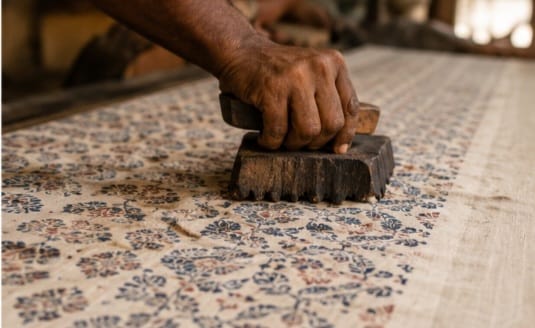
The most visible part of Ajrakh making is block printing, but printing comes after several preparations.
Artisans first need fabric that can respond properly to the later treatments. Depending on the workshop and production method, they may wash and prepare the cloth, remove unwanted residues, and condition it for dyeing and printing.
This preparation affects everything that follows.
A poorly prepared fabric can create problems during printing. Color may not develop as expected. Printing material may behave differently on the surface. Later washing may produce an uneven result.
Experienced artisans therefore do not treat preparation as an optional preliminary chore.
They treat it as part of the actual production.
The customer may never see this stage, but the final saree depends on it.
What Does “21 Days” Actually Include?
A 21-day timeline should not be understood as twenty-one identical working days.
The schedule can contain several types of activity:
Direct lab our
- Preparing the fabric
- Mixing printing materials
- Handling wooden blocks
- Printing motifs
- Applying resist
- Managing dye baths
- Washing the textile
- Checking the result
- Finishing the saree
Material-dependent time
- Drying after washing
- Drying after printing
- Color development
- Waiting between treatments
- Preparing the fabric for another stage
Environmental time
- Sunlight
- Temperature
- Humidity
- Water conditions
These categories overlap throughout production.
For example, an artisan may finish a printing stage in the morning and spread the fabric for drying. The artisan does not spend the next several hours printing that same piece. The fabric continues its journey while the artisan works on another task or another textile.
This distinction helps explain why a long production period does not equal an equal number of full-time lab our days.
The First Cost: Preparing the Cloth
Before an artisan creates a pattern, they need a workable surface.
Fabric preparation can involve washing and other treatments that help the textile respond to subsequent processes. The exact method depends on the particular Ajrakh tradition and workshop.
This stage requires:
- Water
- Workspace
- Handling
- Lab our
- Time
- Knowledge of textile behaviour
Large pieces of cloth also require physical space for washing and drying.
The artisan must move the fabric without damaging it. They must monitor its condition before moving to the next stage.
Preparation therefore contributes to the final cost even though the customer cannot easily identify it when looking at the finished saree.
Printing Demands Repetition, Not Just Strength
People often imagine block printing as a simple action:
Pick up block.
Apply color.
Press block.
Lift block.
Repeat.
The actual task requires much more control.
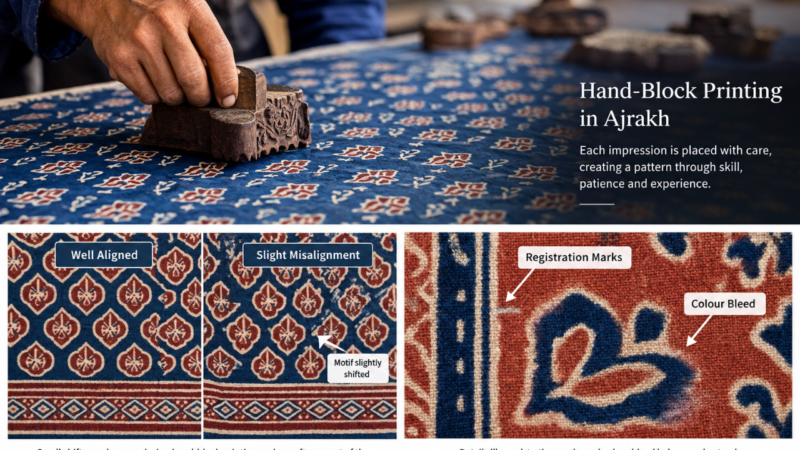
An artisan needs to keep the impressions visually connected across a long piece of fabric. Borders require particular attention because an error can remain visible for the entire length of the saree.
The artisan controls:
- Block position
- Pressure
- Color quantity
- Direction
- Spacing
- Repetition
- Alignment
The artisan also needs to watch the surface while working.
If a block carries too much material, the impression can spread.
If the artisan applies too little pressure, the design may not transfer evenly.
If the block shifts, the motif can lose its intended relationship with the previous impression.
The artisan therefore performs a repeated movement while constantly making small visual decisions.
Why the Wooden Block Does Not Do the Work Alone
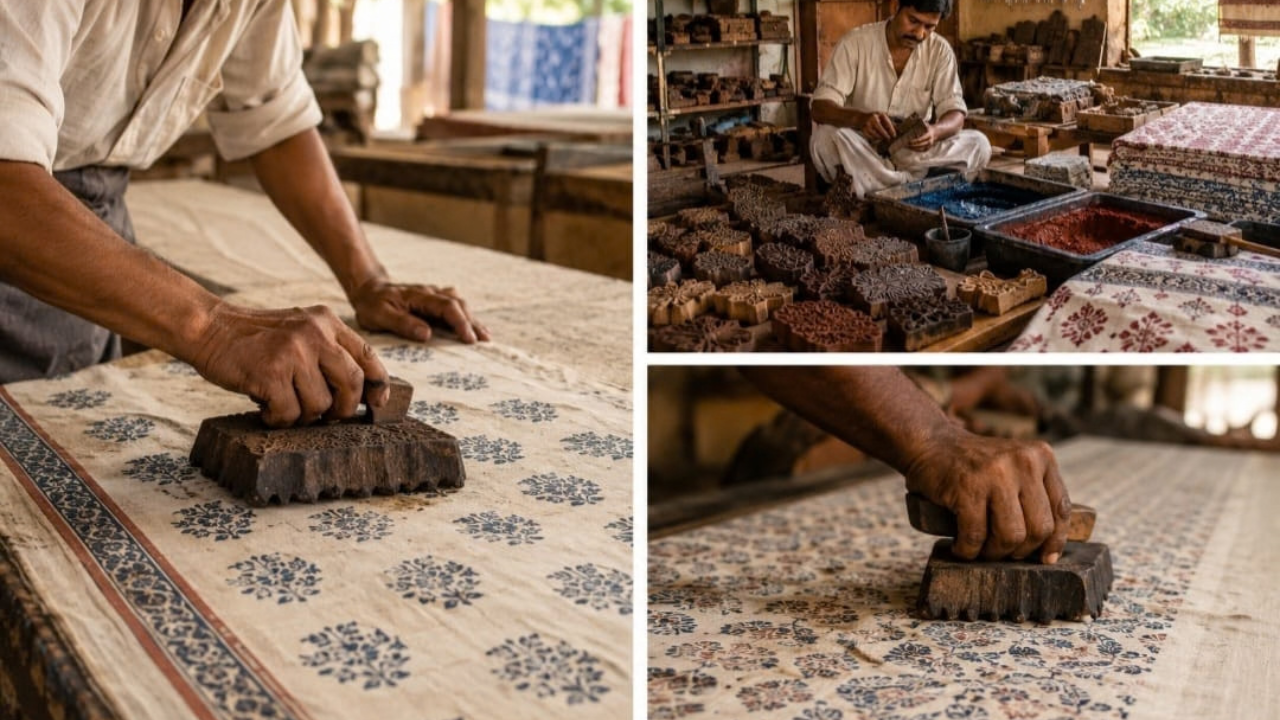
The carved block contains the design, but it does not contain the knowledge required to print that design successfully.
Two people can use the same block and achieve different results.
An experienced printer understands how much material the block should carry. They know how to place it on the cloth. They recognize the correct pressure through touch and movement.
They also understand the rhythm of the design.
Instead of measuring every single impression, an experienced artisan can often judge spacing visually.
This ability develops through practice.
That accumulated experience contributes directly to the value of the saree.
Borders Can Demand Extra Attention
A saree contains long borders, and these borders create a special printing challenge.
A small displacement at one point can become more noticeable as the pattern continues.
The artisan therefore needs to maintain a relationship between one impression and the next.
The process involves more than repeating a motif.
The artisan must understand how the motif travels along the fabric.
If the design contains multiple blocks, the alignment becomes even more important. One block may need to meet another at a specific point so that the combined design looks continuous.
This requires concentration throughout the printing session.
Multiple Blocks Mean Multiple Decisions
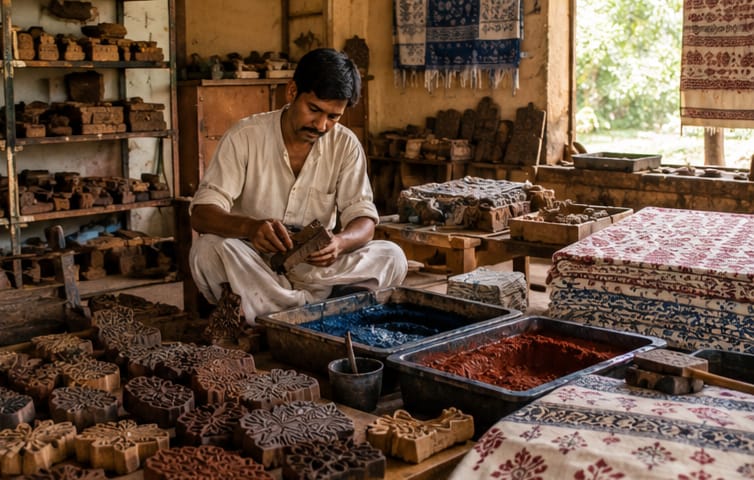
Complex Ajrakh patterns can involve several carved blocks.
Each block may perform a different role in the composition.
One may establish a line.
Another may add a repeated motif.
Another may help create a border.
Another may work with resist or color placement.
The artisan needs to know the order in which these blocks should meet the fabric.
The design therefore develops layer by layer.
A finished pattern that looks unified can contain numerous individual impressions underneath its surface.
Each impression represents another moment of lab our.
Resist Printing Adds Another Layer of Work
Ajrakh often uses resist techniques to control where dye can reach the cloth.
The artisan applies a material to selected areas before a dyeing stage.
That material protects those areas.
The unprotected sections can receive the dye.
This method creates controlled contrast and allows artisans to build complex designs through successive stages.
However, resist printing demands precision.
If the resist spreads beyond the intended area, it can affect the motif.
If it fails to cover an area properly, dye may enter a space that should remain protected.
The artisan therefore needs to apply the resist accurately and maintain the integrity of the printed design.
Dyeing Does Not Mean One Quick Dip
Natural dyeing adds its own timetable to Ajrakh production.
Different dyes require different preparation and working conditions.
Indigo, for example, uses a vat-based process in which the dye develops its visible blue after the cloth comes into contact with oxygen.
Madder requires another type of preparation and can produce red through interactions between its coloring compounds, the fiber, and mordanting conditions.
The artisan must therefore plan the color stages instead of treating every dye as interchangeable.
A more complicated color arrangement can require additional stages.
More stages mean more handling.
More handling means more lab our and more time.
Washing Can Change the Appearance of the Textile
Washing plays an important role throughout traditional textile production.
After printing or dyeing, the cloth can contain residues from different materials used during processing.
Washing helps remove unwanted substances and exposes the developing pattern.
The fabric may look different after washing from the way it looked immediately after printing.
Colours can become clearer.
Protected areas can become more visible.
Some temporary materials disappear.
The artisan evaluates the textile again before proceeding.
This means washing does not simply “clean” the saree.
It helps reveal the result of earlier decisions.
Sun Drying Creates a Different Kind of Schedule
Sun drying connects Ajrakh production directly with the surrounding environment.
After certain stages, artisans spread the textile so moisture can leave the fabric.
The process sounds straightforward, but the drying time can vary.
Bright sunlight can speed drying.
Cloudy weather can slow it down.
Humidity can also affect the process.
The artisan cannot completely control these conditions.
They can monitor the fabric and decide when it has reached a suitable state for the next stage.
This dependence on natural conditions can extend or change the production schedule.
That is one reason traditional textile production does not always follow the same timetable as an industrial production line.
The Economics of Time
Time has a direct economic effect on handmade textiles.
Every production day can involve:
- Artisan wages
- Workshop space
- Water consumption
- Dye materials
- Printing materials
- Fabric handling
- Equipment maintenance
- Drying space
- Repeated processing
The artisan also needs to earn from the work.
If a saree requires several weeks of production, the selling price needs to account for the lab our involved.
This does not mean that every expensive saree automatically represents fair artisan compensation.
Buyers should still consider workmanship, material quality, authenticity, seller reputation, and overall construction.
But production time gives us an important starting point for understanding why handmade textiles can cost more than quickly manufactured alternatives.
What Are You Paying For in a 21-Day Process?
When you buy a handmade Ajrakh saree, the price can represent several forms of value at once.
1. Physical lab our
The artisan handles the fabric repeatedly during washing, printing, dyeing, drying, and finishing.
2. Technical skill
The artisan knows how to manage blocks, printing materials, resist, dyes, and fabric behaviour.
3. Design knowledge
The artisan understands how individual motifs must work together across the saree.
4. Material knowledge
Natural dyes and traditional treatments require practical understanding.
5. Production time
The textile may remain in production for days or weeks.
6. Risk
A handmade process can produce unexpected results. The artisan carries the risk of mistakes, uneven color, or failed stages.
7. Cultural continuity
Buying handmade work can help maintain demand for skills that require long-term learning.
The price therefore represents more than the physical cloth.
The Cost of a Mistake
A mistake in hand printing does not always affect one small section.
If an artisan places a block incorrectly, the error may disrupt the surrounding pattern.
If a resist fails, the following dye stage can affect the wrong area.
If color develops unevenly, the artisan may need to decide whether the textile can continue through the process.
Sometimes the artisan can correct the problem.
Sometimes they must repeat a stage.
Sometimes the textile becomes a piece with a different character from the original plan.
These possibilities make handmade production less predictable than factory production.
The artisan’s experience helps reduce the risk, but it cannot remove it completely.
Lab our Includes Thinking
Artisan lab our does not consist only of physical movement.
It also includes constant decision-making.
The artisan asks:
- Is the fabric ready for the next stage?
- Has the printed material dried sufficiently?
- Does the block need more color?
- Is the alignment correct?
- Has the dye developed enough?
- Does the resist still protect the intended area?
- Should the fabric go through another wash?
- Is the final color strong enough?
These decisions happen throughout the process.
The artisan uses observation instead of relying entirely on fixed instructions.
That judgment forms part of the craft.
Why Faster Production Changes the Equation
A machine can repeat an impression extremely quickly.
An industrial system can also control temperature, drying, color application, and production schedules with high consistency.
Hand-block printing follows another model.
The artisan remains physically involved.
The printing speed depends on human movement.
Natural processes can determine when the textile can move forward.
The result may contain subtle variations that reflect the handmade process.
Neither system needs to be judged by the same standard.
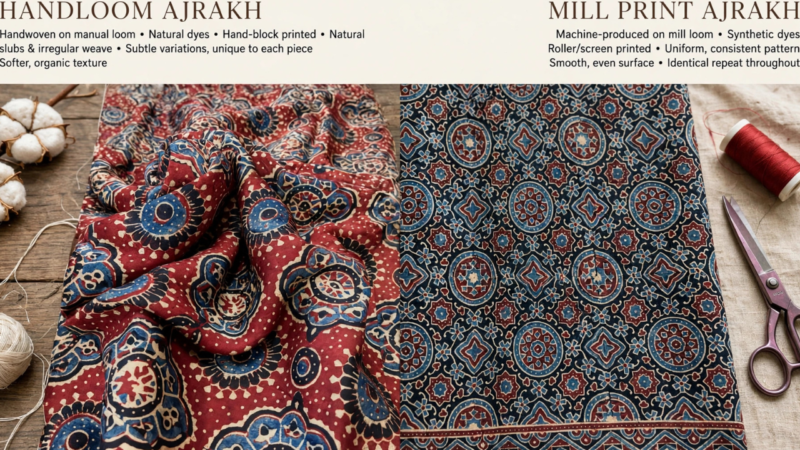
A factory-made textile can offer affordability and consistency.
A handmade Ajrakh offers a different relationship with process, skill, and traditional production.
A Saree Can Carry Weeks of Decisions
Imagine following one Ajrakh saree from beginning to end.
First, the fabric enters the workshop.
The artisan prepares it.
The cloth moves through washing and treatment.
Printing begins.
A wooden block creates one impression.
The artisan places the next impression.
Then another.
A resist protects selected areas.
The textile enters a color stage.
The cloth leaves the dyeing process.
The artisan washes it.
The fabric goes into the sun.
Later, another stage begins.
The artisan repeats selected operations.
Gradually, the final design takes shape.
The customer sees one completed saree.
The artisan remembers a much longer sequence.
Why Handmade Variation Has Economic Meaning
Handmade textiles often contain small variations.
A motif may not appear with machine-level uniformity.
A color may show subtle differences.
The surface can carry signs of repeated human handling.
These details do not automatically indicate poor workmanship.
In many traditional crafts, they reflect the production method itself.
However, good craftsmanship still matters.
A skilled artisan maintains control over the overall composition even when the process allows small variations.
The goal is not random imperfection.
The goal is controlled handmade production.
The Real Meaning of Slow Craft
“Slow craft” does not simply mean that an artisan works slowly.
It describes a production system that gives greater importance to process, material behaviour, skill, and careful making.
Ajrakh demonstrates this clearly.
The textile cannot always move forward until the previous stage reaches the right condition.
The artisan cannot rush the sun.
The artisan cannot replace years of experience with one instruction.
The artisan cannot make every natural dye behave exactly like a synthetic color.
Instead, the artisan works with the materials.
That relationship creates the rhythm of the craft.
How Buyers Can Judge the Value of an Ajrakh Saree
Understanding the production timeline can help buyers ask better questions.
Before purchasing, consider:
- Who made the textile?
- Which printing method did the workshop use?
- Does the seller explain the dyeing process?
- What type of fabric does the saree use?
- Does the design show careful block alignment?
- Does the seller provide information about the artisan or craft tradition?
- Are natural dyes actually used, if the seller claims they are?
- Does the price seem consistent with the amount of work involved?
These questions do not guarantee authenticity, but they encourage more informed buying.
The goal should not be to purchase something simply because the seller calls it “handmade.”
The goal should be to understand what kind of work actually went into it.
From Workshop Time to Customer Value
A customer may spend only a few minutes choosing a saree.
The artisan may spend weeks bringing that saree into existence.
This difference in time changes the way we should understand its value.
The customer experiences the finished result.
The artisan experiences every stage.
The buyer sees the color.
The artisan remembers how that color developed.
The buyer sees the border.
The artisan remembers aligning its blocks.
The buyer sees the soft finished fabric.
The artisan remembers washing and drying it through multiple stages.
That difference explains why the production timeline matters.
The People Behind the Price
A handmade textile cannot exist without people who know how to make it.
When a craft takes weeks to produce, the artisan needs an economic reason to continue making it.
If buyers only compare handmade Ajrakh with cheaper mass-produced prints, they may overlook the lab our difference.
A sustainable craft economy needs buyers who understand what they are purchasing.
Fair compensation can help artisans maintain workshops, train younger makers, purchase materials, and continue traditional techniques.
The survival of a craft therefore depends partly on whether its lab our receives appropriate economic recognition.
Time Becomes Part of the Sarees Value
An Ajrakh saree can take weeks because its production combines different forms of work.
Some stages require physical effort.
Some require technical knowledge.
Some require careful observation.
Some require repeated printing.
Some depend on water.
Some depend on sunlight.
Some simply require the artisan to wait until the fabric reaches the right condition.
The 21-day process therefore represents a production rhythm rather than a stopwatch.
When you understand that rhythm, the price of a handmade saree becomes easier to evaluate.
You begin to see that the cost does not come from fabric alone.
It comes from the accumulated lab our required to transform prepared cloth into a finished textile.
A Price Tag Cannot Show the Whole Process
A sarees price appears as one number.
Its making does not happen as one event.
Behind that number, an artisan may have spent days preparing, printing, washing, drying, dyeing, checking, and finishing the cloth.
The workshop has also carried material and operating costs.
The artisan has contributed learned skills that developed over years rather than during the production of one saree.
That is why the economics of Ajrakh need a wider view.
You are not simply paying for how much cloth you receive. You are paying for how that cloth became what it is.
The 21 Days Behind One Ajrakh Saree
A handmade Ajrakh saree does not become valuable because someone leaves it untouched for three weeks.
Its value comes from what happens throughout those weeks.
The artisan prepares the material.
They print with precision.
They manage resist work.
They handle color.
They wash and dry the fabric.
They watch how the textile responds.
They repeat stages when the design requires them.
They work around natural conditions.
They use skills developed through practice.
That is what the timeline represents.
Artisan labor gives the process its human control. Sun drying connects the work with nature. Hand-block printing gives the design its structure. Repeated treatments build the final surface.
So, when you look at an Ajrakh saree and ask, “Why did this take around 21 days?”, the answer is not simply “because it is handmade.”
The better answer is this:
It takes time because the artisan builds the textile gradually, allowing each stage to prepare the fabric for the next. The final saree carries not only color and pattern, but also the lab our, decisions, materials, and working time required to create them.