
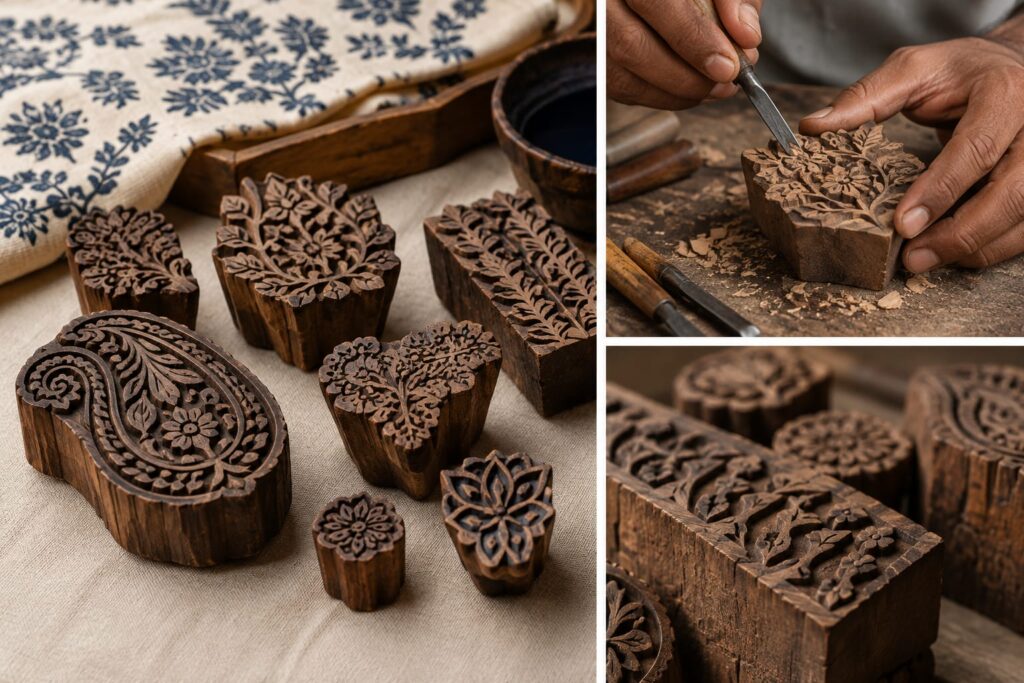
Ajrakh printing begins long before Colors touches the fabric. Behind every repeated border, floral motif, geometric grid, and carefully balanced pattern sits a small but essential tool: the wooden printing block.
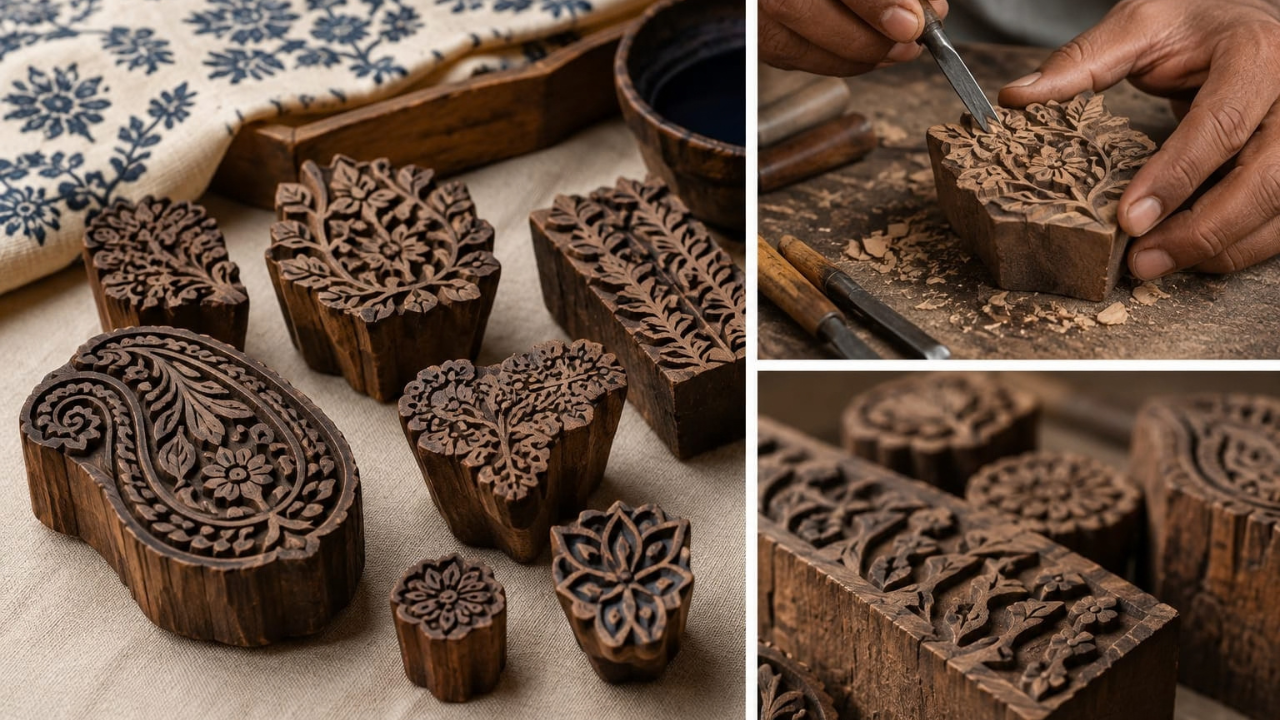
Known in the craft tradition as buntis or wooden blocks, these carved pieces carry the visual language of Ajrakh from the artisan’s mind to the cloth. A block may look like a simple piece of wood when it rests on a workbench. Once an artisan carves it with precision, however, it becomes a tool capable of repeating the same design across meters of fabric.
The process demands patience, planning, and an unusually strong understanding of geometry.
A printer cannot simply carve a beautiful picture into wood and expect it to produce a successful textile pattern. The artisan must consider how the motif will repeat, where the edges will meet, how borders will connect, and how different blocks will work together. Even a tiny error in spacing can become obvious when the design repeats dozens of times.
Traditional Ajrakh block making therefore combines craftsmanship, geometry, material knowledge, and practical experience.
Teak wood provides a strong base for many traditional blocks because it can withstand repeated handling and carving. The artisan selects, prepares, marks, and carves the wood before testing the block on fabric. Small details such as the block’s thickness, carving depth, alignment marks, and grip all influence the final impression.
The real beauty of an Ajrakh block lies in this relationship between precision and repetition.
One carved block may create a single motif, but the artisan uses it again and again to build an entire visual system.
The Geometry of Blocks
Ajrakh designs often depend on repetition and balance.
That means the artisan must think about geometry before beginning the carving process. A motif needs to fit within a particular space. Its edges must connect naturally with neighboring impressions. Lines must continue without creating awkward gaps. Borders must maintain their rhythm across the fabric.
This makes block carving much more than decorative woodwork.
The artisan essentially creates a small piece of a much larger pattern.
Imagine a single floral block placed on fabric. If the artisan repeats it at equal intervals, the individual flower becomes part of a continuous pattern. If another block adds a border around it, the two designs must work together. A third block may add dots, outlines, or another structural detail.
The final textile emerges from these relationships.
This is why Ajrakh block makers need a strong sense of proportion.
They must understand not only the motif inside the block but also the empty space around it.
That space determines how one impression interacts with the next.
A successful block leaves enough room for repetition without making the pattern look crowded. It also prevents unwanted overlaps when the printer places the block repeatedly.
The geometry begins in the design and continues all the way to the finished cloth.
From Design Idea to Wooden Block
Before an artisan carves the wood, someone must decide what the block should represent.
Traditional Ajrakh uses a rich vocabulary of geometric and natural forms. Floral shapes, leaves, dots, lines, stars, grids, and structured borders can appear in different combinations. Artisans may preserve established motifs while also adapting designs for contemporary textiles.
The designer or block maker first considers the overall pattern.
A motif that looks attractive on paper may not work well as a repeating block. The artisan therefore needs to test its proportions and repetition.
The design must answer practical questions:
- Where will the motif begin and end?
- How will it connect to the next impression?
- Will the edges align?
- Does the design require one block or several?
- How much detail can the wood hold?
- Will the carving remain strong after repeated printing?
- How will the motif interact with Colours?
These decisions guide the carving process.
The artisan does not carve blindly.
Every line has a purpose.
Teak Wood: A Reliable Foundation
The wood determines how well a block performs.
Traditional block makers often value teak because of its strength, stability, and ability to hold carved details. A good printing block needs to survive repeated contact with printing paste, fabric, work surfaces, and the artisan’s hands.
The block also needs to remain reasonably stable.
If the wood changes shape too much, the carved pattern can lose accuracy. If delicate sections break, the impression can change. If the surface becomes uneven, the printer may struggle to transfer the design consistently.
For this reason, the block maker pays attention to the quality and preparation of the wood before carving.
The wood needs to provide a suitable working surface.
The artisan then cuts the piece to a practical size and prepares the face that will carry the design.
The block must feel comfortable in the hand as well.
A printer may lift and place the same block hundreds of times during one printing session. Its size, weight, balance, and grip therefore matter.
The best block combines structural strength with practical handling.
Preparing the Wood for Carving
Carving starts with preparation, not decoration.
The artisan smooths the working surface so that the design can sit accurately on the wood. A clean and even face makes it easier to mark the pattern and maintain consistent carving depth.
The artisan then transfers or draws the design onto the prepared surface.
At this stage, accuracy becomes extremely important.
A small mistake in the initial drawing can affect every later impression.
The block maker studies the design carefully before removing wood. Instead of thinking only about the lines that should remain, the artisan also considers the areas that need to disappear.
This creates a kind of reverse drawing.
The carved sections will eventually determine where the printing medium reaches the fabric. The raised areas of the block carry the design and transfer the printing material onto the cloth.
That means the artisan has to understand the relationship between positive and negative space.
A successful block is not simply a carved picture.
It is a functional printing surface.
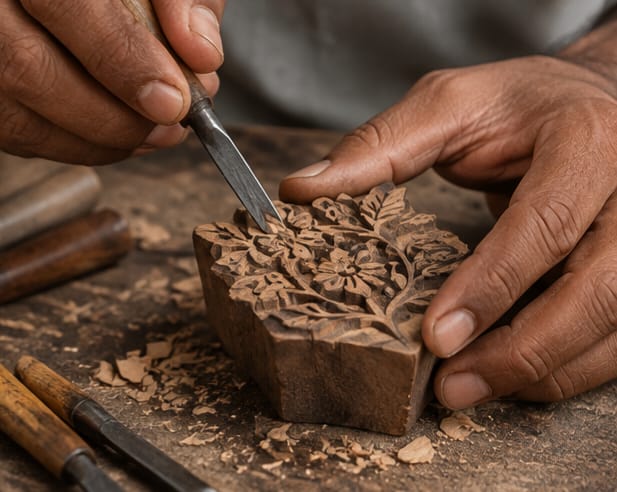
Carving the Motif by Hand
Once the design reaches the wood, the artisan begins carving.
The process requires control rather than speed.
The artisan carefully removes small sections of wood around the intended design. Fine tools allow the maker to create lines, curves, dots, corners, and other details.
The depth of the carving matters.
If the artisan removes too little wood in the wrong area, unwanted parts of the design may interfere with the print. If the artisan removes too much material, delicate sections can weaken.
The block maker therefore works gradually.
Instead of rushing through the entire surface, the artisan develops the motif section by section.
Fine details demand particular attention.
A tiny dot may seem insignificant, but repeated across a border it can become an important part of the pattern. A narrow line may define the edge of a floral form. A small gap may separate two colours or prevent neighboring elements from merging.
The artisan must therefore think about the final textile while working on the wooden block.
The block is small.
The design it creates is not.
Buntis and the Art of Repetition
The real test of a printing block begins when the artisan places it on fabric.
A beautifully carved block still needs to produce consistent impressions.
The printer applies the required printing material to the raised surface and presses the block onto the cloth. The artisan then lifts it carefully, moves it to the next position, aligns it, and repeats the action.
This rhythm creates the repeating structure of Ajrakh.
The artisan develops a physical sense of distance.
After enough practice, the printer can judge spacing through experience, but alignment still requires attention. A small shift can change the rhythm of an entire border.
The block may also contain alignment points that help the printer position the next impression.
These details make repeated printing possible.
The artisan does not treat every impression as an isolated event. Each impression connects to the previous one and prepares the position for the next.
The cloth becomes a continuous field of connected decisions.
Rekh: The Line That Gives Structure
Rekh refers to line-based design elements and outlines that play an important role in block-printed textile construction.
Lines may define floral forms, separate sections, strengthen borders, or provide structure within a larger motif.
A carved line needs precision because even a small irregularity can become visible when repeated.
The artisan therefore considers the width and spacing of the line during carving.
A thick line creates a stronger visual statement. A fine line can create delicacy and detail. The choice depends on the design and the role the block will play within the larger printing sequence.
Rekh also demonstrates how Ajrakh balances detail with order.
The line does not exist only for decoration.
It can guide the eye through the motif and connect one part of the design to another.
When several blocks work together, line-based elements can help unify the entire composition.
Datta and Supporting Design Elements
Ajrakh block printing often uses multiple kinds of blocks rather than relying on one carved piece.
Datta and other supporting blocks can contribute additional design elements, depending on the printing sequence and workshop vocabulary.
A printer may use separate blocks for outlines, fills, borders, dots, or other details. This approach allows the artisan to build a complex design layer by layer.
The viewer may see one finished motif.
The artisan sees a sequence.
One block establishes a structure.
Another adds detail.
Another creates a border or repeating element.
The colours may also change between stages.
This layered method explains why a finished Ajrakh textile can appear much more complex than the individual blocks used to make it.
The blocks divide the design into manageable pieces.
The artisan then brings those pieces together through careful printing.
How Artisans Align the Blocks
Alignment forms one of the most demanding parts of block printing.
Imagine printing a border across a long saree.
The artisan cannot simply place the block anywhere. Each impression needs to follow the previous one. The spacing must remain consistent, and the motif needs to travel along the fabric without suddenly shifting.
Experienced printers develop strong visual and physical coordination.
They watch the edge of the previous impression. They position the block according to the established rhythm. They apply controlled pressure and lift it without dragging.
The artisan repeats this process across the textile.
For larger designs, several blocks may need to align with one another.
This creates another challenge.
The second block must fit the first. The third must fit the second. The entire sequence must remain coherent.
A successful Ajrakh printer therefore works almost like a visual mathematician.
The artisan calculates through movement rather than equations.
When Carving Meets the Printing Process
Block carving cannot exist separately from printing.
A block maker needs to understand how printers will actually use the tool.
A block that looks impressive but feels awkward in the hand can slow down production. A delicate carved section may look beautiful but break during repeated use. A motif with poor spacing may become difficult to align.
The block maker therefore thinks about function.
This relationship between maker and printer creates a practical form of craft knowledge.
The block carries the design, but the printer activates it.
Together, they transform a piece of wood into a repeating textile language.
This also explains why old blocks can hold great value within craft communities.
They may preserve patterns, workshop knowledge, and design traditions that artisans have used across generations.
The Hands Behind the Precision
Machines can reproduce patterns quickly, but hand-carved blocks carry a different kind of knowledge.
The artisan learns through observation and repeated practice.
A skilled block maker understands the resistance of the wood under a carving tool. The maker can recognize when a line needs refinement and when a delicate section needs protection.
The artisan also develops patience.
Carving a detailed block takes time.
The maker cannot force the wood to reveal a complex design immediately. Each section needs attention, and every cut changes the surface permanently.
That patience becomes part of the finished textile.
When a printer repeatedly uses the block, the viewer sees the final motif without seeing the hours that shaped the tool behind it.
The cloth hides the labor of the block maker.
Yet every repeated impression carries that labor forward.
Why Handmade Blocks Create Character
Hand-carved blocks can produce subtle variations.
The artisan may create a slightly different edge from another block. A line may carry a tiny irregularity. The printing pressure may vary from one impression to another.
These differences do not necessarily weaken the design.
They can give the textile a sense of life.
Industrial printing often aims for exact duplication. Handmade block printing allows controlled variation while maintaining an overall pattern.
This balance creates one of Ajrakh’s most appealing qualities.
The textile feels ordered without feeling lifeless.
Its geometry remains clear, but the human hand remains visible.
That combination makes each printed piece feel connected to the process that created it.
Caring for the Blocks
Wooden blocks need care because artisans depend on them repeatedly.
After printing, the artisan needs to clean the block carefully and allow it to dry properly. Excess printing material can affect later impressions if it remains trapped in the carved areas.
The maker also needs to store the blocks safely.
Moisture, rough handling, and careless storage can damage the wood or affect its carved details.
Proper care extends the working life of the block.
A well-maintained block can support repeated printing sessions and preserve a particular motif for years.
In a traditional workshop, these tools can become part of the workshop’s visual memory.
The marks of use may accumulate over time, but the block continues to perform its role.
A Small Block, a Large Visual Language
The scale of a wooden block can make its importance easy to underestimate.
A single block may fit comfortably into an artisan’s hand.
Yet that small object can influence meters of fabric.
Every repeated impression carries its geometry forward.
A border becomes continuous.
A floral motif appears again and again.
A geometric field develops rhythm.
Small carved details become part of a larger visual identity.
This relationship between the small and the large captures something essential about Ajrakh.
The craft does not create complexity through one enormous gesture.
It builds complexity through many carefully controlled actions.
The block provides the structure.
The artisan provides the rhythm.
The fabric provides the space.
Together, they create the finished pattern.
Preserving the Knowledge Inside the Block
A wooden block does more than reproduce an image.
It preserves a piece of design knowledge.
Its dimensions, carving style, motif, alignment system, and relationship with other blocks can reveal how artisans approached textile construction.
When artisans maintain these tools and continue using them, they keep more than an object alive. They keep a method alive.
That matters because textile traditions can change quickly when production methods change.
Modern tools can make printing faster, but traditional blocks preserve a direct connection between carving and cloth.
They allow artisans to continue making decisions by hand.
They also allow younger generations to learn through practice.
An apprentice can watch a senior artisan handle a block, understand its alignment, observe the printing rhythm, and gradually develop the same confidence.
Knowledge moves from one pair of hands to another.
The Geometry That Becomes Ajrakh
A finished Ajrakh textile may look effortless.
The borders appear balanced.
The motifs repeat naturally.
The colours sit within their intended spaces.
The design feels complete.
But that visual calm hides a great deal of preparation.
Someone planned the motif.
Someone selected and prepared the wood.
Someone marked the design.
Someone carved every line.
Someone tested the block.
Someone learned how to align it.
And finally, the printer repeated that small carved form across the fabric with patience and control.
That is why Ajrakh wooden blocks and carving deserve attention as a craft in their own right.
The beauty of the textile begins inside the tool.
A teak block becomes a carrier of geometry. A carved line becomes a repeated motif. A carefully aligned impression becomes part of a larger composition.
The block may disappear from view once the textile reaches the wearer, but its influence remains everywhere.
Every border, curve, dot, and repeated shape carries evidence of its carved beginning.
The next time you look closely at an Ajrakh textile, do not see only the Colours.
Look at the repetition.
Look at the spacing.
Look at the way one motif meets another.
Think about the small wooden block that made that rhythm possible.
Behind every precise Ajrakh print stands a tool shaped by hand—and behind that tool stands an artisan who understands that good geometry is not only about perfect lines; it is about making every line belong to the whole cloth.