
Introduction: How Madder Root Creates Traditional Red
Red holds a special place in traditional Indian textiles. It adds warmth, creates contrast, and brings intricate patterns to life. In Ajrakh printing, artisans often combine red with deep indigo, black, and earthy shades to create balanced geometric and floral designs. Behind these colours lies a detailed process that connects plant materials, textile preparation, and practical knowledge passed from one generation to another.
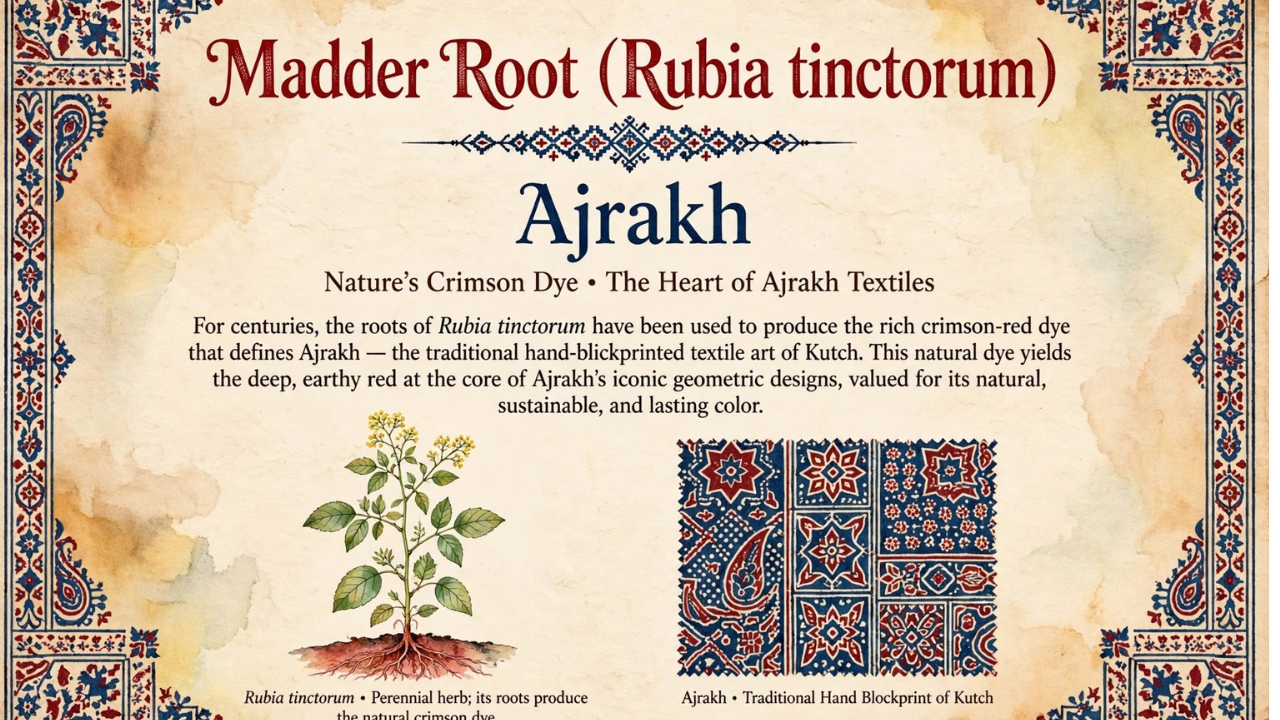
One plant associated with natural red dyeing is Rubbia tinctorum, commonly known as common madder. Its roots contain several color-producing compounds, including alizarin, which contributes to the red shades found in traditional dyeing. Artisans extract these compounds from the roots and use suitable dyeing methods to develop color on fabric.
However, madder does not produce the same red under every condition. Temperature, extraction time, water quality, fabric preparation, and mordants all influence the final result. A small change in the dye bath can affect the shade, making natural dyeing a process of careful observation rather than simple colour mixing.
Understanding madder root, Rubia tinctorum, alizarin, and alum helps us appreciate the science behind natural red dyes. It also explains why experienced artisans pay attention to every stage of textile production.
What Is Madder Root?
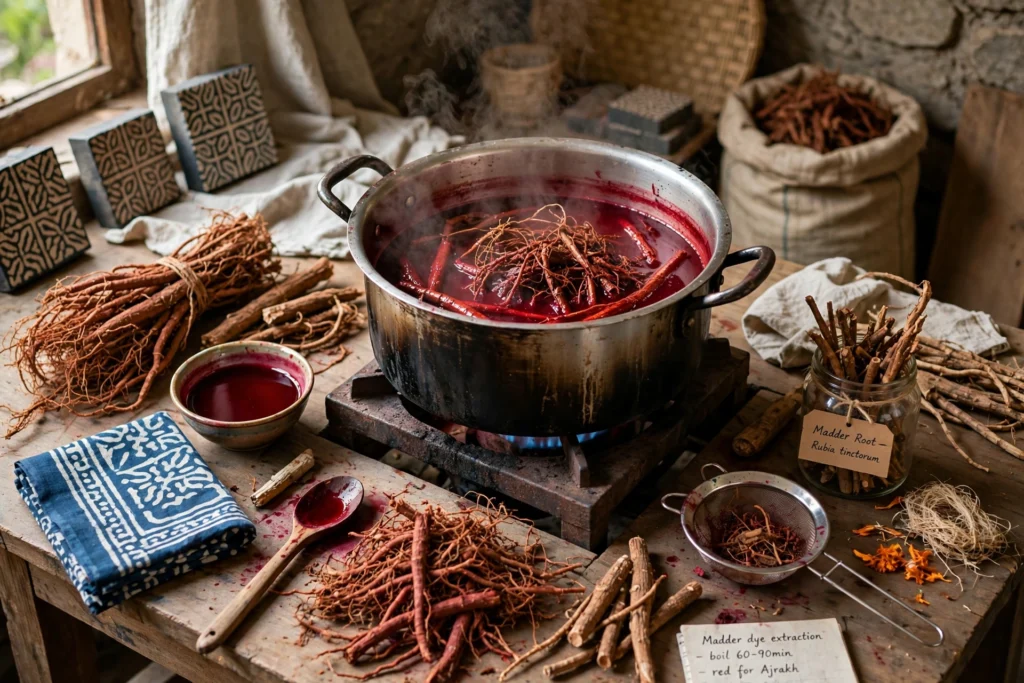
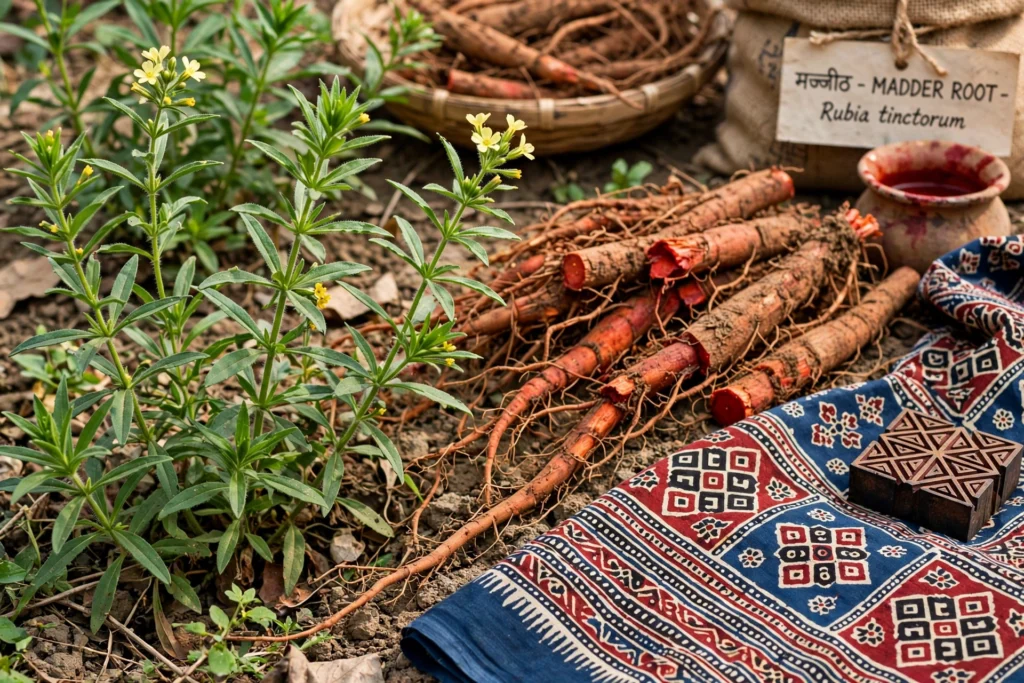
Madder is a plant whose roots have supplied red colorants for textile dyeing for centuries. The species Rubia tinctorum belongs to the Rubiaceae family. Its roots contain naturally occurring compounds that can produce red, orange-red, and reddish-brown shades when artisans process them under suitable conditions.
The roots do not contain only one coloring substance. They contain a mixture of compounds, and the proportions may vary according to the plant species, growing conditions, maturity, harvesting, and storage.
This variation helps explain why two batches of madder may produce different results. One may create a warmer red, while another may give a more muted or brownish tone. The dyeing recipe also affects the outcome, so the root alone does not determine the final colour.
It is important to make one distinction: not every red Ajrakh textile uses madder root. Artisans and textile producers may use other natural dyes or synthetic colorants. The exact method depends on the workshop, region, design, and product. Therefore, we should not assume that every traditional-looking red comes from Rubia tinctorum.
Why Madder Matters in Traditional Textiles
Madder offers artisans a plant-based source of colour and a wide range of possible shades. Its value comes from the way its compounds respond to extraction and dyeing conditions.
Artisans may appreciate madder because:
- It can produce a variety of warm red shades.
- Its colorants interact with suitable mordants.
- It can complement indigo blue and dark printed outlines.
- It connects textile production with botanical knowledge.
- It allows artisans to work with natural variation rather than relying on a single industrial colour formula.
These qualities make madder an interesting subject for anyone studying natural dyes and traditional textile chemistry.
The Chemistry Behind Madder Red
To understand how madder colours fabric, we need to follow the journey from root to dye bath and then to textile fiber.
First, the artisan prepares the root so that its color-producing compounds can enter a liquid. Next, the artisan controls the bath conditions and prepares the fabric. Finally, the dye interacts with the textile, sometimes with the help of a mordant such as alum.
Each stage influences the finished shade.
Alizarin: An Important Red Colorant
Alizarin is one of the best-known compounds associated with Rubia tinctorum. Chemists classify it as an anthraquinone colorant. Its molecular structure contains chemical groups that can interact with certain metal ions.
When suitable conditions allow alizarin to interact with aluminum ions from alum, the resulting complex can influence the colour that appears on the fabric. The interaction depends on the dye bath, mordant, and textile system.
Madder also contains other color-producing compounds, including purpurin and related anthraquinones. These compounds do not necessarily behave in the same way as alizarin. Together, they contribute to the complex shades that madder can produce.
This mixture explains why natural madder dyeing differs from using a single purified colorant. The artisan works with several compounds whose behaviour changes with the processing conditions.
Why the Same Root Can Produce Different Shades
Several variables affect the final colour:
- The species and quality of the root.
- The amount of root used in relation to the water.
- The extraction temperature and duration.
- The acidity or alkalinity of the bath.
- The type and condition of the textile fiber.
- The kind and quantity of mordant.
- The dyeing time, rinsing, and finishing method.
An artisan who understands these variables can make better adjustments when a batch produces an unexpected shade.
Extracting Red: How Artisans Prepare Madder Dye
Extracting red from madder requires more than boiling plant material. The artisan must release useful colorants, manage the bath conditions, and prepare the dye for textile application.
The exact method can vary. The following stages explain the general process rather than prescribing one universal recipe for Ajrakh.
Step 1: Selecting and Preparing the Roots
The artisan begins by selecting suitable madder roots. Clean, properly stored material makes the process easier to manage because dirt and unsuitable plant matter can interfere with preparation.
The artisan may cut, crush, or grind the roots to expose more surface area to the water. This allows the liquid to contact more of the plant material and can improve extraction.
However, very fine particles may complicate filtering. The artisan must choose a preparation method that suits the available equipment and the intended dyeing process.
Step 2: Releasing the Colorants
The artisan places the prepared roots in a suitable liquid and allows the coloring compounds to move into the bath. Water acts as the extraction medium, although the amount of colour released depends on the compounds present and the conditions used.
As extraction continues, the bath develops colour. The artisan can observe its appearance, but the colour of the liquid alone does not reveal the exact concentration or composition of every dye compound.
Time, temperature, and the condition of the roots all influence extraction. A controlled process helps the artisan obtain a useful dye bath without relying on heat alone.
Step 3: Managing the Temperature
Temperature affects how quickly substances move from the plant material into the liquid. In many extraction processes, increased warmth speeds up the movement of compounds and helps release some colorants more efficiently.
However, hotter water does not always produce a better red. Madder contains multiple compounds, and each compound may respond differently to heat and bath chemistry.
If the artisan changes the temperature, the balance of extracted colorants may also change. This can influence whether the finished textile appears more red, orange, or brownish.
The correct temperature therefore depends on the plant material, dyeing method, and intended result. Artisans need to control both temperature and duration instead of assuming that maximum heat will produce maximum quality.
Step 4: Filtering and Preparing the Bath
After extraction, the artisan may strain the liquid to remove root particles. Filtering helps create a more manageable bath and reduces the chance of plant debris remaining on the textile.
The artisan then prepares the dye bath for the next stage according to the chosen recipe. This may involve checking its condition or combining it with other materials used in the process.
Careful preparation at this stage helps the artisan apply the dye more consistently.
Step 5: Preparing the Fabric
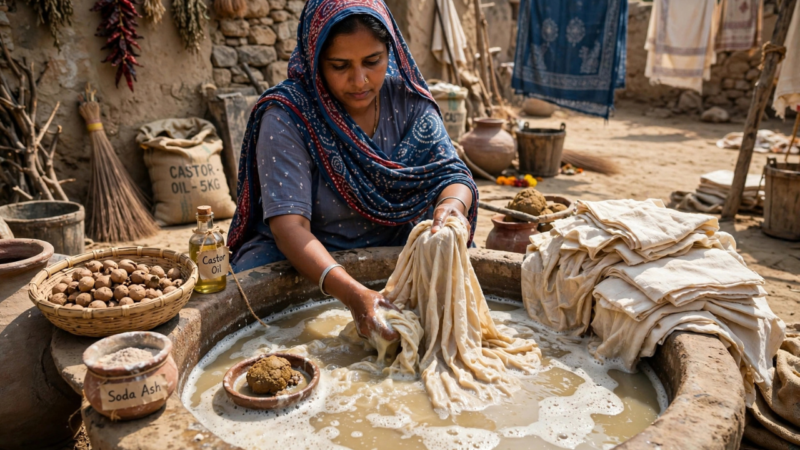
Fabric preparation plays a major role in natural dyeing. Dirt, oils, and manufacturing residues can prevent the dye bath from interacting evenly with the fiber.
The artisan cleans and prepares the textile according to the fiber type and the intended technique. Cotton, silk, and wool behave differently, so a process suitable for one material may not work equally well on another.
In Ajrakh, preparation also needs to suit the printing sequence. The artisan must protect areas that should remain undyed while allowing colour to develop in the intended sections.
How Temperature Changes Madder Red
Temperature is one of the most important factors in madder extraction because it affects the speed of extraction and the balance of color-producing compounds.
Nevertheless, no single temperature guarantees the same shade across all roots, fabrics, and dyeing recipes.
Lower Temperatures: A Slower Process
At lower temperatures, colorants may move into the liquid more slowly. The artisan may need additional time to extract enough colour from the roots.
A slower process can offer greater control in some circumstances, but it may also leave useful colorants in the plant material if the extraction ends too early.
The resulting shade depends on the full recipe, not temperature alone.
Controlled Heat: Balancing Extraction and Shade
Carefully managed warmth can help the artisan extract colorants more efficiently. The artisan must still consider the root’s condition, the duration of heating, and the chemistry of the bath.
A small test batch can reveal whether a particular method produces the intended red. The artisan can then adjust the process before dyeing a larger quantity of cloth.
This approach reduces guesswork and helps the workshop compare results between batches.
Excessive Heat: Why More Is Not Always Better
Prolonged or excessive heating can alter the balance of compounds extracted from madder. Depending on the root and bath conditions, the resulting colour may become duller or shift towards orange or brown.
This effect does not occur identically in every recipe. High temperatures do not always create brown shades, just as lower temperatures do not always produce bright red.
The artisan must consider temperature alongside pH, mordant concentration, and extraction time. A controlled process provides a more reliable way to manage colour than simply heating the bath for longer.
Why Artisans Record Their Results
Artisans can improve consistency by recording a few important details:
- The source and condition of the madder roots.
- The quantity of root and water.
- The extraction temperature and duration.
- The textile fiber and its preparation.
- The mordant used and its concentration.
- The colour after rinsing and drying.
These notes help artisans identify patterns and repeat successful methods. They also make it easier to investigate unexpected colour changes.
Alum: The Mordant Behind Many Natural Red Recipes
Alum is widely used in natural dyeing as a source of aluminum ions. In many dyeing systems, these ions help certain colorants interact with textile fibers and can influence the finished shade.
The term mordant describes a substance used to help a dye attach to a fiber or form a more stable association with it. Alum does not work as a universal fixative for every natural dye, but it can play an important role in suitable madder recipes.
How Alum Interacts With Alizarin
Alizarin contains chemical groups that can coordinate with metal ions under suitable conditions. Aluminum ions may form complexes with alizarin and related compounds in madder.
These complexes can change the colorant’s behaviour and influence the appearance of the dyed textile. The result depends on the dye mixture, bath chemistry, concentration, and fiber.
Artisans must therefore treat alum as part of a larger dyeing system rather than as a substance that automatically produces one particular red.
Why the Amount of Alum Matters
The quantity of mordant can affect the colour outcome. Too little may produce a different result from a carefully balanced recipe, while an unsuitable concentration may change the shade or create unevenness.
The correct amount depends on the textile, dye material, and method. Artisans should follow a tested recipe rather than assume that increasing the mordant will always deepen the colour.
Uniform fabric preparation also matters. If the mordant reaches different areas unevenly, the final shade may vary across the textile.
Does Alum Guarantee Colorfastness?
No. Alum cannot guarantee that a natural red will never fade or bleed.
Colorfastness depends on the colorant, fiber, dyeing method, washing conditions, and exposure to light. A well-prepared textile may retain its colour well, but the result should be assessed through suitable testing rather than appearance alone.
Madder Red Within the Ajrakh Printing Process
Ajrakh printing requires artisans to manage colour placement as carefully as colour development. The craft combines repeated patterns with planned sequences of printing, resist application, dyeing, and washing.
When red forms part of the design, the artisan must ensure that it appears in the intended areas without damaging the surrounding motifs.
The Role of Resist Printing
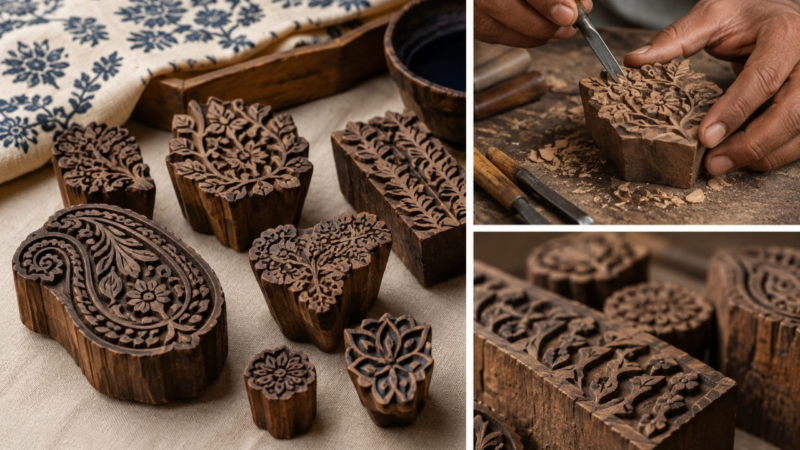
Resist printing uses a material that blocks dye from reaching selected parts of a textile. Artisans apply the resist according to the design and then carry out the appropriate dyeing stages.
The materials and order can vary between Ajrakh traditions and workshops. Some methods use mordant printing, while others rely on different combinations of resist and dyeing techniques.
If madder is included, the artisan must plan how the red will interact with the fabric and the other colours. Poor timing or uneven preparation can affect the clarity of the pattern.
Balancing Red With Indigo and Black
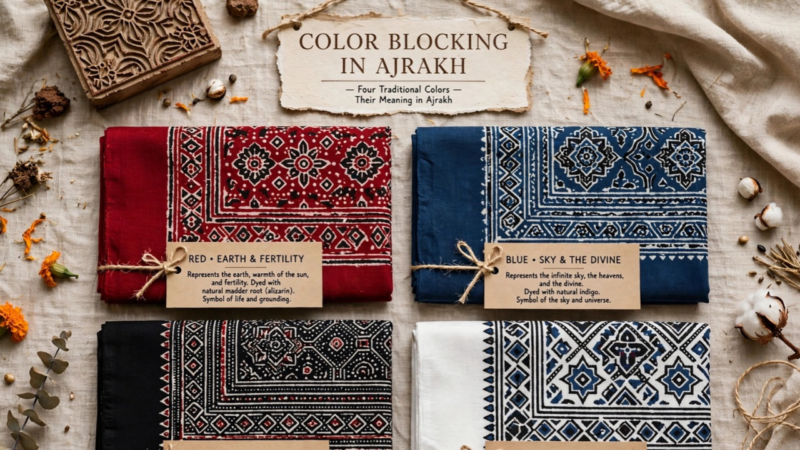
Red, blue, and dark outlines create much of the visual contrast associated with many Ajrakh designs. Red can highlight a floral motif, add warmth to a geometric pattern, or balance a large area of indigo.
The artisan needs to consider the final textile rather than evaluate each colour in isolation. A red that looks attractive in a separate dye bath may behave differently within a multi-stage printing sequence.
This is why the process requires both technical understanding and experience with the complete design.
Why Two Madder-Dyed Fabrics May Look Different
Natural dyes contain complex mixtures, and the raw materials can vary. Even when two artisans follow similar methods, their fabrics may not look exactly alike.
Differences in Plant Material
Roots grown under different conditions may contain different proportions of color-producing compounds. Harvesting, drying, maturity, and storage can also influence their quality.
The artisan may need to adjust the process to achieve a similar result from a new batch.
Differences in Water
Water contains minerals and other substances that can influence dye-bath chemistry. A change in water quality may affect the extraction process or the interaction between colorants and other materials.
This is one reason why a recipe may behave differently in different workshops.
Differences in Mordanting
Mordant concentration and distribution influence the way the dye interacts with the textile. Uneven preparation may create patches or variations in colour.
The artisan must manage this stage carefully to achieve the intended appearance.
Differences in Fabric and Finishing
Different fibers absorb and retain colour in different ways. Even two cotton fabrics may respond differently if their construction or presentment varies.
Washing and drying also influence the final appearance. The wet textile may look different from the fabric after it dries, and washing may remove loosely held colorants.
For this reason, artisans should assess the finished fabric rather than judge the process solely by the colour of the bath.
How to Identify a Madder-Dyed Ajrakh Textile
A red colour alone cannot prove that an artisan used madder root. Buyers should look for clear information about the textile’s materials and production process.
If a seller claims that a product uses Rubia tinctorum, ask which dye source the artisan used and whether the textile contains only natural dyes or a combination of natural and synthetic colorants.
Useful questions include:
- Which plant produced the red shade?
- Did the artisan use Rubia tinctorum or another madder species?
- Did the dyeing method include alum as a mordant?
- Which parts of the textile were hand-block printed?
- What care instructions does the maker recommend?
- Has the textile undergone washing or colorfastness testing?
A responsible seller should explain the process accurately without making unsupported claims. This helps buyers understand what they are purchasing and supports informed decisions about traditional textiles.
Caring for Natural Red Textiles
The right care method depends on the textile’s fiber, dye, and finishing process. Always follow the maker’s instructions when they are available.
A few practical precautions can help protect the fabric:
- Wash the textile using the gentle method recommended by the maker.
- Avoid harsh bleaching agents unless the care instructions specifically allow them.
- Limit prolonged exposure to intense sunlight.
- Store the fabric in a clean, dry place.
- Test an unfamiliar cleaning method on an inconspicuous area when appropriate.
These measures can reduce unnecessary wear, but they cannot prevent every form of fading. Repeated washing, friction, sunlight, and unsuitable detergents may still affect the colour over time.
The Knowledge That Turns Roots Into Red
Madder dyeing brings together botanical materials, chemistry, textile preparation, and skilled observation. The roots supply color-producing compounds, including alizarin. Temperature influences extraction, while alum can help certain colorants interact with textile fibers under suitable conditions.
No single factor determines the final shade. The artisan must manage the relationship between the plant material, water, heat, mordant, fiber, and printing sequence.
In Ajrakh, that knowledge becomes especially important because the red must work within a carefully planned design. It must complement the indigo, support the pattern, and develop in the intended areas of the fabric.
The science explains why the process works, but the artisan’s experience helps turn that science into a finished textile. By observing the materials and adjusting the method carefully, artisans transform madder roots into shades that contribute to the enduring character of traditional textile printing.
Madder red is therefore more than a colour. It reflects the connection between plant chemistry and human craftsmanship, showing how knowledge of natural materials can shape the patterns and colours of a textile tradition.