

Introduction: The Living Science Behind Blue
A deep indigo blue can make a piece of Ajrakh textile feel timeless. Its rich colour, geometric patterns and carefully arranged motifs reflect generations of textile knowledge. Yet the beauty of traditional Ajrakh printing involves much more than skilled hands and wooden blocks. Behind the familiar blue lies a fascinating chemical process that connects plants, microorganisms, water, air and the artisan’s experience.
Natural indigo fermentation in Ajrakh demonstrates how traditional textile makers transform a plant-derived colorant into a form that can enter textile fibers. Artisans must understand how to prepare and maintain an indigo vat, recognize changes in its condition and control the fabric’s exposure to air. They use observation and practical knowledge to guide a process that can respond differently to temperature, water quality, ingredients and working conditions.
Unlike many ready-to-use synthetic dyes, natural indigo does not dissolve readily in water. Artisans must first change its chemical state before it can colour cotton or other suitable fibers effectively. After the fabric leaves the vat, oxygen in the air helps transform the dye into its familiar blue form.
This transformation connects traditional craft with chemistry. It also explains why an indigo vat needs regular attention rather than a single preparation followed by repeated, careless use.
In this article, we explore the science behind natural indigo, the role of Indigofera tinctoria, the meaning of reduction and oxidation, and the practical knowledge that helps artisans maintain a working vat for Ajrakh textiles.
1. Natural Indigo and Its Botanical Origins
Natural indigo begins with plants that produce compounds used to create blue dye. One important species is Indigofera tinctoria, a member of the legume family. Traditional dyeing communities have used indigo-producing plants for centuries, although the particular species and preparation methods vary across regions.
The plant does not simply contain ready-made blue dye that artisans can squeeze directly into water. Instead, it contains precursors that undergo chemical changes during processing.
How does the plant produce indigo colour?
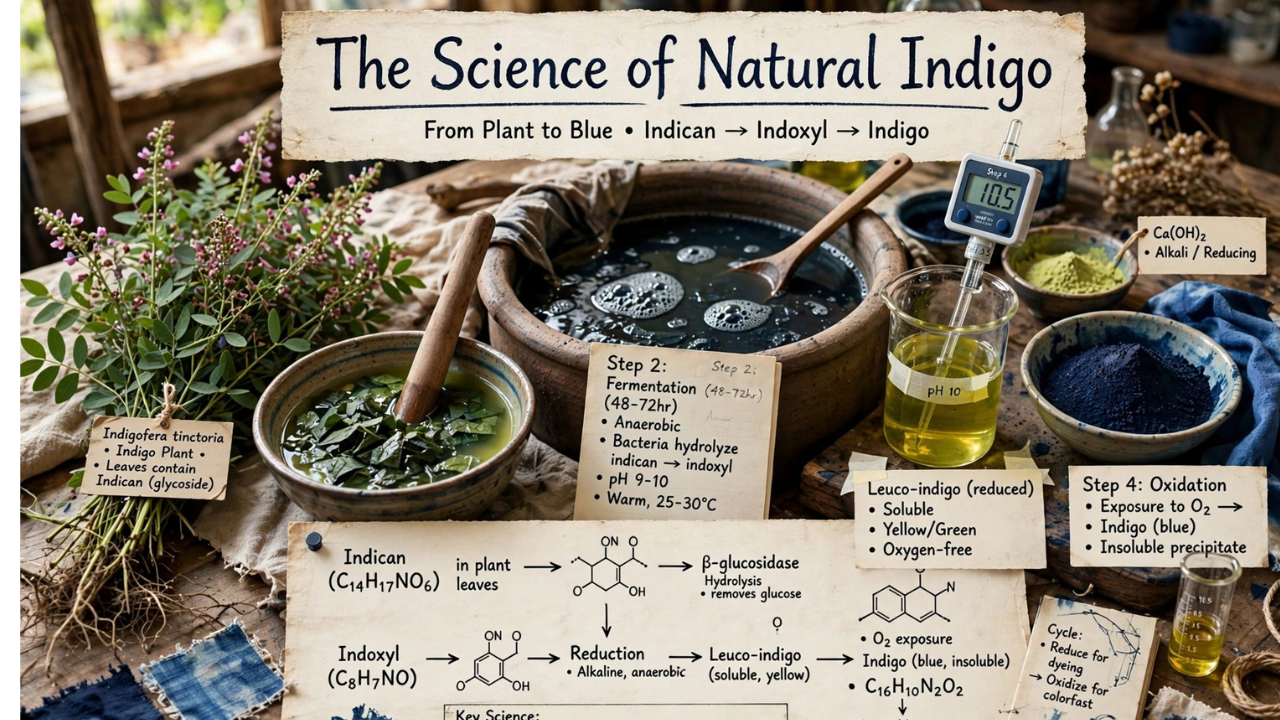
The leaves contain compounds, including Indianan, that can contribute to indigo formation. During suitable processing, enzymes and other conditions help convert these precursors into intermediate compounds. Further reactions produce indoxyl, which can react with oxygen and form indigo tin, the principal blue coloring compound associated with indigo.
Artisans traditionally extract the dye through methods that may involve soaking and fermenting plant material, followed by aeration and further processing. They then collect and prepare the resulting pigment for use.
This process requires several stages because the original plant material and the final blue pigment have different chemical properties.
Why do artisans value natural indigo?
Natural indigo offers several qualities that appeal to traditional textile makers:
- Plant-based origins: Producers can obtain the dye from indigo-producing plants rather than relying entirely on synthetic chemical manufacture.
- Distinctive blue shades: Artisans can create variations in depth and appearance by adjusting dye preparation, vat conditions and the number of dips.
- Compatibility with traditional craft: Indigo works alongside the resist-printing and repeated dyeing techniques used in many Ajrakh traditions.
- Cultural significance: Indigo connects textile production with agricultural knowledge, regional trade and generations of dyeing practice.
However, natural origins do not automatically make every dyeing process environmentally harmless. Water consumption, wastewater treatment, cultivation practices and the management of vat ingredients also affect the overall environmental impact.
Understanding the plant is the first step. The next challenge involves making its blue coloring compound available to the textile.
2. Why Indigo Needs a Special Dyeing Process
Most people associate blue dye with a liquid that already looks blue. Indigo behaves differently.
The principal blue compound, indigo tin, has very low solubility in water. If an artisan simply mixes indigo pigment with water, the pigment does not dissolve into a uniform dye solution in the way that many water-soluble dyes do.
The artisan therefore needs to create a suitable chemical environment that converts the blue pigment into a soluble or more readily dispersal reduced form. This form can enter the textile during immersion. When the artisan removes the fabric and exposes it to oxygen, the dye returns to its blue oxidized form.
This sequence explains the central principle of indigo dyeing:
Reduction makes indigo available for dyeing, while oxidation develops its familiar blue colour.
The artisan must balance both stages. A vat that does not reduce the indigo adequately may produce weak or uneven dyeing. A fabric that receives insufficient exposure to air may not develop its full blue appearance immediately.
What happens inside the vat?
A traditional indigo vat contains more than blue pigment and water. Depending on the method, it may include ingredients that create reducing conditions, adjust alkalinity or support biological activity.
Different dyeing traditions use different vat systems. Some rely on microbial fermentation, while others use non-fermentation chemical reducing systems. Some traditional natural-indigo methods combine biological activity with carefully selected materials.
Therefore, artisans should not treat every natural indigo vat as if it follows one universal recipe.
In Ajrakh production, the exact method can depend on the artisan, workshop, region and materials available. The underlying chemistry remains useful for understanding why the dye behaves as it does.
3. The Living Vat
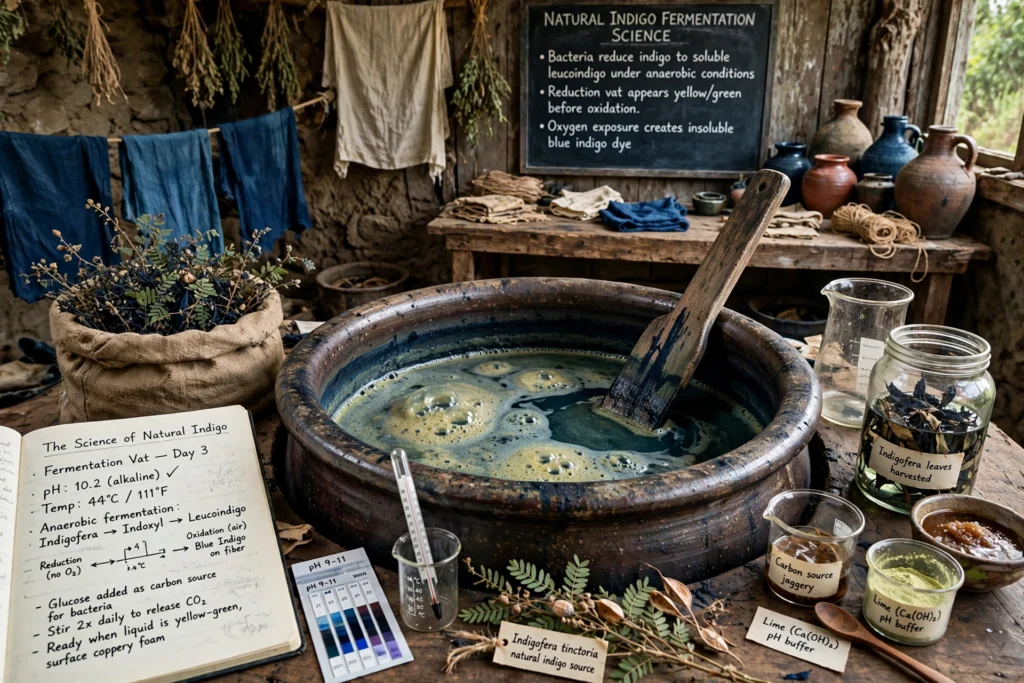
An indigo vat can behave like a living working system because its condition changes with time, temperature, oxygen exposure, pH and the ingredients used to maintain it. In a fermentation-based vat, microorganisms may play an important role in creating the reducing environment that makes indigo suitable for dyeing.
Artisans do not simply prepare the vat and leave it alone. They observe its behaviour and adjust their work according to the conditions they encounter.
How does fermentation support indigo dyeing?
Fermentation involves microorganisms transforming available substances through their metabolic activity. In suitable indigo-vat systems, microbial activity can help consume oxygen and generate reducing conditions. Certain fermentation processes can also produce compounds that influence the vat’s chemistry.
These conditions help convert insoluble blue indigo into its reduced form, commonly called leucotomy-indigo. In an alkaline vat, the reduced dye can become sufficiently soluble for practical dyeing.
The precise microorganisms and chemical reactions depend on the vat recipe. Not every fermentation vat contains the same microbial community, and not every natural indigo vat depends on fermentation.
How do artisans recognize a healthy vat?
Experienced dyers develop a practical understanding of their vat through repeated observation. They may examine several characteristics:
- Colour and appearance: The liquid, suspended pigment and surface can provide clues about the vat’s condition, although appearance alone cannot confirm successful reduction.
- Smell: A fermentation vat may develop a characteristic odor. A change in smell can indicate changing conditions, but no single smell proves that the vat is ready.
- Temperature: Temperature influences microbial activity and chemical reaction rates. Conditions that work well in one season may require adjustments in another.
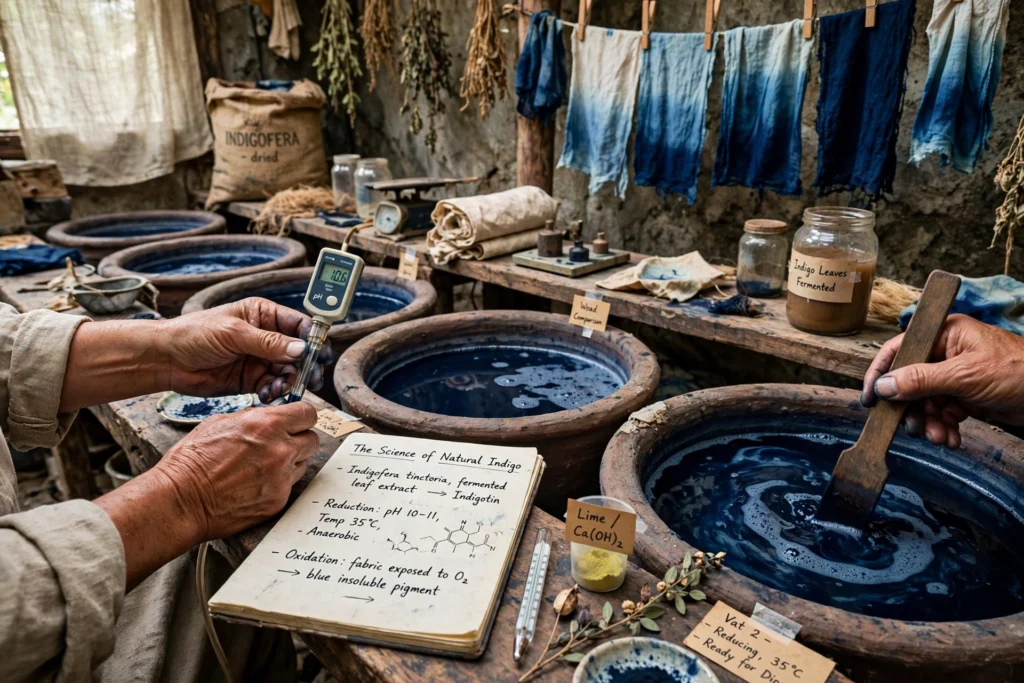
- pH and alkalinity: Many indigo vat systems require alkaline conditions. Artisans may monitor pH when suitable testing equipment is available.
- Dyeing performance: A small test dip can reveal whether the fabric develops an appropriate colour after exposure to air.
These observations help artisans make informed decisions. They should interpret them together rather than rely on one visual sign.
Why does the vat need regular attention?
Microorganisms respond to their environment. A sudden temperature change, excessive oxygen exposure, unsuitable pH or an imbalance in the ingredients may affect a fermentation-based vat.
The artisan must therefore maintain conditions appropriate to the chosen method. Some vats need additional ingredients or careful replenishment as production continues. Others require different maintenance routines.
The goal is not to force every vat into an identical condition. It is to maintain the chemical environment that supports consistent dyeing.
This ongoing care explains why natural indigo dyeing relies on both scientific principles and practical experience. The artisan works with a changing system, not a completely predictable liquid.
4. Reduction: Making Indigo Ready for the Fabric
Reduction is one of the most important chemical processes in indigo dyeing. It changes the chemical state of the indigo molecule and allows the dye to become more accessible to the textile.
In its oxidized form, indigo tin appears blue and remains poorly soluble in water. Under suitable reducing conditions, it converts into leucotomy-indigo, a reduced form that can dissolve more readily in an appropriately alkaline vat.
This change does not destroy the dye’s coloring potential. Instead, it prepares the dye for the next stage.
What causes reduction?
A reducing agent donates electrons, directly or indirectly, during a chemical reaction. In an indigo vat, suitable reducing conditions convert indigo tin into its reduced form.
Traditional vat systems achieve these conditions in different ways. In fermentation-based vats, microorganisms and the substances they produce may support reduction. Other systems use selected chemical reducing agents.
Artisans must choose a method that suits their materials and production process. They also need to maintain the required alkalinity because the reduced form of indigo behaves differently depending on the chemical environment.
Why does reduction matter for Ajrakh printing?
Ajrakh often combines multiple stages of printing, resist application, dyeing, washing and further processing. Indigo can contribute deep blue areas to these carefully developed patterns.
The artisan needs the dye to reach the intended parts of the textile without compromising the resist or surrounding design. A properly maintained vat supports predictable dye uptake, although the final result also depends on fabric preparation, resist quality, immersion time and repeated dyeing.
When reduction works poorly, the fabric may develop a weaker shade than expected. The artisan may then need to investigate the vat rather than simply leave the cloth immersed for longer.
Reduction prepares the dye; it does not guarantee the final colour by itself. The artisan must also manage the textile and the subsequent oxidation stage.
5. Oxidation: How Indigo Develops Its Blue Colour
Once an artisan removes the fabric from the vat, the cloth encounters oxygen in the air. This exposure allows the reduced dye to oxidase and return to its familiar blue form.
Oxidation involves the loss of electrons during a chemical reaction. In indigo dyeing, it converts reduced leucotomy-indigo into the less soluble blue indigo compound.
This stage creates the visible change that makes indigo dyeing so distinctive.
Why does the fabric change colour outside the vat?
The reduced dye that enters the fabric does not initially show the same appearance as fully oxidized indigo. As the artisan exposes the cloth to air, oxygen reacts with the reduced dye and helps regenerate blue indigo tin.
The colour may deepen or become more apparent during this process. Artisans can use repeated cycles of immersion and oxidation to build the desired shade.
The time required for oxidation varies with working conditions, the amount of dye deposited and the particular vat system. Dyers should allow adequate exposure instead of assuming that every fabric needs precisely the same interval.
How do repeated dips create deeper blue?
A single immersion may produce a relatively light shade. When the artisan repeats the immersion and oxidation cycle, the textile can accumulate more indigo.
The process generally follows this sequence:
- The artisan prepares the fabric for dyeing.
- The artisan immerses the cloth in a suitable reduced-indigo vat.
- The reduced dye enters and adheres to the textile.
- The artisan removes the cloth and exposes it to oxygen.
- The dye oxidizes and develops its blue colour.
- The artisan repeats the process if the design requires a deeper shade.
The result depends on more than the number of dips. Vat strength, fabric condition, immersion time and oxidation all influence the final appearance.
Repeated dipping also requires care. An artisan must ensure that the textile receives appropriate treatment throughout the process rather than assuming that additional immersions will always improve the result.
6. The Relationship Between Indigo Chemistry and Ajrakh Patterns
Ajrakh is not simply a method of coloring cloth blue. Artisans use repeated block impressions, carefully prepared resists and multiple dyeing stages to develop intricate geometric and floral compositions.
Indigo chemistry becomes especially important when the artisan must preserve the distinction between blue areas and sections intended to retain other colours or the original fabric shade.
How does resist printing protect the design?
A resist acts as a barrier that prevents dye from reaching selected areas of the textile. Depending on the design and process, artisans may use specially prepared pastes and apply them with carved wooden blocks.
The resist must remain sufficiently effective during the relevant dyeing and washing stages. If it fails, dye may enter areas that should remain protected.
The success of the final pattern therefore depends on the relationship between block placement, fabric preparation, resist consistency and dye-bath conditions.
Why does fabric preparation matter?
Cotton and other natural fibers often require preparation before artisans begin printing and dyeing. Washing and other preparatory treatments can remove substances that interfere with wetting, printing or dye uptake.
Poor preparation may cause uneven absorption, which can make it harder to achieve consistent colour.
The artisan must also consider the compatibility of the textile, resist and dyeing sequence. Indigo may be chemically suitable for the intended shade, but the process can still fail if the fabric or resist does not respond properly.
Can indigo create different shades within one design?
Yes. Artisans can influence the depth of blue through the number of dyeing cycles and the conditions of each immersion. The visual effect also depends on the textile, the areas exposed to the dye and the overall sequence of treatments.
However, not every difference in colour indicates a deliberate design choice. Uneven preparation, inconsistent vat conditions or insufficient oxidation can also produce unwanted variation.
Understanding these possibilities helps artisans distinguish planned variation from a process problem.
7. Maintaining the Indigo Vat for Consistent Results
Maintaining an indigo vat requires attention throughout production. Artisans need to understand the requirements of their chosen vat system and respond to changes before those changes affect a large batch of fabric.
A practical maintenance routine may include the following steps.
Step 1: Check the vat before production
The artisan examines the vat and confirms that its condition suits the intended dyeing work. When possible, the artisan checks relevant measurements, such as pH, rather than relying entirely on appearance.
Step 2: Assess the reducing conditions
The artisan uses appropriate indicators and a small test dip to evaluate whether the vat can provide the desired colour. A test helps reveal problems before the workshop commits valuable fabric to a full production run.
Step 3: Control exposure to air
Oxygen is necessary for the final colour development, but excessive oxygen entering a working vat can interfere with maintaining reducing conditions. Artisans therefore manage stirring, handling and other activities according to their particular vat method.
Step 4: Monitor temperature and working conditions
Temperature changes can affect both microbial activity and chemical reactions. The artisan observes how the vat responds to seasonal conditions and adjusts the process when necessary.
Step 5: Test the fabric after immersion
A small sample allows the artisan to evaluate the colour after oxidation. The artisan can then decide whether to continue with another dip or investigate a problem.
Step 6: Record important changes
Keeping notes about ingredients, temperature, pH, dyeing cycles and results can help the workshop identify patterns. These records support consistency and make it easier to repeat successful batches.
Artisans should follow suitable safety procedures when handling alkaline materials, reducing agents or fermentation ingredients. They should also manage wastewater responsibly and avoid discharging untreated dyeing waste into natural water sources.
8. Common Problems in Natural Indigo Fermentation
Even experienced artisans may encounter difficulties when maintaining a natural indigo vat. Understanding the possible causes helps them diagnose the problem rather than change several variables without a clear reason.
Weak or pale blue shades
A weak shade may indicate inadequate reduction, low available dye, insufficient immersion or poor fabric preparation. The artisan should examine the vat and test the process before automatically adding more indigo.
Uneven colour
Uneven results can arise from inconsistent fabric preparation, poor circulation of the dye bath, variable immersion or differences in the fabric itself. The artisan should also check whether the cloth receives enough time to oxidase.
Unexpected changes in vat behaviour
A sudden change may relate to temperature, pH, oxygen exposure or the ingredients used in the system. In a fermentation-based vat, changes in microbial activity may also affect performance.
The artisan should evaluate the relevant conditions systematically.
Why should artisans avoid relying on colour alone?
The appearance of a vat can offer useful information, but colour does not reveal every chemical condition. A blue surface, for example, cannot by itself confirm that the liquid beneath it has the right reducing capacity.
When available, appropriate testing and controlled sample dips provide more reliable information. Practical experience remains valuable, but combining observation with measurement can improve consistency.
9. Natural Indigo and the Future of Traditional Textile Knowledge
Natural indigo brings together botanical knowledge, chemistry and textile craftsmanship. Its use in Ajrakh demonstrates how artisans can apply scientific principles through methods developed over generations.
Today, workshops can strengthen this knowledge by documenting successful procedures, monitoring important conditions and teaching younger artisans how to interpret the behaviour of their vats.
This approach does not require traditional craft to abandon its identity. Instead, it helps artisans understand why established techniques work and how to adapt them when conditions change.
How can scientific knowledge support craft preservation?
- Better consistency: Understanding reduction and oxidation helps artisans identify the reasons behind differences in colour.
- Improved training: Clear explanations allow apprentices to connect practical actions with the chemistry behind them.
- Responsible production: Knowledge of ingredients and wastewater helps workshops make more informed environmental decisions.
- Stronger documentation: Recording processes preserves workshop knowledge and helps future artisans learn from earlier results.
- More informed buyers: Explaining the dyeing process helps customers appreciate the work involved in creating a traditionally dyed textile.
Scientific understanding should support, not replace, the artisan’s judgment. A vat may respond differently as ingredients, weather and working conditions change. Experienced artisans interpret these changes through practice, while scientific knowledge helps explain the underlying mechanisms.
Conclusion: Blue Created Through Knowledge and Patience
Natural indigo dyeing reveals the remarkable connection between plant chemistry and traditional textile craftsmanship. From Indigofera tinctoria to the finished Ajrakh textile, the process depends on a series of transformations that require attention and skill.
The artisan must understand why indigo does not readily dissolve in water, how reduction creates a dye able form, and how oxidation develops the familiar blue colour. In fermentation-based systems, maintaining the right conditions also requires careful observation of the vat and its changing environment.
These principles explain why indigo dyeing involves more than dipping fabric into a blue liquid. Each stage contributes to the result, and each decision can influence the textile’s colour and appearance.
Natural indigo fermentation in Ajrakh is both a chemical process and a form of inherited practical knowledge. By understanding the living vat, reduction, oxidation and the role of the artisan, we gain a deeper appreciation of the science that supports this enduring textile tradition.
The blue of Ajrakh carries more than colour. It reflects a relationship between nature, chemistry, patience and human skill—one that continues to give traditional textiles their distinctive character.