
Introduction: When Every Impression Has a Story
A piece of fabric does not need perfectly identical patterns to demonstrate exceptional craftsmanship. Sometimes, its most interesting details appear in the tiny differences between repeated motifs, the gentle variation along a printed line, or the way colours interact with the texture of the cloth. In traditional Ajrakh printing, these details encourage us to look beyond appearance and understand the hands, materials, and decisions behind the finished textile.
Ajrakh represents a distinctive textile-printing tradition associated with Kutch in Gujarat and the wider Sindh region. Artisans create its intricate designs through carefully organized printing, dyeing, resist techniques, and fabric preparation. Every stage contributes to the final appearance, and every stage demands knowledge of how materials behave.
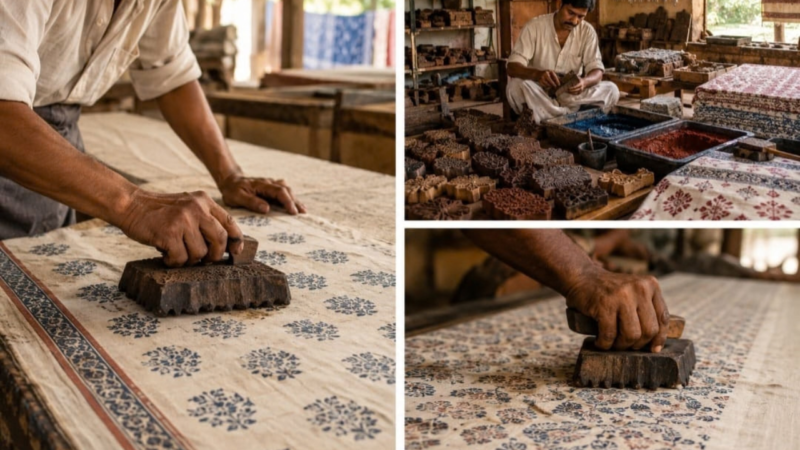
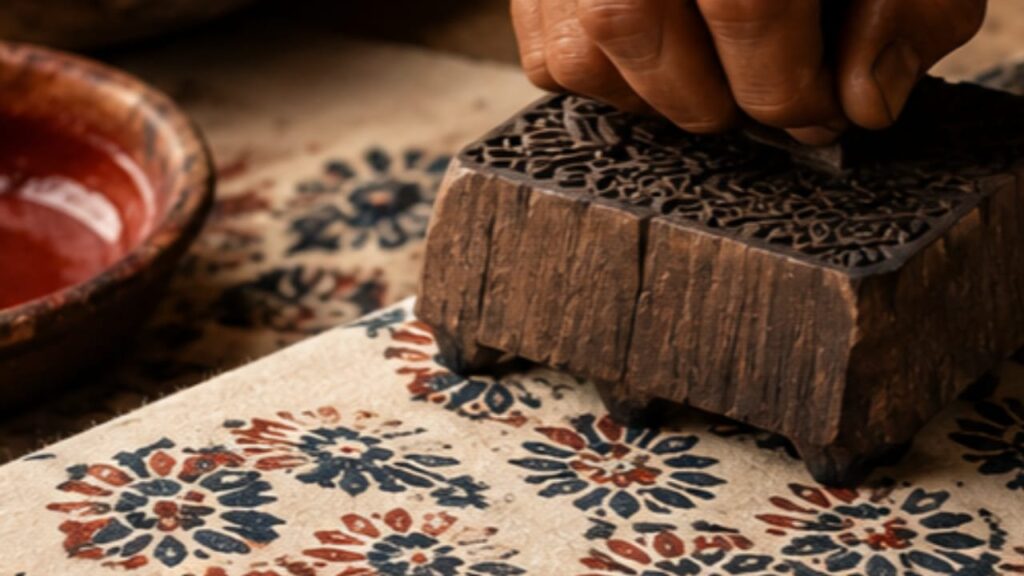
Unlike a machine that repeats a programmed image, a hand-block printer transfers the design through individual impressions. The artisan places a carved wooden block against the fabric, applies pressure, lifts it, and repeats the movement across the surface. The process requires accuracy, patience, and a trained eye.
Small differences can emerge during this work. A motif might shift slightly, a line might appear softer in one section, or the edge of a printed shape might look less uniform than its neighbor. These details sometimes reflect the physical nature of handmade production.
However, an irregular pattern does not automatically prove authenticity. Some variations belong to the printing process, while others result from poor control or unsuitable production conditions.
To appreciate authentic Ajrakh, we must understand the difference between a handmade characteristic and a genuine printing defect. This distinction helps us recognize the artisan’s skill, assess textile quality, and make more informed purchasing decisions.
1. Beyond Uniformity: What Makes Hand-Printed Ajrakh Different?
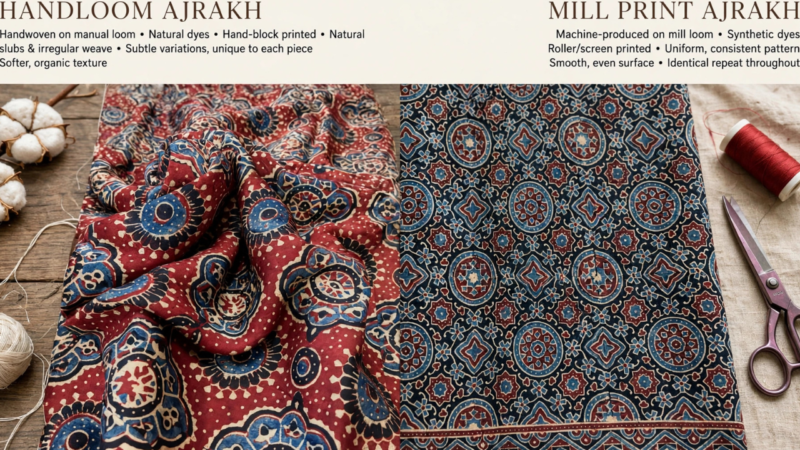
Modern printing technology has changed how manufacturers produce patterned fabrics. Digital and mechanical systems can reproduce a design repeatedly, maintaining a high degree of consistency across large quantities of material.
Hand-block printing follows a different process.
The artisan works directly with the fabric and printing blocks. Each impression requires physical placement, and the printer must maintain the design’s direction, spacing, and relationship with neighboring impressions.
This does not mean that traditional printing lacks precision. Skilled artisans often achieve remarkable consistency through experience and careful technique. The difference lies in how they create that consistency.
A machine follows programmed instructions. A hand-block printer combines a planned design with continuous observation and manual control.
Imagine an Ajrakh fabric covered with small geometric motifs. The pattern depends on repetition, but the artisan must recreate that repetition one impression at a time. Changes in fabric tension, block placement, or printing pressure can influence individual details.
A small variation may therefore occur within an otherwise carefully executed pattern.
Rather than treating every difference as a defect, examine whether the design maintains its visual rhythm. When the motifs remain clear and the overall arrangement looks balanced, minor variations may simply reflect the process.
The goal is not to celebrate carelessness. It is to understand handmade work according to the techniques and materials that shape it.
2. The Beauty of Imperfection
Imperfection becomes meaningful when it reveals the process behind an object.
In Ajrakh printing, a slight difference between two impressions can remind us that the pattern developed through repeated human actions. The artisan did not create the finished design in a single movement. Instead, the printer built it gradually through placement, pressure, observation, and repetition.
Consider a printed border containing rows of diamonds and small decorative lines. One diamond may sit fractionally higher than the next, while the surrounding pattern remains coherent. Such a detail can reveal the physical nature of hand-block printing without changing the overall character of the design.
These differences can also make a textile feel individual. Two pieces produced with the same design may not look absolutely identical, even when both demonstrate skilled workmanship.
Yet we should not confuse individuality with poor quality.
A large gap in a border, a badly distorted motif, or heavy Colours smudging can interrupt the intended design. Such problems deserve attention rather than automatic praise.
The real beauty of imperfection lies in recognizing the human element without lowering our expectations of craftsmanship. A skilled artisan understands the design’s requirements and works to preserve its balance.
That combination of individuality and discipline gives handmade Ajrakh its distinctive appeal.
3. Reading Misalignment: What a Shifted Motif Can Tell Us
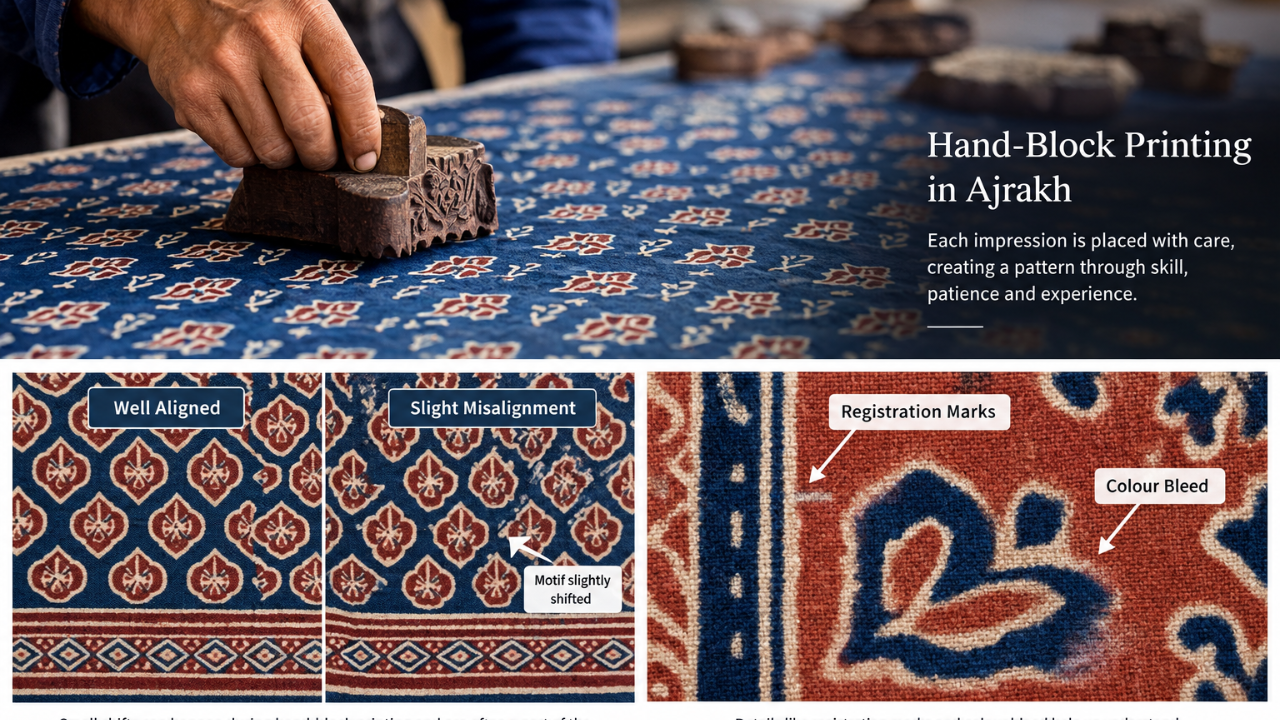
Misalignment occurs when a printed element does not sit exactly where the design intends it to appear. In hand-block printing, the artisan must position each impression in relation to the pattern already printed on the cloth.
This task becomes particularly demanding when the design contains repeated geometric shapes, narrow borders, or multiple colours.
For example, an artisan might print a series of interlocking shapes along the length of a saree. If the block shifts slightly during one impression, the next shape may not connect perfectly with its neighbor.
Several practical factors can influence this result.
- Manual placement: The artisan positions each block individually.
- Fabric movement: The cloth may shift or change tension during printing.
- Pressure variation: Uneven pressure can affect the appearance of the impression.
- Pattern complexity: Detailed designs require close attention to spacing and direction.
- Material behaviour: The fabric and printing medium influence how the impression transfers.
Experienced artisans work to control these factors. They observe the emerging design, maintain alignment, and adjust their technique when necessary.
A tiny deviation can remain visible even after careful work, but repeated misalignment that disrupts the pattern may indicate poor execution.
Buyers should therefore assess the complete textile. Look at the overall arrangement, the continuity of the borders, and the clarity of the motifs rather than using one shifted impression as proof of authenticity.
4. Registration Marks: The Hidden Logic Behind Repeated Designs
Registration marks help printers align different elements of a design. In multicolored printing, the artisan must position each impression so that separate shapes and colours form the intended composition.
Depending on the workshop and design, traditional hand-block printing may rely on visual references, pattern edges, repeated motifs, and the printer’s experience to maintain alignment. Specific techniques vary, so not every Ajrakh textile uses the same registration method.
These alignment references become especially important when the design contains closely spaced lines or decorative shapes that must meet accurately.
Imagine an Ajrakh motif with a dark outline and a contrasting interior. The printer must position the relevant impressions carefully so that the outline frames the intended shape. If a block shifts, the outline may become uneven or the relationship between the elements may change.
Registration methods help reduce such problems.
They also show that traditional textile printing combines artistic understanding with technical planning. The artisan must consider how every impression relates to the previous one and how small changes can influence the final design.
A minor registration difference may occur during manual work, but it does not establish that a textile is authentic. Machine-made products can imitate similar visual effects, while skilled artisans can produce highly aligned patterns.
The most reliable assessment considers the production method, printing quality, fabric, and credible information about the maker.
5. Colours Bleed: When Pigment Crosses Its Intended Boundary
Colours bleed occurs when Colours spreads beyond the area intended by the design. It can soften an outline, cover a neighboring shape, or reduce the contrast between printed elements.
In textile printing, Colours behaviour depends on the printing medium, fabric preparation, moisture, pressure, and the properties of the dye or pigment.
A slightly soft edge may occur in some handcrafted prints. Its significance depends on the technique and the intended appearance of the design.
However, excessive Colours spread can reduce the clarity of an Ajrakh motif.
Suppose a pattern combines dark geometric outlines with lighter interior shapes. If the dark Colours spreads too far, the outlines may lose their definition and the shapes may merge. The textile can then look less precise than the intended design requires.
This is why Colours bleed needs careful interpretation.
A soft edge does not automatically indicate traditional craftsmanship, and a sharp edge does not automatically indicate machine printing. Different processes can produce different edge characteristics.
Buyers should examine whether the colours remain visually distinct and whether the printed motifs retain their intended shapes.
They should also distinguish printing-related spread from Colours transfer during washing. If Colours runs unexpectedly when the textile receives appropriate care, the buyer may need further information about the dyeing process and colorfastness.
A well-crafted textile can display individual character while maintaining suitable technical quality.
6. The Difference Between a Handmade Detail and a Defect
Understanding this distinction helps buyers appreciate Ajrakh without accepting every irregularity as desirable.
A handmade detail may create a small visual difference without affecting the pattern’s overall balance. A defect can interfere with the design, damage the fabric, or reduce the textile’s usefulness.
The context matters.
| Feature | What to examine |
|---|---|
| Motif alignment | Do small shifts preserve the overall pattern, or do they repeatedly disrupt it? |
| Printed edges | Do the shapes remain clear, or does heavy smudging hide their details? |
| Colour coverage | Does the print look balanced, or do large blank patches interrupt the design? |
| Borders | Do the lines remain visually connected, or do major gaps break the pattern? |
| Fabric condition | Does the cloth remain intact, or does it contain tears, holes, or damage? |
These observations do not replace an expert assessment, but they give buyers a practical starting point.
For example, a slight difference between two motifs may have little effect on a sarees appearance. A badly distorted border running across a large section of the same saree may be a more serious concern.
The buyer should consider the product description, price, intended use, and seller’s explanation before making a decision.
Authentic production and high-quality finishing are related, but they are not identical. A traditional textile can contain defects, just as a highly uniform textile can result from skilled handwork.
7. The Artisan’s Eye: Skill Beyond Repetition
Hand-block printing demands more than the ability to press a wooden block against fabric. Artisans must understand how the design behaves across a surface and how different materials respond to the printing process.
They develop this knowledge through practical experience.
An artisan learns to recognize an uneven impression, notice a change in printing paste, and maintain the correct relationship between repeated shapes. The printer also needs to understand when a minor difference remains acceptable and when a problem requires correction.
These decisions influence the finished textile.
Consider a long Ajrakh saree with a repeated border. The artisan must preserve the pattern as printing continues across the fabric. A small change in spacing can affect the next impression, so the printer needs to monitor the emerging design rather than rely on repetition alone.
Experience helps the artisan anticipate these challenges.
This expertise deserves recognition because it combines observation, technique, and judgment. The artisan works towards a clear design while responding to the practical conditions of the material.
The result may show minor variation, but its quality depends on how effectively the printer manages the entire process.
8. Can Imperfections Prove That Ajrakh Is Authentic?
No. Visible imperfections alone cannot establish the authenticity of Ajrakh printing.
A manufacturer can deliberately reproduce uneven-looking patterns through mechanical or digital methods. At the same time, an experienced artisan can create a very consistent print using traditional blocks.
Buyers should investigate the production method rather than relying on appearance alone.
Start by asking the seller whether the textile uses hand-block printing, screen printing, digital printing, or a combination of techniques. Request accurate information about the fabric and printing process.
Where available, examine photographs of the workshop or printing process. Look for credible information about the producer and the craft community involved.
Inspect the finished textile as well. Study its motifs, borders, Colours application, and overall construction. These observations can help assess quality, although no single visual feature guarantees authenticity.
It helps to ask two separate questions:
Was this textile produced using the stated method?
Does the finished textile meet the expected standard of quality?
The first question concerns authenticity. The second concerns workmanship and condition.
An informed buyer considers both rather than assuming that an uneven pattern automatically makes a textile genuine.
9. How to Choose an Ajrakh Saree With Confidence
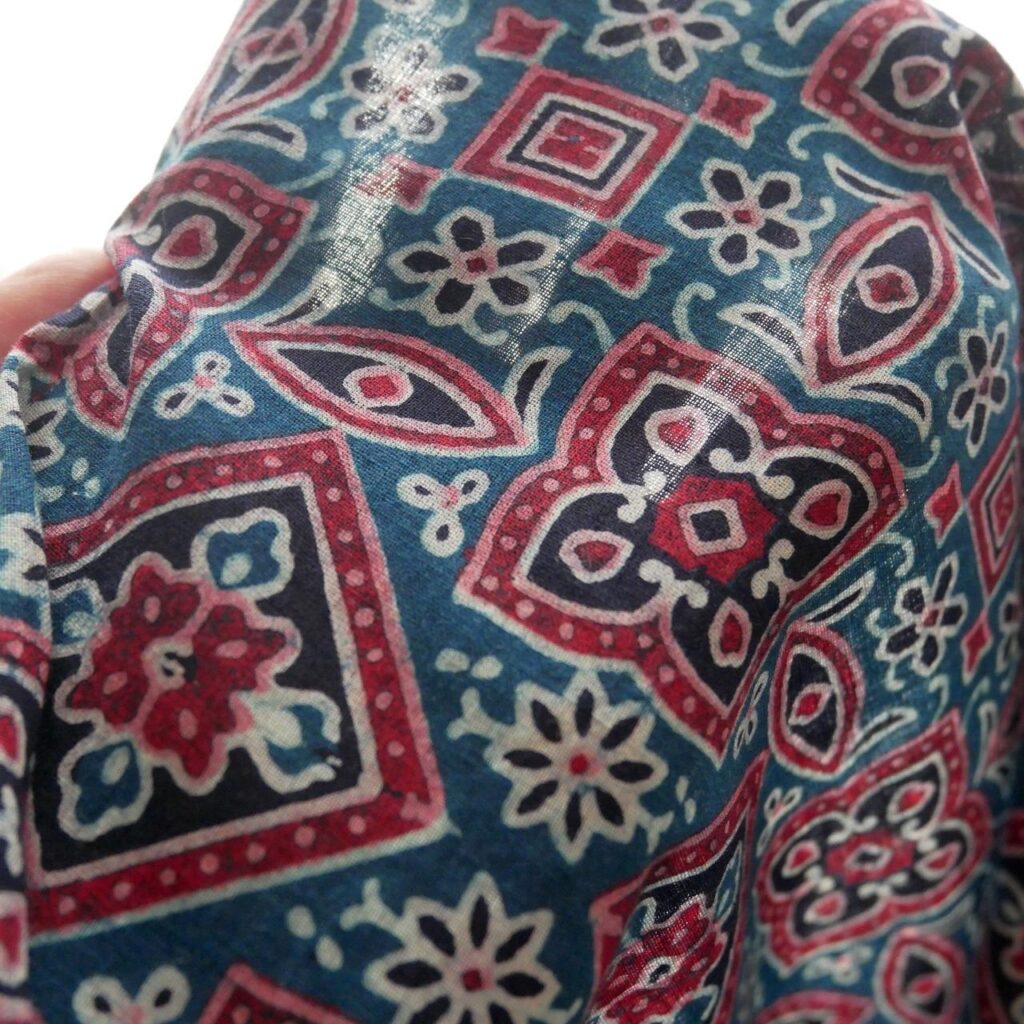
When purchasing an Ajrakh saree, begin with the design as a whole. Look at the arrangement of the motifs, the balance of the borders, and the relationship between the colours.
Then inspect smaller details.
Check whether the printed shapes remain recognizable, whether large gaps interrupt the pattern, and whether the fabric contains visible damage. If you shop online, ask for close-up photographs of the border, central design, and reverse side where possible.
Before placing an order, consider these questions:
- Does the seller clearly state whether the textile uses hand-block printing?
- Does the description identify the fabric accurately?
- Do the photographs show the actual product or only a representative image?
- Are the motifs and borders reasonably consistent with the advertised design?
- Has the seller explained the appropriate care method?
- Can the seller answer questions about colorfastness?
- Does the return policy cover products that differ significantly from their description?
These checks help you make a decision based on evidence rather than assumptions.
You can appreciate the individuality of handmade work while still expecting clear product information and sound construction.
10. Preserving the Character of Your Ajrakh Textile
Once you purchase an Ajrakh saree or dupatta, appropriate care helps preserve its appearance.
Different fabrics and dyeing methods require different washing and storage routines. Follow the instructions provided by the seller or artisan instead of assuming that every Ajrakh textile needs the same treatment.
Handle the fabric carefully and avoid exposing it to conditions that may damage the fibers or alter the colours. Keep it in a clean, dry place and limit prolonged exposure to direct sunlight.
If the textile is new, ask whether you should wash it separately during its first wash. This precaution can help you manage potential Colours transfer while you learn how the fabric responds to cleaning.
If you notice unexpected bleeding or significant Colours changes, contact the seller for guidance.
Proper care cannot correct a printing defect, but it can help maintain the textile’s condition and extend its useful life.
The Beauty of Imperfection: A More Informed Appreciation of Ajrakh
Ajrakh invites us to appreciate the relationship between design and human skill. Each printed motif belongs to a larger composition, and every stage of production contributes to the finished textile.
Small differences in alignment or printed edges can help explain the practical nature of hand-block printing. They remind us that an artisan builds a complex pattern through repeated movements rather than producing the entire image at once.
However, these differences deserve thoughtful interpretation.
A subtle variation may coexist with excellent workmanship, while excessive smudging or badly disrupted motifs can reduce quality. Authenticity depends on the actual production method, not on the presence of visible imperfections.
When buyers understand this distinction, they can appreciate handmade textiles without romanticizing every flaw. They can recognize the artisan’s experience, ask better questions, and choose products that match their expectations.
The value of Ajrakh lies in the knowledge and work behind the fabric. Its patterns express a tradition of design, material understanding, and skilled printing that deserves appreciation on its own terms.
Frequently Asked Questions
Are slight irregularities normal in Ajrakh printing?
Minor differences can occur during manual block printing, but their significance depends on the design and production method. Irregularities alone do not prove authenticity.
What are registration marks in textile printing?
Registration marks and other alignment references help printers position separate design elements correctly, especially when several colours or impressions must form one pattern.
Is Colours bleed a sign of authentic Ajrakh?
No. Colours bleed can occur in different printing processes. Excessive spreading may affect the quality and clarity of a design.
How can I recognize a quality Ajrakh textile?
Examine the overall design, printed details, fabric condition, and finishing. Confirm the production method through reliable seller information rather than judging authenticity by imperfections alone.
Should every handmade Ajrakh saree have uneven patterns?
No. Skilled artisans can produce highly consistent designs. Handmade production does not require visible misalignment or other defects.
Conclusion: Looking at Ajrakh Through the Eyes of Craftsmanship
Authentic Ajrakh deserves appreciation for its intricate designs, thoughtful printing methods, and the skill required to bring repeated motifs together.
Small variations can help us understand the realities of manual printing, but they should never become the only measure of authenticity or value. A thoughtful assessment considers the production process, the artisan’s technique, the textile’s overall quality, and the accuracy of the seller’s claims.
When we understand these details, we can appreciate the human element in Ajrakh without overlooking the importance of good workmanship.
True craftsmanship is not about making every flaw beautiful. It is about understanding the skill, judgment, and care that shape the finished textile.