
Ajrakh printing looks intricate when you see the finished cloth. Geometric borders meet floral forms, small dots sit neatly inside larger motifs, and layers of Colors create a surface that feels almost architectural. Yet the beauty of Ajrakh does not come only from adding Colors. A major part of the craft depends on knowing where Colors must not go.
That is where Khari Chhapai, a traditional resist-printing technique, becomes important.
Khari Chhapai helps the printer protect selected areas of the fabric before applying another Colours. Instead of treating the cloth as an empty surface that needs decoration, the artisan works with both presence and absence. Some areas receive pigment or dye; other areas remain protected so they can retain their earlier Colours or reveal the natural tone of the fabric.
The process requires patience because a small mistake in the resist can change the final design. The artisan must place the resist accurately, control its consistency, print it evenly, and allow it to perform its job before the next stage begins.
At the heart of this method lies a simple but powerful idea: protect the space before you Colours the surface.
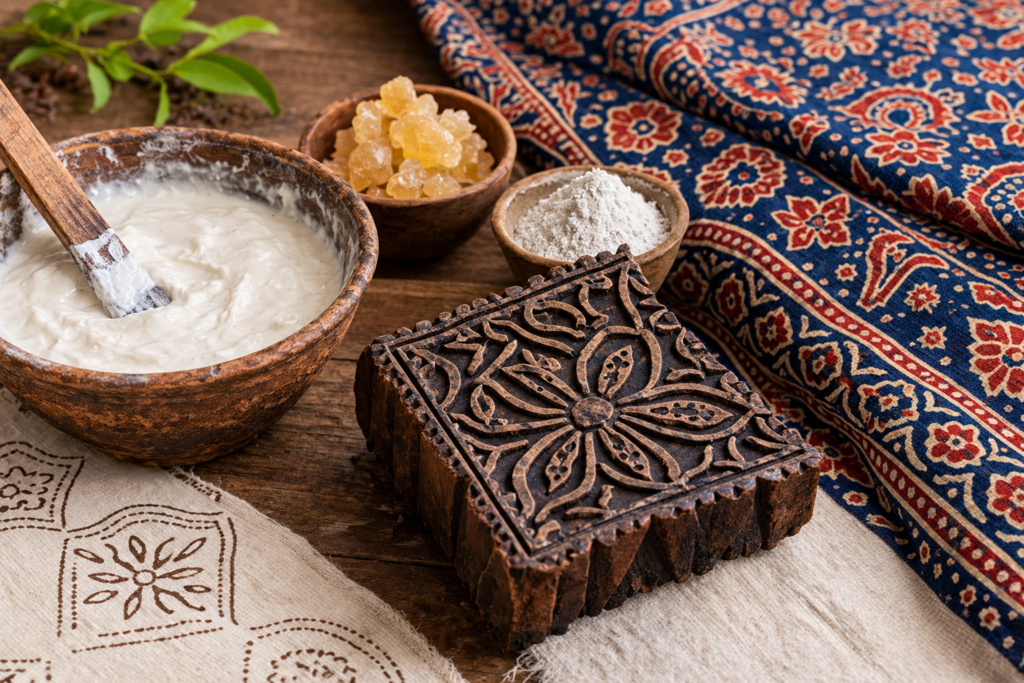
What Is Khari Chhapai?
Khari Chhapai refers to a resist-printing stage used in traditional Ajrakh production. The artisan applies a resist material to selected parts of the fabric. This protective layer prevents subsequent Colours from reaching those areas in the same way it reaches the exposed cloth.
The technique becomes especially important when the design contains light spaces surrounded by darker colours.
Think of the resist as a temporary shield.
The artisan does not permanently paint the white area. Instead, the artisan protects that area while another Colours moves across the fabric. Once the resist has completed its work and the cloth undergoes the required washing or processing, the protected section can reveal the intended lighter area.
This approach allows the printer to build complex designs through controlled stages rather than trying to place every Colours independently.
Khari Chhapai therefore demonstrates one of the most interesting principles of traditional textile printing: sometimes the artisan creates a design by stopping Colours rather than adding it.
The Materials Behind the Resist
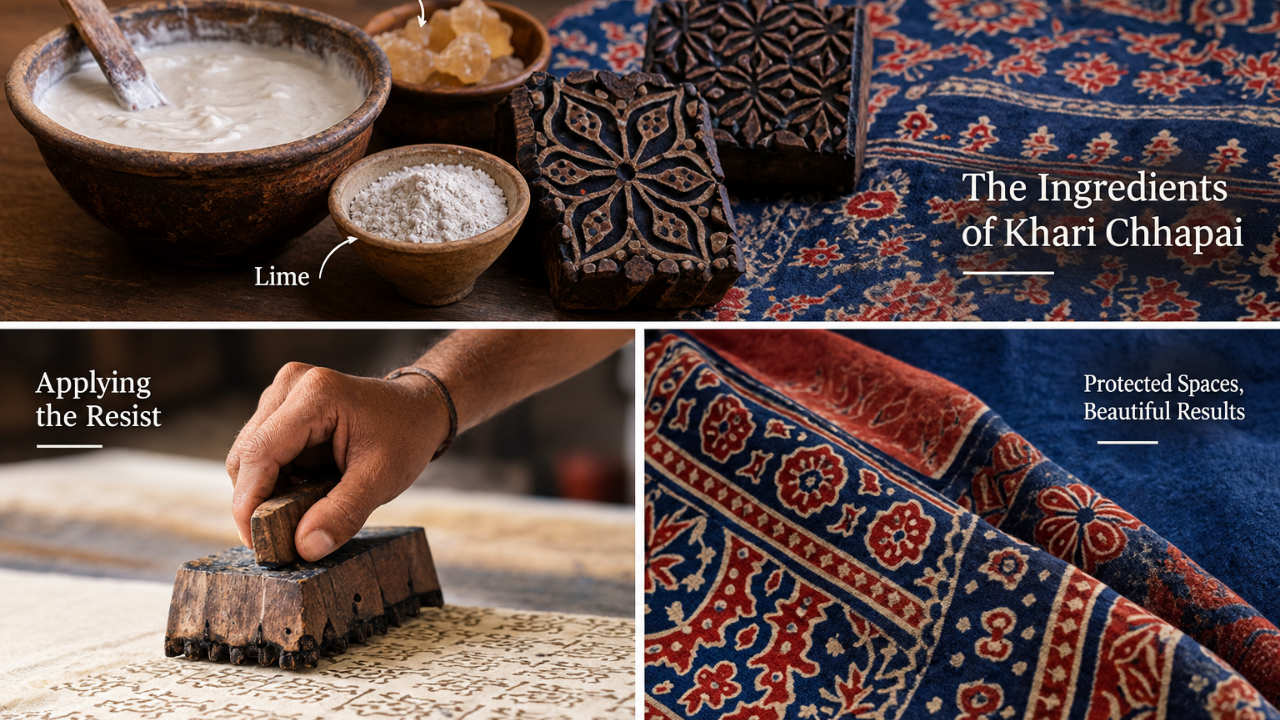
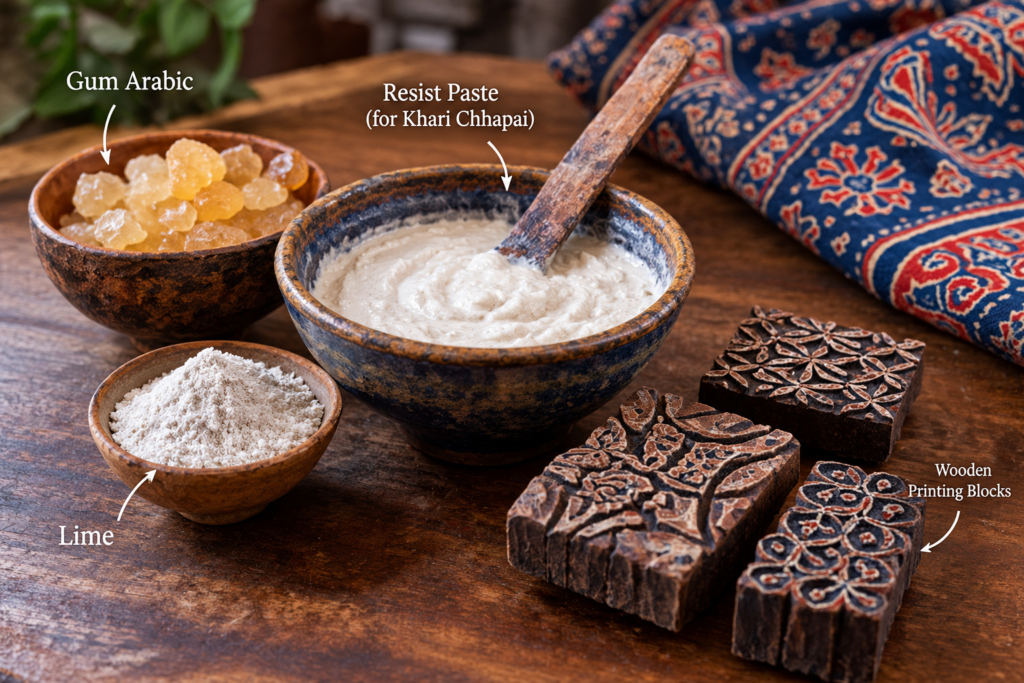
The effectiveness of Khari Chhapai depends heavily on the resist mixture. Traditional practice can use materials such as lime and gum, with the exact preparation and working method varying according to the artisan, workshop, fabric, design, and printing stage.
Two important components deserve attention:
- Lime
- Gum Arabic
Each material contributes a different quality to the resist.
Lime: Creating the Protective Body
Lime gives the resist an important mineral component. In traditional textile practice, artisans use lime in carefully prepared mixtures rather than treating it as an ordinary printing Colours.
The lime helps create the physical character needed for the resist. It contributes to a paste that can sit on the fabric and protect selected areas during the next printing or dyeing stage.
The artisan needs to control the mixture carefully. A resist that becomes too thin may spread beyond the intended design. A mixture that becomes too thick may fail to print cleanly or may not settle properly into the fabric.
This balance matters because Ajrakh designs often contain fine lines, repeated geometry, small dots, borders, and closely spaced motifs.
The resist must therefore behave predictably.
Gum Arabic: Holding the Mixture Together
Gum Arabic works as a natural binding and thickening component. It helps the resist develop the consistency needed for controlled block printing.
For the printer, consistency matters just as much as the ingredients themselves.
When the artisan presses a wooden block onto the fabric, the resist must transfer from the block to the correct areas without creating unwanted spreading. Gum helps the mixture maintain a workable body so the printed mark remains controlled.
The artisan does not simply mix ingredients and begin printing. The working consistency must suit the particular task.
A delicate motif may require a different handling approach from a broad border. The fabric itself also affects how the resist behaves.
This is why traditional printing cannot rely entirely on a fixed industrial formula. The artisan reads the material and adjusts the process through experience.
The Real Purpose: Protecting the White Spaces
The phrase “white space” can sound simple, but in Ajrakh it carries a deeper meaning.
A light or white section can form an essential part of the visual structure. It can separate two colours, sharpen a geometric edge, define a floral form, or create rhythm across a repeating pattern.
If the next Colours reaches that area, the design loses its intended contrast.
Khari Chhapai prevents that from happening.
Protecting the White Spaces
The artisan first identifies the areas that need protection. The resist then covers those sections according to the design.
The following Colours can move over the surrounding fabric, but the protected areas remain shielded.
After the required processing and washing, the temporary resist no longer controls the surface. The protected spaces reveal the contrast that the artisan planned from the beginning.
This method gives the final textile its crisp visual relationships.
The important point is that the artisan does not work randomly.
Every protected space has a purpose.
A narrow line may define a border. A small opening may separate two shapes. A larger protected section may become the background of a motif.
The artisan therefore designs both the printed marks and the spaces between them.
Block Printing Makes Precision Possible
Ajrakh relies heavily on hand-carved wooden blocks. These blocks carry the design and allow the artisan to repeat the same visual language across the cloth.
For Khari Chhapai, block placement becomes particularly important.
The artisan positions the block carefully, applies pressure, and transfers the resist onto the fabric. The printer then repeats the movement across the textile.
A successful repeat requires alignment.
If the block shifts slightly, the pattern can develop a visible break. If the artisan applies uneven pressure, some parts of the resist may print strongly while others may appear weak.
Experienced printers develop a strong sense of rhythm.
They do not need to measure every movement with a ruler. Their hands learn the spacing, pressure, direction, and timing through years of practice.
That hand knowledge becomes part of the technique.
Why the Resist Must Have the Right Consistency
A resist may look like a simple paste, but its behaviour determines the quality of the print.
The artisan needs a mixture that:
- transfers cleanly from the block,
- stays within the intended design,
- adheres properly to the fabric,
- protects the selected area,
- supports the next Colours stage,
- and remains manageable during repeated printing.
If the resist spreads, it can blur the motif.
If it prints too lightly, the next Colours may penetrate the protected area.
If the mixture becomes difficult to handle, the artisan may struggle to maintain consistency across a long length of fabric.
The printer therefore watches the material continuously.
This hands-on judgment separates traditional craft from a simple “print and repeat” process.
Khari Chhapai as a Conversation Between Colours and Space
One of the most beautiful things about resist printing lies in its relationship with negative space.
Modern design often talks about negative space as an intentional visual element. Ajrakh demonstrates this principle through craft.
The artisan does not fill every part of the cloth.
Instead, the artisan creates a conversation between:
Colours and restraint,
pattern and pause,
mark and space.
The protected area gives the surrounding Colours greater definition.
A dark motif looks stronger when a lighter space separates it from another form. A repeated border gains rhythm when small protected details break the visual density.
The artisan therefore uses absence as carefully as presence.
From Resist to Pattern
The resist itself is temporary, but its influence remains visible in the final design.
Once the artisan applies the resist, the fabric becomes ready for the next Colours or treatment. The new Colours interacts with the exposed portions while the protected areas remain guarded.
This creates layers.
Ajrakh often depends on multiple stages of printing, dyeing, washing, drying, and reprinting. Each stage contributes to the final surface.
Khari Chhapai fits into this layered system by controlling what happens at a particular moment.
The artisan does not attempt to create the complete textile in one action.
Instead, the final pattern develops gradually.
One stage prepares the cloth for another.
One Colours changes the visual relationship of another.
One resist protects a space so the next layer can produce the intended contrast.
This cumulative process explains why a finished Ajrakh textile can look much more complex than the individual printing actions that created it.
The Artisan’s Eye Matters as Much as the Materials
It is easy to focus on lime, gum, blocks, dyes, and fabric when discussing resist printing. However, these materials cannot operate independently.
The artisan makes constant decisions.
The printer checks whether the fabric has the right condition for the next stage. The artisan watches how the resist transfers from the block. The printer evaluates alignment and pressure. The artisan knows when the cloth needs to move forward and when it needs more care.
Traditional knowledge often lives in these small decisions.
A written recipe can describe ingredients, but it cannot fully describe the feel of the correct paste under the hand.
It cannot easily explain how much pressure a particular block needs.
It cannot completely capture the visual judgment required to notice a weak impression before the mistake repeats across the cloth.
The crafts person learns these details through practice.
Why Small Errors Matter
Khari Chhapai demands concentration because resist printing can magnify small mistakes.
Imagine a repeating border where one section shifts slightly. The error may not remain isolated. As the artisan continues printing, the misalignment can affect the rhythm of the entire pattern.
A weak resist mark can also allow the following Colours to enter an area that should remain protected.
That can soften an edge or change the balance of a motif.
The artisan therefore works with patience rather than speed.
Traditional hand printing rewards consistency.
The goal does not simply involve finishing the cloth quickly. The artisan must maintain the visual relationship across the entire textile.
Khari Chhapai and the Character of Handmade Cloth
Machine printing can reproduce patterns with remarkable speed and consistency. Hand printing follows a different logic.
A handmade Ajrakh textile carries the physical decisions of the person who produced it.
The pressure of the block, the movement of the hand, the behaviour of the fabric, and the interaction between resist and Colours can create subtle variations.
These variations do not automatically represent flaws.
They can show that the textile passed through human hands.
Khari Chhapai makes this especially interesting because the artisan controls not only what appears on the surface but also what remains protected during each stage.
The final textile therefore records a sequence of decisions.
Why Gum and Lime Matter Beyond Their Names
When people first encounter traditional textile techniques, they may remember the names of materials without understanding their function.
Knowing that Khari Chhapai uses a resist is useful.
Understanding why the resist needs a particular consistency is more important.
Lime contributes to the body and mineral character of the mixture. Gum Arabic helps bind and control the paste. Together, within the traditional working system, they help the artisan create a resist that can perform its protective role.
But the materials only become meaningful when the artisan knows how to use them.
This is why textile knowledge cannot be separated from craftsmanship.
The recipe may begin the process.
Experience controls it.
Reading Khari Chhapai in a Finished Ajrakh Textile
You can often understand the importance of resist printing by looking closely at the finished cloth.
Notice the areas where colours meet.
Look at narrow borders.
Observe the tiny spaces inside motifs.
Study the repeated geometric structures.
Ask yourself how the artisan kept one Colours from overwhelming another.
The answer often lies in controlled stages of printing and resist.
Instead of seeing the finished textile as one flat image, imagine it as a sequence.
First, the artisan prepares the fabric.
Then the printer establishes selected marks.
The artisan protects specific areas.
Another Colours enters the process.
The resist performs its temporary job.
The cloth moves through washing and further treatment.
Additional printing builds the pattern.
Finally, the layers come together.
The finished design hides much of this journey.
That hidden sequence gives Ajrakh its depth.
The Intelligence of Traditional Resist Printing
Khari Chhapai demonstrates a form of practical material intelligence.
The artisan understands that different materials behave differently. The printer knows that the fabric absorbs, holds, and releases Colours in particular ways. The crafts person understands that timing affects the result.
None of these decisions exists separately.
They form one connected system.
The artisan works with the fabric rather than simply forcing a design onto it.
That relationship makes resist printing more than a decorative technique.
It becomes a method of controlling transformation.
The cloth changes step by step, while the artisan guides those changes toward a planned visual result.
A Technique Built Around Restraint
Perhaps the most interesting lesson from Khari Chhapai comes from its emphasis on restraint.
The artisan does not always need to add more Colours to make the design richer.
Sometimes the artisan needs to stop the Colours from entering a particular place.
That protected space can make the surrounding pattern clearer.
It can create contrast.
It can give a motif breathing room.
It can strengthen the geometry.
It can help the viewer understand the structure of the textile.
In that sense, Khari Chhapai turns protection into design.
The resist becomes a temporary tool, but the space it protects becomes part of the permanent visual story.
Keeping the Technique Alive
Traditional techniques survive when people continue to practice them, understand them, and value the knowledge behind them.
Khari Chhapai deserves attention because it represents more than an old printing step.
It shows how Ajrakh artisans combine natural materials, carved blocks, fabric preparation, Colours, timing, pressure, and experience.
The technique also reminds us that handmade textiles contain knowledge that may not appear at first glance.
A finished saree or textile can look effortless.
Behind that appearance, the artisan may have completed numerous careful stages, corrected small variations, and repeated precise movements across a long piece of fabric.
The viewer sees the pattern.
The crafts person knows the process.
The Beauty of What Remains Untouched
Khari Chhapai ultimately teaches us to look differently at textile design.
We often admire a fabric because of its colours, motifs, and decorative details. Resist printing asks us to notice something else: the areas the artisan deliberately protected.
Those spaces create clarity.
They separate colours.
They define forms.
They support repetition.
They give the eye somewhere to rest.
The white or lighter areas do not exist because the artisan forgot to print them. The artisan planned them.
That distinction captures the heart of Khari Chhapai.
The technique does not simply put a pattern onto cloth. It carefully decides where the pattern should stop.
And that is what makes the process so powerful.
Final Perspective
Khari Chhapai shows how much intelligence can exist inside a seemingly simple printing technique.
With a resist based on materials such as lime and gum, the artisan protects selected areas of fabric from the next stage of Colours application. Through carved wooden blocks, careful pressure, repeated alignment, and years of experience, the printer builds a controlled relationship between Colours and space.
The finished Ajrakh may appear as one beautiful composition, but its visual balance comes from many deliberate decisions.
Some areas receive Colours.
Some areas resist it.
Some marks define the pattern.
Some spaces give those marks room to breathe.
That balance makes Khari Chhapai more than a technical process. It represents a way of thinking about craft—one that understands that creating beauty sometimes means knowing exactly where to stop.