

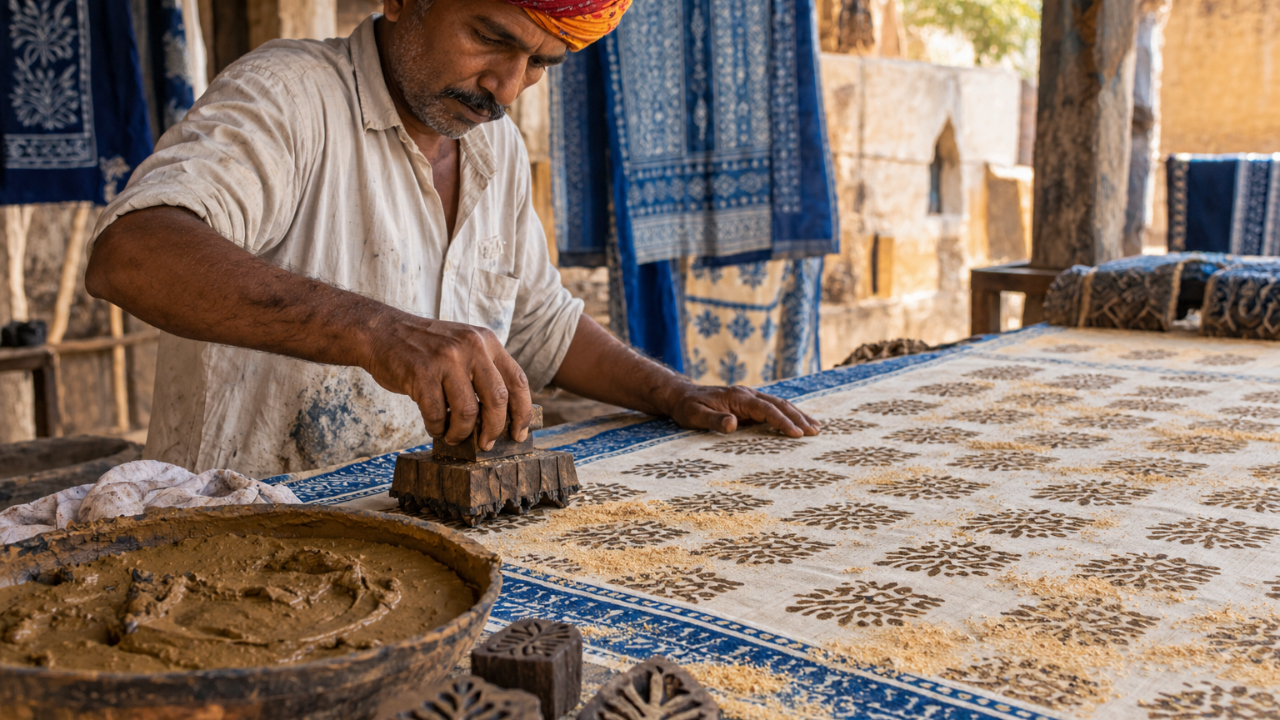
Ajrakh printing does not depend on color alone. Its beauty comes from the way artisans control color, protect certain areas, build layers, and slowly reveal a pattern. Among the most fascinating techniques in this process is Dabu, a traditional mud-resist method that helps artisans create protected spaces on fabric before dyeing.
At first glance, Dabu may look simple. An artisan applies a specially prepared mud mixture to selected areas of the cloth, lets it settle, adds another material to keep the resist in place, and then continues with dyeing or printing. But the technique requires far more than spreading mud across fabric.
This careful control gives Dabu its character.
The technique allows artisans to create light, dark, and contrasting areas within the same textile. It also creates the layered appearance that makes traditional resist-printed fabrics feel so rich and tactile.
For anyone exploring Dabu mud resist Ajrakh, the most important idea to understand is this: the mud does not simply “make” the dark color. It protects selected parts of the fabric so that later dyeing processes can create the intended contrast.
That small distinction explains much of the magic behind the technique.
The Dabu Technique
Dabu works as a resist.
In simple terms, a resist prevents dye from reaching particular parts of the fabric. Instead of coloring the entire surface evenly, the artisan creates controlled areas where the dye cannot penetrate in the same way.
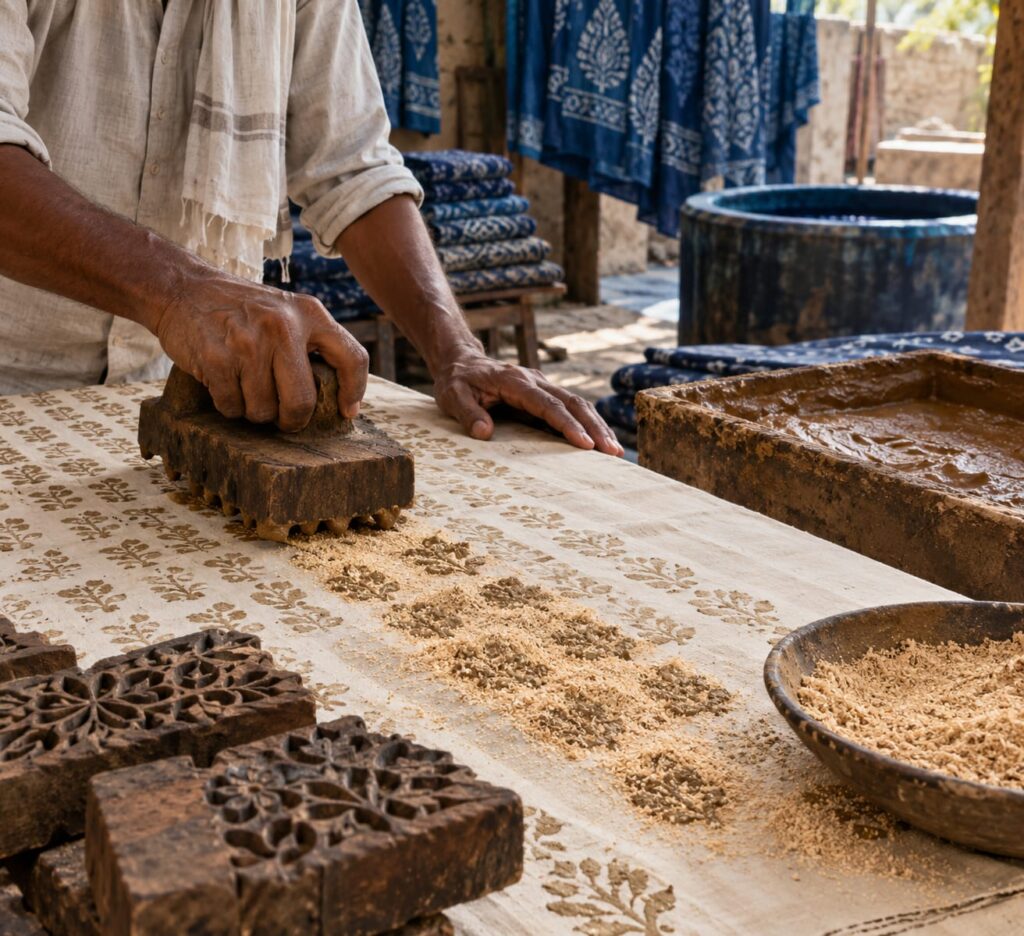
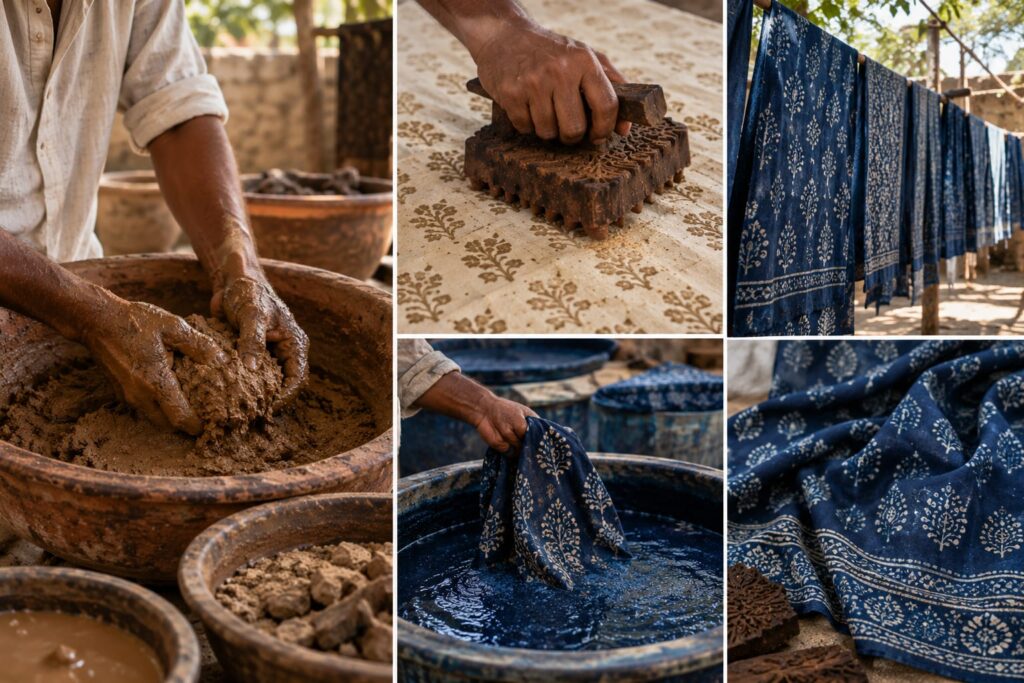
Traditional Dabu uses a mud-based mixture that artisans apply to the fabric according to the design. The mixture can contain mud along with materials that improve its consistency and help it remain on the textile. Wheat chaff or similar fibrous material can add body and texture to the resist.
The artisan first prepares the fabric carefully. Clean, well-prepared fabric gives the resist a better surface to work with. The printer then places the fabric on a suitable work surface and positions the wooden block according to the design.
The next stage requires a steady hand.
The artisan applies the Dabu mixture through a carved wooden block. The block carries a specific motif, border, or repeating element. With controlled pressure, the printer transfers the resist onto the cloth.
The resist must cover the intended area properly.
If the mixture becomes too thin, dye may reach the protected section. If it becomes too thick, the design may lose its fine details. The artisan therefore works with experience rather than relying only on measurements.
After applying the resist, the artisan allows it to dry sufficiently. The drying stage matters because the resist needs to stay in place when the fabric moves through later processes.
Many traditional resist processes also use a fine layer of dust or another dry material over the wet resist. This step helps protect the surface and reduces unwanted sticking while the artisan handles the cloth.
The fabric can then move toward dyeing or another printing stage.
The result develops gradually.
What looks like an ordinary mud-covered section during the process can eventually become an important part of the final Ajrakh pattern.
Why Artisans Use Mud as a Resist
Mud might seem like an unusual material for textile printing, but its usefulness becomes clear when we understand the purpose of a resist.
A resist needs to perform one basic job: it needs to stop or reduce the movement of color into selected areas.
Dabu provides a practical traditional way to achieve this.
The mud-based mixture sits on top of the fabric and forms a temporary protective layer. When the artisan dyes the fabric, the covered areas respond differently from the exposed areas.
This difference creates contrast.
Instead of producing one flat color across the entire cloth, the artisan can build a design with multiple visual levels. Some sections receive color strongly, while protected areas remain lighter or reveal another layer beneath.
The process gives the printer control over negative space.
That negative space matters just as much as the printed motif. In a traditional textile, an artisan does not only think about where to place color. The artisan also thinks about where color should not appear.
Dabu makes that possible.
Wheat Chaff and the Structure of the Resist
Wheat chaff plays an interesting role in traditional mud-resist preparation.
The resist needs a workable body. It should spread across the fabric without flowing uncontrollably into nearby areas. It also needs enough texture and strength to remain on the surface while the artisan handles the cloth.
Fibrous materials such as wheat chaff can contribute to that structure.
The chaff creates a more textured mixture rather than a completely smooth paste. This characteristic helps the resist hold together and can also contribute to the slightly irregular surface associated with handmade resist printing.
That irregularity should not automatically be treated as a flaw.
Handmade textile printing carries small variations because artisans work with natural materials, hand-carved blocks, changing weather conditions, and repeated manual applications. Those variations can give each piece a sense of individuality.
Machine printing aims for identical repetition.
Traditional Dabu often celebrates controlled variation.
The artisan wants the design to remain recognizable and balanced, but the process still allows tiny differences to appear from one impression to another.
Those details help reveal the human hand behind the textile.
How the Mud Creates Protected Spaces
The easiest way to understand Dabu is to imagine the fabric as a surface divided into two groups: areas that should receive color and areas that should remain protected.
The artisan applies the resist to the second group.
Once the fabric enters a dye bath or receives another color treatment, the exposed areas interact with the dye. The protected areas behave differently because the resist blocks or reduces the dye’s contact with the cloth.
This creates a visual separation.
For example, an artisan may place a Dabu resist over a floral motif. During the next dyeing stage, the surrounding fabric absorbs color while the protected floral area remains lighter or retains an earlier color layer.
When the artisan eventually removes the resist, the hidden shape becomes visible.
This moment gives resist printing its distinctive appeal.
The final design does not reveal itself immediately. It develops through several stages, and the artisan has to trust the process.
That element of uncertainty makes traditional resist printing especially fascinating.
The printer knows what the block should create, but the final color relationship only becomes fully visible after the later stages.
How Does Mud Create Black or Dark Fields?
This question often causes confusion.
Dabu mud itself does not simply turn the fabric black.
The mud acts primarily as a resist. It protects selected areas while the artisan applies color through later stages.
Dark fields can appear because of the dyes, mordants, printing mixtures, and repeated color processes used after or around the resist stage.
In traditional Ajrakh, artisans build color gradually. They may use natural dye sources and mineral or plant-based materials in different stages, depending on the particular process and color they want to achieve.
When a resist protects one area while the surrounding fabric receives a dark color, the protected section remains visually lighter. This contrast makes the surrounding field appear even deeper.
The eye experiences the relationship between the protected and dyed areas as strong tonal contrast.
So, rather than thinking:
Mud → black color
it is more accurate to think:
Mud resist → protected area → later dyeing/printing → contrasting light and dark fields.
This distinction helps us understand why Dabu matters.
The artisan does not rely on one material to create the complete visual effect. Instead, the artisan uses the resist as part of a larger sequence.
That sequence creates depth.
Building Depth Through Multiple Layers
Traditional Ajrakh printing often develops through repeated stages rather than one single application.
Dabu becomes especially powerful when the artisan combines it with other printing and dyeing techniques.
An artisan can protect one section, apply a color, wash or process the fabric, and then introduce another layer of design. Each stage changes the relationship between the colours.
This layered approach gives the textile visual depth.
Look closely at a richly printed Ajrakh textile and you may notice that the pattern does not feel like a single surface image. Borders, floral forms, geometric shapes, dots, lines, and larger color fields interact with one another.
Dabu can help create some of those relationships by controlling which areas receive particular colours.
The artisan essentially builds the textile like a visual map.
One layer tells the next layer where it can go.
Another layer tells it where it must stop.
The printer repeats this logic until the intended design begins to emerge.
The Human Skill Behind Every Dabu Impression
The materials matter, but the artisan remains at the center of the process.
A wooden block may contain a beautifully carved pattern, but the block cannot print the textile by itself. The artisan decides where to place it, how much pressure to apply, how much resist to use, and how to align it with previous impressions.
Alignment becomes especially important when the design repeats across a large piece of fabric.
A small shift can interrupt a border or disturb a geometric pattern.
Experienced printers develop a physical rhythm. They learn how the block feels in their hand. They recognize when the resist has the right consistency. They understand how the cloth behaves under pressure.
This knowledge often comes through years of practice.
That is why Dabu represents more than a textile technique.
It represents accumulated knowledge.
One generation learns from another. A young artisan observes how an experienced printer prepares the resist, handles the block, corrects an uneven impression, and judges the fabric before moving to the next stage.
Much of this knowledge cannot be fully explained through a written instruction manual.
The hands learn alongside the mind.
When Imperfection Becomes Part of the Beauty
Modern printing systems often aim for perfect repetition.
Traditional Dabu printing follows a different rhythm.
A handmade block can leave tiny variations. The resist may spread slightly differently in two places. The fabric may absorb color with subtle differences. The artisan may adjust pressure depending on the part of the cloth.
These details create character.
They also remind us that the textile came through a human process.
A small variation does not necessarily reduce quality. In many cases, it helps distinguish handmade work from industrial reproduction.
The beauty lies in control without complete uniformity.
The artisan aims for balance, not mechanical sameness.
That balance gives Dabu-printed textiles their organic visual quality.
Dabu and the Language of Ajrakh
Ajrakh has a recognizable design vocabulary.
Geometric structures, floral motifs, repeated borders, dots, grids, and symmetrical arrangements often work together to create a strong visual rhythm.
Dabu supports this language by helping artisans control the relationship between pattern and background.
A floral motif can stand against a deeper field.
A border can remain visually distinct.
A geometric section can hold its shape while surrounding color changes.
The resist therefore does not simply protect random spaces. It becomes part of the design strategy.
The artisan thinks about positive and negative space at the same time.
That approach gives Ajrakh its layered appearance.
When you look at a finished textile, it can be easy to focus only on the visible motifs. But the empty spaces also carry information. They show where the artisan prevented color from entering and where the printing process deliberately left room for another visual element.
Dabu gives those spaces structure.
From Mud to Textile: A Patient Transformation
The journey from a simple mud mixture to a finished textile feels almost surprising.
The process begins with ordinary materials.
Mud.
Water.
Fibrous material such as wheat chaff.
Natural or traditional color materials.
Wooden blocks.
Fabric.
None of these elements looks extraordinary on its own.
The transformation happens through knowledge and sequence.
The artisan prepares the cloth, applies the resist, protects selected areas, introduces color, continues the printing process, and washes or processes the textile until the design reaches its intended form.
Each stage affects the next.
That dependency makes patience essential.
An artisan cannot rush every stage simply to finish the fabric faster. The resist needs the right consistency. The fabric needs appropriate preparation. The printed areas need enough time to settle. Later dyeing stages need careful handling.
Traditional textile work often rewards patience because the final beauty comes from accumulated stages rather than instant results.
Why Dabu Still Matters Today
Dabu remains relevant because contemporary fashion continues to value handmade textiles.
Modern buyers increasingly want to understand how a textile came into existence. They want more than a beautiful pattern. They want to know about the process, the materials, the artisans, and the cultural knowledge behind the cloth.
Dabu offers that deeper story.
It shows how traditional communities developed practical methods for controlling color with locally available materials. It demonstrates how artisans transformed simple ingredients into sophisticated visual effects.
Today, designers can use Dabu-inspired techniques in garments, sarees, home textiles, scarves, and other textile products.
The forms may change.
The colours may change.
The scale of the motifs may change.
But the basic idea of resist remains powerful: protect one area so that another area can receive color.
That principle connects traditional textile knowledge with contemporary design.
A Technique Built on Trust
Perhaps the most beautiful part of Dabu is the trust involved in the process.
Once the artisan covers a section with mud resist, the final result remains partly hidden.
The printer has to trust the preparation.
Trust the block.
Trust the fabric.
Trust the dye.
Trust the sequence.
Only later does the protected pattern fully reveal itself.
That delayed reveal gives resist printing a special emotional quality.
The finished textile carries evidence of decisions that the viewer cannot always see immediately.
A dark field may look simple, but behind it may sit several carefully controlled stages. A lighter motif may exist because an artisan deliberately prevented color from reaching that area.
The final pattern therefore contains both presence and absence.
It shows what the artisan printed.
It also shows what the artisan chose to protect.
Dabu as Living Textile Knowledge
Dabu should not be understood only as an old printing method.
It represents living knowledge.
Artisans continue to adapt traditional techniques to changing markets, new garments, contemporary color preferences, and modern design requirements. At the same time, the core principle of resist printing remains connected to older textile traditions.
This balance keeps the technique meaningful.
Preserving Dabu does not require freezing it in one historical form. Artisans can continue to experiment while respecting the knowledge that gives the technique its identity.
For a contemporary saree, Dabu can bring texture, contrast, depth, and a strong handmade character.
For the wearer, that creates an opportunity to experience textile heritage in an everyday form.
The craft moves from the workshop into the wardrobe.
The Beauty Hidden Behind the Mud
Dabu may begin with mud, but the finished textile tells a much larger story.
It speaks about color control, patient craftsmanship, natural materials, carved blocks, repeated patterns, and the knowledge required to make every layer work together.
Most importantly, Dabu teaches us to look beyond the visible surface.
When we see a dark field on an Ajrakh textile, we can ask how the artisan created the contrast. When we notice a light motif, we can think about how the artisan protected that space. When we see a repeating border, we can imagine the careful alignment required to carry it across the fabric.
That perspective changes the way we see handmade textiles.
We stop seeing only a finished pattern.
We start seeing the process behind it.
Dabu gives Ajrakh one of its most interesting visual tools: the ability to create beauty by controlling where color cannot go.
The mud disappears during the later stages, but its work remains visible.
That is the quiet brilliance of the technique.
Dabu does not simply add color to Ajrakh. It helps artisans decide where color should stop, where another color should appear, and how different layers should come together. Through mud, patience, and skilled hands, artisans turn protected spaces into part of the story of the cloth.


