
Introduction: The Art of Organizing an Ajrakh Design
Ajrakh fabric stands out for its rich colours, geometric patterns, and carefully balanced layouts. Every printed section contributes to the overall design, from the detailed border along the edges to the repeating motifs across the main body. Artisans do not simply place patterns randomly on fabric. They organize each element to create rhythm, symmetry, and visual harmony.
Two important elements help us understand this structure: the Kakkar border and the Jaal field. The border frames the fabric, while the field carries the main pattern. The Pallu, especially in an Ajrakh saree, adds another opportunity for artisans to develop the design and create a distinctive visual finish.
Understanding the anatomy of Ajrakh helps buyers appreciate the thought behind a handcrafted textile. It also helps designers, students, and textile enthusiasts recognize how artisans combine individual motifs into a complete composition.
In this guide, we will explore Ajrakh layout architecture, the relationship between borders and fields, the role of the Pallu, and the design principles that make traditional Ajrakh textiles visually balanced.
Understanding Ajrakh Layout Architecture
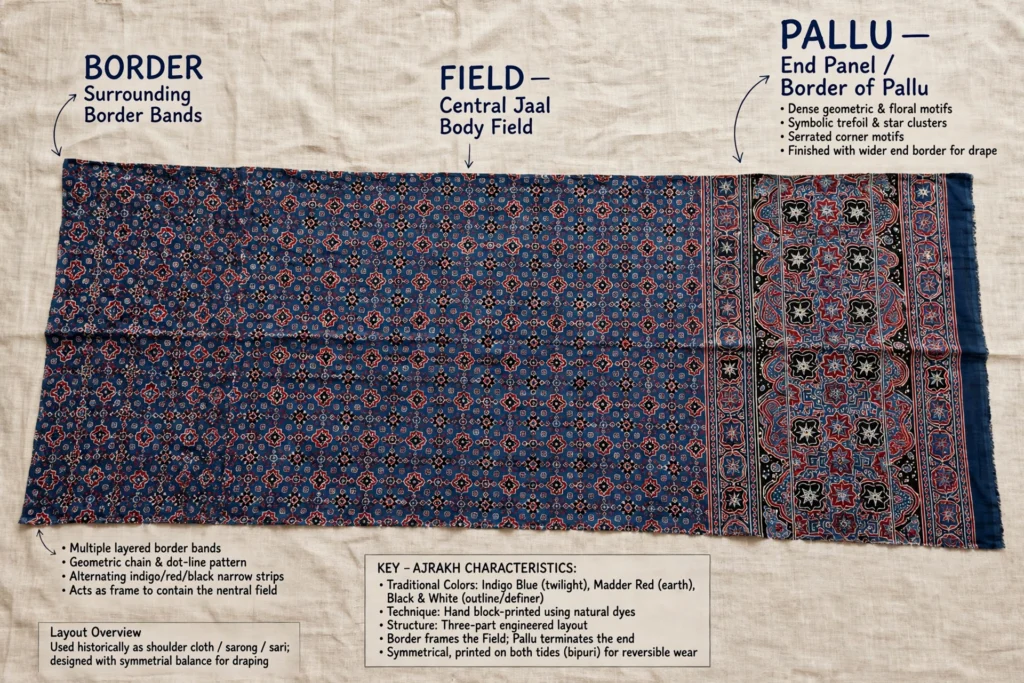
Ajrakh layout architecture refers to the way artisans organize different patterns across a piece of fabric. Think of it as a visual plan. Just as an architect arranges rooms, entrances, and open spaces within a building, an Ajrakh artisan arranges borders, central patterns, and decorative sections to create a unified textile.
The layout determines where each motif appears, how patterns repeat, and how the eye moves across the fabric. A well-planned composition gives every section a purpose.
Traditional Ajrakh designs often use geometric arrangements, repeated floral forms, stars, dots, and intricate interlocking patterns. Artisans combine these elements with a thoughtful approach to spacing and symmetry.
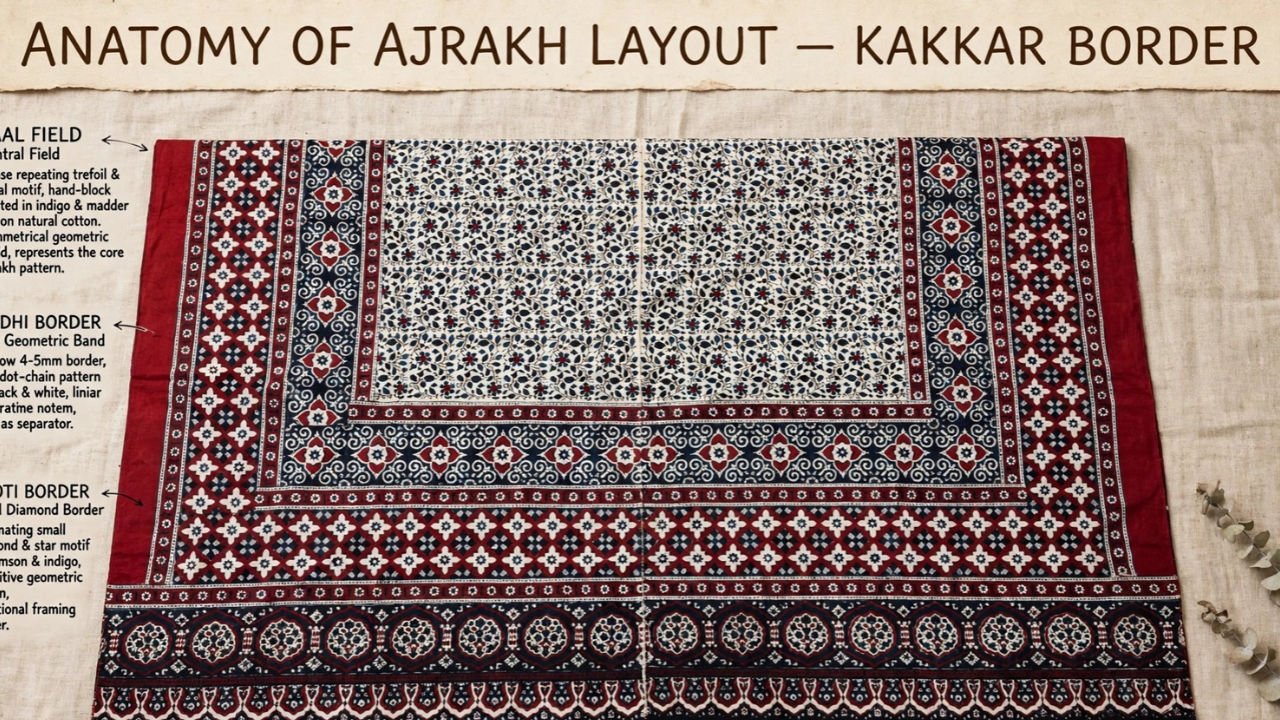
A typical Ajrakh textile may contain several visual zones:
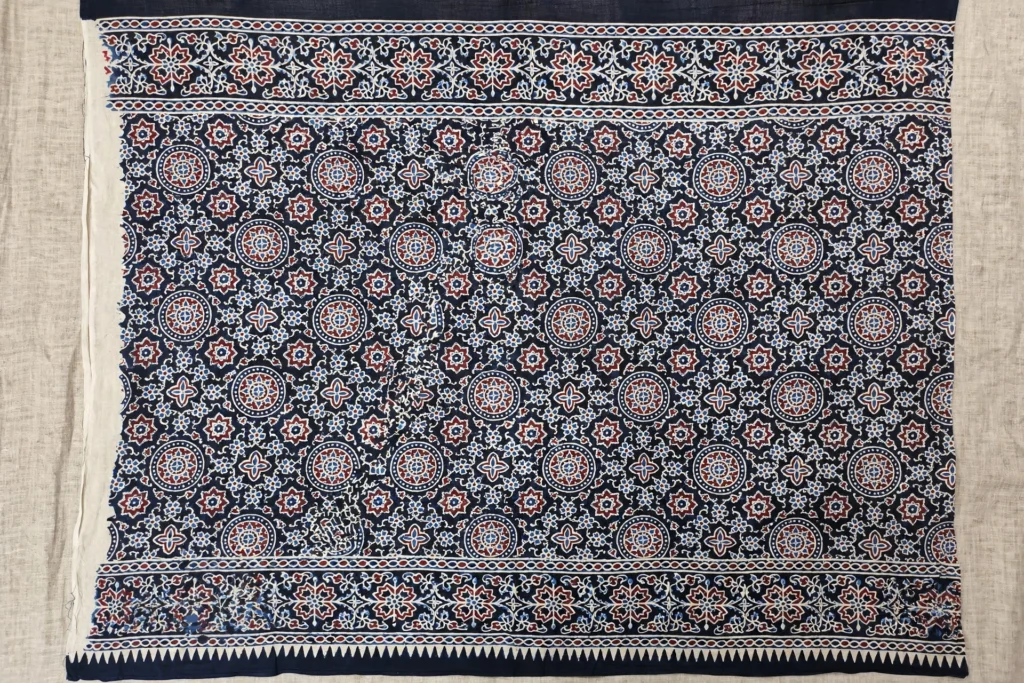
- Kakkar border: A decorative frame that defines the edges of the textile.
- Jaal field: The main patterned area that fills most of the fabric.
- Pallu: The prominent end section of a saree, which can carry a distinctive arrangement of motifs.
- Connecting motifs: Smaller patterns that visually link the border to the field.
- Negative space: Areas between motifs that allow the design to breathe.
These sections work together rather than competing for attention. The border establishes the framework, the field creates continuity, and the Pallu can provide a strong finishing statement.
What Is a Kakkar Border in Ajrakh?
The Kakkar border is a term used in some Ajrakh design contexts for a decorative border or edge pattern. Specific terminology and motif interpretations can vary between artisan communities and design traditions, so the term does not always describe one universal pattern.
In an Ajrakh layout, a border usually forms a structured band along one or more edges of the fabric. Artisans may fill it with repeated geometric shapes, small floral elements, stepped forms, or other motifs that complement the central design.
The border performs both a decorative and a structural role. It gives the composition a defined edge and helps the main field appear organized.
How the Border Frames the Fabric
Imagine looking at an Ajrakh saree with a dense field of indigo and white motifs. Without a defined border, the repeating pattern might appear to continue endlessly toward the edges. A contrasting border creates a visual stopping point.
The eye can recognize where the central design ends and the outer frame begins. This separation makes the overall arrangement easier to read.
Artisans can create this effect through changes in colour, motif size, pattern density, or direction. A narrow border may create a subtle finish, while a broader border can make the textile feel more elaborate.
The right choice depends on the overall composition and the intended use of the fabric.
Repetition and Rhythm in Kakkar Borders
Repetition plays a major role in traditional textile borders. Artisans repeat a motif at measured intervals to create a consistent visual rhythm.
For example, a border might contain a sequence of small geometric forms separated by evenly spaced dots. The repeated units establish a pattern that guides the eye along the edge.
A consistent rhythm does not mean every Ajrakh border must look identical. Artisans can vary the scale, spacing, colour, and arrangement while maintaining a sense of order.
A successful border usually complements the main field rather than overwhelming it. When both sections contain equally dense patterns, differences in scale and colour can help distinguish their roles.
Colour and Contrast in Ajrakh Borders
Colour gives the border much of its visual character. Traditional Ajrakh textiles often feature combinations of indigo, red, black, white, and other earthy tones, depending on the design and dyeing process.
A dark border can frame a lighter field, while a light border can separate two darker patterned areas. A red accent may draw attention to the edge without requiring a completely different motif.
Artisans must consider how colours interact across the entire fabric. A border that looks attractive on its own may not work as well when paired with a dense central pattern.
This is why designers evaluate the complete composition instead of choosing each section independently.
What Is a Jaal Field in Ajrakh?
The Jaal field is the main patterned area of a textile. The word jaal commonly refers to a network or mesh-like arrangement, and in textile design it describes patterns that repeat across a surface in a connected or grid-like manner.
In Ajrakh, a Jaal field can contain geometric forms, flowers, stars, dots, and interlocking motifs. The pattern may repeat in straight rows, staggered arrangements, or more intricate networks.
Unlike a border, which usually occupies a defined band, the field spreads across the central body of the fabric. It establishes the textile’s overall visual rhythm and often determines its first impression.
How Artisans Build a Jaal Pattern
Artisans begin with a repeatable motif or group of motifs. They then arrange the elements across the fabric according to a planned layout.
The repeat may follow horizontal and vertical lines, or it may shift slightly from one row to the next. This choice affects how the design moves across the surface.
A regular grid can produce a strong geometric effect. A staggered repeat can make the pattern feel more fluid, even when the artisan uses the same motif throughout.
Spacing matters just as much as the motif itself. Closely placed elements create a dense field, while wider gaps produce a more open appearance.
Artisans also consider the relationship between positive and negative space. The printed motifs form the positive shapes, while the unpainted or less decorated areas create the negative space around them. Both contribute to the overall design.
Motif Scale and Pattern Density
Motif scale changes the character of an Ajrakh field.
Small repeating motifs can create a fine, detailed surface. Larger motifs become more noticeable and can give the fabric a bolder appearance.
Pattern density also affects the visual weight of the textile. A dense Jaal may look intricate and richly decorated, while a more open Jaal can feel lighter and more spacious.
Neither approach automatically makes a design better. The best arrangement depends on how the artisan balances the field with the border and any additional decorative sections.
For example, a dense field often benefits from a border with a clear, controlled pattern. An open field may work well with a more elaborate border that adds visual interest without crowding the composition.
Symmetry and Balance in Jaal Fields
Symmetry is a familiar feature of many traditional Ajrakh designs. Artisans use repeated shapes and measured spacing to create a sense of order.
However, visual balance does not always require perfect symmetry. A textile can balance a large motif with several smaller elements or use contrasting colours to distribute attention evenly.
The goal is to prevent one section from feeling unintentionally heavier than the rest.
A carefully arranged Jaal field allows the eye to travel across the fabric without getting lost in competing patterns. It also gives the textile a consistent identity, even when the viewer examines it from different angles.
How Kakkar Borders and Jaal Fields Work Together
The relationship between the Kakkar border and the Jaal field forms the foundation of Ajrakh layout architecture. Each element has a different job, but both must support the same overall design.
The border defines the edge. The Jaal fills the central space. Their contrast creates structure, while their shared motifs or colours maintain continuity.
Creating a Clear Visual Hierarchy
Visual hierarchy describes the order in which the eye notices different elements.
In an Ajrakh textile, the viewer might first notice the overall colour, then the repeating Jaal pattern, and finally the finer details of the border. In another design, a broad contrasting border may attract attention first.
Artisans can control this hierarchy through motif size, colour intensity, and pattern density.
A bold border paired with a subtle field creates a different effect from a narrow border paired with a dense field. Designers consider these relationships when planning the textile.
Connecting the Border and the Field
A border should not always look like a separate strip attached to the main fabric. Repeated shapes, matching colours, or related geometric elements can create a visual connection between the two zones.
For example, an artisan may repeat a small geometric element from the Jaal inside the border. This repetition creates a subtle link between the central pattern and the outer frame.
Colour also helps establish continuity. If the field contains indigo, red, and white, the border can reuse those colours in a different arrangement.
The motifs do not need to match exactly. A shared visual language is often enough to make the composition feel unified.
Avoiding Visual Overcrowding
Ajrakh designs can contain considerable detail, but more decoration does not always create a stronger composition.
When the border and field both contain highly dense patterns, the fabric may lose a clear focal point. The viewer may struggle to distinguish the main design from the supporting details.
Artisans can prevent this problem by adjusting motif size, changing the spacing, simplifying one section, or introducing a stronger contrast between the border and field.
These choices help preserve the intricate character of Ajrakh while maintaining a readable layout.
The Role of the Pallu in Ajrakh Sarees
The Pallu is the decorative end section of a saree that often receives special attention. It may carry a more elaborate arrangement than the main body, making it an important part of the overall textile design.
In an Ajrakh saree, the Pallu can repeat the central Jaal, introduce larger motifs, or combine several patterns into a more concentrated composition. The exact arrangement depends on the artisan’s design and the sarees intended appearance.
How the Pallu Differs From the Main Field
The Jaal field usually maintains a repeating pattern across a broad area. The Pallu can create variation by changing the scale, density, or arrangement of the motifs.
An artisan might use a familiar geometric pattern from the field but enlarge it in the Pallu. Alternatively, the Pallu might combine several decorative bands to create a layered effect.
These choices establish a visual transition from the main body to the end of the saree.
The Pallu does not need to contrast sharply with the field. It can maintain continuity through colour and motif while using a different arrangement to create distinction.
The Pallu and Border Relationship
The border can continue along the sarees edges and interact with the Pallu at the end. This connection helps the entire saree feel like one composition rather than several unrelated pieces.
A carefully planned layout considers the meeting points between the border, field, and Pallu. Motifs should align or transition in a way that supports the overall design.
This relationship becomes especially noticeable when someone drapes the saree, because different parts of the fabric appear together in folds and visible panels.
How Artisans Plan an Ajrakh Layout
A well-organized Ajrakh textile requires more than an attractive motif. Artisans must consider the fabric, the printing process, the repeating design, and the relationship between each patterned section.
1. Establish the Main Design
Artisans first develop the visual direction of the textile. They consider whether the fabric will feature a dense geometric Jaal, a more open repeat, or a combination of patterns.
This decision guides the rest of the composition.
2. Determine the Border Width
The border needs enough space to display its motif clearly. A very narrow band may not suit a complex pattern, while an overly broad border can dominate the central field.
Artisans consider the fabric’s proportions and the scale of the Jaal when determining the border’s width.
3. Plan the Repeating Motifs
A repeating design must maintain a consistent rhythm across the fabric. Artisans consider the size of each motif, the distance between repeats, and the alignment of neighboring rows.
Traditional hand-block printing requires careful placement, so the repeat must work with the dimensions of the printing blocks and the intended layout.
4. Coordinate Colours and Pattern Density
Artisans consider how the border, field, and Pallu will look together. They balance dark and light areas, distribute accent colours, and decide where the design needs greater detail.
This planning helps maintain visual harmony across the textile.
5. Consider the Printing and Dyeing Process
Ajrakh often involves multiple stages of printing, resist application, washing, and dyeing. Each stage contributes to the final appearance.
Artisans must account for the way the process affects the placement and definition of motifs. Precise registration between printing stages helps keep the pattern aligned.
Natural dye recipes, fabric preparation, and workshop techniques can vary, so artisans adapt their methods to the design and materials.
6. Check the Complete Composition
Before considering a design finished, artisans evaluate how its sections relate to one another.
They look for consistent repetition, clear borders, balanced spacing, and a natural transition into the Pallu where applicable. These details help create a textile that feels deliberate rather than crowded.
How to Identify a Well-Designed Ajrakh Layout
You do not need professional textile training to recognize a thoughtful Ajrakh composition. A few observations can help you understand its design.
Look at the border first. Check whether it forms a clear frame and whether its motif repeats consistently.
Examine the Jaal field. Notice how the motifs align, how much space separates them, and whether the pattern creates a steady visual rhythm.
Compare the colours. Look for relationships between the border and field. Repeated colours often help connect the different sections.
Check the Pallu. If you are examining a saree, see whether the end section complements the main body or introduces a planned variation.
Observe the transitions. Pay attention to how the border meets the field and how the motifs continue across different sections.
Remember that handmade work can show variation. Hand-block printing may produce small differences in registration or detail. These variations do not automatically indicate poor craftsmanship. Evaluate the overall design, the clarity of the pattern, and the textile’s finish rather than expecting every handmade detail to look mechanically identical.
Why Ajrakh Layout Architecture Matters to Buyers and Designers
Understanding the relationship between Kakkar borders and Jaal fields helps buyers look beyond colour alone. Two textiles may use similar shades but create very different impressions because their layouts differ.
A closely spaced Jaal with a narrow border may feel understated and continuous. A bold field paired with a wide border may create a more dramatic look.
For designers, layout architecture provides a framework for developing new compositions while respecting traditional textile principles. They can explore motif scale, colour relationships, spacing, and border treatments without treating each element as an isolated decoration.
For students, these concepts offer a useful way to study how traditional crafts combine geometry and visual balance. They also encourage a deeper appreciation of the planning behind hand-block printing.
For saree buyers, understanding the Pallu, border, and field makes it easier to assess how a design may look when draped. The arrangement of the motifs can change the way the textile appears across the shoulder, pleats, and visible end section.
Ultimately, the layout influences how people experience the fabric. It gives the motifs a framework and allows the artisan’s design decisions to become visible.
Preserving the Design Logic of Ajrakh
Ajrakh carries a rich textile heritage, and its visual language depends on more than individual motifs. Borders, repeating fields, colour relationships, and decorative end sections work together to create a complete design.
The Kakkar border provides a frame, the Jaal field establishes the main pattern, and the Pallu can introduce a distinctive finish in a saree. Each element contributes something different, yet all must work in harmony.
When you understand this relationship, you begin to see Ajrakh as a carefully organized composition rather than simply a printed fabric. Every repeated shape, every change in spacing, and every contrast between the border and field helps build the textile’s identity.
That balance between structure and ornament gives Ajrakh its lasting visual appeal. It also reminds us that traditional craftsmanship combines artistic expression with thoughtful planning, precision, and a deep understanding of pattern.