
Introduction: Where Traditional Craft Meets Mathematics
Ajrakh is more than a beautiful textile tradition. It combines artistic imagination with geometry, repetition, measurement, and careful planning. Every geometric motif, repeated line, and balanced pattern reflects the artisan’s understanding of space and proportion.
When you look closely at an Ajrakh fabric, you may notice stars arranged in neat rows, circles repeated across an indigo field, or intricate shapes that connect without leaving awkward gaps. These patterns create a sense of order even when the design contains hundreds of individual details.
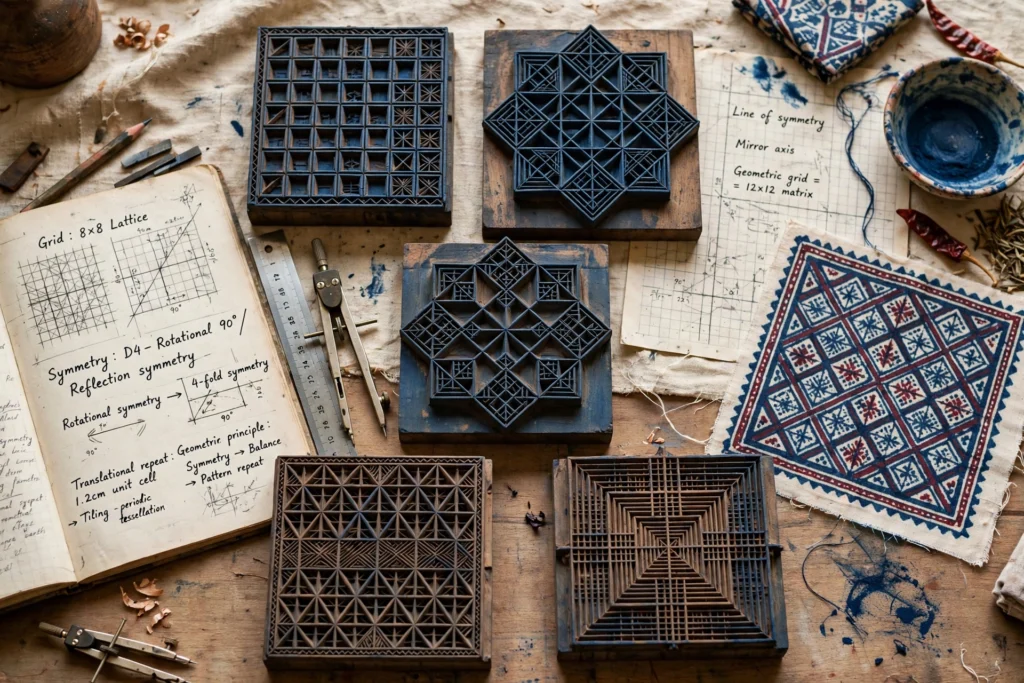
Artisans achieve this effect through geometric symmetry, a planned grid, and precise block registration. They study how motifs fit together, where each printing block should meet the next, and how repeated shapes can create a balanced composition.
The mathematics behind Ajrakh does not require an artisan to use modern computers or advanced equations. Much of this knowledge comes from practical experience, traditional design methods, careful observation, and skills developed through repeated printing.
In this guide, we explore how Ajrakh geometric symmetry works, how artisans use grids and repetition, why block registration matters, and how mathematical precision helps transform individual motifs into a harmonious textile.
Understanding Geometric Symmetry in Ajrakh
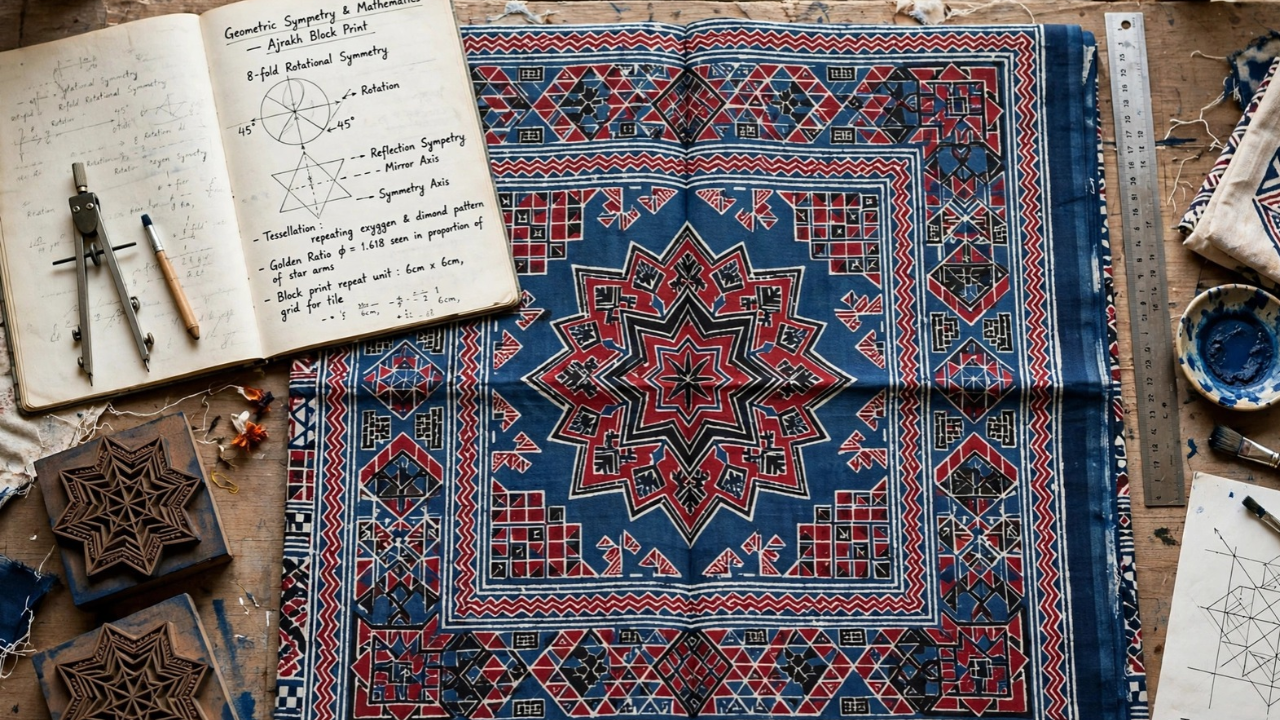
Geometric symmetry describes the way shapes relate to one another through balanced arrangements. A design may repeat a shape along a line, rotate it around a central point, or reflect it across an imaginary axis.
Ajrakh artisans use these principles to develop patterns that feel organized and visually consistent.
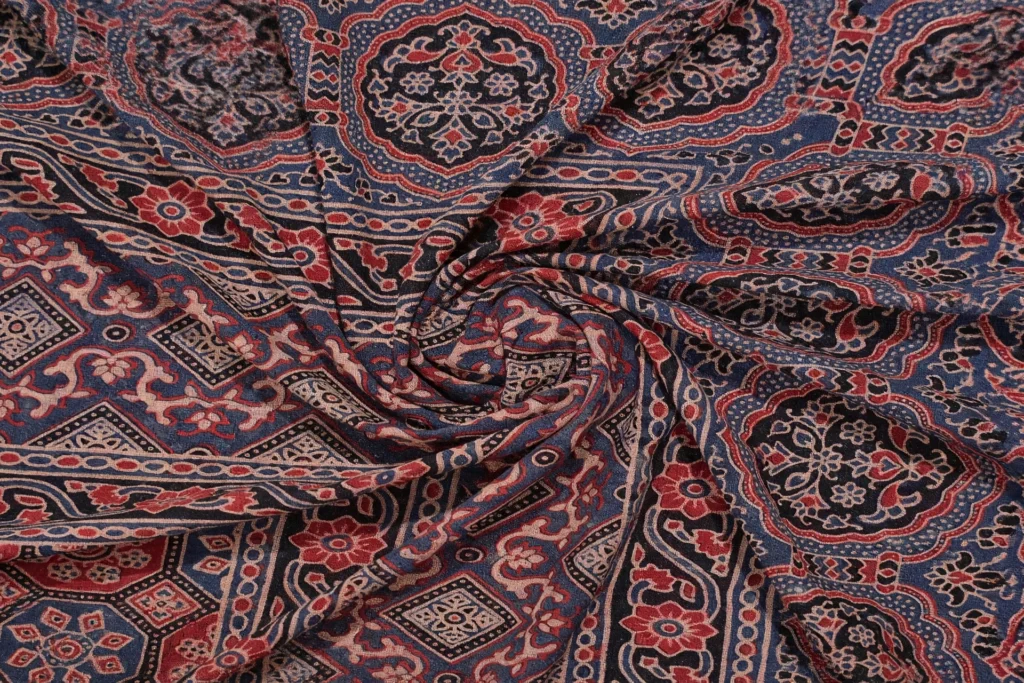
Common geometric elements in Ajrakh include circles, diamonds, squares, stars, dots, triangles, and interlocking shapes. Artisans combine these elements to create repeating patterns that cover the fabric.
Symmetry helps these patterns maintain their structure. Without a consistent arrangement, repeated motifs could appear uneven, crowded, or disconnected.
Types of Symmetry in Ajrakh Patterns
Different forms of symmetry create different visual effects. Understanding them helps explain why some Ajrakh designs feel orderly while others create a sense of movement.
1. Reflection symmetry
Reflection symmetry occurs when one part of a design mirrors another part across an imaginary line. For example, a floral or geometric motif may have matching elements on either side of its center.
This type of symmetry creates balance and makes individual motifs easier to recognize.
2. Rotational symmetry
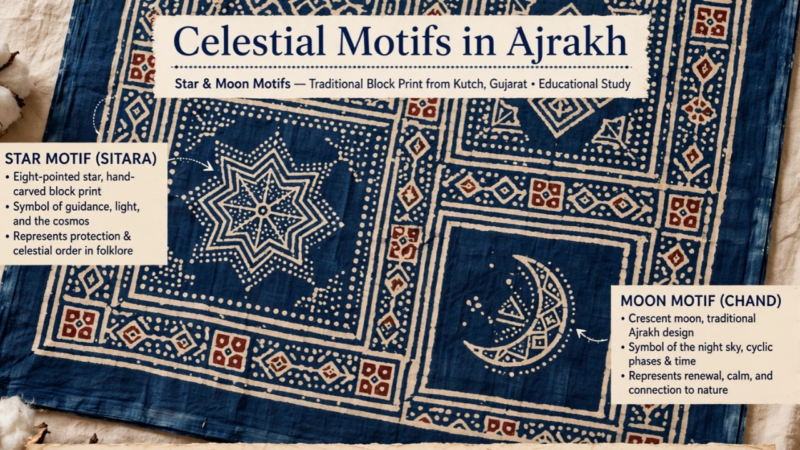
Rotational symmetry occurs when a shape looks the same after turning around a central point by a particular angle. A star-shaped motif, for example, may maintain its overall appearance when rotated through several equal intervals.
Artisans can use rotational arrangements to create stars, circular forms, and other balanced motifs.
3. Transnational symmetry
Transnational symmetry appears when artisans repeat a motif by shifting it across the fabric without changing its orientation.
A row of identical geometric motifs illustrates this principle. Each repeat maintains the same basic shape and spacing, creating a continuous pattern.
4. Repeating grid symmetry
A grid organizes motifs into rows and columns or another regular arrangement. Artisans can place repeated elements at consistent intervals to maintain a structured design.
These forms of symmetry can work together. A single motif might contain reflection symmetry, while the complete textile repeats that motif through translation across a grid.
Mathematical Precision: How Artisans Plan Their Patterns
Mathematical precision in Ajrakh begins with understanding relationships between shapes, distances, and repeated units. Artisans must determine how a motif will appear on the fabric and how it will connect with neighboring motifs.
They do not necessarily calculate every measurement using formal mathematics. Instead, they may use established block dimensions, visual guides, practical measuring methods, and experience to maintain consistency.
The Role of Measurement and Proportion
Proportion describes the relationship between the sizes of different elements.
In Ajrakh, the size of a motif influences the space it occupies and the number of times it can repeat across a given area. A large motif requires more room, while a smaller motif allows a denser arrangement.
Artisans consider these relationships when selecting or designing blocks.
For example, imagine a textile that uses a repeating motif measuring approximately 4 centimeters across. If the artisan plans a simple arrangement with 4-centimetre intervals, the motif may repeat in a regular rhythm. The actual layout must also account for the motif’s shape, the spacing between repeats, and the fabric’s dimensions.
This example illustrates the principle rather than a universal Ajrakh measurement. Different blocks and patterns require different arrangements.
Why Consistent Spacing Matters
Consistent spacing helps the viewer recognize a repeating pattern. When the distance between motifs changes unexpectedly, the design may appear uneven.
Artisans monitor the distance between successive block impressions and the alignment of adjacent rows. They also consider the visual space surrounding each motif.
Spacing does not always need to remain identical in every direction. A staggered layout may deliberately shift alternate rows to create a different rhythm. The important point is that the artisan plans the relationship between the motifs rather than placing them randomly.
Balancing Positive and Negative Space
Positive space contains the printed motif, while negative space refers to the surrounding area between motifs.
Both contribute to the final design. A dense pattern leaves less open space, producing a rich and intricate appearance. A more open arrangement allows individual motifs to stand out.
Artisans must balance these spaces so the pattern remains legible and visually harmonious.
For example, closely spaced stars may form a dense geometric field. If the artisan increases the distance between them, the same motifs can create a lighter, more open design.
This simple change in spacing can transform the character of the fabric without requiring a completely new motif.
How the Grid Organizes Ajrakh Designs
A grid provides a framework for arranging repeated motifs. It can help artisans plan horizontal rows, vertical columns, diagonal relationships, or staggered patterns.
Although a grid may remain invisible in the finished fabric, it can guide the placement of each impression.
Establishing a Regular Grid
In a simple grid, the artisan places motifs at recurring horizontal and vertical intervals. This arrangement creates a predictable structure.
The grid helps maintain alignment and gives each motif a defined position. It also makes it easier to estimate how a design will fit within the available fabric.
Some patterns require a more complex framework. A diamond-shaped motif, for instance, may work better with diagonal relationships than with a straightforward square grid.
Artisans choose an arrangement that suits the geometry of the pattern.
Staggered Grids and Repeating Rhythms
Not every Ajrakh pattern follows straight rows and columns. Some designs use staggered repeats, in which each row shifts relative to the previous one.
This arrangement can reduce the appearance of rigid vertical lines and create a more connected surface.
Imagine rows of circular motifs. If each circle sits directly beneath the one above it, the pattern creates clear vertical columns. If each alternate row shifts sideways, the circles form a staggered arrangement.
Both layouts use repetition, but they create different visual rhythms.
Planning the Grid Around the Fabric
Artisans must consider the fabric’s width and length when planning a repeat. A motif that fits neatly across one section may require adjustment near the edge.
The artisan may plan the design so that the pattern ends at a suitable point, aligns with a border, or transitions into another decorative section.
This planning becomes particularly important in textiles that combine a repeating field with borders or a distinct Pallu.
A successful layout considers the whole fabric rather than treating the central pattern as an isolated design.
Block Registration: The Key to Precise Ajrakh Printing
Block registration refers to the accurate placement of one printed impression in relation to another. In multi-stage printing, it also involves aligning successive blocks so that different parts of the design meet at their intended positions.
This process matters because even an attractive motif can lose clarity if the impressions do not align correctly.
Traditional Ajrakh printing may involve multiple blocks, colours, resist applications, and dyeing stages. Each step can contribute a different part of the design, making careful placement essential.
Why Registration Matters
Suppose an Ajrakh pattern contains a dark geometric outline and a contrasting detail intended to sit inside it. If the second impression shifts away from its intended position, the outline and detail may no longer align.
The result can look blurred, doubled, or uneven.
Small shifts can also affect the relationship between repeating motifs. A pattern that depends on connected lines or interlocking shapes may lose continuity when the impressions drift.
Registration helps preserve the artisan’s intended geometry.
How Artisans Achieve Accurate Block Placement
Artisans develop registration skills through practice, observation, and familiarity with their blocks and materials. Their methods can vary by workshop and design.
Several factors help support accurate placement:
- Clear reference points: Artisans use visible design features or established positioning methods to guide the next impression.
- Consistent block orientation: They maintain the intended direction of the block so repeated motifs do not rotate unexpectedly.
- Controlled pressure: They apply pressure carefully to create a clear impression without unwanted movement.
- Measured spacing: They monitor the distance between successive impressions.
- Careful fabric handling: They keep the cloth positioned consistently during printing.
- Regular inspection: They check the developing pattern and correct placement issues when possible.
These techniques combine hand skill with a practical understanding of geometry.
The Challenge of Repeating a Pattern Across a Large Surface
Printing one motif accurately is only part of the task. Artisans must maintain consistency across a much larger area.
The first few impressions may establish the pattern’s direction, but each subsequent impression must relate correctly to those already printed.
A slight positional error can become more noticeable when it repeats across several rows. For this reason, artisans pay attention to alignment throughout the process rather than checking only the first impression.
They also need to adapt to the fabric’s behaviour. Cloth can shift, fold, stretch, or move during handling, so the artisan must maintain control over the working surface.
Precise registration therefore depends on both planning and skilled execution.
The Relationship Between Geometry and Hand-Block Printing
Geometry provides the framework, but the printing process determines how that framework appears on the fabric.
A wooden block carries a carved design. When the artisan presses it onto the cloth, the block transfers the pattern according to the printing material and technique.
The artisan must understand how the block’s dimensions relate to the intended repeat.
Designing Blocks for Repetition
A block intended for a repeating pattern needs to work with neighboring impressions. Its edges and motif placement influence how the pattern continues.
For example, a design may include shapes that visually connect across successive impressions. The artisan must place each impression so those shapes meet as intended.
Other blocks create a pattern that repeats without requiring the motifs to touch. In these cases, spacing becomes the main factor in maintaining the design’s rhythm.
The design of the block and the planned layout must therefore work together.
Why Small Details Make a Difference
Fine lines, dots, and small geometric elements can contribute significantly to the final appearance of Ajrakh.
However, tiny details also require careful handling. If an impression lacks clarity or shifts slightly, the design may lose some of its definition.
Artisans must consider the relationship between intricate carving, the printing medium, and the fabric surface.
A successful block design balances detail with the practical requirements of printing. The pattern must remain visually effective when transferred repeatedly across the cloth.
Mathematical Precision and the Ajrakh Dyeing Process
Ajrakh is known for complex printing and dyeing traditions. Depending on the design, artisans may use several stages of fabric preparation, printing, resist application, dyeing, and washing.
Geometric planning supports these stages because the different elements must remain in the intended positions throughout the process.
Maintaining Alignment Across Multiple Stages
Some designs require more than one printing stage to develop the complete motif. An artisan may print one set of details before adding another colour or pattern element.
Each stage must relate to the earlier impressions. If the placement shifts, the final design may lose its intended structure.
The artisan’s understanding of alignment becomes especially important when the pattern contains fine outlines, small repeated details, or interlocking geometry.
The Influence of Fabric Preparation
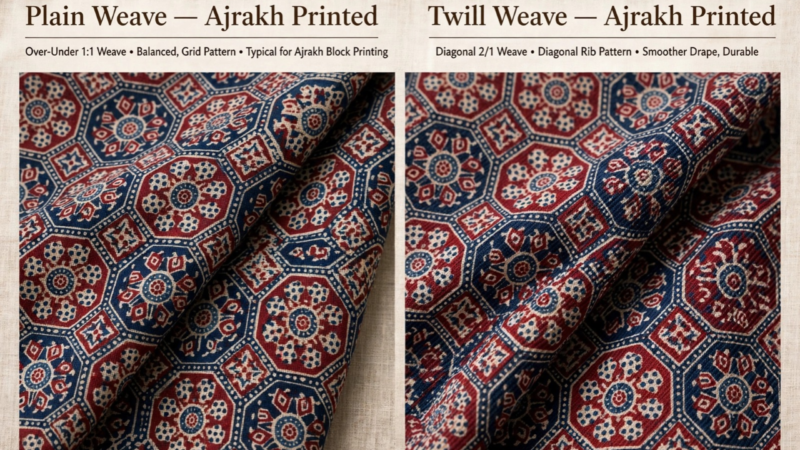
Fabric preparation affects the printing process. The surface must suit the intended technique so the printing material transfers clearly and the cloth behaves predictably during handling.
Changes in moisture, tension, or fabric movement can influence placement. Artisans therefore pay attention to preparation and working conditions alongside the design itself.
The precise procedures vary between workshops, materials, and individual traditions. There is no single universal method for every Ajrakh textile.
Preserving the Pattern Through Washing and Dyeing
Dyeing and washing help develop the textile’s final colours and appearance. The artisan must understand how the chosen materials and process interact with the printed design.
Good planning allows the different pattern elements to remain visually coherent after the fabric passes through its various stages.
The final result reflects many connected decisions: the geometry of the motif, the accuracy of each impression, the properties of the fabric, and the sequence of the printing and dyeing process.
Common Challenges in Ajrakh Geometric Printing
Even with a well-designed block, artisans must manage practical challenges during printing.
Misaligned Impressions
A block may land slightly away from its intended position. This can interrupt repeating lines or create uneven gaps.
Artisans reduce this risk through consistent positioning, careful handling, and repeated practice.
Uneven Spacing
The distance between motifs may vary across the fabric. This can make a pattern appear less regular than intended.
Monitoring each impression helps artisans maintain the planned rhythm.
Fabric Movement
The cloth may shift during printing, especially when the artisan works across a large area.
Stable positioning and careful fabric handling help reduce this problem.
Inconsistent Impressions
Pressure, printing material, and the condition of the block can affect the clarity of the transferred design.
Artisans must control their technique and inspect the impressions as the work progresses.
Pattern Drift Across Rows
Small placement errors can accumulate, causing later rows to move away from the intended alignment.
A well-planned layout, clear reference points, and regular checks help artisans maintain the pattern’s direction.
These challenges show why geometric symmetry alone cannot guarantee a successful textile. The artisan must translate the planned design into a consistent series of physical impressions.
How to Recognize Geometric Precision in Ajrakh Fabric
You can study the geometry of Ajrakh by observing a few details closely.
Look at the repeated motifs. Do they maintain a consistent shape and orientation across the fabric?
Check the spacing. Do the gaps between neighboring motifs create a deliberate rhythm?
Follow the lines. If the design contains connected geometric forms, do they align as intended?
Observe the symmetry. Do individual motifs show reflection or rotational symmetry? Does the larger arrangement repeat in a consistent way?
Examine the borders. Do the border patterns meet the main field neatly, and does the transition look planned?
Notice handmade variation. Hand-block printing can produce minor differences in individual impressions. These variations do not automatically indicate poor craftsmanship. Consider whether the overall composition remains coherent and whether the motifs retain their intended relationships.
Looking at these details helps you appreciate the balance between the artisan’s design and the physical process of printing.
Why Ajrakh Geometric Symmetry Matters Today
Geometric symmetry gives Ajrakh a visual language that designers and textile enthusiasts can study across generations.
For students, it offers a practical example of how mathematics appears in traditional craft. Repetition, proportion, symmetry, and spatial relationships become visible in an everyday material rather than remaining abstract concepts.
For textile designers, these principles provide a foundation for creating patterns that feel balanced and connected. They can explore new arrangements while considering the relationships between motifs, spacing, and borders.
For buyers, understanding the design helps reveal the skill behind a finished textile. A pattern may appear simple from a distance, but close inspection can show the careful alignment and repetition that make it work.
Modern design tools can help people explore grids and symmetry digitally. However, traditional hand-block printing still depends on the artisan’s practical knowledge, judgment, and control of the printing process.
The value of Ajrakh lies in this relationship between a planned geometric structure and the human skill required to reproduce it on fabric.
Conclusion: The Human Skill Behind Mathematical Precision
Ajrakh demonstrates how geometry and craftsmanship can work together to create a distinctive textile tradition. Symmetry organizes the motifs, grids guide their placement, and block registration helps preserve the relationship between repeated impressions.
Artisans bring these principles to life through experience, careful measurement, observation, and controlled printing techniques. They must consider not only the shape of each motif but also how it connects with neighboring impressions and how the complete pattern develops across the fabric.
Small decisions about spacing, pressure, alignment, and fabric handling can influence the final result. This is why mathematical precision in Ajrakh is not simply about producing identical shapes. It is about maintaining a coherent design through a complex handmade process.
When you look at an Ajrakh textile, every repeated star, geometric line, and carefully placed motif offers a glimpse into that process. The fabric becomes a meeting point between mathematics, artistic expression, and generations of textile knowledge.