
Introduction
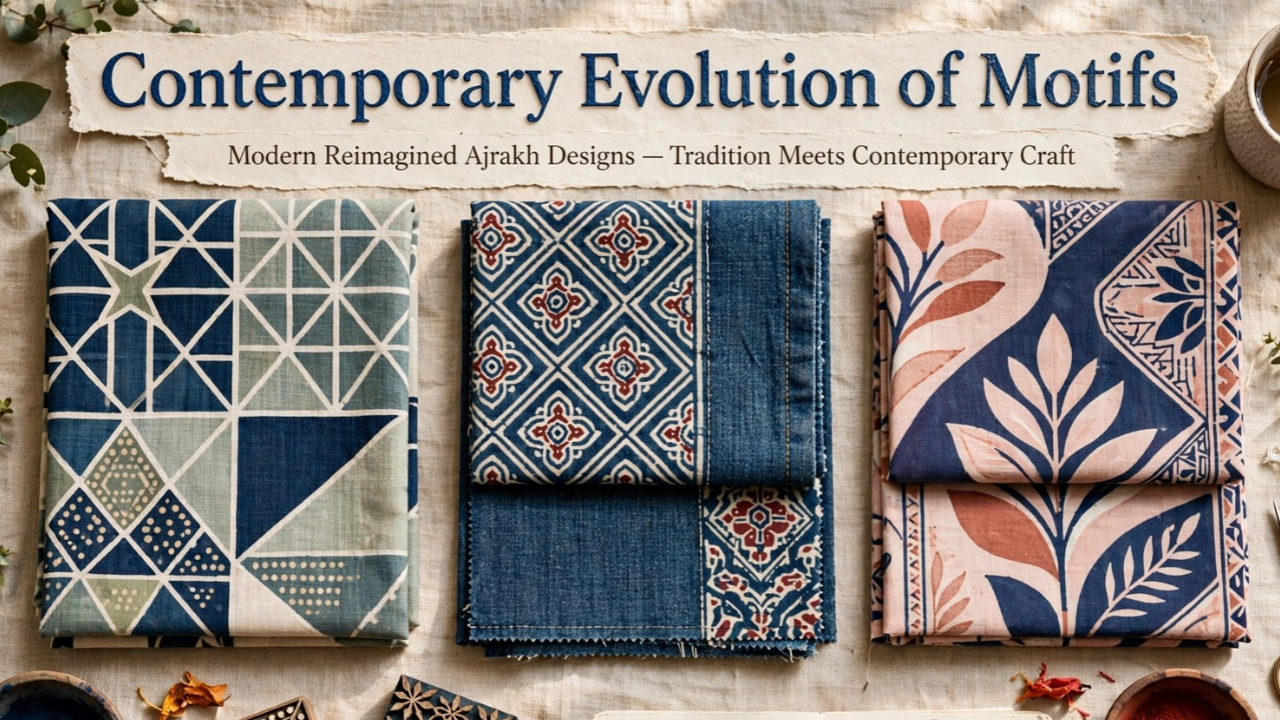
Walk through a design studio in Mumbai or Delhi today, and you will see Ajrakh like you have never seen it before. The classic stars and flowers remain, but they share space with bold abstractions, over sized geometries, and unexpected color stories. Traditional wooden blocks — some carved a century ago — now print patterns their original makers never imagined.
This transformation did not happen by accident. A new generation of designers has discovered Ajrakh, and they are re-imagining its motifs for contemporary wardrobes while master artisans in Kutch adapt their ancient craft to new visions. The result is one of the most exciting design movements in Indian textiles today.
This guide traces that evolution. You will learn how designers deconstruct traditional blocks, meet the abstract turn reshaping Ajrakh’s visual language, discover who leads the change, understand what artisans refuse to alter, and learn how to judge quality in modern pieces.
Design Evolution
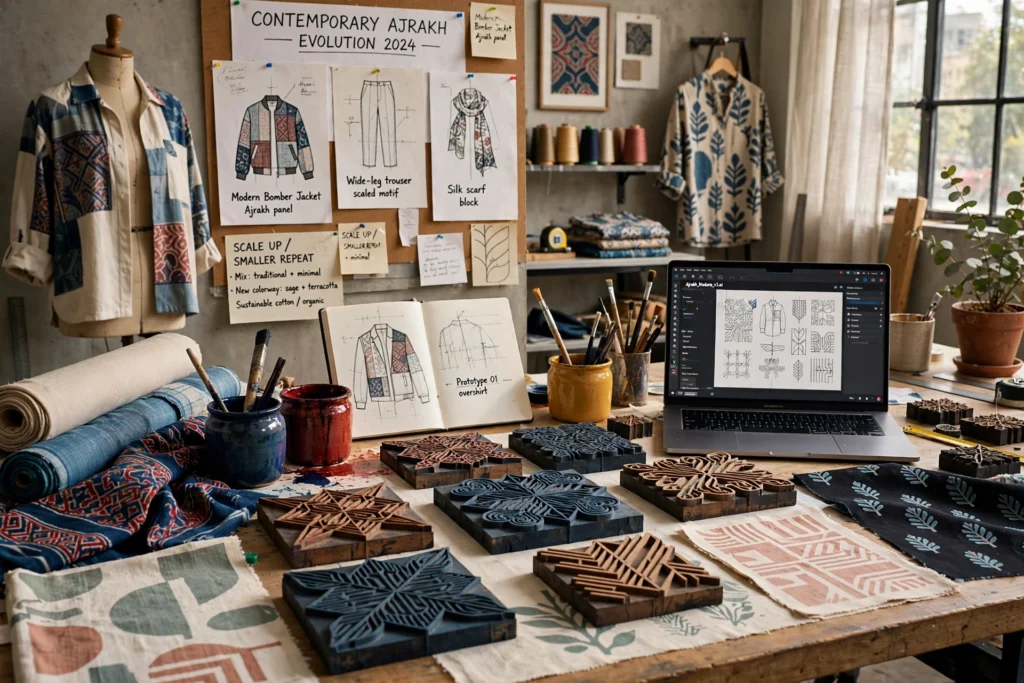
Every design evolution follows a pattern: respect, deconstruct, rebuild. Ajrakh’s contemporary journey follows this arc faithfully.
Designers begin with deep respect. They travel to Ajrakhpur, sit with master artisans, and study the traditional motif vocabulary — the stars, the trefoils, the floral jaals, the geometric grids. They learn what each motif means and how artisans have used it for generations. No serious designer skips this step; those who do produce shallow work that the craft community quickly dismisses.
Then designers deconstruct. They isolate a single motif from its traditional context — they pull one star from a dense jaal, one flower from a Persian cascade — and they examine it alone. They ask what makes it beautiful: the symmetry? The negative space? The rhythm? This analytical phase breaks the motif free from habit.
Finally, designers rebuild. They scale the isolated motif to dramatic new sizes. They repeat it in unexpected rhythms. They strip away companion motifs that traditionally surrounded it. They place a single enormous star where a hundred small ones once marched. The motif remains recognizably Ajrakh, but its presentation shocks pleasantly.
Technology accelerates this evolution. Designers now sketch variations digitally before committing to wood. They test dozens of scales and arrangements on screen, then carve only the winners. This digital prototyping — unthinkable a generation ago — lets designers experiment fearlessly while respecting the artisan’s carving time.
Collaboration drives the deepest changes. When a designer and a master artisan work as true partners, the artisan contributes technical wisdom — which scales print cleanly, which densities dye evenly — and the designer contributes fresh vision. The best contemporary Ajrakh emerges from these partnerships, not from designers dictating to craftspeople.
The Abstract Turn
The most striking trend in contemporary Ajrakh is abstraction. Designers are pushing traditional motifs toward pure form, and the results redefine what Ajrakh can look like.
Designers achieve abstraction through simplification. They take a detailed floral jaal and reduce it to its essential lines — they keep the curve of a petal but drop its veins, they keep the rhythm of a vine but drop its leaves. What remains is a ghost of the original: recognizable in spirit, modern in execution. This reduction requires confidence, because every removed detail must earn its absence.
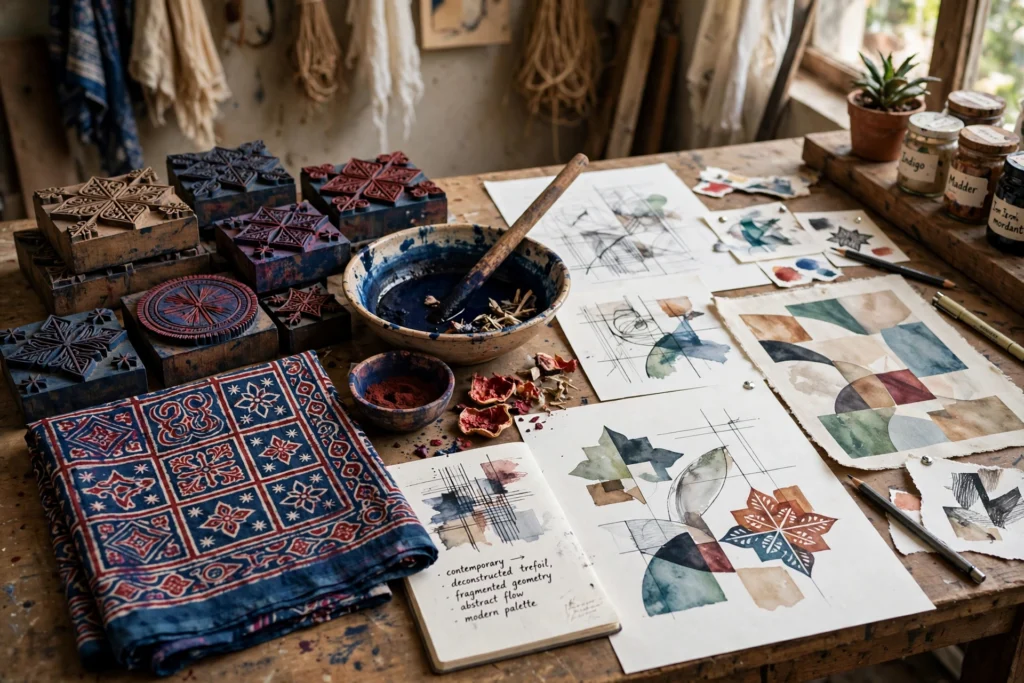
Designers also abstract through fragmentation. They break a symmetrical medallion into pieces and scatter them across the cloth. They slice a geometric grid diagonally and let the fragments float. This deliberate breaking of symmetry — almost sacrilegious in traditional Ajrakh — creates dynamic, energetic textiles that feel utterly current.
Scale does heavy lifting in abstraction. A trefoil motif at traditional size reads as a quaint flower. The same trefoil blown up to fill half a meter reads as bold abstract art. Designers exploit this transformation constantly. They let size change meaning.
Negative space plays a starring role too. Traditional Ajrakh fills the cloth generously, but contemporary designers often leave vast undyed areas around a single abstract motif. This emptiness — borrowed from modern art — makes the motif hit harder. The eye has nowhere else to go, so it surrenders fully to the one form.
Critics sometimes ask whether abstract Ajrakh is still Ajrakh. Master artisans answer pragmatically: if human hands block-print it with natural dyes in the traditional process, it remains Ajrakh. The motif may evolve, but the craft anchors the identity. This generous definition keeps the tradition alive instead of freezing it.
Designers Leading the Change
Several designers have shaped this movement, and their distinct approaches map the territory.
The revivalists work closest to tradition. They research archival textiles, revive forgotten motifs, and reproduce historical designs with museum-level accuracy. Their contribution is preservation through excellence — they prove that traditional Ajrakh needs no reinvention to stun contemporary eyes. Collectors prize their work for its authenticity.
The fusionists blend Ajrakh with other crafts. They pair Ajrakh blocks with bandhani dots, kantha stitches, or shibori dyeing. They print Ajrakh motifs on unexpected fabrics — linen, hemp, even leather. Their work introduces Ajrakh to audiences who might never enter a craft store, and it sparks cross-pollination that enriches every craft involved.
The minimalists strip Ajrakh to its essence. They use one motif, one or two colors, and vast negative space. Their textiles appeal to younger urban buyers who love heritage but dress quietly. The minimalists have done more than anyone to put Ajrakh into everyday contemporary wardrobes.
The maxima lists go the opposite direction. They layer motifs densely, mix traditional and invented patterns, and push color to its limits. Their textiles function as wearable art — bold, unapologetic, and unforgettable. Fashion photographers love them because they dominate every frame.
The conceptualizes use Ajrakh to make statements. They design motifs around themes — migration, climate, identity — and they exhibit the textiles as art installations before they ever become garments. Their work pulls Ajrakh into galleries and museums, earning the craft intellectual prestige.
Iconic Re imagined Motifs: Before and After
Seeing specific transformations makes the evolution concrete. Here is how designers have re imagined three classic motifs.
The star. Traditionally, artisans print eight-pointed stars in dense, disciplined rows across the jaal. Contemporary designers isolate a single star, enlarge it to fill the entire textile width, and let it float in negative space. The motif keeps its geometry but gains monumentality. What was once one voice in a chorus becomes a solo performance.
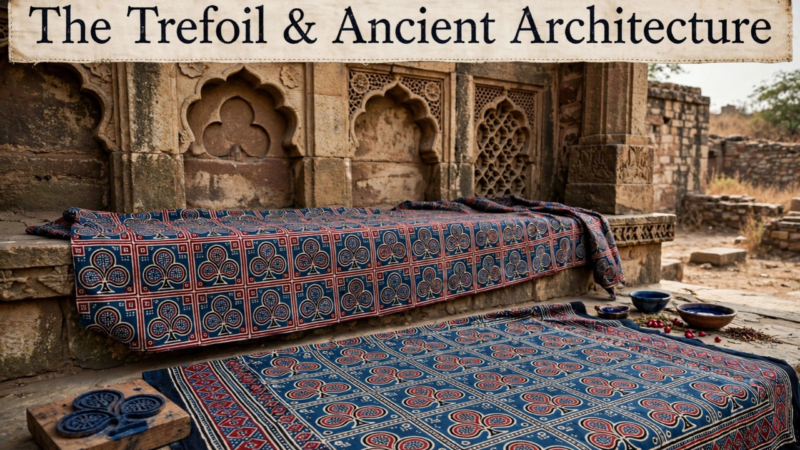
The trefoil. Traditionally, the three-leaf trefoil appears as a small, repeated filler motif. Designers have stretched its leaves into sweeping curves, overlapped multiple trefoils into interlocking chains, and even split it into abstract triplets that barely recall the original leaf. The trefoil’s journey from filler to feature shows how scale and context transform meaning.
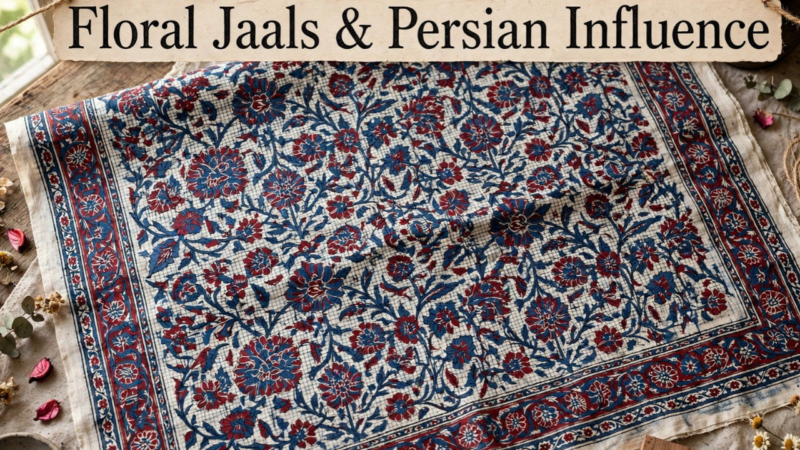
The floral jaal. Traditionally, Persian-influenced floral vines cover the cloth in abundant, orderly cascades. Contemporary designers extract one vine, enlarge its flowers to dramatic proportions, and let a single stem wander across an otherwise empty field. The abundance becomes suggestion. The garden becomes a single perfect bloom.
Each transformation respects the original while refusing to repeat it. That is the essence of the contemporary movement: reverence expressed through reinvention.
What Stays Sacred
For all this innovation, master artisans draw firm lines. They welcome new motifs but protect the craft’s soul. Understanding these boundaries helps you distinguish genuine evolution from exploitation.
Artisans insist on the traditional process. They block-print by hand, they use natural dyes, and they follow the multi-stage washing and mordanting sequence. A designer may invent any motif, but the artisan will not screen-print it or dye it chemically and call it Ajrakh. The process defines the craft more than any pattern does.
Artisans protect the color discipline. Ajrakh’s classic palette — indigo, madder red, black, white — carries cultural meaning, and artisans resist abandoning it entirely. They accept new colors as accents and experiments, but they expect the core palette to anchor every serious piece. A textile with no indigo and no madder raises eyebrows in Ajrakhpur.
Artisans defend the geometry’s integrity. They will enlarge, fragment, and abstract motifs, but they will not print sloppy, misaligned work and call it “contemporary.” Precision remains non-negotiable. The contemporary license covers what you print, not how well you print it.
Artisans also protect fair practice. They welcome designers who credit them, pay fairly, and share the story honestly. They reject those who treat them as anonymous labor. The healthiest contemporary collaborations name the artisans, photograph their hands at work, and split recognition equitably. When you buy modern Ajrakh, look for this transparency — it signals an ethical supply chain.
How to Spot Quality in Modern Ajrakh
The contemporary market mixes brilliance with opportunism. Use these tests to tell them apart.
Check the process, not just the pattern. Ask the seller how the textile was made. Genuine contemporary Ajrakh uses hand-block printing and natural dyes. If the seller hesitates or the price seems impossibly low for the complexity, suspect screen printing. A bold abstract design means nothing if a machine made it.
Judge the abstraction’s intelligence. Good abstract design shows clear thinking — you can sense the traditional motif underneath the transformation. Bad abstraction looks random, like the designer simply splashed shapes without understanding them. Ask yourself: does this feel like a thoughtful evolution or a careless departure?
Inspect the execution. Innovation never excuses poor craftsmanship. Check the alignment, the color edges, and the symmetry (where the design intends symmetry). Contemporary or traditional, a well-made textile shows clean, confident work.
Look for the artisan’s name. The best contemporary labels credit their artisan partners. This transparency indicates a real collaboration rather than a design imposed on anonymous workers. It also usually correlates with fair wages and better quality.
Feel the fabric. Natural dyes on good cotton or silk have a distinctive hand — soft, substantial, alive. Chemical dyes on cheap fabric feel flat and lifeless. Your fingers learn this difference quickly with experience.
Start with one statement piece. If you are new to contemporary Ajrakh, buy one bold piece first — a stole, a dupatta, a cushion cover. Live with it, wear it, see how it makes you feel. Then decide whether the aesthetic suits your life before investing in larger pieces.
Where Contemporary Ajrakh Is Headed
The movement shows no signs of slowing. Several currents point to where it goes next.
Digital tools will deepen the collaboration. Designers already prototype on screen; soon artisans may carve blocks from digital designs with laser precision, then print them by hand. This hybrid workflow — digital design, hand execution — could expand the motif vocabulary enormously while keeping the craft’s soul intact.
Sustainability will drive more innovation. As buyers demand econ-friendly fashion, Ajrakh’s natural dyes and hand processes become selling points rather than limitations. Designers will lean into this advantage, creating contemporary pieces that compete directly with fast fashion on ethics as well as beauty.
Global recognition will grow. Museums already exhibit Ajrakh; fashion weeks already feature it. As the world discovers the craft, international designers will bring their own perspectives, and the motif vocabulary will absorb global influences. The challenge will be maintaining the craft’s identity through this expansion — a challenge the artisan community has met before.
Styling Contemporary Ajrakh
Contemporary Ajrakh asks for contemporary styling. These guidelines help the modern motifs shine.
Let one piece lead. A bold abstract Ajrakh textile already makes its statement. Pair it with quiet companions — solid trousers, plain kurtas, minimal jewelry. When everything shouts, nothing is heard.
Mix eras deliberately. Wear a contemporary Ajrakh dupatta over a traditional silk kurtas, or pair an abstract stole with classic denim. The contrast between eras creates the most interesting outfits. Just keep the color stories compatible.
Use modern silhouettes. Contemporary motifs love contemporary cuts — structured jackets, wide-leg trousers, minimalist dresses. The modern frame completes the modern pattern. Traditional drapes work too, but the fusion of new motif with new silhouette feels most coherent.
Edit your accessories. Abstract Ajrakh pairs beautifully with sculptural modern jewelry — clean metal cuffs, geometric earrings. Avoid traditional temple jewelry with abstract pieces; the styles belong to different centuries and they clash rather than converse.
Frequently Asked Questions
Is contemporary Ajrakh less authentic than traditional?
No. Authenticity lives in the process — hand-block printing with natural dyes — not in any specific motif. A bold abstract design made traditionally is fully authentic Ajrakh.
Do artisans like the new designs?
Most welcome thoughtful innovation, especially when designers collaborate respectfully and pay fairly. Artisans take pride in their craft’s evolution. They resist only careless or exploitative approaches.
Can I mix traditional and contemporary Ajrakh in one outfit?
Yes, and stylists encourage it. Pair a traditional body with a contemporary dupatta, or vice versa. The contrast creates visual interest and shows your range.
How do I care for contemporary Ajrakh?
Exactly like traditional pieces: cold water, mild soap, shade drying, gentle handling. The dyes and processes are the same, so the care is the same.
Conclusion
Ajrakh’s motifs are not museum pieces — they are living forms, and living forms evolve. Today’s designers deconstruct traditional blocks, push them toward abstraction, and rebuild them for contemporary eyes. Master artisans guide this evolution with their technical wisdom and their firm boundaries.
The result honors both past and future. When you wear contemporary Ajrakh, you wear centuries of craft thinking in a language today understands. Choose pieces where the innovation shows intelligence, the execution shows mastery, and the artisans receive credit. Then wear the evolution proudly — you are part of the story now.