
Introduction
The colors glow, the patterns mesmerize, and you imagine yourself wearing it. Then you drape it, look in the mirror, and something feels off. The textile is beautiful, but it does not flatter you.
The culprit is almost always scale — the size and density of the pattern against the size of your frame. Ajrakh offers two broad pattern families: the minimalist jaal and the heavy jaal. This guide shows you how to match the right family to your silhouette, test any textile in sixty seconds, and avoid the mistakes that ruin an otherwise perfect drape.
Proportion and Print
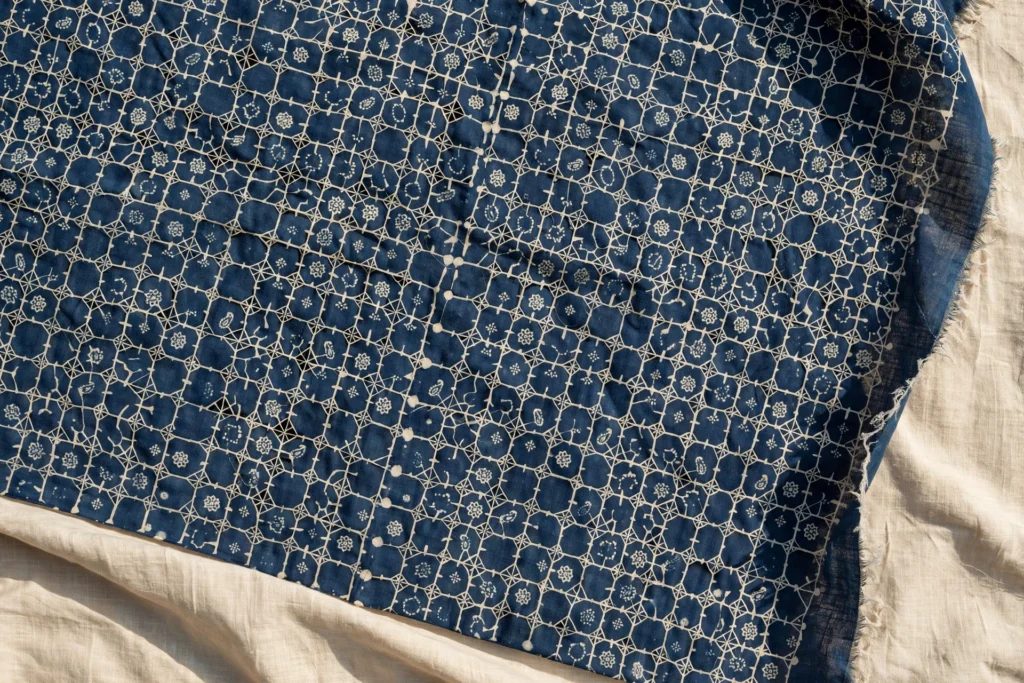
Stylists work with one core idea: the scale of your print should harmonize with the scale of your body. A petite frame pairs naturally with smaller, airier motifs. A plus-size frame pairs naturally with larger, denser ones. When the two match, the outfit looks effortless. When they clash, the print either swallows you or vanishes against you.
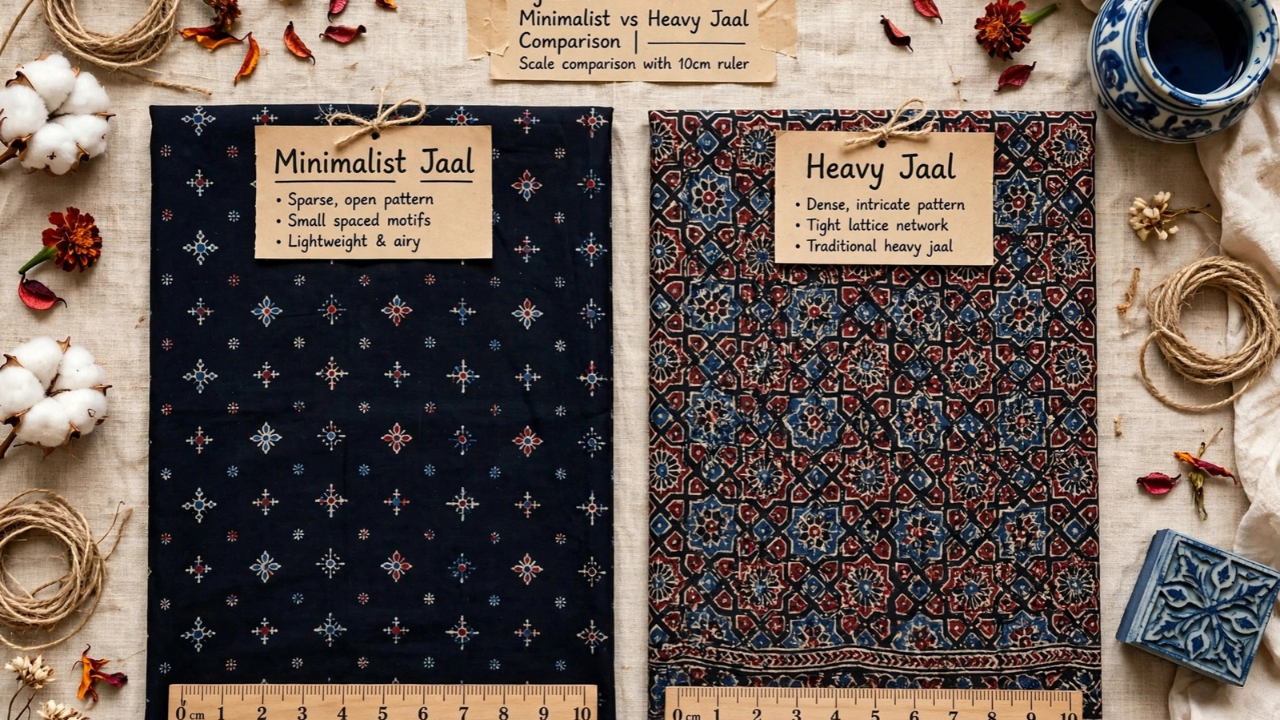
Ajrakh makes this principle especially visible because its geometry is so bold. Sharp stars, deep indigo fields, and dense borders all command attention. In a minimalist jaal, artisans print small motifs with generous breathing space, so the eye glides and rests. In a heavy jaal, artisans pack large motifs edge to edge, so the eye works and marvels. Neither approach is better — they simply create opposite effects, and your job is to pick the effect that serves your silhouette.
Color multiplies the effect. Ajrakh’s deep indigo s and madder reds already carry visual weight, so a heavy jaal in dark tones doubles the impact while a minimalist jaal in the same tones softens it. Judge pattern and color together, never separately.
The Minimalist Jaal
Artisans build the minimalist jaal through restraint. They carve small blocks — tiny stars, delicate flowers, fine dots — and they space each impression widely across the cloth. They often limit the palette to two or three tones instead of the full four-color range. The textile breathes, and fine details reward close looking.
This restraint demands serious skill. Empty space exposes every flaw, so the printer must place each small motif with perfect consistency across meters of cloth. A wobbling line or uneven spacing would scream from the open field. When you hold a fine minimalist jaal, you hold proof of a steady, experienced hand.
The minimalist jaal creates a quiet, refined mood. It suits formal workplaces, daytime ceremonies, and anyone who prefers heritage without drama. It asks for simple styling — structured blouses, minimal jewelry — because the textile’s beauty lives in its details, not its volume.
The Heavy Jaal
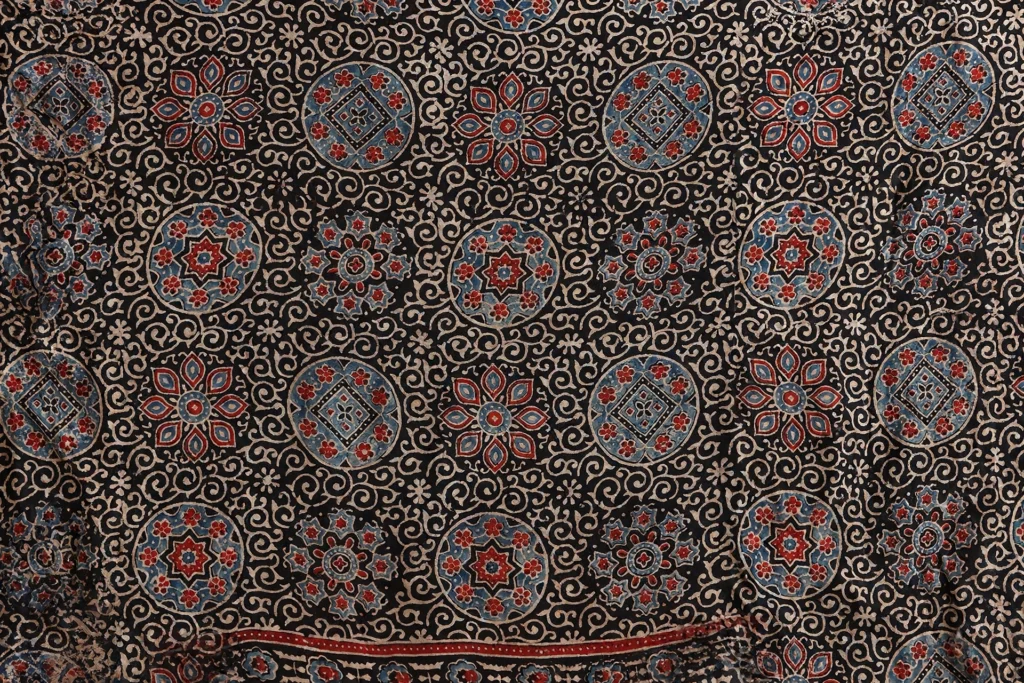
Artisans build the heavy jaal through abundance. They carve large blocks, pack impressions densely, and layer multiple motif families across the surface. Flowers intertwine with geometry, borders multiply, and colors stack in rich layers. The textile pulses with energy.
This abundance demands serious labor. A heavy jaal requires more blocks, more impressions, and more dyeing stages than a minimalist piece. Artisans give the cloth extra dips in indigo and madder vats to deepen the tones. The density you see represents hours of additional work, which is why heavy jaal textiles typically cost more.
The heavy jaal creates a celebratory, commanding mood. It dominates weddings, festivals, and evening events. It asks for a confident wearer and simple styling elsewhere — plain blouses, restrained jewelry — because the textile itself provides all the drama the outfit needs.
How Artisans Choose the Scale
Before a single block touches cloth, the master artisan decides the jaals scale — and this decision shapes everything that follows.
The artisan starts with the cloth’s purpose. He asks who will wear it and where. Bridal commissions get heavy jaals with grand motifs because weddings demand presence. Daily-wear orders get minimalist jaals because comfort and versatility matter more. The artisan reads the customer’s life, not just her measurements.
Next, the artisan considers the fabric. He knows that silk absorbs dye deeply and holds crisp edges, so it carries large motifs beautifully. He knows that fine cotton softens edges slightly, so he scales motifs down a touch to keep them legible. The fabric talks, and the experienced artisan listens.
Then the artisan plans the block set. A minimalist jaal needs fewer blocks — sometimes just three or four — but each must print flawlessly because open space exposes errors. A heavy jaal needs a dozen or more blocks, and the artisan must choreograph their sequence so colors layer correctly without muddying. Both approaches demand mastery; they simply demand different kinds of mastery.
Finally, the artisan tests on scrap cloth. He prints a full repeat, steps back, and judges the scale with his eye. If the motifs feel lost, he enlarges the blocks. If they feel crowded, he opens the spacing. This test print — never sold, never shown — is where the jaal finds its true scale. When you admire a perfectly balanced Ajrakh, you admire the ghost of that test print.
Styling by Body Type
Petite frames: Choose minimalist jaals. Small motifs with open spacing echo your scale without overwhelming it. If a heavy design tempts you, pick its medium-scale version and keep the blouse plain so the overall look stays balanced.
Plus-size frames: Choose heavy jaals. Large, dense motifs meet your silhouette as equals and create a continuous flow that flatters. Tiny sparse patterns look accidental on a fuller frame, so avoid them.
Tall, slim frames: Wear either family. Minimalist jaals emphasize your height with elegance; heavy jaals fill your vertical space with interest. Let the occasion decide.
Curvy frames: Choose medium-density jaals — the middle ground between sparse and heavy. This balance looks intentional without adding visual bulk. Drape the pallu diagonally across the shoulder to create lengthening lines.
Short and curvy frames: Choose small-to-medium motifs with moderate spacing, and drape the saree slightly higher on the waist to lengthen the leg line. Avoid both extremes.
These are starting points, not cages. If your heart wants a family that breaks your guideline, wear it — just adjust the styling around it to keep the balance.
Draping Techniques That Transform Scale
The same textile can look dramatically different depending on how you drape it. Master these techniques and you gain control over scale itself.
The open pallu. Let the end-piece fall freely over your shoulder without pleating it. This displays the Mohra at full scale and works best when the end-piece flatters your frame. Use it with grand Mohra designs you want to showcase.
The pleated pallu. Fold the end-piece into neat pleats before draping it over your shoulder. Pleating compresses the pattern visually and reduces its apparent scale. This technique rescues a slightly-too-bold Mohra on a petite frame — the pleats tame the grandeur.
The double drape. Bring the pallu over your shoulder, then loop it once more around your arm. This creates layered bands of pattern that break up large motifs. Plus-size wearers use this technique to add graceful movement, while petite wearers use it to distribute a heavy jaals visual weight.
The seedha pallu. Drape the end-piece straight down your front instead of over the shoulder. This puts the Mohra’s full design on display across your torso. It suits tall wearers beautifully and gives photographers a perfect frontal composition.
The nivi tuck. Tuck the pallu end into the waistband at your side. This shortens the visible end-piece and works well when you love a textile’s body but find its Mohra slightly large. The tuck is practical for active days too.
Practice each technique in front of a mirror with the same saree. You will see how draping alone changes the scale equation — sometimes more than the pattern itself.
Occasion Guide: What to Wear Where
Office and formal work: Choose minimalist jaals in indigo or black-dominant colorways. The restrained pattern reads as professional and cultured. Pair with a crisp solid blouse and simple stud earrings.
Daytime family events: Choose medium-density jaals. They look festive without overwhelming daylight. A Banded Mohra works perfectly here — lively but not loud.
Weddings (as a guest): Choose heavy jaals with grand Mohra designs. Weddings welcome abundance, and your textile should match the celebration’s energy. Just avoid red bridal tones if the bride wears them.
Evening parties: Choose heavy jaals in deep colorways. Artificial light enriches indigo and madder tones, making dense patterns glow. This is the heavy jaals natural habitat.
Religious ceremonies: Choose minimalist or medium jaals in traditional colorways. Reverence favors restraint. A Medallion Mohra in classic colors honors the occasion perfectly.
The 60-Second Scale Test
Use this quick test in any shop. It takes one minute and removes all guesswork.
Step 1 — The palm check. Hold your open hand against the textile. If the largest motifs are smaller than your palm, the jaal leans minimalist. If they match or exceed your palm, it leans heavy. Your palm gives you a personal, portable measuring tool.
Step 2 — The square check. Look at a one-foot square of the cloth. If you see clear background space between motifs, the jaal breathes. If motifs touch or overlap with barely any background visible, the jaal is dense. This tells you the density, which matters as much as motif size.
Step 3 — The shoulder check. Drape the pallu over your shoulder and step back from the mirror. The Mohra always runs larger than the body — that is its job — but ask yourself: does the end-piece frame you, or does it compete with you? If your eye goes to the textile first and you second, the scale is too big for your frame.
Step 4 — The walk check. Walk a few steps and watch the textile move. A well-matched jaal flows with you; the pattern feels like part of your movement. A mismatched scale feels separate, like the cloth is doing its own thing. Trust this instinct — it rarely lies.
5 Mistakes That Ruin the Look
Buying for the hanger, not the body. A textile looks different folded on a hanger than draped on you. Folding compresses the pattern and hides true scale. Always drape fully before deciding.
Letting the blouse fight the jaal. A printed blouse under a heavy jaal creates chaos. A dull blouse under a minimalist jaal looks unfinished. Give heavy jaals plain blouses and minimalist jaals slightly detailed ones.
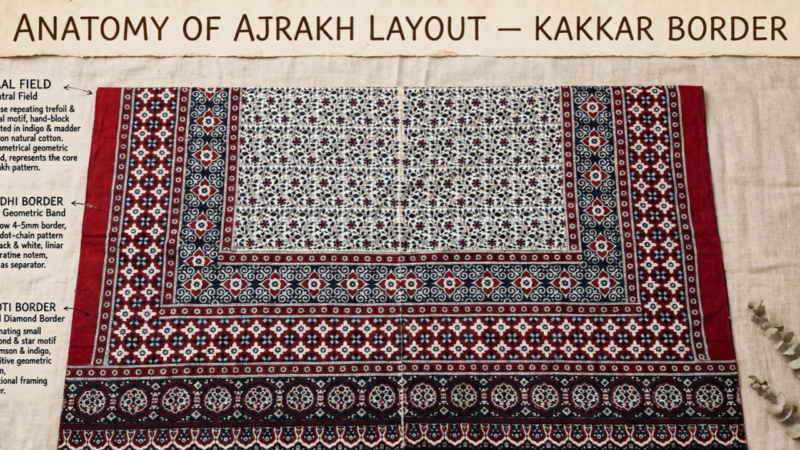
Hiding the pallu. Many wearers tuck the end-piece tightly and bury the Mohra. The artisan designed it as the focal point — let it show. A hidden pallu wastes the textile’s best feature.
Ignoring fabric weight. Heavy silk adds visual bulk; light cotton floats. A petite frame in heavy silk with a heavy jaal can look weighed down, while a plus-size frame in feather light cotton with a sparse jaal can look under dressed. Match fabric weight to your frame too.
Shopping without a plan. Walk in knowing your scale range and your occasion. Without a plan, color seduces you and scale surprises you later at home.
Buyer’s Checklist
Keep this list on your phone and consult it before you pay.
- [ ] I draped the full textile, including the pallu, and checked it in a mirror.
- [ ] The motif scale suits my frame (palm check passed).
- [ ] The pattern appears clearly on both sides of the cloth (proof of hand-blocking).
- [ ] The Mohra’s symmetry holds when I compare left and right halves.
- [ ] The blouse I own (or plan to buy) matches the jaals energy.
- [ ] The fabric weight suits my body and the season.
- [ ] The seller accepts returns, in case the drape disappoints at home.
Frequently Asked Questions
How can I spot a machine-printed fake?
Check the reverse side. Hand-blocked Ajrakh shows the pattern clearly on both faces. Machine prints look sharp on the front and pale on the back. Also look for tiny human irregularities — perfect repetition signals a machine.
Does a heavy jaal suit a short woman?
It can, in medium scale. Choose motifs around palm size rather than larger, keep the blouse plain, and drape the pallu simply. The key is moderation, not avoidance.
Which jaal photographs best?
Heavy jaals photograph dramatically — the dense pattern fills the frame. Minimalist jaals photograph elegantly but need good lighting to reveal their fine details. For portraits, make sure the Mohra faces the camera.
How do I wash Ajrakh at home?
Use cold water and mild soap, wash separately for the first few washes, dry in shade, and never wring the end-piece. Natural dyes reward gentle care with a beautiful patina over years.
Can I mix a minimalist body with a heavy pallu?
Yes — artisans design many textiles exactly this way. A quiet body with a grand Mohra gives you the best of both worlds: easy wearing with a striking focal point. This combination suits petite wearers who want some drama without full commitment.
Do men wear Ajrakh too?
Absolutely. Ajrakh shawls, stoles, and kurtas carry the same jaal families. The scale principle applies identically — match the pattern to the frame. Men often prefer the geometric and banded designs.
How do I store Ajrakh between wears?
Fold it with the Mohra tucked inward, place muslin between folds, and store away from direct light. Natural dyes fade in sunlight, so a dark cupboard preserves the colors best.
Conclusion
The right jaal does not shout or whisper on your behalf — it harmonizes. Learn your scale, test every textile in sixty seconds, and let the proportion principle guide you. The best Ajrakh for you is the one whose pattern meets your silhouette as an equal. When you find it, you will feel the difference before the mirror confirms it.