
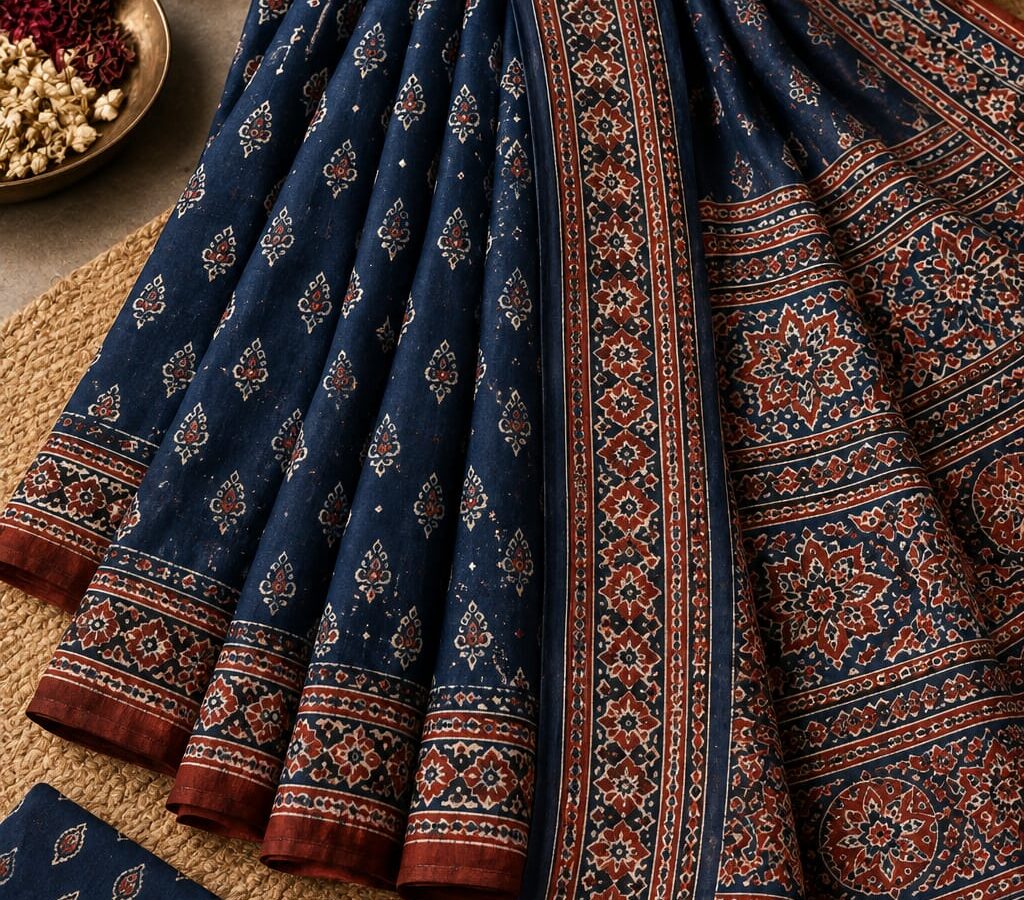
Ajrakh looks beautiful at first glance, but its real beauty begins much before the finished saree reaches the wardrobe. Behind every geometric motif, deep color, and carefully printed border is a process that demands patience, precision, and years of craftsmanship.
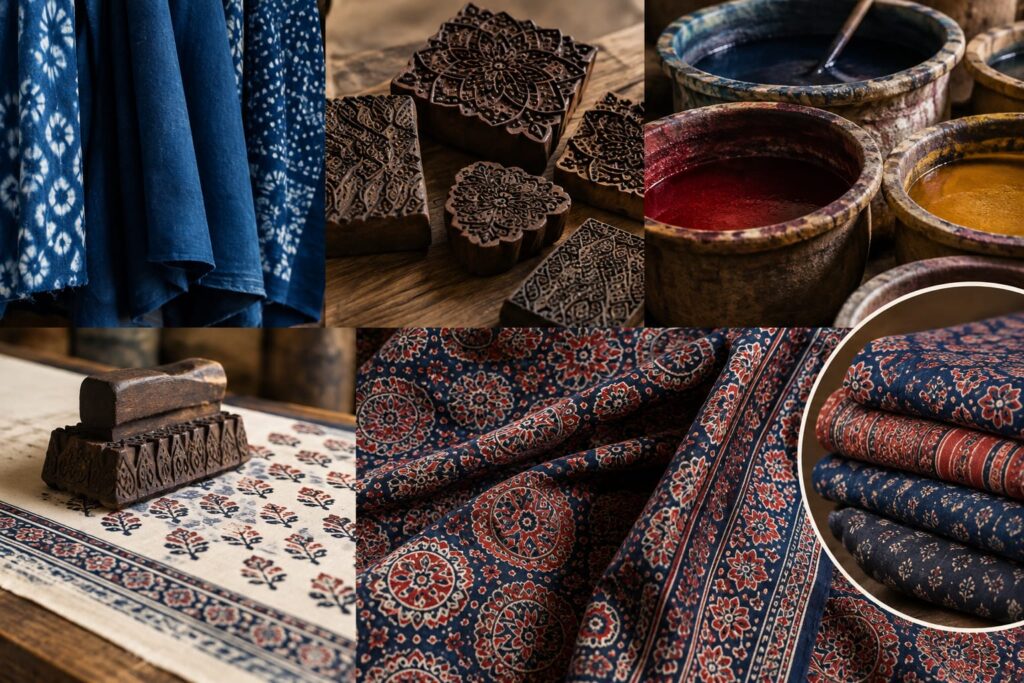
For an artisan, Ajrakh is not simply about putting a design on fabric. It is about understanding the fabric, preparing colours, positioning wooden blocks, and repeating each step carefully until the pattern comes together.
The Craft of Patience: The Artisan’s Essential Block
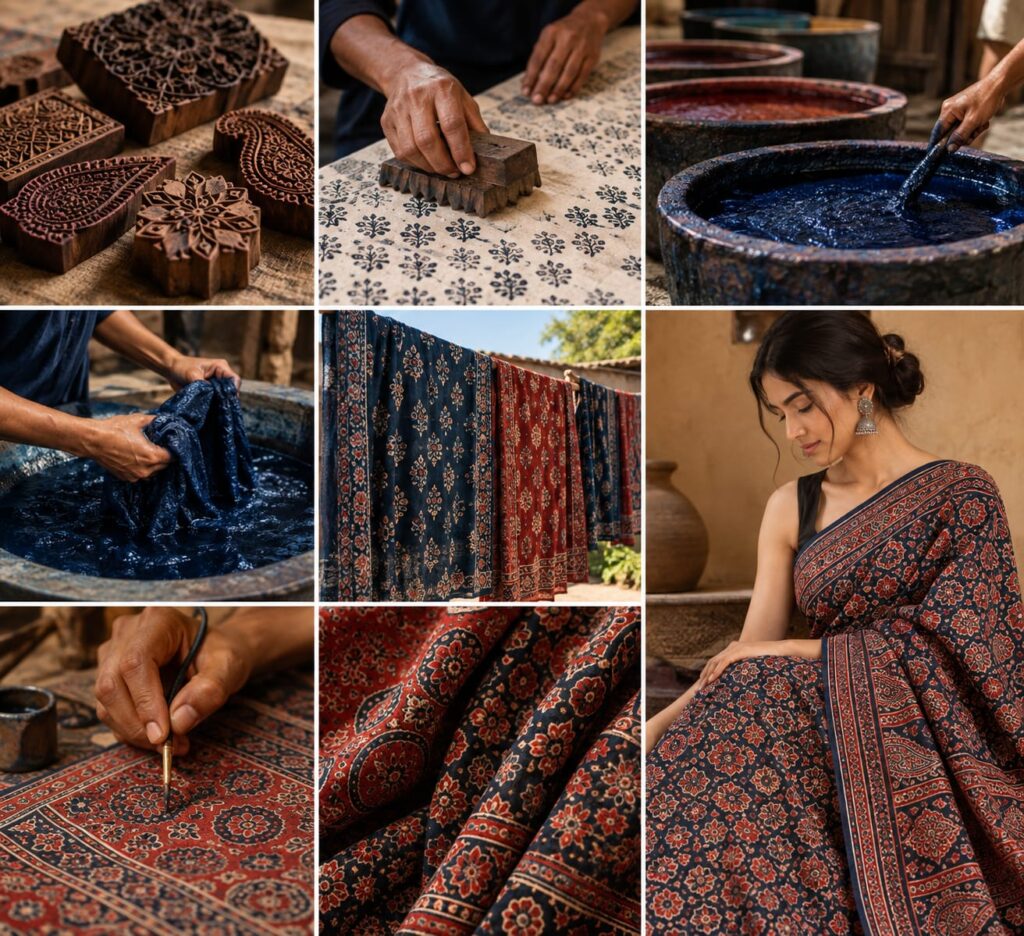
: The journey starts with preparing the fabric. It needs to be properly washed and treated so that it can absorb colours evenly. This may sound like a simple step, but it is important for achieving a good-quality final print.
: Once the fabric is ready, the artisan begins the detailed work of printing and dyeing. Unlike fast machine printing, traditional Ajrakh develops gradually through several stages. This is where the patience of the craftsman becomes part of the textile itself. One of the most fascinating parts of Ajrakh is its wooden block printing.
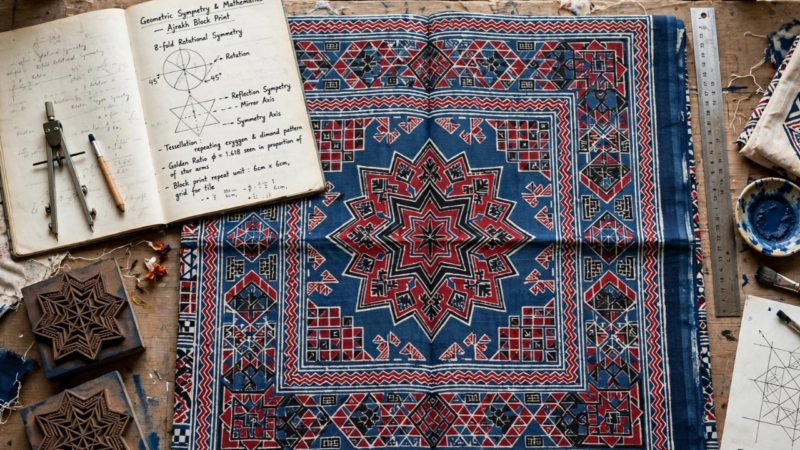
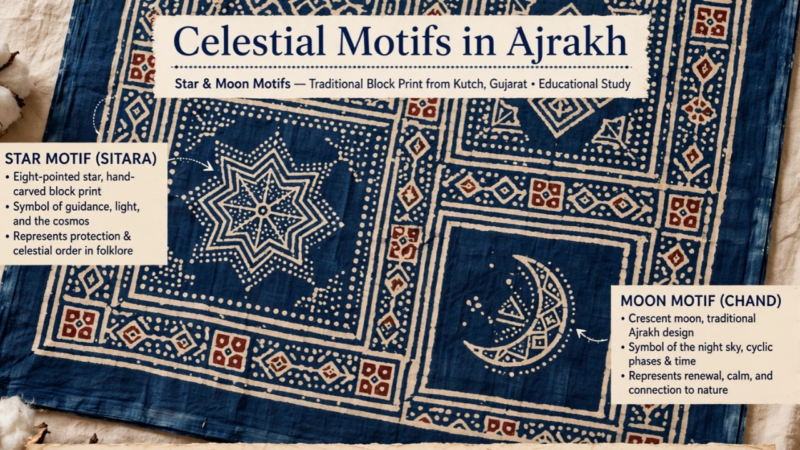
: The blocks are carefully carved with traditional motifs and geometric patterns. Different blocks are used for outlines, borders, and individual design elements.
: The artisan places the block onto the fabric, applies the color, and presses it carefully. Then the same process is repeated across the fabric.
: It sounds repetitive—but maintaining the correct alignment throughout a long piece of fabric requires an experienced eye and a steady hand. A tiny difference in placement can change the entire rhythm of the design.
The Journey of an Ajrakh Print
Ajrakh is created through a combination of printing, dyeing, washing, and drying. Rather than creating the complete design in one step, the artisan builds it gradually.
Natural and traditional dyes are an important part of the craft. Rich indigo blues, earthy reds, blacks, and other shades create the characteristic depth associated with Ajrakh.
The fabric may go through repeated treatments before the final color and pattern are achieved. This layered approach is one reason handmade Ajrakh has such a distinctive visual character.
The Beauty of Imperfection: Understanding the Value of Every Handcrafted Piece
When we look at a machine-made print, we usually expect every motif to be exactly identical.
Handcrafted Ajrakh is different.
Small variations can appear in the printing, Colours intensity, or alignment. Rather than being a flaw, these subtle differences are evidence of the human hand behind the textile.
They remind us that the saree was created through a craft process—not simply reproduced by a machine.
Behind the Price
A handcrafted Ajrakh saree represents much more than its final appearance.
Its value can come from several elements:
- Time spent preparing the fabric
- Skill of the artisan
- Hand-carved wooden blocks
- Multiple stages of printing
- Dyeing and washing processes
- Use of traditional techniques
- Attention required for pattern alignment
- Experience passed down through generations
When we understand this process, the price of a handcrafted textile becomes easier to appreciate. We are not paying only for a piece of fabric; we are also valuing the time, knowledge, labor, and craftsmanship involved in creating it.
The Hands Behind the Pattern
The next time you see an Ajrakh saree, look beyond its colours and motifs.
Think about the hands that carved the blocks, the repeated impressions made across the fabric, the careful dyeing and washing, and the patience required to complete the process.
Beyond Fabric: The Story Ajrakh Tells
For craft students, Ajrakh is a wonderful example of how traditional textile making brings together design, Colours, material knowledge, and technical skill.
For conscious consumers, it offers another perspective on clothing—one where the story behind the product matters just as much as the finished look.
And for artisans, it represents a living craft that continues to connect traditional knowledge with contemporary fashion.
That is the true craftsmanship of Ajrakh—where every print carries not just a pattern, but the time, skill, and human touch of its maker.