

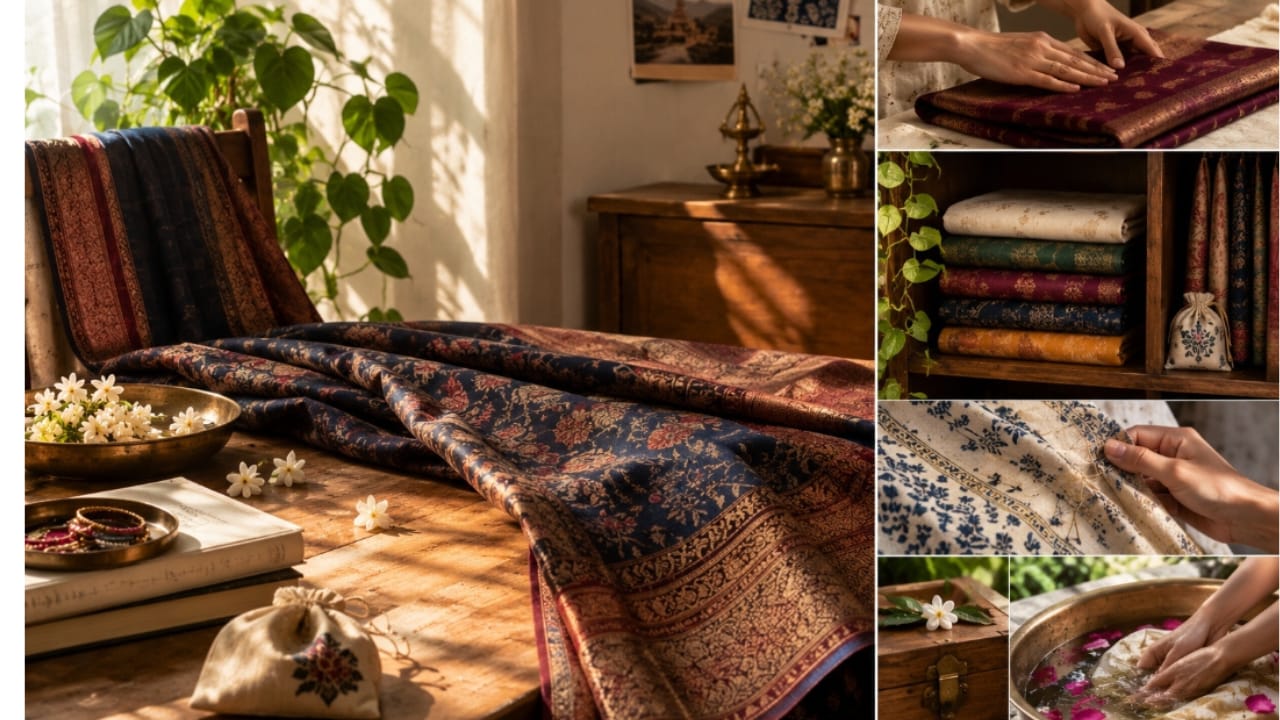
A saree is rarely just another piece of clothing.
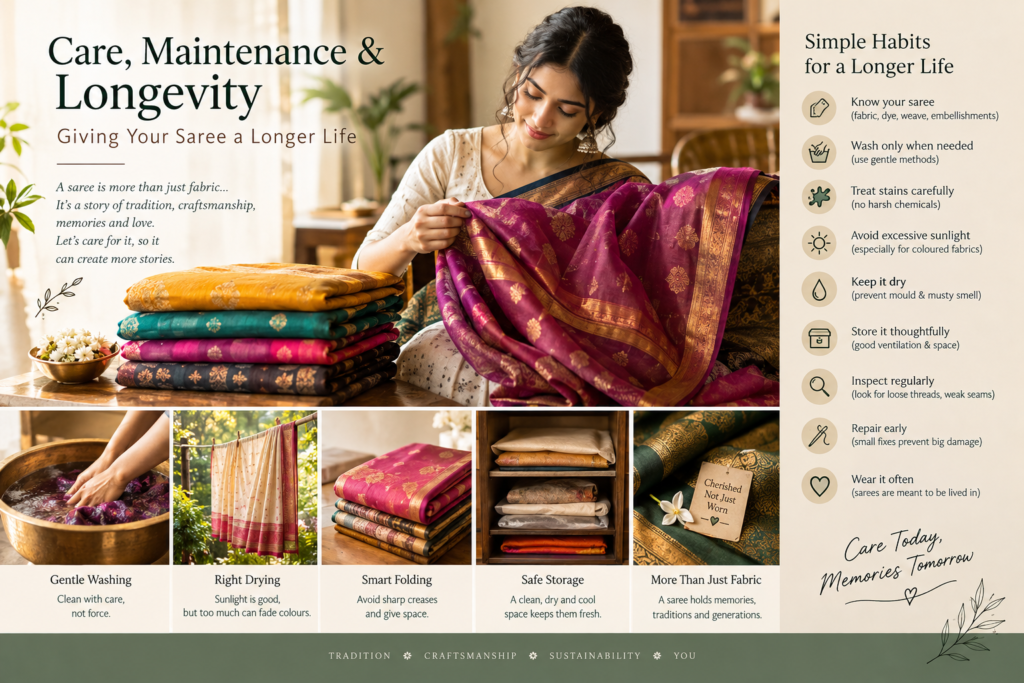
Some sarees are bought because their colors immediately catch the eye. Some are chosen for their weave, some for a beautiful print, and some simply because they remind us of a particular place, person, or moment. A saree may be worn for a wedding, carefully folded away for years, brought out for a festival, and eventually become something that carries memories within its folds.
That is what makes saree care different from ordinary clothing care.
The aim is not simply to keep a saree looking new. It is to protect the fabric, colors, craftsmanship, and character that make it worth keeping.
This becomes even more important with handcrafted sarees. Natural dyes, hand printing, delicate weaves, embroidery, sari, block prints, and traditional finishing techniques can all respond differently to washing, sunlight, moisture, friction, and storage.
A saree that receives thoughtful care can remain part of a wardrobe for many years—and sometimes become something that is passed from one generation to another.
A Saree Begins Aging From the Day You Bring It Home
- We often think of aging as something that happens only after many years.
- For textiles, aging begins much earlier.
- Every time a saree is folded, unfolded, worn, washed, exposed to sunlight, stored in a cupboard, or handled with jewelry, it experiences some degree of change. None of these things are necessarily harmful on their own. They simply become important when repeated over time.
- This is why long-term saree care is not about one perfect washing technique.
- It is about many small decisions made consistently.
- How you fold it.
- Where you keep it.
- How often you expose it to sunlight.
- How you deal with a stain.
- Whether you allow it to dry completely before storing.
- Whether you repair a loose thread when you first notice it.
- Small habits may not seem important today, but their effect becomes visible over years.
First Understand the Saree, Then Decide How to Care for It
- Not every saree should be treated in the same way.
- A lightweight cotton saree, a silk saree, an Ajrakh-printed textile, a handwoven saree, a heavily embroidered piece, and a sari saree can all have different care requirements.
- Even two sarees made from the same fiber may need different treatment because their dyes, prints, weaving techniques, finishes, and embellishments are different.
- Before washing or storing a saree, look at its construction.
- Is the print handmade?
- Does the color appear naturally dyed?
- Is the surface delicate?
- Does it contain sari or metallic work?
- Are there embroidered sections?
- Does the fabric feel unusually soft or lightweight?
- These details can tell you that the saree deserves more careful handling.
- If the saree comes with care instructions from the artisan, weaver, designer, or seller, those instructions should take priority over general advice.
- Understanding the saree is the first form of care.
Washing Less Can Sometimes Mean Caring More
- One of the easiest ways to extend a sarees life is to avoid unnecessary washing.
- This does not mean wearing an unclean saree repeatedly. It simply means understanding that washing itself places stress on textiles.
- Water, detergent, friction, twisting, drying, and repeated handling can gradually affect fibers and colors.
- If a saree has only been worn for a short period and has not become dirty or sweaty, allowing it to air properly may sometimes be enough before storing it.
- This is especially useful for sarees that are worn occasionally.
- Of course, once a saree genuinely needs cleaning, it should be cleaned using the method appropriate to its material and construction.
- The idea is simple:
- Clean your saree when it needs cleaning, not simply because it has been worn once.
Hand washing Is Not Automatically Safe for Every Saree
- Hand washing is often considered gentler than machine washing, but even hand washing can damage a delicate saree if done incorrectly.
- Aggressive rubbing can disturb prints, weaken fibers, or affect delicate surfaces. Twisting a wet saree can put unnecessary stress on the fabric.
- If hand washing is recommended for the particular saree, use a gentle approach and follow the textile’s care instructions.
- Avoid treating a handcrafted saree like a bed sheet that needs vigorous scrubbing.
- The beauty of many traditional sarees lies in details that are not designed to withstand rough handling.
- A little patience during cleaning can make a significant difference later.
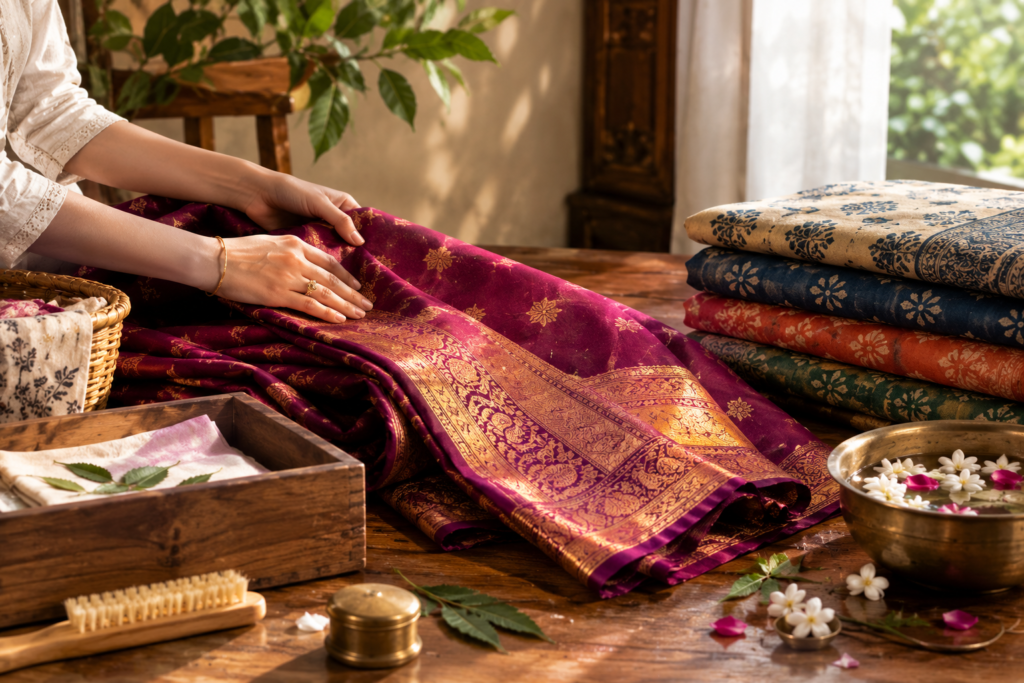
The Relationship Between Water and Color
Color is one of the first things we notice about a saree, but it is also one of the areas that can change with time.
Different dyes behave differently.
Some handcrafted and naturally dyed textiles may have a character that changes subtly with washing and use. Slight variations in color are not necessarily signs that something is wrong. In some traditional textiles, these variations are part of the making process.
However, strong detergents, excessive soaking, high temperatures, or unsuitable washing methods can accelerate unwanted color changes.
For this reason, never assume that a brightly colored saree should be treated exactly like a plain everyday garment.
When in doubt, especially with a valuable or handcrafted saree, it is better to seek care guidance than to experiment.
Never Let a Small Stain Become a Bigger Problem
- A stain can be stressful, particularly when it appears on a saree you love.
- The natural reaction is often to rub it immediately.
- That can sometimes make the situation worse.
- Rubbing may spread the stain, push it deeper into the fibers, or disturb a printed or delicate surface.
- Instead, deal with the stain according to the fabric and the nature of the mark. Avoid applying random household chemicals simply because they worked on another garment.
- For an expensive, antique, delicate, or heavily embellished saree, professional cleaning may be the safer choice.
- The important thing is to resist panic.
- A saree does not need aggressive treatment simply because a small spot has appeared on it.
Sunlight Can Help—and Harm
- There is something beautiful about seeing a saree spread out in natural light.
- The colors become clearer. The weave becomes easier to appreciate. The fabric seems to come alive.
- But prolonged direct sunlight is another matter.
- Strong and repeated exposure can gradually affect dyes and fibers. This can be especially noticeable on deeply colored textiles.
- After cleaning, follow the drying method recommended for that particular saree. Avoid leaving delicate or color-sensitive textiles under harsh sunlight for unnecessarily long periods.
- The same principle applies during storage.
- A saree kept permanently near a bright window may slowly experience uneven fading, particularly in areas receiving direct light.
- Natural light is beautiful.
- Too much of it, however, can leave a mark.
Folding a Saree Is Part of Its Care
- A saree may spend more time folded than it does being worn.
- That makes folding an important part of long-term maintenance.
- Avoid creating extremely sharp folds in exactly the same places for years. When possible, gently refold stored sarees from time to time so that pressure is not continuously concentrated along the same lines.
- Do not compress a large collection into a cupboard so tightly that the fabrics have no room.
- Heavy sarees should also be stored thoughtfully so that their weight does not continuously press against delicate pieces underneath.
- Folding should protect the saree, not squeeze it into submission.
The Saree Needs a Clean and Dry Home
- A cupboard may look perfectly clean from the outside while its internal environment is not ideal for textiles.
- Moisture, poor ventilation, dust, and excessive heat can all affect stored sarees.
- Before storing a saree, make sure it is completely dry.
- This is particularly important after washing or wearing it during humid weather. Even slight moisture trapped between folds can become a problem over time.
- Periodically checking stored sarees is also useful. Open them, inspect the fabric, allow appropriate airing, and refold them carefully when necessary.
- A saree should not disappear into the back of a cupboard for ten years without being checked.
Give Special Sarees Extra Attention
Some sarees deserve additional care because of their construction or value.
Heavily embroidered sarees, sari sarees, vintage pieces, delicate silks, handwoven textiles, and sarees with intricate surface work can be more vulnerable to friction and improper cleaning.
For such pieces, consider:
- Storing them separately when appropriate.
- Avoiding rough or sharp accessories.
- Limiting unnecessary washing.
- Following specific care instructions.
- Inspecting embroidery and borders regularly.
- Seeking professional cleaning when recommended.
- Keeping them away from damp storage areas.
The more delicate the craftsmanship, the more carefully the saree should be handled.
Jewelry Can Be a Sarees Unexpected Enemy
- A saree can be damaged while you are wearing it, without you realizing it.
- Necklaces, bangles, rings, brooches, handbag hardware, and even rough surfaces can catch on delicate fabrics.
- A tiny snag may seem insignificant.
- But repeated snagging can gradually damage a weave or pull a thread further out of place.
- Before wearing a delicate saree, check the jewelry and accessories you plan to pair with it.
- This does not mean avoiding jewelry.
- It means understanding that styling and textile care should work together.
- A beautiful outfit should not come at the cost of unnecessary damage to the fabric.
Your Way of Draping Also Matters
- The way a saree is draped can create repeated pressure points.
- The waist area, shoulder, pleats, and places where pins are used may experience more friction than other sections.
- Pins should be handled carefully, particularly with lightweight or delicate textiles.
- Avoid pulling the fabric unnecessarily tight.
- When removing the saree, take a moment to loosen the pleats and remove pins carefully rather than pulling everything apart quickly.
- This takes only a few extra seconds.
- Over years, those seconds can matter.
Perfume, Makeup and Sarees
- A saree is often the final part of getting dressed.
- By then, perfume, moisturizer, makeup, hair products, and other cosmetics may already be present.
- Direct contact between these products and delicate fabrics can sometimes create marks or affect the textile.
- Allowing skincare and fragrance products to settle before wearing a special saree can reduce unnecessary contact.
- Pay particular attention to areas around the neckline, shoulders, and sleeves.
- Good saree care often comes down to preventing a problem rather than trying to repair it later.
Do Not Ignore a Loose Thread
- A loose thread can look harmless.
- Sometimes it is.
- Sometimes it is the beginning of a larger problem.
- If a thread has become loose, resist the temptation to pull it.
- Pulling may disturb the surrounding weave and make the problem worse.
- Instead, assess the area and, when necessary, have it repaired by someone familiar with the fabric.
- The same applies to loose embroidery, weak seams, or damaged borders.
- Early attention is usually easier than major repair later.
Storage Is Not the End of the Sarees Life
A special saree is often kept in storage because it is considered too precious to wear frequently.
Ironically, storing something forever can sometimes disconnect it from the reason it was loved in the first place.
- A saree is made to be worn.
- Instead of waiting for the “perfect occasion,” thoughtful rotation can allow special pieces to become part of life.
- Wear them carefully.
- Store them properly.
- Maintain them regularly.
- A saree that is worn thoughtfully can create memories that a saree hidden away in a cupboard never will.
Age Does Not Always Mean Damage
- One of the most interesting things about traditional textiles is that aging is not necessarily the same as deterioration.
- A saree may become softer with use.
- Its folds may carry memories.
- Its colors may acquire a subtle character.
- Its surface may show signs of a life that has actually been lived.
- The goal of care should not always be to make an old saree look exactly like a new one.
- Instead, good maintenance protects the textile from unnecessary deterioration while allowing natural aging to remain part of its story.
- A well-loved saree does not have to remain frozen in time.
- It simply needs to remain strong enough to continue its journey.
Repair Instead of Replacing
- Modern wardrobes often encourage quick replacement.
- A damaged garment is discarded.
- A faded garment is forgotten.
- A loose seam becomes a reason to buy something new.
- Traditional sarees invite a different approach.
- A saree with a damaged edge can sometimes be repaired.
- A blouse can be altered.
- A textile can be restyled.
- A family saree can be passed down.
- A damaged section can sometimes be restored by someone with the right textile skills.
- Repair does more than save fabric.
- It preserves craftsmanship.
- It keeps memories alive.
And it allows a saree to continue being useful instead of becoming another forgotten object.
Caring for a Saree Is Also Caring for Craft
- When you take care of a handcrafted saree, you are protecting more than your own purchase.
- You are also respecting the work behind it.
- Think about the hands involved in making a traditional textile—the weaver, printer, dyer, embroiderer, designer, or artisan.
- Hours of skill can exist inside something that takes only a few seconds to fold.
- That perspective changes how we handle it.
- A handmade saree is not disposable simply because another one can be purchased.
- Its value includes the time, knowledge, and craft invested in creating it.
- Care is one way of acknowledging that.
The Sustainable Side of Saree Longevity
- There is also a practical environmental benefit to keeping sarees for longer.
- When a saree remains useful for years, the need to replace it becomes less frequent.
- The same piece can be styled differently across occasions.
- A traditional saree can be paired with a contemporary blouse.
- An older saree can be restyled with different jewelry.
- A family saree can become part of a new generation’s wardrobe.
- Longevity gives one textile more opportunities to be useful.
- Sustainability does not always begin with buying something new.
- Sometimes it begins with taking better care of what is already in your cupboard.
A Saree Can Carry More Than Color and Pattern
- Ask someone about a favorite saree and the answer is often not simply about its color.
- They may remember who gave it to them.
- Where they bought it.
- What occasion they wore it to.
- Who complimented them.
- Which city they visited while wearing it.
- Which family member helped them drape it.
- That is why sarees can become emotional objects.
- Their physical life and emotional life become connected.
- Good maintenance protects the fabric, but it also protects the possibility of those memories continuing.
A Simple Saree-Care Philosophy
- There is no need to make saree care complicated.
- A thoughtful routine can begin with a few simple habits:
- Know your saree.
Understand its fabric, print, weave, dye, and embellishments. - Wash only when needed.
Follow the care method appropriate for the textile. - Treat stains gently.
Avoid aggressive rubbing and random chemicals. - Protect it from excessive light.
Especially when storing colored or delicate pieces. - Keep it completely dry.
Moisture should never be trapped inside folded fabric. - Store it thoughtfully.
Give sarees enough space and keep the storage environment clean and dry. - Inspect occasionally.
Look for loose threads, weak seams, stains, or signs of moisture. - Repair early.
Small problems are easier to manage before they become larger. - Wear it.
A well-cared-for saree should still have a life beyond the cupboard.
Let the Saree Grow Older With You
Perhaps the most beautiful way to think about saree longevity is to stop expecting a saree to remain exactly the same forever.
- A saree changes.
- You change too.
- The first time you wear it, it may be for a special occasion.
- Years later, it may remind you of that day.
- Perhaps the same saree will eventually be worn by someone younger in your family.
- Its color, texture, and folds may carry evidence of the life it has lived.
- That is not failure.
- That is longevity.
- The purpose of caring for a saree is not to keep it untouched.
- It is to help it survive enough of life’s moments to become meaningful.
The Last Fold
- A sarees journey does not end when it leaves the store.
- In many ways, that is when its real story begins.
- It enters wardrobes, celebrations, photographs, festivals, family gatherings, journeys, and everyday moments. It is folded, unfolded, worn, washed, repaired, stored, rediscovered, and sometimes passed forward.
- Care gives that journey more time.
- Maintenance protects the details that make the saree special.
- And longevity gives craftsmanship the opportunity to travel beyond a single season or generation.
- A beautiful saree is worth wearing.
- A meaningful saree is worth keeping.
- And a well-cared-for saree can become something even more valuable—a piece of clothing that does not simply survive with time, but collects a story with it.