
India’s textile traditions are not simply divided by patterns, colors, or fabrics. They are shaped by places, people, weather, history, local resources, family traditions, and countless small decisions made by artisans along the way. A textile may look beautiful when it is finally placed on a shelf or wrapped around someone, but its real story often begins much earlier—in a village workshop, beside a dyeing vat, at a wooden printing table, or inside a home where a craft has been practiced for generations.
This is what makes regional textiles so fascinating. Move from one part of India to another, and the language of craft changes. The colors may become softer or stronger. Motifs may change their rhythm. Fabrics may feel different in the hand. Even the way an artisan works can reflect the landscape around them.
A saree, for example, can carry the character of its region without announcing it. Its colors, borders, motifs, texture, and method of making can quietly tell us where it comes from and what kind of community has preserved its making.
Behind every traditional textile, there are people.
There are dyers who understand how color behaves. Printers who know exactly how much pressure a wooden block needs. Weavers who can feel a thread without measuring it. Embroiderers who turn small stitches into stories. And there are families who have protected these skills not because they were fashionable, but because they were part of everyday life.
Regional textile traditions are therefore also stories of artisan communities.
A Textile Often Begins With Its Landscape
- Before talking about a particular craft community, it is worth understanding the role of geography.
- India’s regions offer very different natural environments. Some areas are dry and dusty, others humid and green. Some have access to particular plants, minerals, water sources, or agricultural materials. These conditions have historically influenced the materials artisans could work with and the techniques they developed.
- Even water can matter enormously.
- Traditional dyeing and printing processes may depend on the quality of water available in a particular area. The same dyeing process can behave differently when the water changes. Local knowledge develops through years of observation, and artisans learn to make small adjustments almost instinctively.
- The climate also affects clothing traditions. In one region, lightweight cotton may be practical for everyday wear, while another may develop heavier textiles suited to a different environment.
- This is why regional identity in textiles is not simply a matter of decoration. It is often a response to the surroundings.
- The landscape becomes part of the textile without ever being directly printed onto it.
- When we look at a traditional textile, it is easy to focus on its appearance first.
- We notice the color.
- Then the motif.
- Then perhaps the border or texture.
- But artisans often see something else.
- They see the process.
- They can recognize the type of fabric, understand how the dye has behaved, notice the pressure of a print, or identify whether something was made by hand or mechanically reproduced.
- This difference between looking and understanding is important.
- A machine can reproduce a pattern with impressive consistency. Handmade textiles, however, often contain small variations. A line may be slightly different. A color may have tiny changes in intensity. A motif may not sit perfectly in the same position.
- These details are sometimes treated as imperfections.
- Within traditional craftsmanship, they can be evidence of the human hand.
- The individuality of a handmade textile comes partly from these small differences. It reminds us that the object was not simply produced—it was worked on.
Ajrakh and the Living Tradition of Kutch
- One of the clearest examples of regional identity can be seen in Ajrakh, particularly in the Kutch region of Gujarat.
- Ajrakh is known for its deep indigo, earthy reds, black, white, and carefully arranged geometric and floral forms. But describing Ajrakh only through its color palette would miss much of its character.
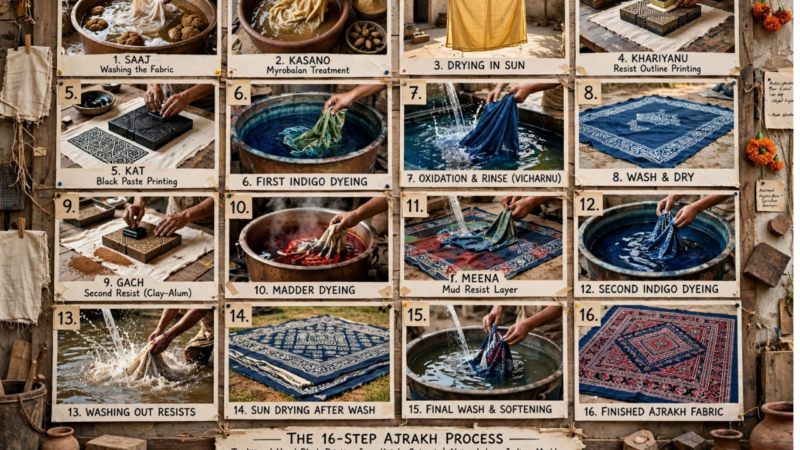
- The craft is closely connected with communities of artisans who have preserved complex processes involving resist printing, natural and synthetic dyes, washing, drying, and repeated printing.
- What makes the tradition remarkable is the patience involved.
- A single piece can pass through numerous stages before reaching its final form. Fabric may be washed, treated, printed, dyed, washed again, and printed repeatedly. Each stage affects what comes next.
- The artisan is not simply following a decorative recipe.
- They are responding to the material.
- The fabric has its own behaviour. The dye has its own nature. The weather can influence drying. Water quality can affect washing and dyeing. The printing block must meet the fabric with the right amount of pressure.
- This relationship between craft and environment is one reason regional traditions cannot always be separated from their geographical roots.
- Ajrakh belongs to a place, but it also travels.
- Today, Ajrakh-inspired textiles can be seen far beyond Kutch. They appear in contemporary clothing, home decor, accessories, scarves, sarees, and fashion collections.
- Yet the story becomes richer when we remember where the knowledge came from.
The Artisan Community Is Part of the Design
- We often describe a textile by its pattern.
- But who made the pattern possible?
- Traditional crafts survive through communities. Knowledge is frequently passed from experienced artisans to younger members of families or local communities. Some skills are learned through formal teaching, while others are absorbed simply by watching, helping, repeating, and making mistakes.
- A young artisan may have grown up seeing fabric being washed in the morning, blocks being arranged on a printing table, or dyed textiles drying in the sun.
- At first, these activities may look ordinary.
- Over time, they become knowledge.
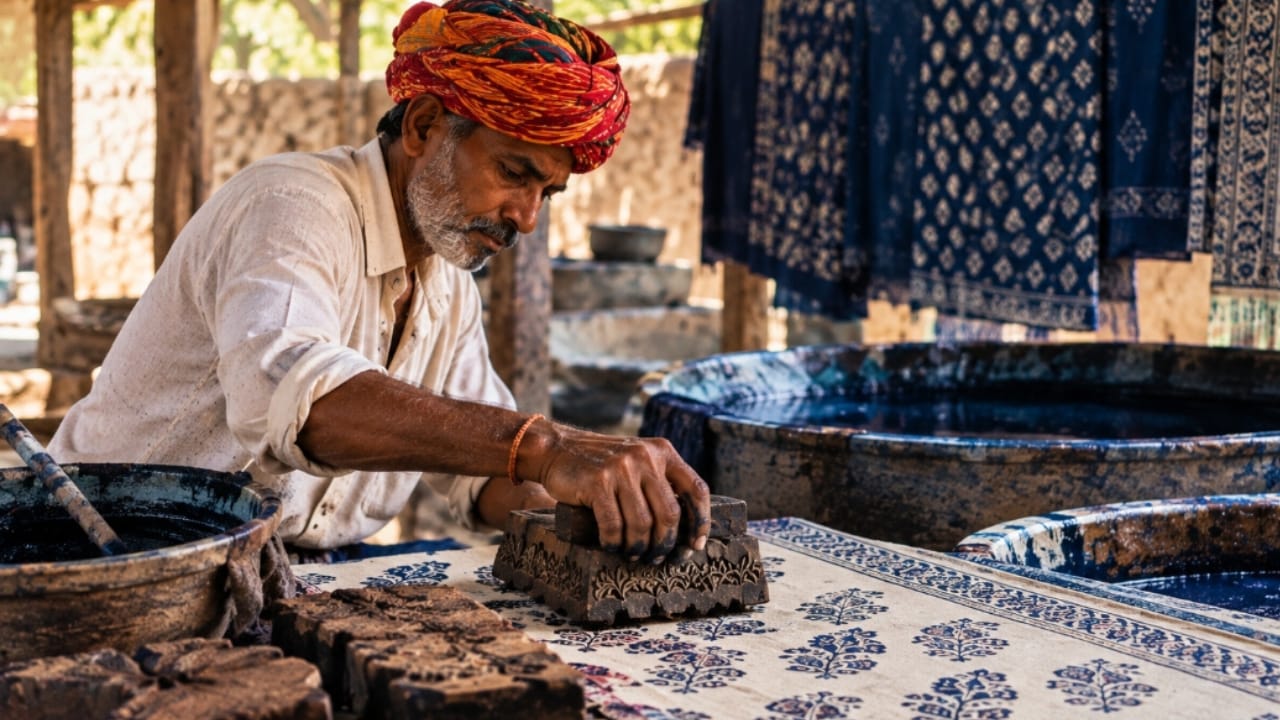
- The hand learns how to hold the block.
- The eye learns to judge alignment.
- The mind learns how colors will interact.
- The body remembers the movement.
- This kind of knowledge is difficult to capture completely in written instructions because much of it is practical and sensory.
- That is why artisan communities are so important to textile heritage.
- A technique can be documented, but keeping it alive requires people who are willing and able to continue practicing it.
Regional Nuances Are More Than Color
When we say that two textiles have different regional identities, we are not talking only about color.
Regional nuances can appear in many ways:
- Motifs may reflect local nature, architecture, beliefs, or historical influences.
- Colors can be influenced by available dyes, local preferences, and cultural traditions.
- Fabric choices may respond to climate and practical use.
- Printing methods can differ from one craft center to another.
- Weaving structures can create distinctive textures.
- Borders and layouts can become recognizable signatures of a region.
- Finishing techniques may be passed down within particular communities.
- Uses can reveal how a textile fits into everyday or ceremonial life.
Even the same basic material can become completely different when interpreted by another community.
That is where regional craft becomes interesting.
There is no single Indian textile language.
There are many.
And they continue to evolve.
The Hands Behind the Cloth
- It is easy to say that a saree is “handcrafted.”
- The phrase sounds beautiful, but it can become meaningless if we forget what those hands actually do.
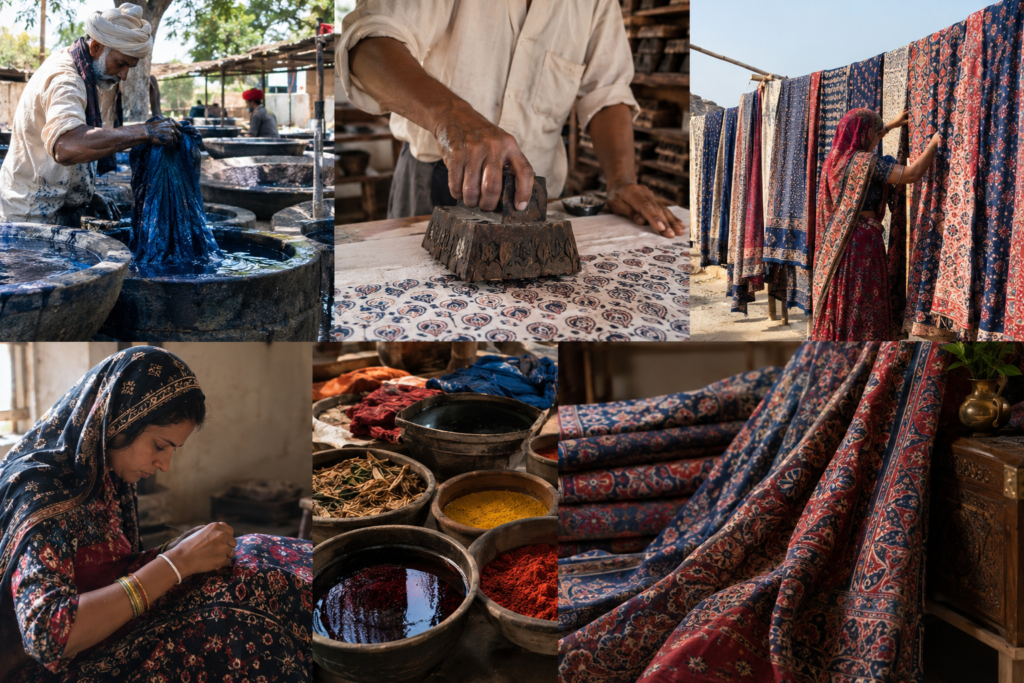
- Consider the journey of a printed textile.
- Someone has to prepare the fabric.
- Someone needs to prepare the colors.
- Someone must position the printing block.
- Another person may wash or dye the fabric.
- The textile needs to dry.
- The process may need to be repeated.
- Finally, the fabric must be finished and prepared for use.
- Each stage contains decisions.
- A small mistake can affect the next stage. A slightly different amount of dye can alter the final shade. Uneven pressure can change a print. Weather can affect drying.
- The artisan is therefore working with variables rather than simply pressing a button.
- This is one reason handmade textiles deserve to be viewed differently from mass-produced fabric.
- Their value is connected not only to the final appearance but also to the time, skill, knowledge, and labor invested in reaching that appearance.
When Craft Becomes a Family Memory
- For many artisan communities, textile-making is more than an occupation.
- It can be connected to family identity.
- A skill learned from a parent may be taught to a child. A particular block may remain in a family workshop for years. Old patterns may be remembered even when the original paper designs no longer exist.
- Sometimes, the most valuable knowledge is not written anywhere.
- It exists in memory.
- An older artisan may remember how a particular color was traditionally prepared. Another may know how to achieve a particular finish. Someone else may understand which part of the process needs more attention during a certain season.
- These forms of knowledge are fragile.
- If younger generations move away from the craft because it no longer provides a sustainable livelihood, the knowledge can disappear with them.
- This is why supporting artisans is not only about purchasing a beautiful textile.
- It can also contribute to keeping knowledge in circulation.
Tradition Does Not Mean Standing Still
- One misconception about traditional crafts is that they must remain exactly as they were in the past.
- In reality, living traditions change.
- Artisans respond to changing customer preferences, new fabrics, new colors, changing fashion, and new markets. A craft may move from traditional clothing into contemporary fashion. A pattern once used on one type of fabric may appear on another.
- Ajrakh, for example, has found a place in modern wardrobes far beyond its traditional applications.
- This does not necessarily mean the craft has lost its identity.
- Adaptation can sometimes help a craft survive.
- The important question is how that adaptation happens.
- When contemporary demand encourages artisans to experiment while respecting the knowledge behind the technique, tradition can remain alive rather than becoming frozen in time.
- The craft continues to speak—but in a new vocabulary.
Women and the Often-Unseen Work of Textiles
- The story of artisan communities also needs to include work that is not always visible.
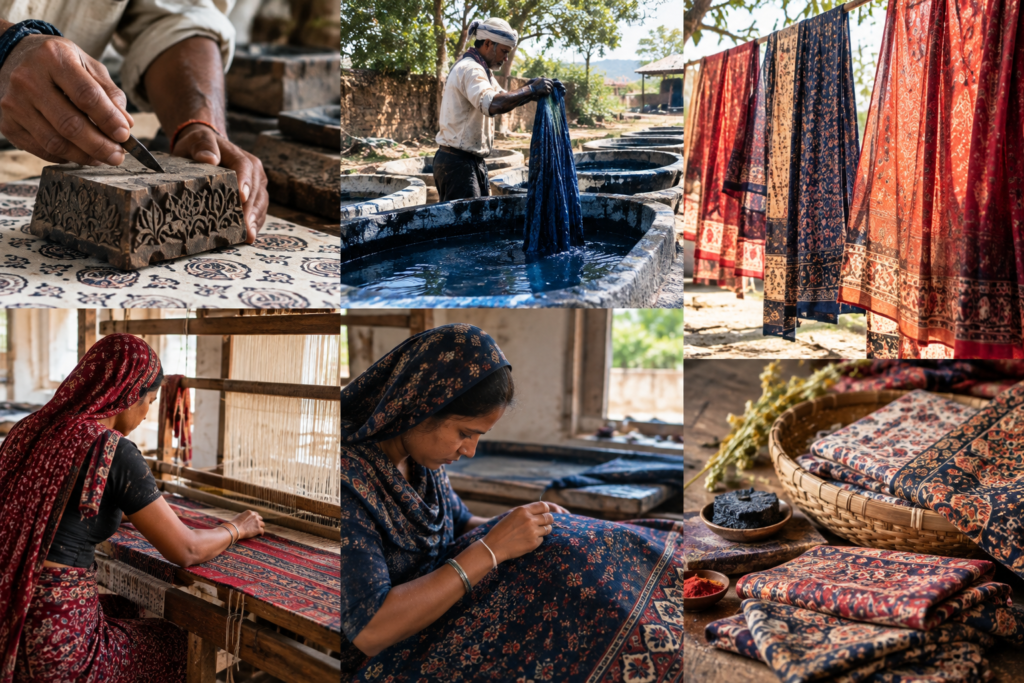
- In many textile traditions, women have played important roles in spinning, embroidery, stitching, finishing, preparation, and other stages of production. Yet the final product may not always carry the names of everyone involved.
- This makes the textile industry a story of collective labor.
- One finished saree can represent the contribution of several people.
- Some work happens in workshops.
- Some happens in homes.
- Some stages may be completed by specialists in different locations.
- The final textile brings all of these efforts together.
- Recognizing this invisible labor changes the way we look at handmade products. Instead of imagining one artisan creating everything from beginning to end, we begin to see a network of skills.
- That network is the real community behind the craft.
The Difference Between Handmade and Hand-Finished
- Modern textile markets contain many terms that sound similar but can mean very different things.
- “Handmade,” “hand-printed,” “handwoven,” and “hand-finished” are not interchangeable.
- A textile may involve a combination of handmade and machine-based processes. For buyers who care about authenticity, understanding how a textile was actually produced can be more useful than relying on attractive labels.
- Asking questions can help.
- Who made it?
- Where was it made?
- Which part was done by hand?
- What printing or weaving technique was used?
- Are the colors natural, synthetic, or a combination?
- How long does the process generally take?
- These questions do not need to be asked with suspicion. They can be a way of appreciating the craft more deeply.
- The more we understand the process, the more meaningful the final textile becomes.
Why Small Variations Tell a Story
- One of the most beautiful aspects of handmade textiles is that they are rarely perfectly identical.
- Two sarees made using the same technique may have slight differences.
- The color might vary subtly.
- The print may have a tiny irregularity.
- The texture may feel slightly different.
- Instead of seeing these differences as defects, it can be useful to understand them as part of the handmade process.
- Of course, quality still matters. Poor workmanship and genuine handmade variation are not the same thing.
- A well-made traditional textile can have character without being careless.
- The distinction comes from understanding the craft.
- This is why knowledge is important for both artisans and buyers.
- An informed buyer can appreciate authentic variation, while an artisan can receive recognition for the skill involved in producing it.
Regional Crafts in a Changing Market
- The textile market today is very different from the one in which many traditional crafts developed.
- Customers can discover products through social media, websites, online marketplaces, exhibitions, and international fashion platforms. A textile once known primarily within a particular region can now reach buyers thousands of kilometers away.
- This creates opportunities.
- It can also create challenges.
- Greater demand can provide artisans with new income opportunities, but rapid production pressure may make it difficult to maintain traditional processes. There can also be confusion between authentic craft and machine-made products inspired by traditional designs.
- Another challenge is pricing.
- A handmade textile may take considerably more time than a mass-produced imitation. When buyers compare only the final price, the handmade product can appear expensive without understanding what the price represents.
- The cost may include skilled labor, multiple processing stages, materials, washing, dyeing, printing, finishing, transportation, and the artisan’s time.
- The price of a textile therefore tells only part of its story.
- The process tells the rest.
Preserving Craft Without Turning It Into a Museum Piece
- Preservation does not mean keeping a craft locked in the past.
- A craft survives when people continue to use it.
- A saree that is worn, washed, repaired, and passed to another generation becomes part of living culture. A hand-printed fabric used in contemporary clothing can introduce an old technique to someone who might otherwise never encounter it.
- This is why modern design and traditional craftsmanship can exist together.
- Designers may experiment with silhouettes.
- Artisans may work with new color combinations.
- Younger customers may style traditional textiles differently.
- None of this automatically removes cultural value.
- In some cases, it gives the craft another life.
- The goal is not simply to preserve an old object.
- It is to preserve the knowledge, dignity, and opportunity that allow people to continue creating.
A More Thoughtful Way to Buy Traditional Textiles
- For someone purchasing a traditional saree or textile, the experience can become much more meaningful with a little curiosity.
- Instead of asking only, “Does this look beautiful?” consider asking:
- Who made it?
- Where does the craft come from?
- What technique was used?
- How much of the process was done by hand?
- What makes this region’s textile tradition distinctive?
- Is the artisan or craft community being fairly represented?
- These questions turn shopping into learning.
- They also help us move beyond the idea that traditional textiles are simply fashion products.
- They are cultural products, but they are also working products made by living communities.
- That distinction matters.
The Future Belongs to Both Heritage and Change
- Traditional textile crafts have survived because they have changed while carrying important parts of their identity forward.
- The future will probably bring more changes.
- Digital marketplaces will connect artisans with new customers. Social media will introduce regional crafts to younger audiences. Contemporary designers will reinterpret traditional techniques. Buyers will become increasingly interested in the story behind what they wear.
- At the same time, the future of these crafts will depend on whether artisan communities can continue to earn sustainable livelihoods from their skills.
- A craft cannot survive only because people admire it.
- It needs people who practice it.
- It needs younger generations who see value in learning it.
- It needs customers who understand the work behind the final product.
- And it needs markets that recognize craftsmanship rather than treating handmade work as simply another inexpensive category.
Where the Pattern Ends, the Story Continues
- A traditional textile is easy to admire from a distance.
- Its colors catch the eye.
- Its patterns create rhythm.
- Its texture invites touch.
- But the deeper beauty appears when we understand the people and places behind it.
- Regional nuances remind us that Indian textiles were never created in one uniform style. Each community developed its own relationship with material, color, technique, environment, and culture.
- Artisan communities turned that knowledge into something tangible.
- A printed block became a repeated pattern.
- A natural dye became color.
- A thread became fabric.
- A technique became tradition.
- And a tradition became something that could travel from one generation to another.
- That is perhaps the most important part of textile heritage.
- The story does not end when the artisan finishes the fabric.
- It continues when someone wears it, cares for it, tells its story, and passes it forward.
- A saree can therefore be more than something beautiful to wear. It can become a small piece of regional memory—carrying the character of a place and the knowledge of people whose hands have kept that tradition alive.
- When we look closely, the pattern is only the beginning.
- Behind it are landscapes, families, workshops, generations, experiments, failures, patience, and countless human hands.
- And that is what makes a traditional textile truly worth remembering.