
There are journeys that begin with a destination.
And then there are journeys that begin because staying is no longer possible.
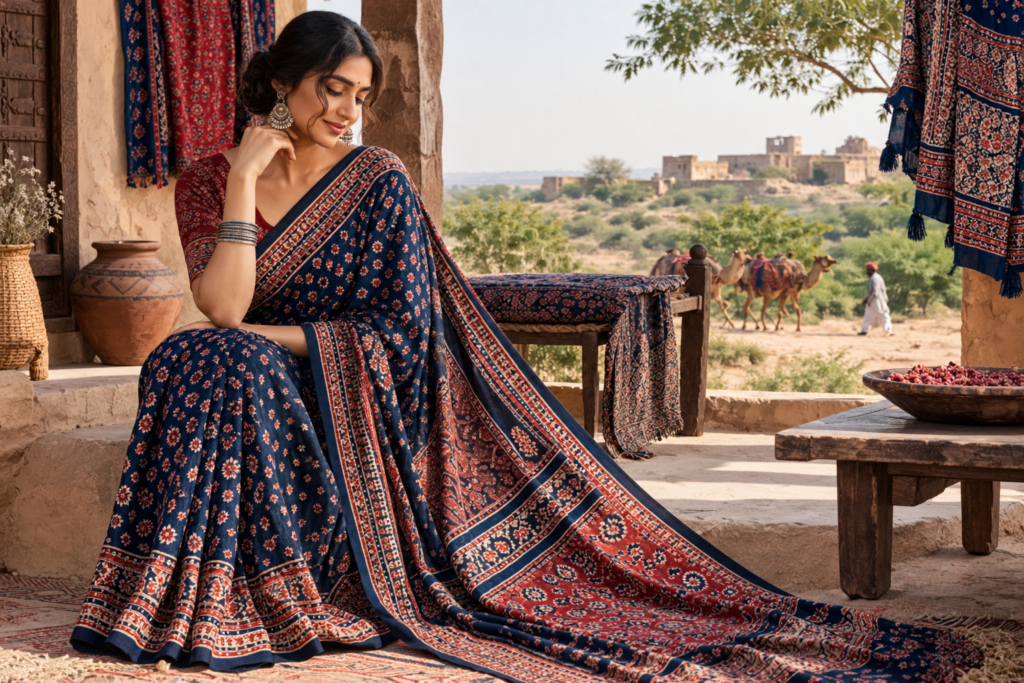
Some journeys are remembered through dates, some through family stories, and some through objects that quietly survive long after the people who made them are gone.
The journey from Sindh to Kutch belongs to the last kind.
It is difficult to tell this story only through maps. A map can show where Sindh ends and Kutch begins, but it cannot show what a family carried when it moved. It cannot show the wooden printing blocks wrapped carefully among belongings, the knowledge of natural dyes remembered by hand, or the stories of a homeland that slowly became part of another landscape.
The movement of communities between Sindh and Kutch created cultural connections that can still be seen today, particularly in textile traditions such as Ajrakh. Historical sources associate Khatri printing communities with migration from Sindh to Kutch, where the craft later developed into one of the region’s most recognizable textile traditions.
But perhaps the most interesting part of this history is not simply that people moved.
- It is what happened after they arrived.
- They did not merely reproduce the life they had left behind.
- They adapted.
- They learned the new land.
- They met new communities.
- They found new customers.
- And slowly, the memory of one place became woven into the identity of another.
Before There Was a Border
Today, Sindh and Kutch are separated by an international border.
For the people of earlier centuries, the landscape was understood differently.
There were no modern border checkpoints interrupting every movement. Communities travelled for trade, pastoral life, work and other practical reasons. The wider region connected people through routes that crossed dry landscapes, villages and seasonal environments.
Kutch itself has never been a place where movement was unusual.
Its pastoral communities travelled in search of grazing and water. Traders moved goods. Artisans moved where their skills were needed.
In such a world, migration was not necessarily the dramatic event that the modern word sometimes suggests.
Sometimes it was simply a decision:
Where can we live?
Where can our children work?
Where can our craft survive?
Those questions may sound modern, but they have existed for generations.
A Family Does Not Migrate Alone
- When we read about migration in history books, it can sound as though an entire community suddenly picked itself up and moved.
- Real migration is rarely so simple.
- A family leaves.
- Another family stays.
- Someone returns.
- Someone settles permanently.
- A child grows up in the new place.
- A grandparent continues telling stories about the old one.
- Over time, the meaning of “home” becomes complicated.
- For artisan communities, there was another important thing to carry:
- their profession.
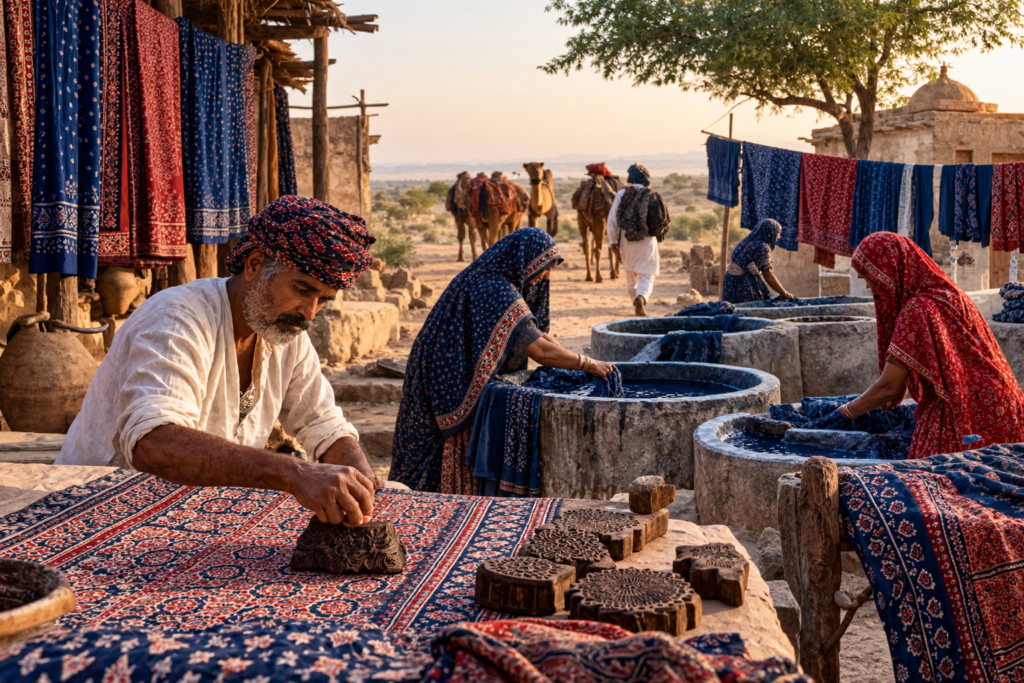
- For the Khatri printers associated with Ajrakh, their knowledge was not just a job. It was a form of inheritance.
- They knew how fabric needed to be prepared.
- They understood printing blocks.
- They knew how color behaved.
- They knew how washing, resist printing and dyeing worked together.
- That knowledge could travel.
- And that made the craft itself capable of migration.
The Arrival of the Printers
Historical accounts connect the arrival of Khatri cloth printers from Sindh with the development of textile printing in Kutch. Shaped records an important migration during the reign of Rao Bharmalji I, who ruled Kutch from 1586 to 1631, while the Government of India’s handicrafts documentation also describes Ajrakh as a craft that originated in Sindh and later flourished in Karachi.
- But imagine the arrival not as a line in a history book.
- Imagine an artisan seeing Kutch for the first time.
- The landscape is unfamiliar.
- The soil is unfamiliar.
- The local communities have their own ways of dressing.
- The climate demands adjustment.
- The artisan has brought something from home—but that something now has to make sense here.
- This is where migration becomes more than movement.
- It becomes translation.
- A craft has to learn a new language.
When the New Land Started Changing the Old Craft
- A beautiful misconception about traditional crafts is that they remain unchanged for centuries.
- In reality, living crafts are constantly negotiating with their surroundings.
- The people who make them change.
- The people who wear them change.
- The materials available to them change.
- Markets change.
- Even water can change the process.
- Ajrakh is a perfect example.
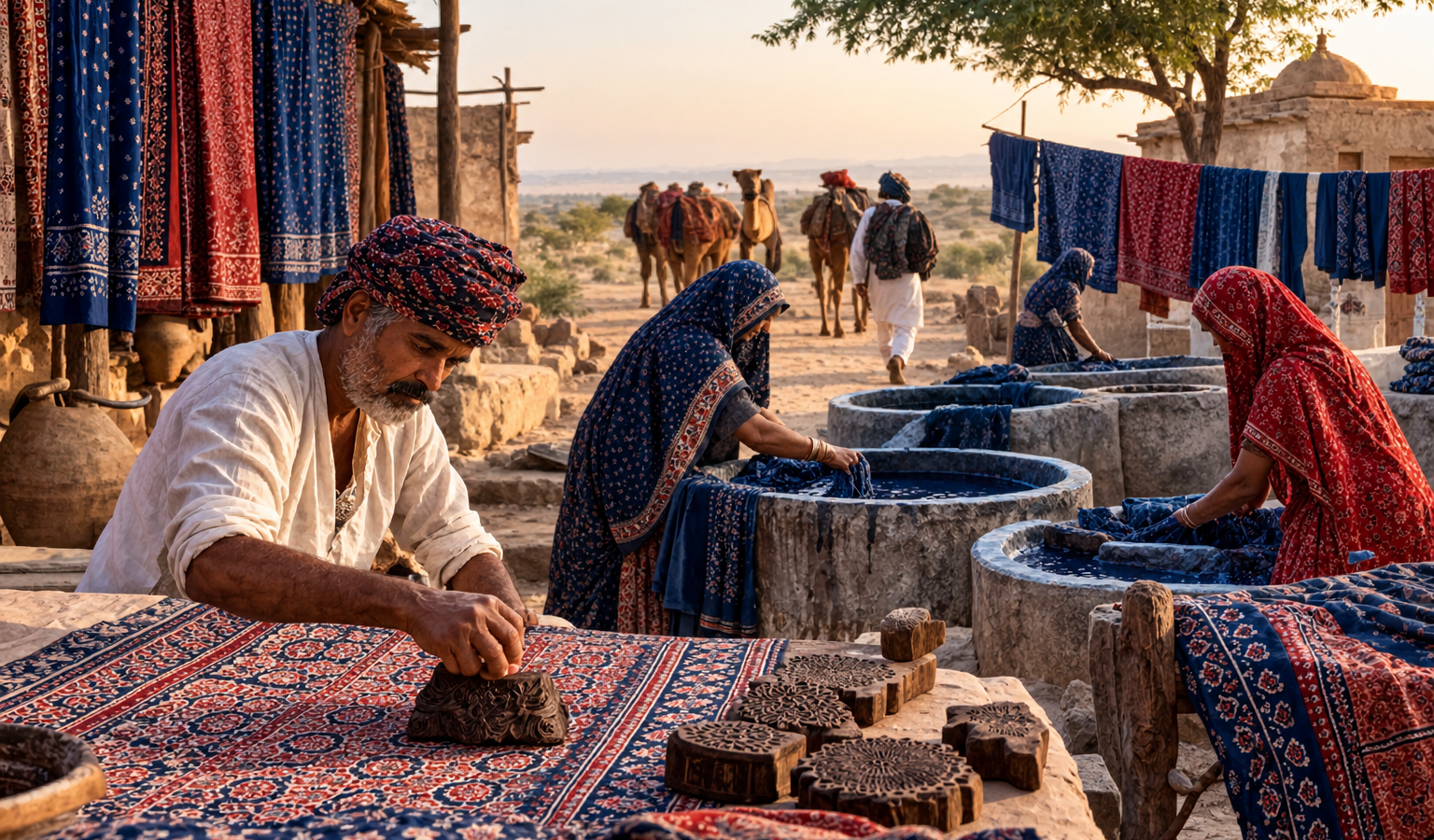
- Its traditional production involves repeated washing, dyeing, resist printing and block printing. Water was therefore not simply a background resource; it was closely connected to the practical survival of the craft. Historical accounts connect Khatri settlement in Kutch with places such as Dhamadka, which became important centers of Ajrakh production.
- The craft was therefore shaped by the new land.
- Sindh had not disappeared from it.
- It had simply gained another chapter.
Dhamadka: Where Hands Found a New Home
- Dhamadka became one of the important centers associated with Ajrakh printing.
- The name is now familiar to people interested in traditional Indian textiles, but behind the name is a much more human story.
- A craft community had to establish itself.
- It had to find customers.
- It had to create relationships.
- It had to make a living.
- And it had to teach the next generation.
- The relationship between Khatri printers and pastoral communities was particularly important. Kashmir’s documentation describes the historical connection between Ajrakh printers and Malarial communities and records accounts of printers traveling to Bani to sell textiles and maintain relationships with customers.
- This tells us something important.
- Ajrakh did not survive only because artisans knew how to print.
- It survived because people wanted to wear it.
- A craft lives when there is a relationship between the hand that makes something and the person who finds meaning in using it.
The Cloth That Knew Its People
- Before Ajrakh became a fashionable textile for contemporary wardrobes, it had a much more intimate role.
- It belonged to everyday life.
- It was connected with communities, clothing practices and identity.
- Traditional Ajrakh was associated with pastoral communities in Kutch and the wider Sindh–Kutch region, including Maldharis. Its use was not limited to decoration; different forms were used as garments and accessories.
- This changes how we should look at an old textile.
- A cloth is easy to admire when displayed in a gallery.
- But imagine the same cloth being worn every day.
- Imagine dust settling on it.
- Imagine it being washed.
- Imagine it traveling across a village.
- Imagine someone recognizing a person from far away because of the colors or style they were wearing.
- That is when a textile stops being an object.
- It becomes part of someone’s life.
The Colors of a Migrating Memory
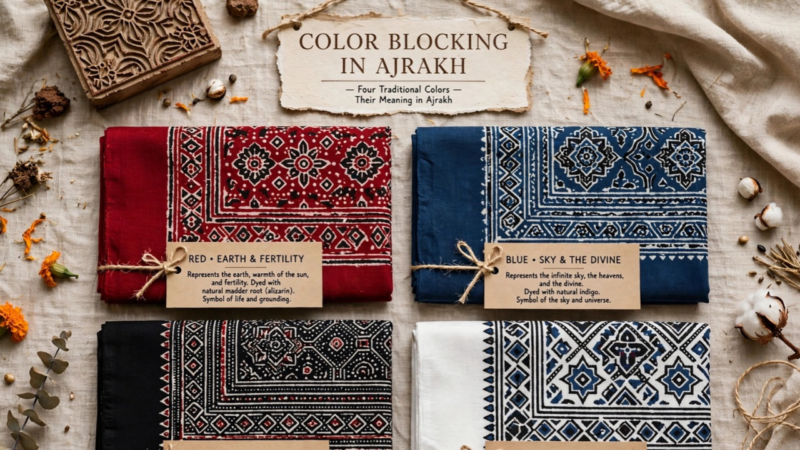
- Ajrakh color palette is instantly recognizable.
- Deep indigo.
- Rich red.
- Black.
- White.
- Earthy shades.
- The colors seem to belong naturally to the landscape.
- And perhaps that is part of their appeal.
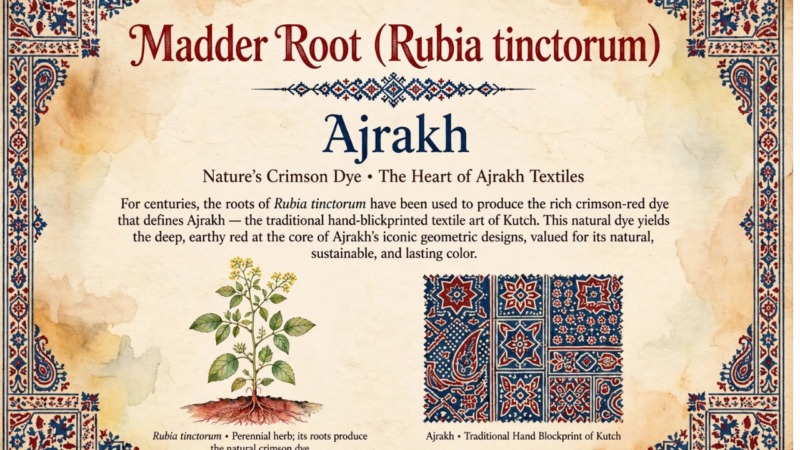
- Ajrakh traditional production is associated with natural dyes and complex resist-printing processes. Indigo and madder are among the dyes traditionally connected with the craft.
- But colors also have emotional power.
- Indigo can feel like night.
- Red can feel like earth, warmth or celebration.
- Black can create depth.
- White allows everything around it to breathe.
- Together, they create a textile that looks both ancient and remarkably modern.
- That is one reason Ajrakh has travelled so successfully into contemporary design.
- Its visual language never really needed to become fashionable.
- It already had a language of its own.
And Then the World Drew a Line
- For centuries, cultural connections between Sindh and Kutch developed across a landscape that did not resemble today’s political map.
- Then came Partition in 1947.
- Suddenly, the relationship between the two regions was transformed.
- The border became real.
- Routes that had once been used for trade and movement were disrupted.
- Communities that had shared economic and cultural connections were separated.
- Kashmir’s documentation describes the impact of Partition on trade between Sindh and Kutch and notes how the closure of the border affected traditional relationships, including those between Khatri printers and Malarial communities.
- For a textile tradition, this mattered enormously.
- Because textiles need movement.
- Cotton needs to move.
- Dyes need to move.
- Blocks need to move.
- Artisans need customers.
- Ideas need exchange.
- When movement stops, a craft has to find another way to survive.
When the Old Customer Disappeared
- One of the hardest parts of cultural change is that it does not always announce itself.
- Sometimes it begins quietly.
- A customer stops coming.
- A traditional garment becomes less common.
- A cheaper machine-made fabric enters the market.
- A young person decides that another profession will provide a more stable income.
- One generation understands the craft.
- The next generation may not want it.
- Industrialization placed enormous pressure on traditional textile communities. Historical accounts of Ajrakh describe how the availability of mill-made cloth and changing consumer preferences affected the traditional craft economy.
- This was not only an economic problem.
- It was a cultural question:
- If nobody wears the cloth, who will keep making it?
The Craft Had to Learn How to Survive Again
- This is where the story becomes especially interesting.
- Ajrakh did not survive by pretending the world had not changed.
- It adapted.
- The textile gradually found new uses and new audiences.
- Traditional patterns began appearing in contemporary clothing.
- Designers became interested in handmade processes.
- Customers outside the communities traditionally associated with Ajrakh began discovering it.
- Research on Ajrakh documents its transition from a traditional textile associated with specific communities into a broader fashion and design material.
- This transformation is sometimes described as “modernization.”
- But perhaps another word fits better:
- continuation.
- The craft continued because it found a reason to remain relevant.
The Earthquake That Changed the Map Again
- Just when the story seemed to have survived centuries of change, Kutch faced another major disruption.
- In 2001, a devastating earthquake struck Gujarat, causing extensive destruction in Kutch.
- Artisan settlements were affected.
- Homes and workshops were damaged.
- Communities once again had to rebuild.
- Ajrakh story gained another chapter in the years following the earthquake, with the development of Ajrakhpur as a new center for artisans.
- There is something almost poetic about this.
- The craft had once crossed from Sindh to Kutch because people were building a new life.
- Centuries later, artisans were again building.
- Different reason.
- Different generation.
- Same instinct.
- Keep the work alive.
Ajrakhpur: A New Place for an Old Memory
- Ajrakhpur is more than a location on a map.
- Its significance comes from what it represents.
- A community whose history already included migration had to rebuild after another disruption.
- The craft became part of that rebuilding.
- Workshops became spaces where old techniques could continue.
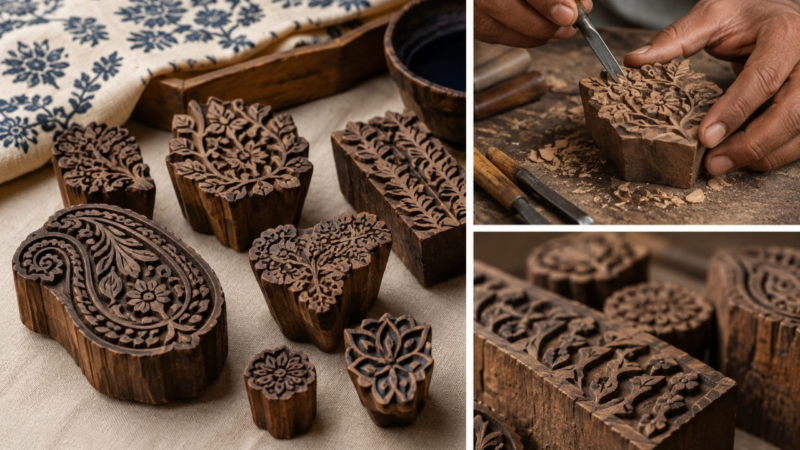
- Blocks could still be carved.
- Fabric could still be washed.
- Dyes could still be prepared.
- Patterns could still emerge.
- And younger artisans could watch older hands.
- This is how heritage survives in reality.
- Not through grand speeches.
- Through repetition.
- One block.
- One piece of fabric.
- One lesson.
- One generation.
- Then another.
What Did the Migrants Really Carry?
- Perhaps this is the question that deserves the most attention.
- When people moved from Sindh toward Kutch, what exactly travelled with them?
- Not just possessions.
- They carried skills.
- They carried taste.
- They carried memory.
- They carried stories.
- They carried ways of working.
- They carried an understanding of what looked beautiful.
- They carried knowledge about what a community needed from its textiles.
- Some things could be placed in a bag.
- Other things could only exist inside a person’s memory.
- That is what makes artisan migration different from ordinary movement.
- A person can carry a wooden block.
- But they cannot physically carry the entire knowledge behind using it.
- That has to be remembered.
- And eventually taught.
A Block Is Never Just a Block
- Look closely at a traditional printing block.
- It may look like a small piece of carved wood.
- But imagine the number of decisions hidden inside it.
- Which lines should be raised?
- How should the pattern repeat?
- How will it meet the next block?
- How will the design behave after washing?
- How will color change the appearance?
- The block is only the tool.
- The knowledge is in the hands.
- That is why traditional textile knowledge is so difficult to replace with machines.
- A machine can reproduce a pattern.
- It cannot automatically reproduce the cultural memory behind the pattern.
- It cannot tell the story of why that particular form travelled from one community to another.
- It can copy the surface.
- It cannot inherit the journey.
When Home Becomes More Than One Place
- Perhaps migration changes the meaning of home.
- For someone whose family moved from Sindh to Kutch generations ago, what is home?
- Is it Sindh because that is where the ancestors came from?
- Is it Kutch because that is where the family built its life?
- Maybe the answer is both.
- This is one of the most beautiful aspects of cultural heritage.
- It does not always demand one identity.
- A tradition can remember its birthplace while belonging completely to its new home.
- Ajrakh demonstrates this beautifully.
- Its historical roots are strongly associated with Sindh.
- Its modern identity is deeply connected with Kutch.
- The two histories do not need to compete.
- They can exist together.
A Border Cannot Easily Stop a Pattern
- Political borders can control movement.
- They can change trade routes.
- They can divide territories.
- But patterns are harder to contain.
- A motif can travel through memory.
- A technique can survive inside a family.
- A color combination can be remembered.
- A textile can carry the visual language of a place long after the people who first created it have moved somewhere else.
- That is why textiles are such powerful historical documents.
- They do not speak with dates and paragraphs.
- They speak through repetition.
- Through color.
- Through material.
- Through touch.
From Sindh to Kutch, and From Kutch to the World
- Today, Ajrakh is no longer confined to the communities and contexts in which it was traditionally used.
- It can be seen in sarees, scarves, garments, contemporary fashion and home textiles.
- Its journey has become much larger.
- But its growing popularity also creates a responsibility.
- If we only see Ajrakh as a beautiful print, we miss half the story.
- The other half belongs to the people.
- The printers.
- The block makers.
- The dyers.
- The families.
- The communities who wore it.
- The generations who kept teaching it.
- And the migrants who carried its knowledge across landscapes.
The Real Meaning of Heritage
- Heritage is often imagined as something old.
- A monument.
- An ancient building.
- A museum object.
- But heritage can also be something that is still moving.
- Still changing.
- Still being made.
- Ajrakh is one such example.
- Its heritage is not trapped in the past.
- It is being recreated every time an artisan works with cloth.
- Every time a block touches fabric.
- Every time a natural dye changes the color of a textile.
- Every time a young person learns a technique from an older generation.
- That is why the story of Sindh to Kutch is not finished.
- It is still being printed.
The Journey That Never Really Ended
- Perhaps the most powerful way to understand the migration from Sindh to Kutch is not to imagine a line drawn between two points.
- Imagine instead a thread.
- One end disappears into the history of Sindh.
- The thread travels through generations.
- It passes through hands.
- It crosses landscapes.
- It encounters new communities.
- It survives political borders.
- It bends around economic change.
- It survives industrial competition.
- It passes through the destruction of an earthquake.
- And eventually, it reaches the present.
- But it does not stop there.
- Someone takes the thread and continues.
- That is the real story of migration.
- People move, but they do not necessarily leave their culture behind.
- Sometimes they carry it quietly.
- Sometimes they rebuild it.
- Sometimes they change it.
- And sometimes, without even realizing it, they create something that belongs to both the place they left and the place they found.
- Sindh gave the story one of its earliest chapters.
Kutch gave it another home.
The artisans gave it hands.
And generations gave it time. - That is why Ajrakh is more than a textile tradition.
- It is a record of movement.
- A memory of adaptation.
- A meeting between two landscapes.
- And, perhaps most beautifully, proof that when people migrate, their stories can migrate with them—and sometimes those stories become stronger in the place where they finally take root.