
A textile can tell a story without saying a single word.
Look closely at a piece of Ajrakh. Notice the deep indigo, the earthy red, the carefully repeated borders and the small geometric details that seem to fit together almost perfectly. It may look like a beautiful piece of fabric, but behind those colors and patterns is a much longer story—a story of people, movement, skill, memory and generations of learning.
At the center of this story is the Khatri community of Kutch, particularly the artisans associated with traditional textile crafts such as block printing, Ajrakh, Bandhani, Batik and dyeing.
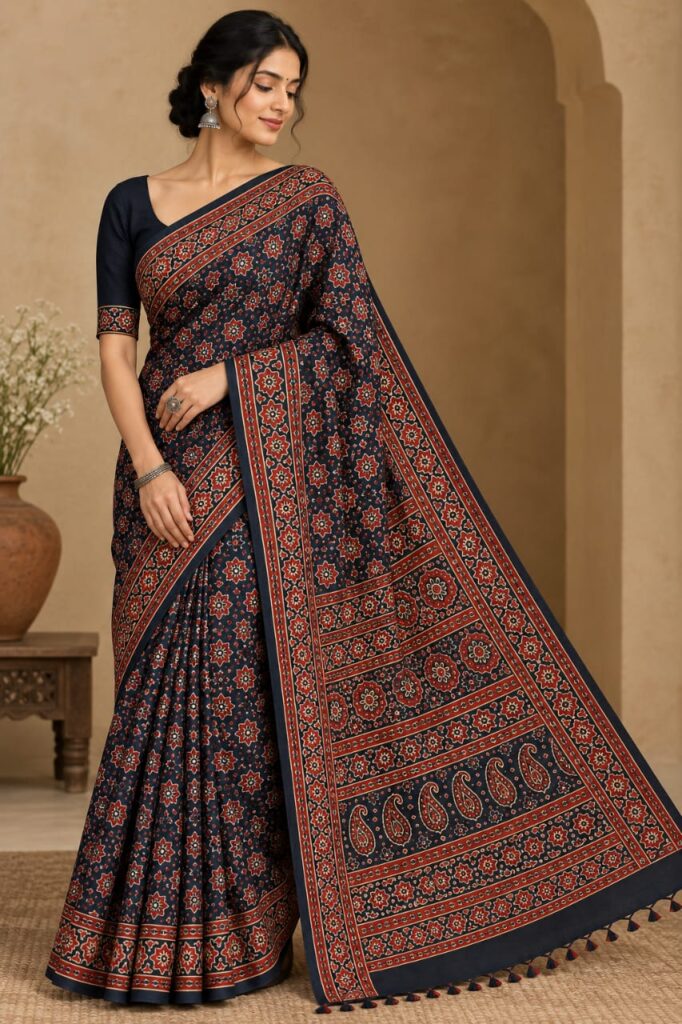
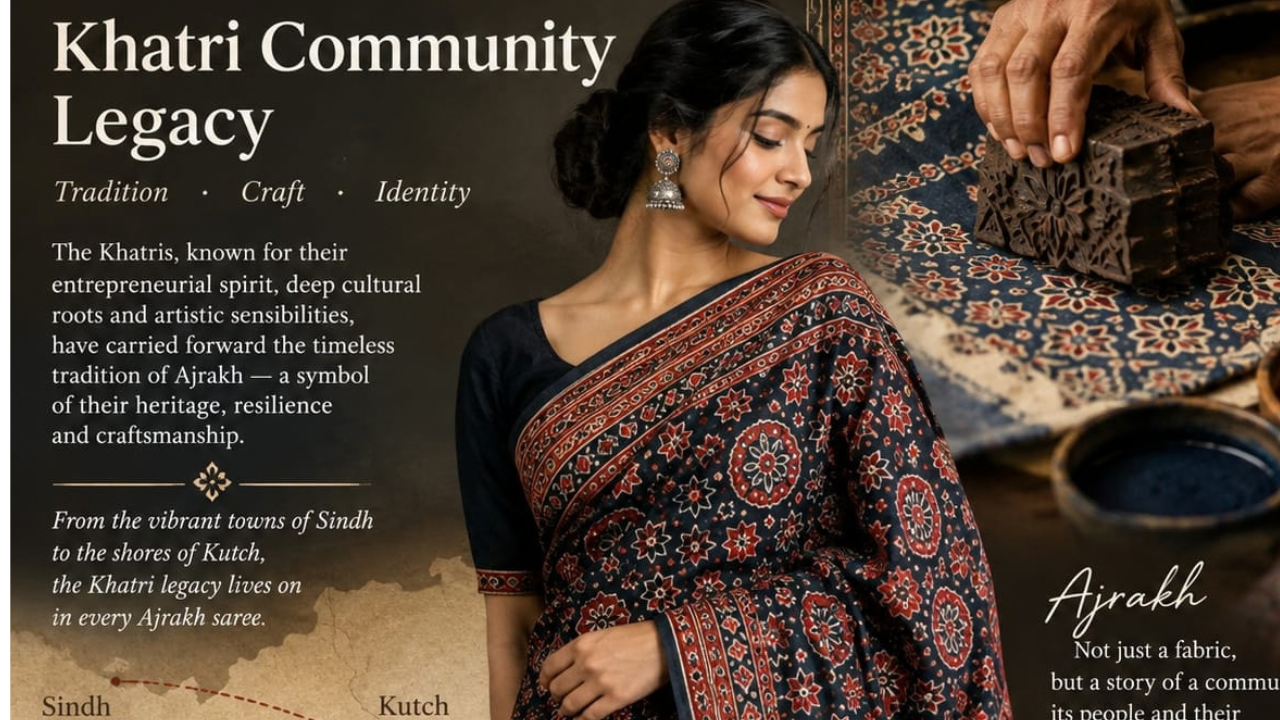
The history of Khatri artisans in Kutch is closely connected with Sindh. Historical and community sources describe Khatri families moving from Sindh into Kutch, carrying with them knowledge of textile printing and dyeing. Over time, this knowledge became deeply rooted in the landscape of Kutch and developed its own local character.
But the Khatri legacy is not simply the story of one craft.
It is the story of a community that learned how to make tradition useful in changing times.
It is about artisans who understood that color was not merely decoration, that a pattern could communicate identity, and that a craft could survive only when knowledge was passed from one pair of hands to another.
Most importantly, it is a story of people.
A Community Defined by Skill
The word “Khatri” is often immediately associated with textile printing in Kutch, but the community’s craft traditions are broader than a single technique.
Kashmir’s documentation describes Khatri in Kachchh as an artisan community with traditions including block printing, Batik, tie-and-dye and Rogan painting. It also notes that both Hindu and Muslim Khatri live in Kachchh.
This diversity is important.
There is no single story that can explain every Khatri family.
Different families settled in different parts of Kutch. They developed relationships with different communities. Some specialized in particular techniques or color traditions. Some worked with local farmers, some with pastoral communities and others with customers in nearby villages.
The craft was therefore not produced in isolation.
It grew through relationships.
An artisan needed a customer who valued the work.
A customer needed a textile that matched a particular way of dressing.
A village needed someone who understood its preferred colors and motifs.
This created an economic and cultural relationship that could continue for generations.
From Sindh to Kutch: Carrying Knowledge Across the Landscape
The connection between Sindh and Kutch is one of the most important parts of Khatri history.
According to Shaped, Kutch ruler Rao Bharmalji I, who ruled from 1586 to 1631, invited cloth-printing Khatri artisans from Sindh to settle in Kutch. The source records that the artisans were given land and relief from taxes on their produce, and that Dhamadka and Khalid eventually became important centers of the craft.
Community histories preserved by Khamir also remember migration from Sindh and describe ancestral links to places such as Khalid and Dhamadka. One family tradition traces an ancestor, Jinda Jeeva, to a settlement in Kutch around the seventeenth century. These family memories are valuable oral histories, although individual accounts naturally differ from one another.
What matters most is what the migrants brought with them.
They brought knowledge.
They understood how cloth should be prepared before printing.
They knew how colors could be created and fixed.
They understood the behaviour of dyes.
They knew how blocks needed to meet one another.
They knew that washing was not an afterthought but part of the making process.
And they knew that experience mattered.
A craft like this cannot simply be learned from a written instruction sheet.
It has to be watched.
Practiced.
Corrected.
Repeated.
That is why the migration of artisans was also a migration of knowledge.
Dhamadka and the Making of a Craft Center
Dhamadka became one of the places most strongly associated with Khatri textile printing in Kutch.
The location was particularly important because traditional printing and dyeing required access to water. Washing, preparing and dyeing fabric were essential parts of the process, and community accounts remember rivers and water sources as central to everyday craft life.
It is easy to look at an old textile and think only about the final design.
But imagine the work before the finished cloth existed.
Fabric had to be prepared.
It had to be washed.
Natural materials had to be processed.
Dyes had to be prepared.
Blocks had to be positioned accurately.
Resist areas had to be protected.
The cloth had to pass through repeated stages.
Then it had to be dried.
The same process had to be repeated again and again.
This required patience, but it also required a deep understanding of materials.
That understanding became part of the Khatri inheritance.
The Customer Was Part of the Craft
One of the most fascinating aspects of traditional Khatri textile production was the close relationship between artisan and customer.
Kashmir’s documentation records that Khatri printers produced textiles for particular communities and that designs, colors and styles could be connected to the needs and identity of those communities. The traditional system could be highly specific, with particular families or groups purchasing from particular printers.
This meant that the artisan did not necessarily print a large quantity of cloth and simply wait for an unknown buyer.
The artisan knew the customer.
He knew what the customer wore.
He understood which designs were expected.
He knew when more cloth would be needed.
Marriage celebrations could create greater demand.
Festivals could bring another period of activity.
In some cases, customers and printers maintained relationships across generations.
This is very different from the modern idea of textile production.
Today, a garment may be designed for an anonymous market.
Earlier, a textile could be made for a community whose tastes the artisan already understood.
The customer was not just a buyer.
The customer was part of the craft’s ecosystem.
Ajrakh and the Communities Who Wore It
Ajrakh became particularly associated with pastoral communities in Kutch.
Shaped identifies Muslim nomadic animal-keeping communities, including Maldharis in Kutch, among the traditional purchasers of Ajrakh. The textile was traditionally used as part of clothing, including garments such as sarongs and turbans.
Kashmir’s community documentation adds another layer to this relationship, describing Khatri printers working with different Maldharis groups and recalling journeys to Bani to sell cloth. Artisans describe relationships in which business was connected with trust, hospitality and long-standing familiarity.
This relationship gives Ajrakh a meaning beyond fashion.
It was not originally created for a runway.
It was part of someone’s everyday identity.
The cloth could tell people something about where a wearer belonged.
Its colors and designs were not simply chosen because they looked attractive.
They could be connected with community traditions.
This is why the disappearance of traditional customers later became such an important challenge for Khatri printers.
When the wearer changes, the craft has to change too.
The Art of Color: More Than Decoration
Khatri textile traditions are deeply connected with color.
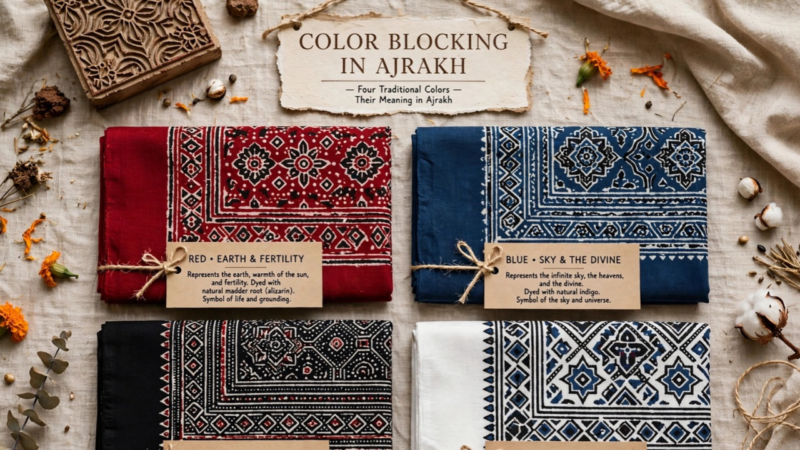
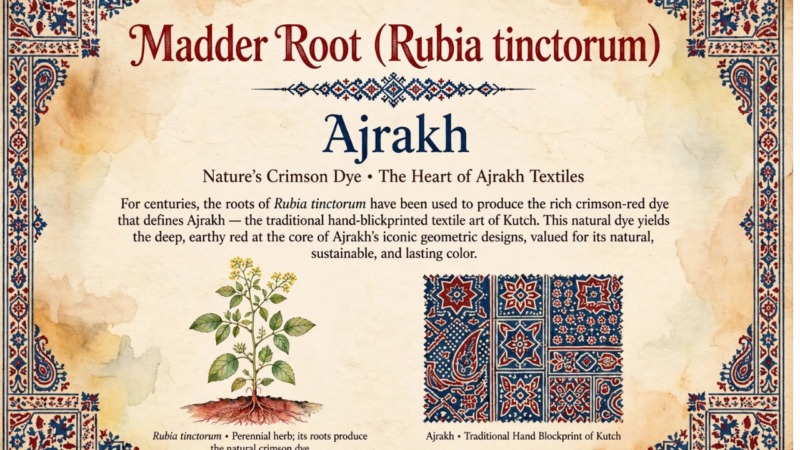
Ajrakh is particularly recognized for combinations of indigo, red, black and white, along with complex geometric and floral arrangements. Traditional production can involve repeated washing, dyeing, resist application, block printing and drying. The Government of Gujarat describes a traditional Ajrakh process involving numerous stages and natural materials.
The beauty of these colors comes partly from the patience behind them.
A natural dye is not simply poured onto cloth and forgotten.
The fabric must be prepared.
The color has to be encouraged to enter the fiber correctly.
Resist areas must remain protected.
The cloth may be washed and dried repeatedly.
The artisan has to understand timing.
This is where craft knowledge becomes almost invisible.
A finished textile does not show every decision that created it.
It simply looks beautiful.
But the beauty is the final result of hundreds of small decisions.
Khatri and the Wider Textile Heritage of Kutch
Ajrakh is perhaps the best-known Khatri textile tradition associated with Kutch, but it is not the only one.
Khatri artisans are also strongly connected with Bandhani, the traditional tie-and-dye craft.
The Government of Gujarat’s Kachchh district documentation describes Bandhani as a craft associated with the migration of Khatri community members from Sindh to Kutch and notes that Khatri artisans remain major producers of Bandhani in Gujarat.
Bandhani is based on a completely different visual process from block printing.
Instead of pressing a carved block onto fabric, sections of cloth are tightly tied before dyeing.
When the threads are removed, small areas resist the color and create patterns.
The result may look delicate.
The process is anything but simple.
Traditional Khatri expertise therefore extends beyond one textile identity.
Their legacy is better understood as a broader knowledge of color, resist, pattern and cloth.
When Trade Routes Changed
The Khatri craft economy was never separated from trade.
Raw materials moved.
Textiles moved.
Customers moved.
Artisans moved.
Kashmir’s historical documentation records that communities in parts of Kutch obtained materials from Sindh and that trade between Sindh and Kutch continued through different routes for long periods. It also records how changing geography and later political events affected these connections.
Then came 1947.
Partition changed everything.
The international border made the earlier movement between Sindh and Kutch far more difficult.
Trade routes were disrupted.
Pastoral communities whose movement had once crossed the region were affected.
For Khatri artisans who depended on those communities as customers, the consequences were serious. Kashmir’s documentation specifically records the collapse of trade between parts of Kutch and Sindh after Partition and the effect on communities whose traditional economic relationships had depended on movement across the region.
This was not simply a change on a map.
It changed people’s livelihoods.
When Machine-Made Cloth Entered Everyday Life
Partition was not the only challenge.
Industrialization also transformed the textile market.
Machine-made cloth could be produced more quickly and sold at lower prices.
For customers who depended on affordable clothing, handmade textiles could become difficult to purchase regularly.
Shaped notes that Khatri artisans in Kutch increasingly stopped producing traditional Ajrakh for some Maldharis customers because cheaper screen-printed materials became popular.
This created a difficult moment.
The traditional craft was beautiful.
It was technically demanding.
But beauty alone cannot pay for raw materials, lab-our and time.
A craft community needs an economic reason to continue.
The Khatri therefore faced a question that many traditional artisans have faced:
How do you protect an old skill without refusing the modern world?
The 2001 Earthquake and Another Beginning
In 2001, a devastating earthquake struck Gujarat, causing severe destruction across Kutch.
Dhamadka was badly affected.
For Khatri artisans, this was another major interruption to a history that had already experienced migration, changing trade routes and industrial competition.
But once again, the community rebuilt.
Khamir records that Khatri families came together to establish Ajrakhpur, a new village dedicated to printing craftsmen. Homes and workshops were developed with support from organization working in the region, and a shared washing area was created for the printing units.
Ajrakhpur therefore represents more than a new settlement.
It represents continuity after disruption.
The artisans had lost homes and workshops.
Some had lost treasured tools and blocks.
Yet the knowledge remained.
A wooden block can be broken.
A workshop can collapse.
But knowledge stored in a person’s hands is harder to destroy.
That knowledge became the foundation for starting again.
Ajrakhpur and the New Generation
The establishment of Ajrakhpur also opened new possibilities.
Its location closer to Bhuj created opportunities to connect with traders, customers and visitors. Kashmir’s documentation describes Ajrakhpur as a growing craft village and records around 80 Khatri families living there at the time of its documentation.
The craft also began entering new design spaces.
Researchers have documented how Ajrakh changed from a traditional textile associated with rural communities into a contemporary fashion fabric. Designer collaborations, exhibitions and new markets helped create demand beyond its older customer base.
This transformation is important because it shows that tradition does not always survive by remaining unchanged.
Sometimes it survives by finding a new audience.
The traditional block remains.
The knowledge remains.
The color language remains.
But the product may become a sarees, shirt, scarf, jacket, home textile or contemporary fashion piece.
The craft moves forward without completely abandoning its past.
The Legacy Is Not Just in the Cloth
It would be easy to define Khatri heritage through beautiful textiles.
But the deeper legacy is the knowledge system behind those textiles.
It includes knowing how to prepare fabric.
Knowing which dye to use.
Knowing how much pressure to apply to a block.
Knowing how a pattern should repeat.
Knowing how a community likes to dress.
Knowing when a cloth needs more washing.
Knowing how to teach a child.
These things are rarely visible when we look at a finished sarees.
Yet they are what make the sarees possible.
This is why handmade textiles should not be understood only as products.
They are the result of accumulated knowledge.
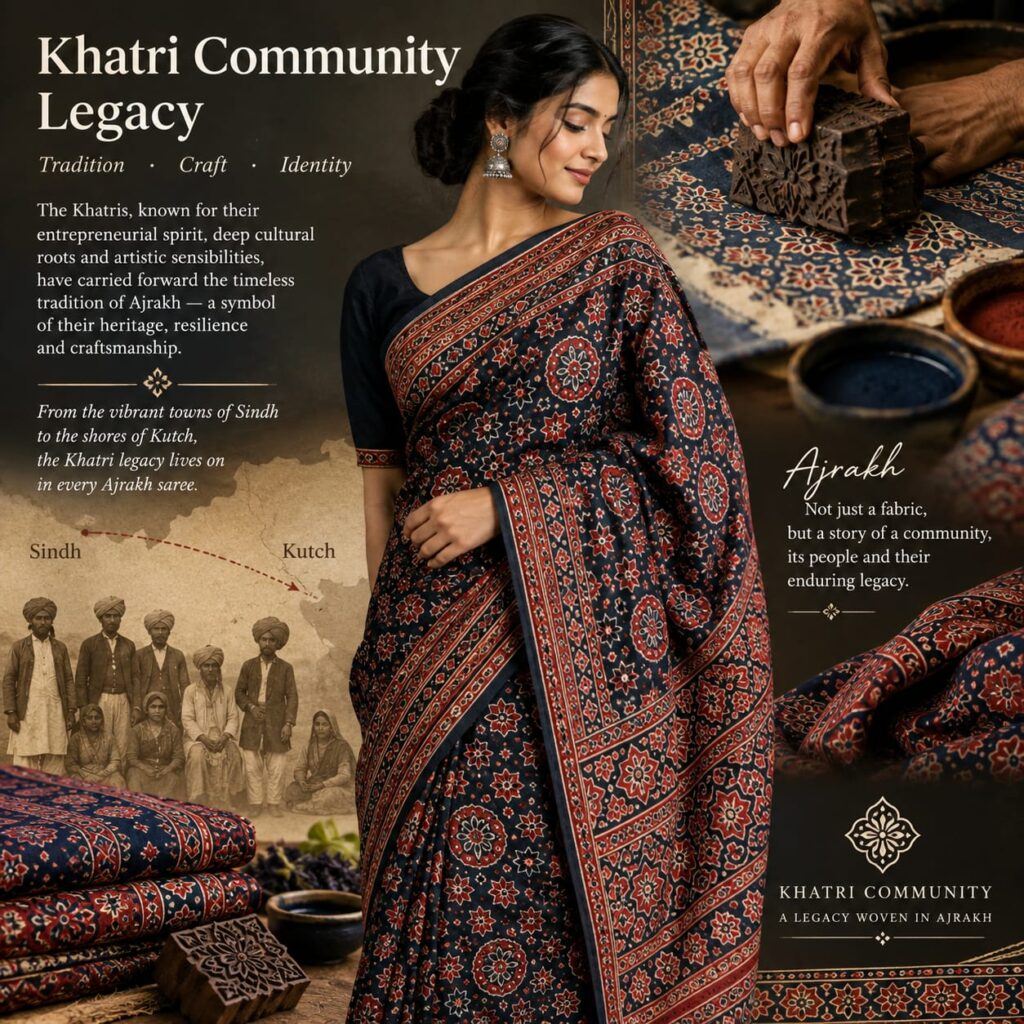
A Family Tradition That Became a Regional Identity
Over generations, Khatri craftsmanship became deeply associated with the identity of Kutch.
Ajrakh became one of the strongest examples.
Research by E.M. Edwards describes Ajrakh as having become a signature textile of Khatri communities in Dhamadka and Ajrakhpur, while also documenting its transition into contemporary fashion.
That transformation says something powerful.
A tradition that once belonged primarily to specific communities could become recognized far beyond its original social setting.
Yet its community history remains essential.
Without the Khatri artisans who maintained the technique, there would be no contemporary Ajrakh story to celebrate.
The modern textile world may have discovered Ajrakh relatively recently.
The artisans did not.
They had been living with it for generations.
What Makes the Khatri Legacy Different?
Perhaps it is the combination of tradition and adaptability.
The Khatri community did not have one uninterrupted path.
There were migrations.
There were changes in religion and community life.
There were different regional practices.
There were changing customers.
There were political borders.
There was industrialization.
There was environmental disaster.
And there were new markets.
Yet the craft kept adapting.
That does not mean every traditional practice survived unchanged.
Some techniques became less common.
Some traditional customers moved away from handmade textiles.
Some older processes became too expensive or lab-our-intensive for everyday production.
Kashmir’s documentation, for example, records that some of the most demanding traditional Ajrakh processes are now performed mainly on special orders in Kutch because of the time and lab-our involved.
This is an important reality.
Heritage is not always about preserving every detail exactly as it was.
Sometimes it is about deciding which knowledge must be protected while allowing the craft to find a sustainable place in the present.
The Human Hands Behind the Heritage
When people see Ajrakh today, they often notice the pattern first.
But perhaps we should look at the hands.
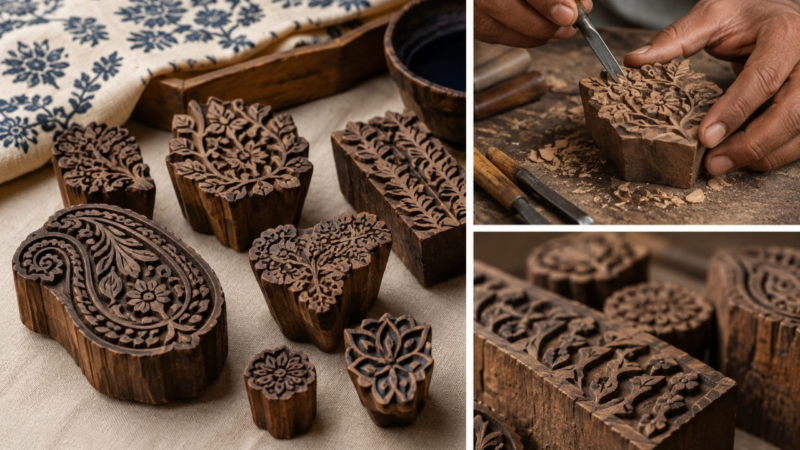
The hand holding the wooden block.
The hand checking the alignment.
The hand washing the cloth.
The hand mixing color.
The hand passing the knowledge to a child.
Those hands connect the past with the present.
A traditional craft does not travel through time by itself.
People carry it.
That is the real meaning of the Khatri legacy.
More Than a Textile History
The story of the Khatri community cannot be reduced to the sentence “Khatri migrated from Sindh and developed Ajrakh in Kutch.”
That is only the beginning.
The fuller story includes villages built around water and craft.
It includes relationships between printers and pluralists.
It includes customers who knew exactly which patterns belonged to their community.
It includes trade routes connecting Sindh and Kutch.
It includes the shock of Partition.
It includes the arrival of industrial textiles.
It includes the destruction caused by the 2001 earthquake.
And it includes the decision to build again.
The result is not simply a surviving craft.
It is a living cultural history.
A Legacy Still Being Printed
Today, when an Ajrakh fabric is spread across a table, it is tempting to see only the finished pattern.
But behind it lies a much longer journey.
A journey that began in a different landscape.
A journey carried by artisans.
A journey shaped by Kutch.
A journey connected with pastoral and farming communities.
A journey interrupted by borders and changing markets.
A journey rebuilt after disaster.
And a journey that continues through younger generations.
The Khatri legacy is therefore not locked inside the past.
It is still being made.
Every block that touches cloth adds another moment to the story.
Every new artisan who learns the process extends the chain.
Every contemporary design that respects the technique gives the tradition another opportunity to remain relevant.
The story keeps moving because the hands keep moving.
When Hands Become History
Perhaps the most beautiful way to understand the Khatri community legacy is to think about inheritance.
Inheritance is usually associated with things that can be owned.
Land.
Homes.
Jewelry.
Money.
But artisans inherit something different.
They inherit how to make.
A child watches.
A young apprentice tries.
An elder corrects.
The process is repeated.
Slowly, knowledge becomes instinct.
That is how a tradition survives for generations.
The Khatri community’s textile legacy is therefore not simply preserved in old fabrics hanging in museums.
It survives in workshops.
In blocks.
In dye pots.
In washing areas.
In family memories.
In villages such as Dhamadka and Ajrakhpur.
And in the hands of artisans who continue to work.
The journey from Sindh to Kutch changed the geography of the community, but it did not erase its knowledge.
Instead, that knowledge found a new home.
And perhaps that is the deepest meaning of the Khatri legacy:
A craft can travel with its people. A tradition can change without disappearing. And a piece of cloth can carry the memory of a journey long after the journey itself has end