
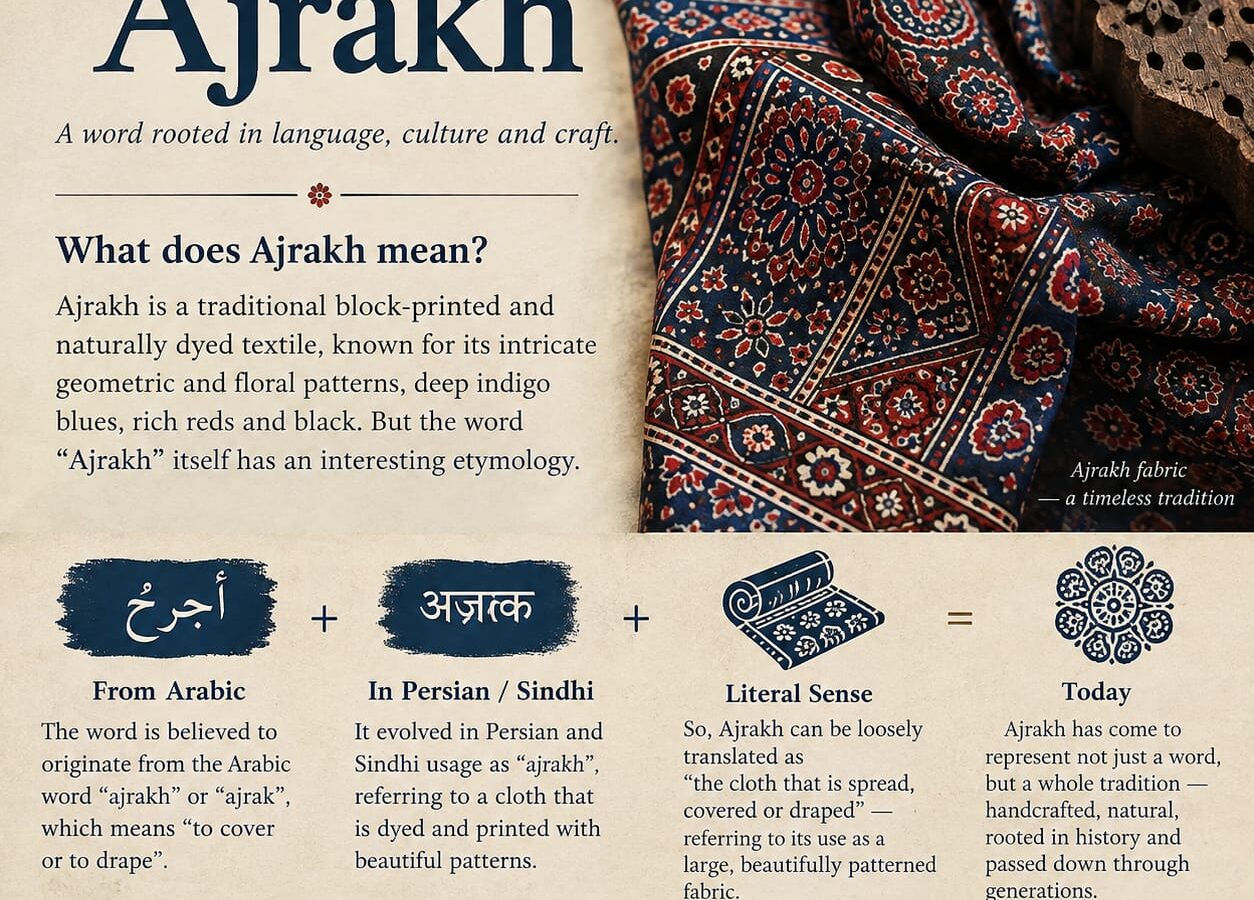
There are some textile names that simply identify a fabric.
Then there are names that seem to carry a story of their own.
Ajrakh belongs to the second kind.
The moment you hear the word, a certain image comes to mind: deep indigo, earthy red, fine black lines, pale spaces, repeating geometry and a cloth that seems to become more beautiful the longer you look at it.
But behind that familiar image is a question that is surprisingly difficult to answer in just one sentence:
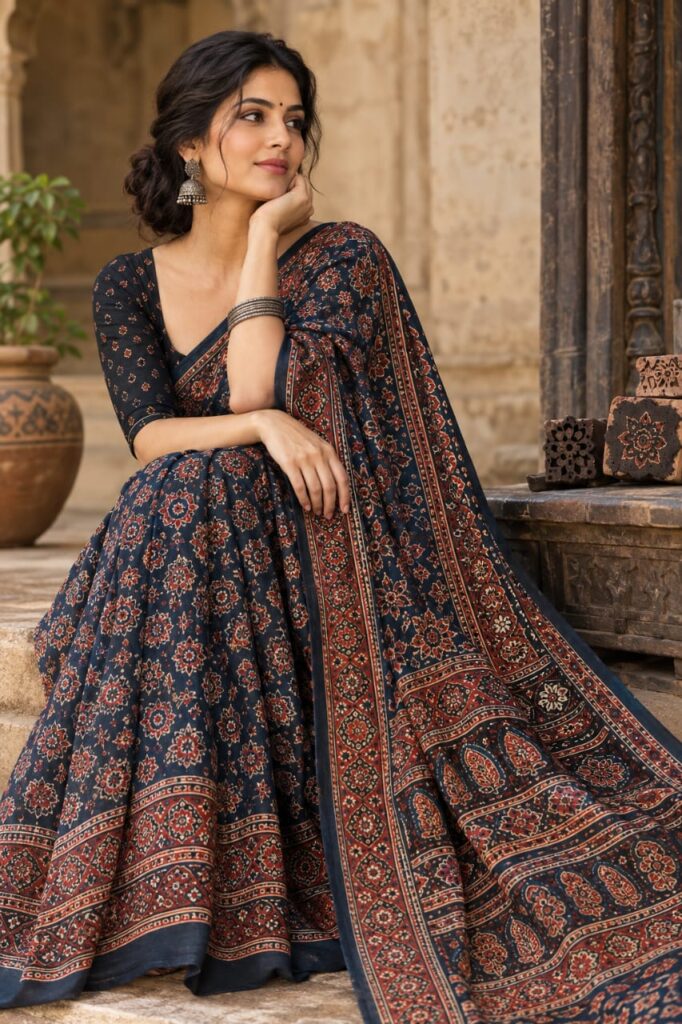
Where did the word “Ajrakh” come from, and what does it actually mean?
The answer is not completely settled.
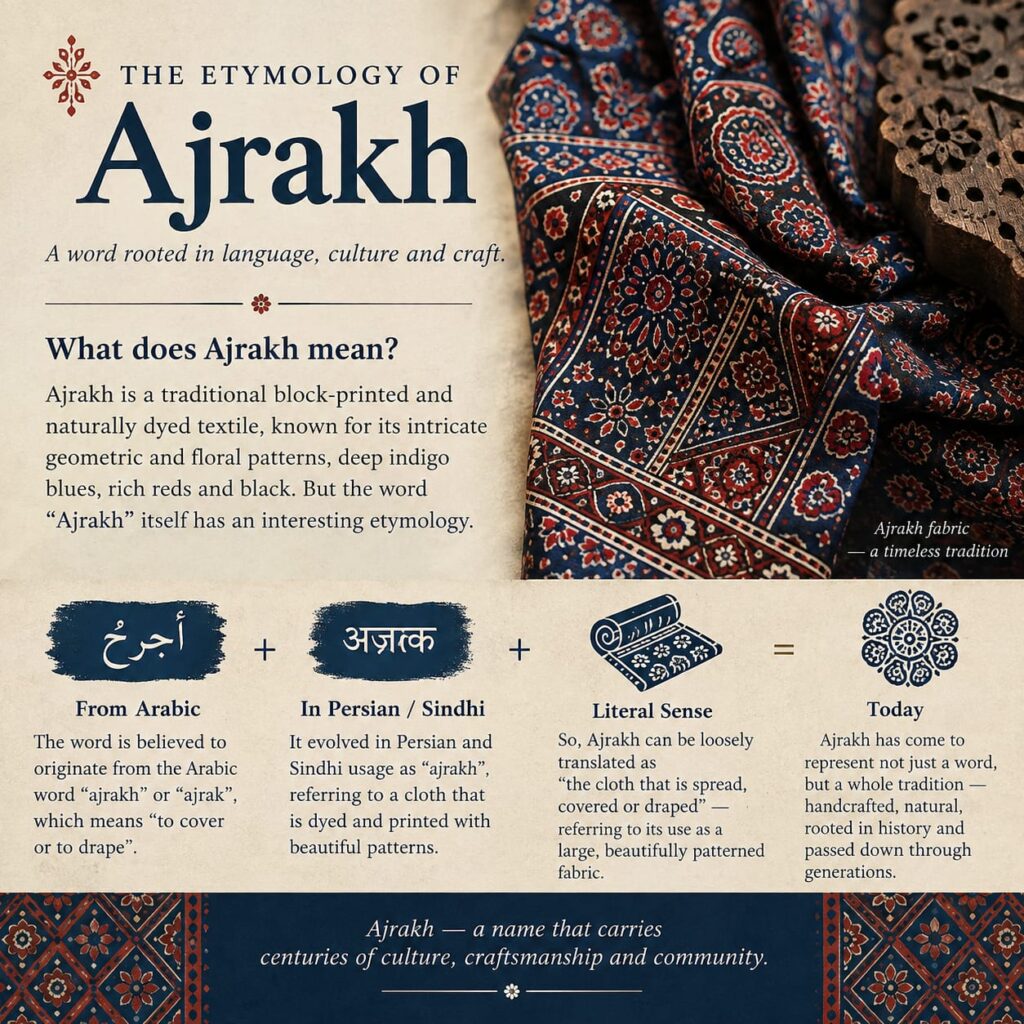
One widely discussed explanation connects the word with Ajrakh an Arabic word meaning blue. Another popular explanation links Ajrakh with the Sindhi expression “Ajrakh,” commonly understood as “keep it for today.” Craft sources record both interpretations, while research also acknowledges that the exact linguistic origin of the name remains a matter of discussion.
At first, these two explanations seem unrelated.
One is about color.
The other is about time.
But when you understand how Ajrakh looks and how it is made, something interesting happens.
Both begin to make sense.
A Word That Refuses to Have Just One Story
Etymology is usually presented as something neat.
A word comes from another word.
That word has a meaning.
The story ends there.
Ajrakh does not fit so comfortably into that pattern.
The textile has existed within a region where languages, communities, trade routes and craft traditions have crossed paths for centuries. Its history is connected with Sindh, Kutch and parts of Rajasthan, and Khatri printing communities became particularly associated with its production in Kutch and Barber.
When people, textiles and techniques move, words move with them.
Their pronunciation can change.
Their spelling can change.
Sometimes a new meaning becomes attached to an older word.
Sometimes an oral explanation survives even when its original linguistic history is difficult to prove.
That is why the story of Ajrakh’s name is better understood as a collection of possibilities rather than one perfectly documented translation.
And perhaps that uncertainty is part of its charm.
Ajrakh itself has never been a frozen tradition.
Why should its name be any different?
The Blue That Gave the Cloth Its Identity
If there is one color that immediately feels inseparable from Ajrakh, it is blue.
Not an ordinary bright blue.
A deeper blue.
An indigo blue.
A blue that can look almost black in one part of the cloth and unexpectedly soft in another.
This is why the connection between Ajrakh and the Arabic Azrak, meaning blue, has been discussed so often.
Shaped records the possibility that the name developed from the Arabic word associated with blue, while another Shaped article states that Ajrakh is very likely derived from azrak.
The connection becomes even more interesting when we remember that traditional Ajrakh is strongly identified by its color palette.
Indigo.
Madder red.
Black.
White.
These colors are arranged with remarkable balance.
The blue is not simply filling empty spaces.
It becomes part of the personality of the cloth.
It creates depth.
It gives the geometric patterns room to breathe.
It makes the red appear warmer and the white appear brighter.
In traditional Ajrakh, color is not an afterthought.
Color is part of the language of the textile.
When Blue Was Not Simply a Color
To a modern shopper, indigo may simply mean a beautiful shade of blue.
For an artisan, it is much more complicated.
Traditional Ajrakh involves processes of washing, preparing, resist printing, dyeing, drying and repeating different stages. Khamir describes Ajrakh printing as a multi-stage process requiring considerable time, concentration and skill.
The final blue therefore represents much more than pigment.
It represents knowledge.
The artisan needs to understand how the fabric reacts.
How the dye behaves.
How the resist protects particular areas.
How the block must be positioned.
How much pressure is needed.
When the fabric needs washing.
When it needs drying.
And when it is finally ready for another color.
The blue that we see at the end is the visible result of decisions that began much earlier.
That is why the possible relationship between Azrak and Ajrakh feels so appropriate.
The name may have been connected with blue, but the blue itself became inseparable from the identity of the craft.
Then There Is Another Story: ”Ajrakh”
Now comes the more intimate explanation.
Among local printers, a popular story connects Ajrakh with the Sindhi phrase “aaj Ajrakh,” generally understood as “keep it for today” or “leave it for today.” Khamir records this as a popular local explanation of the name.
At first, it sounds almost like an ordinary sentence.
But imagine the workshop.
The cloth has already gone through several stages.
The artisan has worked for hours.
The fabric still needs to be washed or dried.
Another color has to be added later.
The design cannot be completed immediately.
So the work waits.
Aah Ajrakh.
Leave it for today.
Continue tomorrow.
Whether this phrase is the original linguistic source of the word cannot be stated as an established historical fact. Shaped presents it as one possible explanation alongside the Arabic connection.
Yet as a craft story, it captures something very real.
Ajrakh takes time.
And perhaps that is why the explanation has remained so memorable.
The Cloth That Teaches You to Wait
We live in a world where speed is often treated as a virtue.
Fast delivery.
Fast fashion.
Fast production.
Fast results.
Ajrakh belongs to another rhythm.
Its traditional production asks the artisan to slow down.
The fabric has to be prepared properly.
The blocks need to meet with precision.
Resist has to work.
Colors need to develop.
The cloth needs washing.
The cloth needs drying.
Some stages have to be repeated.
Khamir describes the process as one that requires patience and careful alignment of blocks and colors.
This is one of the reasons the “aaj Ajrakh” explanation feels so poetic.
Even if it is not proven as the original etymology, it expresses the character of the craft beautifully.
Ajrakh is a textile that does not respond well to hurry.
Before Ajrakh Became a Fashion Fabric
Today, Ajrakh can be found on sarees, dresses, shirts, scarves, dupattas, jackets and contemporary accessories.
It is photographed for fashion catalogs.
It appears in designer collections.
It is sold to customers who may live thousands of kilometers away from the workshops where it is produced.
But this is not how its story began.
Ajrakh traditionally belonged to everyday life in the Sindh-Kutch region.
It was used for garments and cloth associated with particular communities. In Kutch, pastoral communities such as Maldharis traditionally wore Ajrakh as turbans, lungis and other forms of clothing. Khamir describes it as a time-honored emblem of local communities.
In Sindh, Ajrakh also became deeply connected with cultural identity and significant occasions.
It was not simply something people admired.
It was something they lived with.
That difference matters.
A modern fashion customer may see an Ajrakh print.
A traditional wearer could see family, community and belonging.
The People Behind the Name
It is difficult to talk about Ajrakh without talking about the Khatri artisans who have carried its printing traditions across generations.
In Kutch, Khatri families became closely associated with Ajrakh printing. Historical accounts describe Khatri artisans coming from Sindh to Kutch, where Dhamadka and Khavda became important centers of the craft.
The craft was not learned from a simple instruction manual.
It was learned by watching.
A child could spend time around the workshop.
They might begin with small tasks.
Preparing materials.
Helping with colors.
Watching the blocks being printed.
Learning how the fabric was handled.
Slowly, the work became familiar.
Eventually, the hands learned what the eyes had been watching.
That is how traditional craft knowledge survives.
Not simply through books.
Through people.
Where Geometry Became a Language
Look closely at traditional Ajrakh.
It is difficult to find a random-looking space.
Borders repeat.
Stars return.
Geometric shapes interlock.
Floral elements are arranged with discipline.
One part of the design seems to know exactly where the next part belongs.
This precision is one of Ajrakh’s most recognizable characteristics.
Sources discussing Ajrakh note strong geometric and symmetrical qualities in its designs, along with influences from Iranian and Islamic artistic traditions.
The result is fascinating.
From a distance, the textile looks calm.
From close up, it becomes incredibly detailed.
You can keep discovering small elements inside larger patterns.
It is almost like looking at a night sky.
The farther you look, the more there is to notice.
And this is another reason the word Ajrakh cannot be separated from its visual identity.
The name belongs to a textile with a very distinctive visual language.
The Journey from Sindh to Kutch
A name becomes even more interesting when we consider how far it has travelled.
Ajrakh is deeply associated with Sindh, but its history also became closely connected with Kutch and Barber.
Shaped records the widely cited historical account that Kutch ruler Rao Bharmalji I invited cloth-printing Khatri artisans from Sindh and allowed them to settle in Kutch. Dhamadka and Khavda subsequently became important centers of the craft.
The movement of artisans meant the movement of knowledge.
Printing traditions travelled.
Blocks travelled.
Design knowledge travelled.
Words travelled.
And the craft developed new identities in new places without completely losing its older connections.
This is why Ajrakh is best understood as a textile of movement, not isolation.
Its story crosses geographical boundaries.
Its name does too.
When Water Became Part of the Story
There is another element of Ajrakh’s history that is easy to overlook:
water.
Traditional textile dyeing and washing require suitable water.
Khamir describes how Dhamadka river once played an important role in the work of local printers. Changes in water availability and quality later created serious challenges for the craft.
This reminds us that Ajrakh is not only a human story.
It is also an environmental story.
A textile may depend on a particular landscape.
The artisan may need a particular kind of water.
Natural dyes may depend on plants and materials.
A village may develop around the availability of those resources.
When the environment changes, the craft changes too.
Suddenly, the meaning of Ajrakh becomes larger than language.
It becomes a relationship between people, materials and place.
When the Old Market Began to Change
For generations, Ajrakh had a strong relationship with traditional customers.
But modernization changed that relationship.
Cheaper screen-printed fabrics and synthetic materials entered the market. Khamir notes that these changes weakened some traditional community connections and affected the demand for traditional Ajrakh.
This part of the story is important because heritage is not always a smooth journey.
There were moments when Ajrakh could easily have become a disappearing craft.
Traditional production was labor-intensive.
Modern alternatives were cheaper.
Customers’ clothing habits changed.
And younger generations had new opportunities outside the workshop.
The survival of Ajrakh therefore cannot simply be explained by saying that “tradition continued.”
Tradition had to adapt.
When Ajrakh Found a New Beginning
The 2001 earthquake in Gujarat caused severe damage in Kutch and badly affected Dhamadka.
Khatri artisans later established Ajrakhpur, which became a new center for printing. Sources describe how government and social support, together with designers and new markets, helped the craft develop in contemporary forms.
This chapter gives the name Ajrakh another layer.
A craft that had already travelled once was forced to move again.
But it did not leave everything behind.
The workshops changed.
The market changed.
New products appeared.
New customers arrived.
Yet the blocks, colors, techniques and knowledge continued.
The story was not restarted from zero.
It was continued from where it had been interrupted.
From Community Cloth to Contemporary Wardrobe
The Ajrakh seen today can look very different from the cloth traditionally worn by pastoral communities.
You might find it as a saree.
A modern jacket.
A contemporary kurtas.
A home textile.
A designer garment.
The use has expanded considerably.
But this does not automatically erase its older identity.
Instead, it shows how a living craft can enter new spaces.
The important thing is understanding what lies behind the finished fabric.
When someone buys a handmade Ajrakh today, they are not simply buying a blue-and-red pattern.
They are buying the result of a process involving design, block carving, fabric preparation, resist work, dyeing, washing, drying and repeated printing.
And behind that process are generations of accumulated knowledge.
So, What Does “Ajrakh” Really Mean?
After following the word this far, it becomes clear that there is no responsible reason to force it into one simple definition.
The Arabic connection with Azrak gives us the meaning blue and is widely cited in discussions of the textile’s name.
The Sindhi “aaj Ajrakh” explanation gives us the memorable idea of keeping the work for today, reflecting the slow and demanding process of traditional printing.
Both are part of the story surrounding the word.
But neither should be presented carelessly as an unquestionable fact.
The exact etymology remains debated.
And honestly, that makes the story richer.
Because Ajrakh has never belonged to only one place, one language or one generation.
The Meaning You Can See Without Reading a Dictionary
Perhaps the most beautiful thing about Ajrakh is that you do not need to know its etymology to understand something about its character.
You can see the patience in the precision.
You can see the history in the motifs.
You can see the importance of blue.
You can see the artisan’s hand in the slight individuality of handmade printing.
You can see repetition without monotony.
And if you know the story behind it, every layer becomes more meaningful.
The blue is no longer simply blue.
The geometric border is no longer simply decoration.
The repeated block is no longer simply a pattern.
Each becomes part of a much longer conversation between craft and culture.
A Name That Has Outlived Its First Meaning
Perhaps this is what happens to important words.
They begin with one meaning.
Then generations use them.
People migrate.
Languages influence each other.
Crafts change.
Markets change.
The word remains.
Ajrakh has travelled through all of these changes.
It has survived changes in clothing.
It has survived industrial competition.
It has survived environmental difficulties.
It has survived earthquakes and the rebuilding of artisan communities.
And it has entered a completely new world of contemporary fashion.
Yet when the cloth is placed on a table and the first deep blue pattern appears, the name is still there.
Ajrakh.
Where Blue Meets Time
So perhaps the most meaningful way to understand Ajrakh is not to ask for one final translation.
Instead, think of the two ideas that surround its name.
Blue.
And time.
Blue connects to one of the strongest visual identities of the textile and to the widely discussed Arabic Azrak explanation.
Time connects beautifully with the popular Sindhi “aaj Ajrakh” story and, more importantly, with the actual patience demanded by traditional Ajrakh printing.
Between these two ideas sits everything else:
the artisan,
the block,
the dye,
the water,
the cloth,
the community,
the landscape,
the memory,
and the generations.
That is why Ajrakh is difficult to translate into a single word.
It is easier to understand as a story.
A story in which color became identity.
A story in which patience became part of the process.
A story in which artisans carried knowledge across regions.
And a story in which a simple piece of cloth became a living record of culture.
The next time you see an Ajrakh saree or textile, don’t look at it only as a beautiful print.
Look at the blue.
Follow the geometry.
Notice the repetition.
Imagine the hands behind it.
Then remember that even the name has a journey of its own.
Ajrakh is not just a word printed beside a textile.
It is a word that, like the cloth itself, has travelled through generations — carrying color, craft and memory along the way.