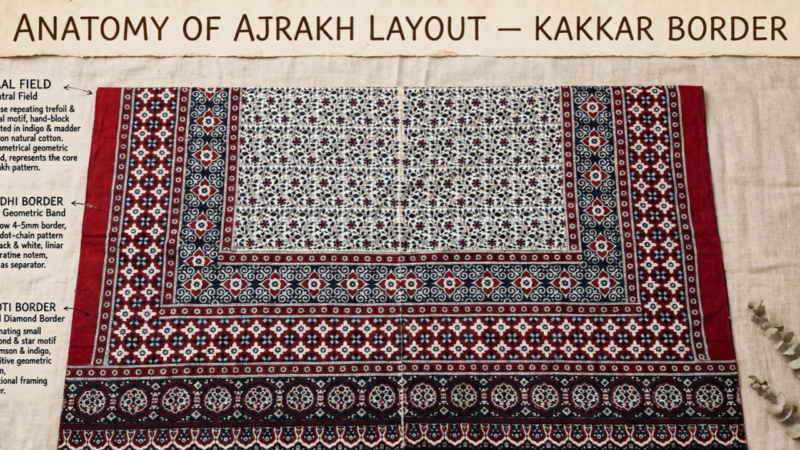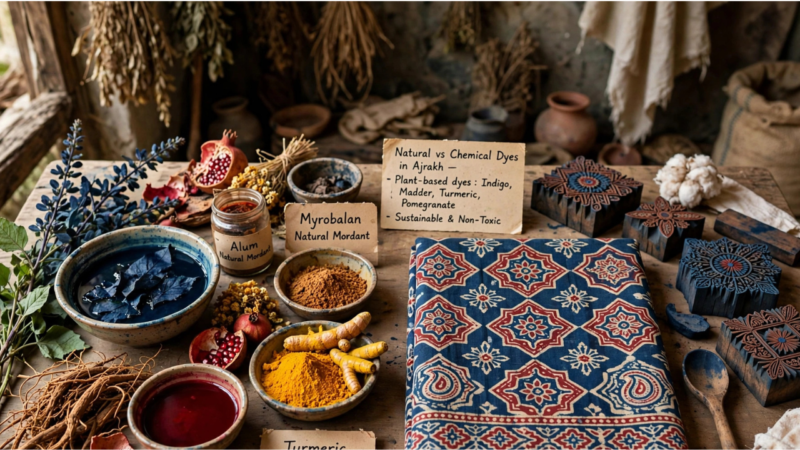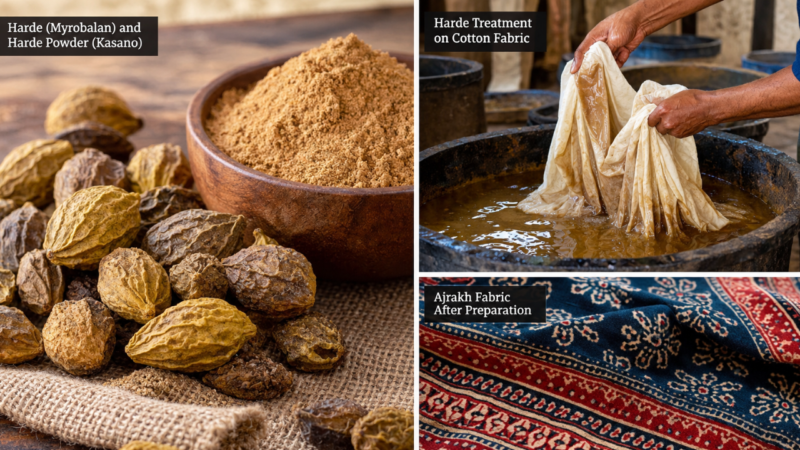

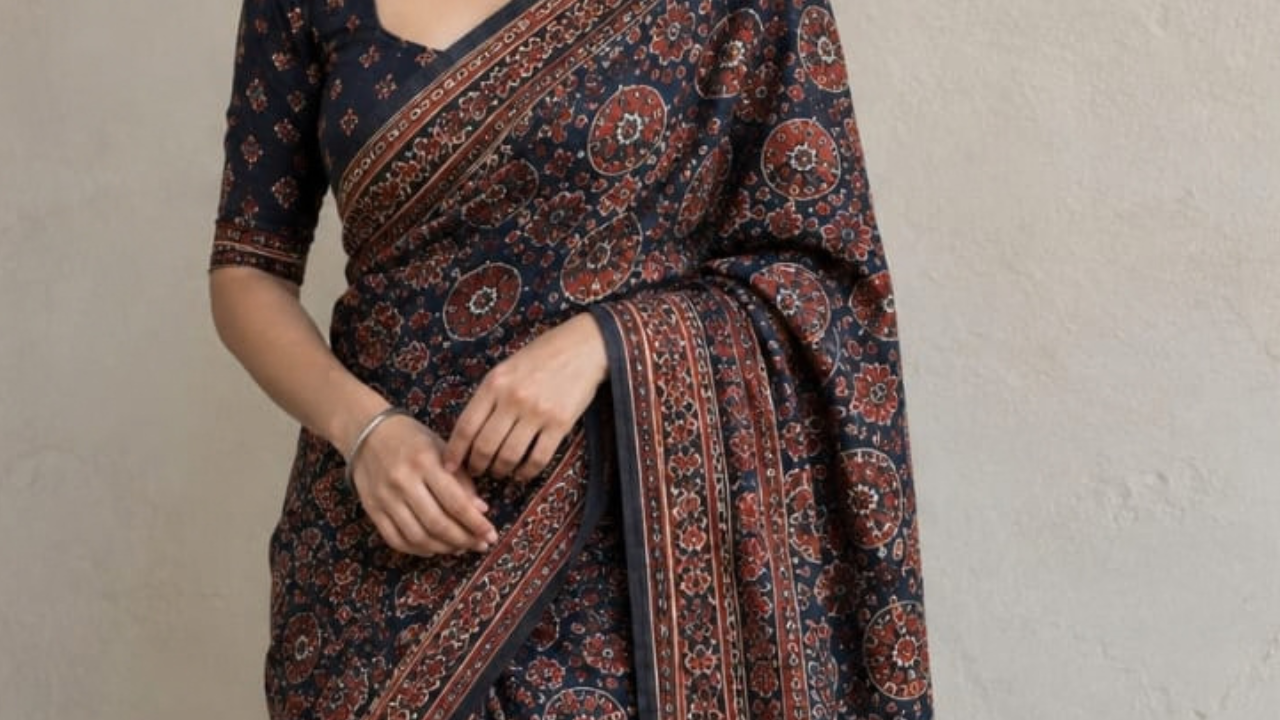
A piece of Ajrakh may look quiet when it is folded.
There is no sound in its deep indigo. No movement in its repeating borders. No obvious sign that the cloth has travelled across deserts, villages, rivers and trading centers.
But unfold it, and another story begins.
The blue opens.
The red becomes visible.
The geometric patterns start moving across the fabric.
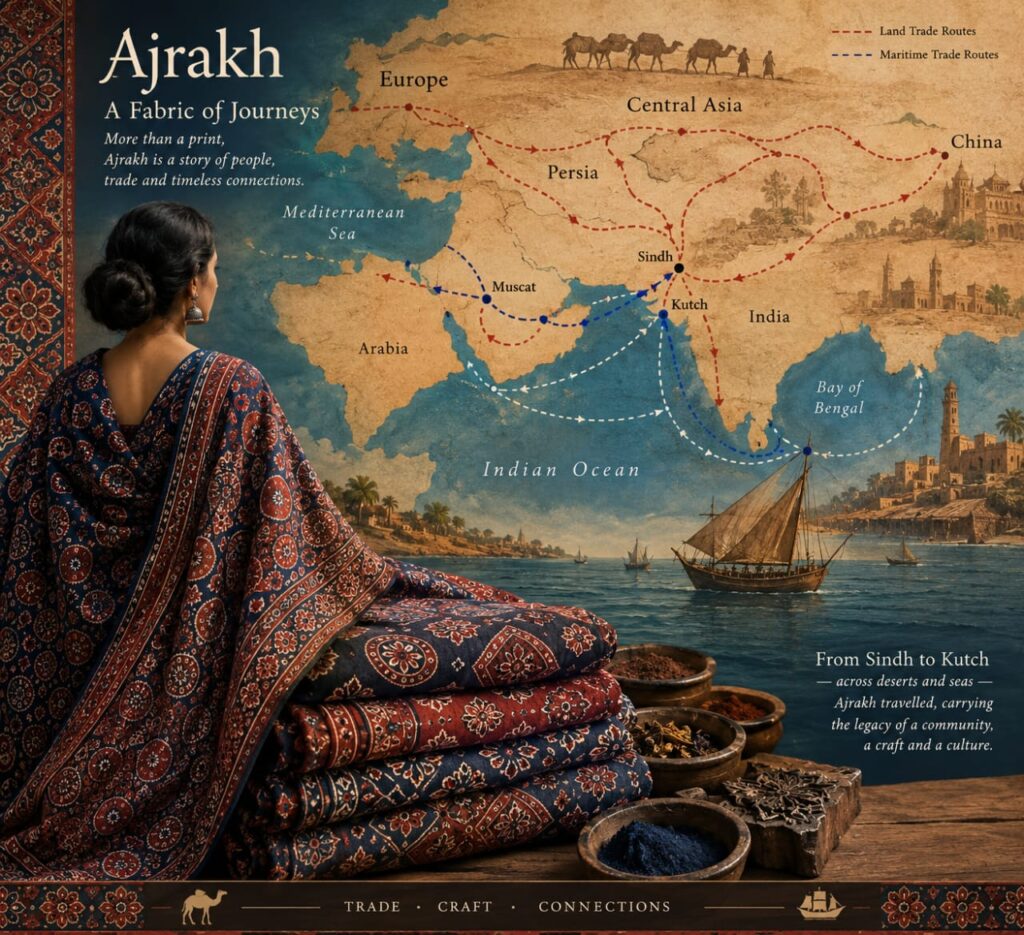
And suddenly, it becomes easier to imagine that Ajrakh was never simply a textile made in one place and kept there. Its history is closely connected with movement — of artisans, pastoral communities, traders, raw materials, ideas and cloth.
Long before Ajrakh became a familiar name in contemporary fashion, textiles were moving through the wider region around the Indus, Sindh and Kutch. Trade routes connected communities that lived across landscapes that today are separated by an international border. Ports, river crossings, desert paths and village markets created networks through which goods and knowledge travelled.
Ajrakh became part of those networks.
Its story is therefore not only about printing.
It is also about routes.
Before the Map Had Today’s Borders
When we look at a modern map of India and Pakistan, it is tempting to imagine the border as the natural dividing line of the landscape.
Historically, however, people moved through the region according to very different realities.
A trader cared about a usable port.
A pastoral cared about water and grazing.
An artisan cared about access to cloth, dyes, customers and water suitable for washing.
A merchant cared about where goods could be exchanged.
A caravan cared about the next place where animals and people could rest.
The region connecting Sindh and Kutch had many such routes.
Khamir documentation of Khatri communities describes places such as Bela, Lakhpat, Raper, Dhamadka and Chobari as part of older networks of production and exchange. Different communities were served by local printers, while some materials came through Sindh.
Ajrakh grew within this moving landscape.
That is important because the history of a textile is rarely limited to the workshop where it was printed.
The workshop is only one stop on the journey.
The Indus Was More Than a River
The Indus has always been more than a geographical feature.
For communities living along and around it, the river supported agriculture, settlement, transport, trade and cultural exchange.
Ajrakh became particularly associated with the Sindh region and was traditionally used along both sides of the Indus and in neighboring areas including Kutch and Mar-war. Shaped describes its traditional use among communities across this wider region and notes its connection with Muslim animal-keeping communities.
This wider geography helps explain why Ajrakh should not be thought of as belonging to one isolated village.
Its patterns and techniques developed within a region where people and goods were already moving.
Cotton could move.
Indigo could move.
Other dye materials could move.
Cloth could move.
And most importantly, craft knowledge could move with the people who carried it.
Sindh: One of the Important Starting Points
Ajrakh historical identity is deeply connected with Sindh.
The craft was especially popular there, and the textile became an important part of Sindhi cultural life. Traditional Ajrakh could be used as a sarong, turban, shawl, cummerbund and other forms of clothing.
The cloth was not simply produced for an anonymous market.
It had particular users.
It was connected with communities.
It could communicate familiarity and identity.
A person who wore a particular textile was not necessarily making a fashion statement in the modern sense. They were participating in an established clothing tradition.
This relationship between artisan and wearer became one of the most important features of Ajrakh older trade system.
The printer knew who the cloth was for.
The customer knew what kind of cloth they wanted.
Patterns and colors were not simply selected from a catalog.
They were connected to local expectations.
That created a very different kind of marketplace.
When Artisans Became Part of the Route
The movement of Khatri artisans from Sindh to Kutch is an important chapter in Ajrakh history.
Shaped records the widely cited account that Kutch ruler Rao Bharmalji I, who ruled from 1586 to 1631, invited cloth-printing Khatri artisans from Sindh to settle and earn their livelihoods in Kutch. They were given land and exemptions related to taxation on their produce. Over time, Dhamadka and Khalid became important centers of the craft.
This movement changed the geography of Ajrakh.
The craft did not disappear from Sindh.
Instead, another important center developed across the region.
The artisans brought their knowledge.
They brought printing traditions.
They brought ways of working with color and resist.
They brought an understanding of the customers who wore the cloth.
And they entered a new landscape where they had to understand new communities and local conditions.
That is how a trade route becomes more than a line on a map.
It becomes a route of knowledge.
Dhamadka and the Importance of Water
If you imagine a traditional textile workshop, it is easy to picture the artisan and the wooden block.
But there is another character in the story that is just as important:
water.
Traditional printing and dyeing require repeated washing and processing.
Khamir documentation of Dhamadka describes the importance of the river and the washing and dyeing activities connected with it. Artisans recall how much of their work once happened around the riverbank.
This tells us something important about historical trade routes.
A craft center did not grow randomly.
It needed resources.
The availability of water could influence where printers settled.
The availability of raw cotton could influence production.
The availability of customers could influence what they produced.
And the availability of routes could influence how materials and finished cloth moved.
So Dhamadka was not simply a village where Ajrakh happened to be made.
Its natural and economic surroundings helped shape the craft.
Bela: Where Trade Met the Outside World
Among the places connected with the older Kutch trade network, Bela is particularly interesting.
Khamir oral-history documentation describes Bela as an old port and trading post. Artisans recall that it once provided an important route toward Sindh and that goods and raw materials came through this network.
Bela was connected to villages in the Waged region of East Kachchh.
Khatri families worked there and produced textiles for nearby farming and other communities.
The trade was not necessarily based on enormous commercial shipments.
Much of it was local and practical.
A community needed clothing.
The artisan produced it.
The customer paid in money, goods or through established exchange relationships.
Materials came through connected routes.
The finished cloth moved back into the community.
This is an important reminder that historical trade was not always about huge ships crossing oceans.
Sometimes trade was simply a printer traveling between villages.
Sometimes it was a bale of cotton.
Sometimes it was indigo arriving from Sindh.
Sometimes it was a cloth bundle carried by a trader or traveler.
What Was Moving Along These Routes?
The trade routes connecting Sindh and Kutch carried many kinds of goods.
Khamir historical accounts mention materials such as indigo from Sindh, as well as other food and agricultural products moving through the region.
This is where Ajrakh history becomes especially interesting.
The cloth itself was only one part of the trade network.
The ingredients required to make the cloth were also part of the network.
Think about what an artisan needs.
Cotton fabric.
Dyes.
Resist materials.
Water.
Wood for blocks.
Fuel.
Tools.
And eventually, customers.
If even one important part of this system became difficult to obtain, production could be affected.
The trade route therefore supported not only the movement of finished textiles but also the ecosystem that allowed textile production to exist.
The Customer Was Part of the Craft
Historical textile trade was not simply about making something and finding anyone willing to buy it.
Ajrakh had strong relationships with particular communities.
In Kutch, traditional purchasers included Maldharis, pastoral communities who used Ajrakh as part of their clothing. In Mar-war, related pastoral communities also formed part of the traditional customer base.
The artisan understood these customers.
The cloth was made with their clothing practices in mind.
This created a relationship that could last across generations.
A printer did not necessarily have to convince a customer that Ajrakh was beautiful.
The customer already knew it.
They knew what the cloth represented.
They knew how it should be worn.
They knew which colors and designs were appropriate.
That kind of relationship made the trade route personal.
The cloth was moving from one known community to another, not simply from a factory to an unknown buyer.
Trade Was Also a Conversation Between Communities
Khamir documentation shows that Khatri artisans in different areas produced textiles for a range of communities, including farmers, Jain, Rabbis and others. The designs and colors could be connected to the identity and clothing practices of those communities.
This means textile trade was also cultural exchange.
An artisan learned what another community valued.
The community learned the artisan’s skills.
Over time, both sides influenced the product.
A design could become associated with a particular group.
A color could become preferred in a particular area.
A particular garment could develop its own style.
This is how local textile traditions become complicated and rich.
They are not created by artisans alone.
They are created through relationships between makers and wearers.
When the Desert Was Not a Barrier
Today, the landscape between Sindh and Kutch can look harsh.
Dry land.
Salt flats.
Long distances.
Extreme temperatures.
Yet people have crossed these landscapes for centuries.
Pastoral communities moved in search of grazing and water.
Traders travelled with animals and goods.
Artisans travelled to reach customers.
Khamir records memories of people traveling between Bela and Sindh using camels, bullock carts, horses and donkeys.
These journeys were slow by modern standards.
But slow did not mean disconnected.
A journey that takes days can still create a strong network.
A trader carrying goods can carry news.
A pastoral moving between regions can carry cultural practices.
An artisan can carry a technique.
A textile can carry a design.
In this way, the desert became not simply an obstacle but part of the route.
Ports, Rivers and Villages Formed One Network
It is easy to imagine trade routes as one straight road.
Historical textile trade rarely worked that way.
Instead, there were layers.
A port connected to a river.
A river connected to a settlement.
A settlement connected to villages.
Villages connected to pastoral routes.
And all of these connections created a larger network.
Lakhpat, for example, became an important port connected with Sindh. Historical accounts describe it as a major point for goods entering Sindh and as a transit point, while a ferry route connected people across the water channel. In the late eighteenth century, a significant Sindhi merchant community lived in Lakhpat.
This broader commercial world helps us understand how textiles such as Ajrakh could exist within a much larger regional economy.
The cloth did not need one giant marketplace.
It needed a network.
The Route Changed in 1819
Trade routes do not remain unchanged forever.
In 1819, a major earthquake dramatically altered parts of the Kutch landscape and affected the old port geography, including Bela. Khamir historical documentation records that Bela’s port was shut after the earthquake. Even after the port closed, movement between the regions continued by land.
This is an important detail.
A port can disappear.
A route can change.
But trade does not necessarily stop immediately.
People find another way.
The journey becomes longer.
The transport changes.
The goods move differently.
This is exactly what happened in many historical trade systems.
The geography changed.
The network adapted.
And textile production continued.
1947: When a Route Became a Border
The most dramatic change came in 1947, when British India was partitioned and India and Pakistan became separate countries.
For communities that had traditionally moved between Sindh and Kutch, this changed everyday life.
The routes that had once connected communities were now interrupted by an international border.
Khamir oral-history documentation records that trade between East Kachchh and Sindh collapsed after Partition because crossing the border was no longer possible in the same way.
This affected much more than merchants.
Raw materials could become harder to obtain.
Customers could become unreachable.
Pastoral communities that had traditionally moved across the region faced new restrictions.
Artisans lost established markets.
A route that had existed as part of everyday life for generations had suddenly become politically divided.
For Ajrakh, this was not simply a change in geography.
It was a change in the economic system that supported the craft.
When the Customer Could No Longer Travel
The story of the Maldharis communities is particularly important here.
Traditionally, many pastoral communities moved between Sindh and Kutch according to seasonal conditions and the availability of grazing land.
After Partition, those movements became restricted.
Khamir documentation notes that this had serious consequences for pastoral communities and for the Khatri artisans who depended on them as customers. During difficult conditions, textile consumption was reduced.
Think about what that means for a craft.
An artisan may still know how to make the cloth.
The blocks may still exist.
The dyeing knowledge may still be present.
But if the traditional customer can no longer reach the market, the entire economic relationship becomes weaker.
A craft can survive technically and still struggle economically.
That distinction is important.
Industrial Cloth Arrives
Then another major change appeared.
Industrialization.
Machine-made fabrics and screen-printed textiles could be produced faster and sold more cheaply than labor-intensive handmade Ajrakh.
Shaped notes that screen-printed materials using chemical dyes became popular among traditional customers, reducing demand for traditionally produced Ajrakh in Kutch.
For a handmade textile, this created a difficult question.
How can a cloth that takes considerable time to make compete with something that can be produced quickly?
The answer was not simple.
Some traditional markets became smaller.
Some artisans left the craft.
Some continued part-time.
Others began experimenting with new customers and new products.
Ajrakh had to find another route.
From Old Trade Routes to New Markets
This is where the story takes an unexpected turn.
Ajrakh began traveling again.
But this time, it was not only traveling along old pastoral and regional trade routes.
It entered urban markets.
Design exhibitions.
Contemporary fashion.
New retail spaces.
Academic and cultural institutions.
Design collaborations.
Research on Ajrakh describes how, particularly over the last several decades, the textile moved from a traditional community dress into contemporary fashion, supported by government initiatives, artisan-designer collaborations and new commercial markets.
The destination changed.
But the journey continued.
The textile that once travelled between villages and pastoral communities could now travel to cities.
A cloth made in Kutch could reach a customer who had never visited Dhamadka.
That was a completely different kind of trade route.
Ajrakhpur: A New Chapter After Disaster
The 2001 earthquake brought another major disruption.
Dhamadka was severely damaged.
Khatri artisans subsequently established Ajrakhpur, a new center for printing, with support from government and social organizations. Designers, voluntary organizations and businesses also contributed to the development of contemporary Ajrakh.
Ajrakhpur is significant not only because it is a new place.
It represents the ability of a craft community to rebuild its economic and cultural life after disruption.
The route had changed again.
But the knowledge had travelled with the artisans.
The blocks survived.
The techniques survived.
The color vocabulary survived.
The relationship with the cloth survived.
The story simply continued somewhere new.
The Journey From Desert Cloth to Contemporary Fashion
Today, Ajrakh can travel much farther than its traditional routes ever allowed.
A piece may be made in Kutch and purchased in Delhi.
A designer may use it in a collection.
A customer may discover it through a website.
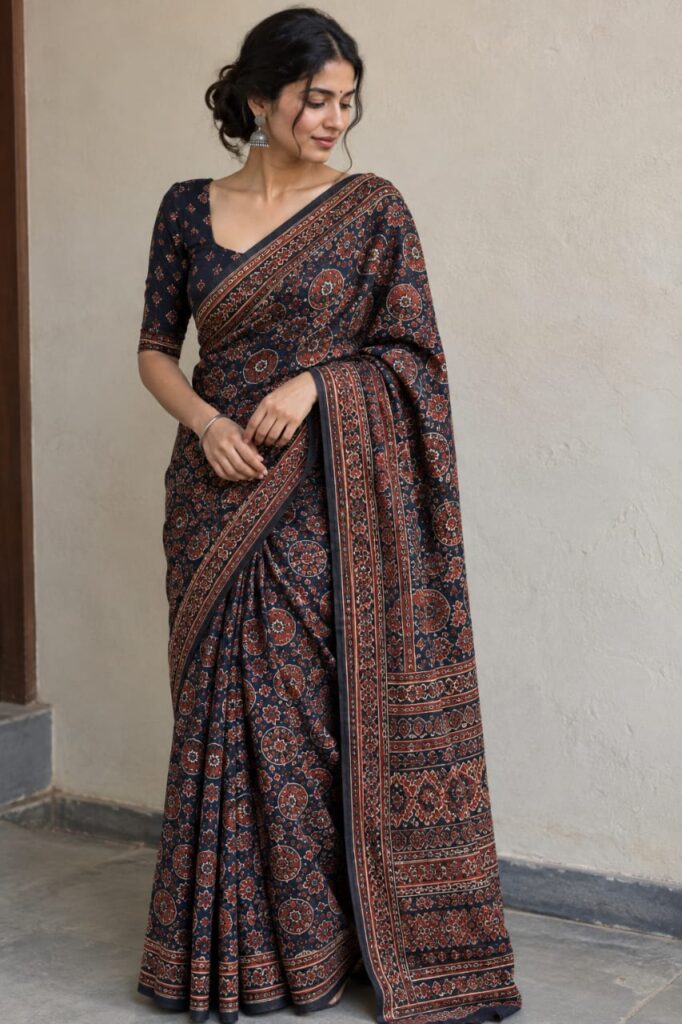
A sarees may travel across India.
A textile may be photographed and shared online before being sold thousands of kilometers away.
This is a completely different form of trade.
Yet the basic idea remains surprisingly familiar.
Someone makes.
Someone carries.
Someone sells.
Someone wears.
The route has simply become longer and more complex.
The old camel route has been replaced by trucks, courier networks, exhibitions, retail stores and digital commerce.
But the textile is still traveling.
What Makes Ajrakh Trade History Special?
Many textiles have been traded across regions.
So why is Ajrakh story particularly interesting?
Because the trade route did not only move finished cloth.
It moved culture.
It carried techniques.
It carried materials.
It connected artisans with particular communities.
It allowed designs to develop according to local needs.
It connected Sindh and Kutch through generations of exchange.
And when those routes were disrupted, the effects were visible in the craft itself.
That is what makes Ajrakh a powerful example of how textiles are shaped by history.
A textile is never only a textile.
Behind it are roads.
Ports.
Markets.
People.
Water.
Politics.
Migration.
Technology.
And time.
The Route Is Still Moving
It would be easy to end the story with the old trade routes.
Sindh.
Kutch.
Bela.
Dhamadka.
Lakhpat.
But Ajrakh journey did not end there.
The route is still moving.
Today, contemporary Ajrakh continues to develop in Kutch and Barer. Researchers have documented how artisans have adapted traditional designs and techniques for new markets and modern fashion.
This does not mean every modern Ajrakh is identical to the traditional form.
It should not be.
Living crafts change.
Some pieces are made for traditional use.
Others are designed for contemporary clothing.
Some use traditional natural dyes.
Others may use different materials or processes.
The important thing is to understand the difference rather than treating every printed textile carrying the Ajrakh name as historically identical.
The route has changed.
The craft has responded.
A Textile That Carries the Memory of Roads
Perhaps the best way to understand Ajrakh historical trade routes is to imagine one piece of cloth at the center of a map.
Draw a line toward Sindh.
Another toward Kutch.
Another toward Dhamadka.
Another toward Bela.
Another toward the pastoral communities who wore it.
Another toward the rivers where cloth was washed.
Another toward the ports through which goods travelled.
Then draw a line forward to the modern city.
To contemporary fashion.
To a designer.
To a customer discovering Ajrakh for the first time.
The map becomes much larger.
And the cloth remains at the center.
That is the real story.
Where the Old Roads Meet the New Ones
Ajrakh history is ultimately a story of movement.
It moved because artisans moved.
It moved because customers travelled.
It moved because traders created routes.
It moved because raw materials came from connected regions.
It changed because rivers changed.
It adapted because ports disappeared.
It suffered because Partition interrupted established networks.
It struggled because industrial textiles changed the market.
And it survived because artisans found new ways to connect their knowledge with new customers.
That is why looking at Ajrakh through the history of trade routes reveals something that a simple craft description cannot.
Ajrakh was never trapped in one place.
Its identity was shaped by movement.
From the Sindh region toward Kutch.
From village to village.
From riverbank to workshop.
From artisan to customer.
From old markets to modern cities.
And eventually, from a regional textile tradition to a craft recognized far beyond the landscapes where its story developed.
The next time you unfold an Ajrakh textile, imagine the routes hidden inside it.
Not just the journey of the finished cloth, but the journey of everything that made it possible: the artisan who learned the technique, the cotton that became fabric, the indigo that brought depth to the cloth, the water used during its making, the customer who knew its value, and the roads that connected one community to another.
Ajrakh is a textile of patterns, but its history is a map.
And like every meaningful map, it tells us not only where something came from, but also how far it has travelled.