
On the morning of 26 January 2001, Kutch was preparing for Republic Day celebrations when the ground beneath the region suddenly began to move.
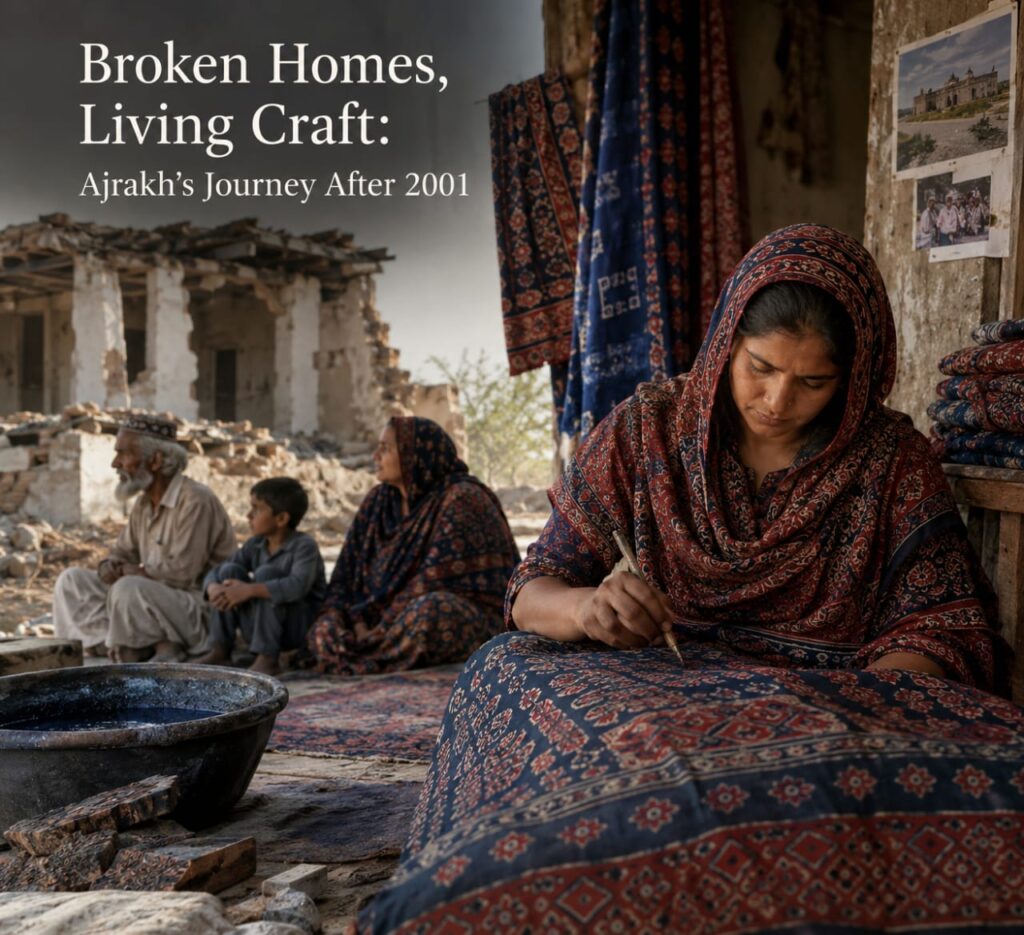
- At around 8:46 a.m., a devastating earthquake struck Gujarat. Kutch was among the worst-affected regions, and towns and villages across the district suffered enormous destruction. Bhuj, An-jar, Bhachau and surrounding areas experienced widespread damage to homes, public buildings, roads and livelihoods. Contemporary technical assessments recorded the earthquake as one of the most destructive in modern Indian history, with enormous loss of life and property.
- But the damage was not measured only in collapsed buildings.
- For communities whose livelihoods depended on traditional skills, the earthquake also disturbed the physical spaces, natural resources and working conditions that had supported those crafts for generations.
- Among them were the Khatri artisans of Dhamadka, a community closely associated with Ajrakh block printing.
- Ajrakh was not simply something they produced.
- It was part of their family history, their knowledge, their income and their identity.
- When the earthquake changed their village and disrupted the conditions required for printing, the community faced a difficult question: how could they continue making Ajrakh when the land around them had changed?
- The answer eventually led to the creation of Ajrakhpur.
- The story of Ajrakh after the earthquake is therefore not only a story of destruction. It is also a story of movement, adaptation, craftsmanship and rebuilding.
Before the Ground Changed
- Long before Ajrakh became associated with contemporary fashion, designer collections and urban wardrobes, it was deeply connected with everyday life in Kutch.
- Khatri artisans traditionally practiced the craft in Dhamadka. The community carried knowledge of resist dyeing, block printing, washing, mordanting and color preparation from one generation to another.
- Ajrakh itself is a complex process.
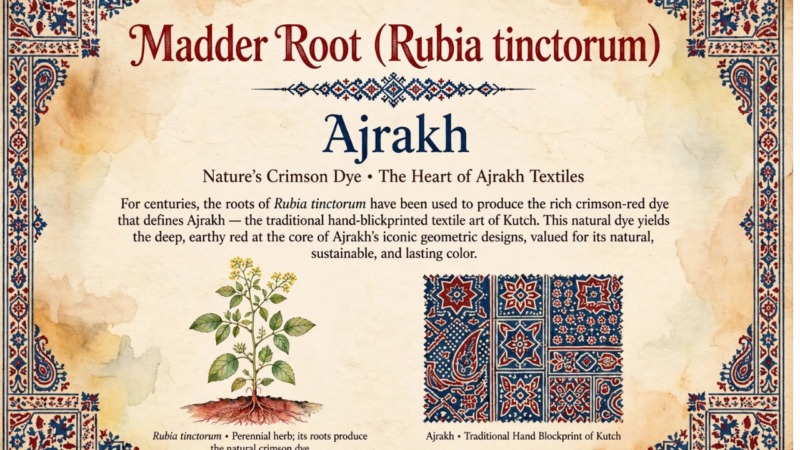
- The fabric passes through repeated stages of washing, preparing, printing, dyeing and drying. Artisans carefully carve and align wooden blocks by hand. Natural dyes such as indigo and madder have historically played an important role in the characteristic color palette.
- The process depends on patience.
- It also depends on resources.
- Water is especially important.
- Artisans need to wash the fabric repeatedly. Dyeing requires suitable water. Printing requires careful preparation. Drying and washing are part of the rhythm of production.
- For an artisan, therefore, the environment is not separate from the craft.
- The land, water, trees, animals and workshop all become part of the production system.
- This relationship became painfully visible after the earthquake.
A Morning That Changed Kutch Forever
- The 2001 earthquake did not affect Kutch as an abstract geographical region.
- It affected homes.
- It affected families.
- It affected workshops.
- It affected tools and materials.
- And it affected the places where people had built their livelihoods.
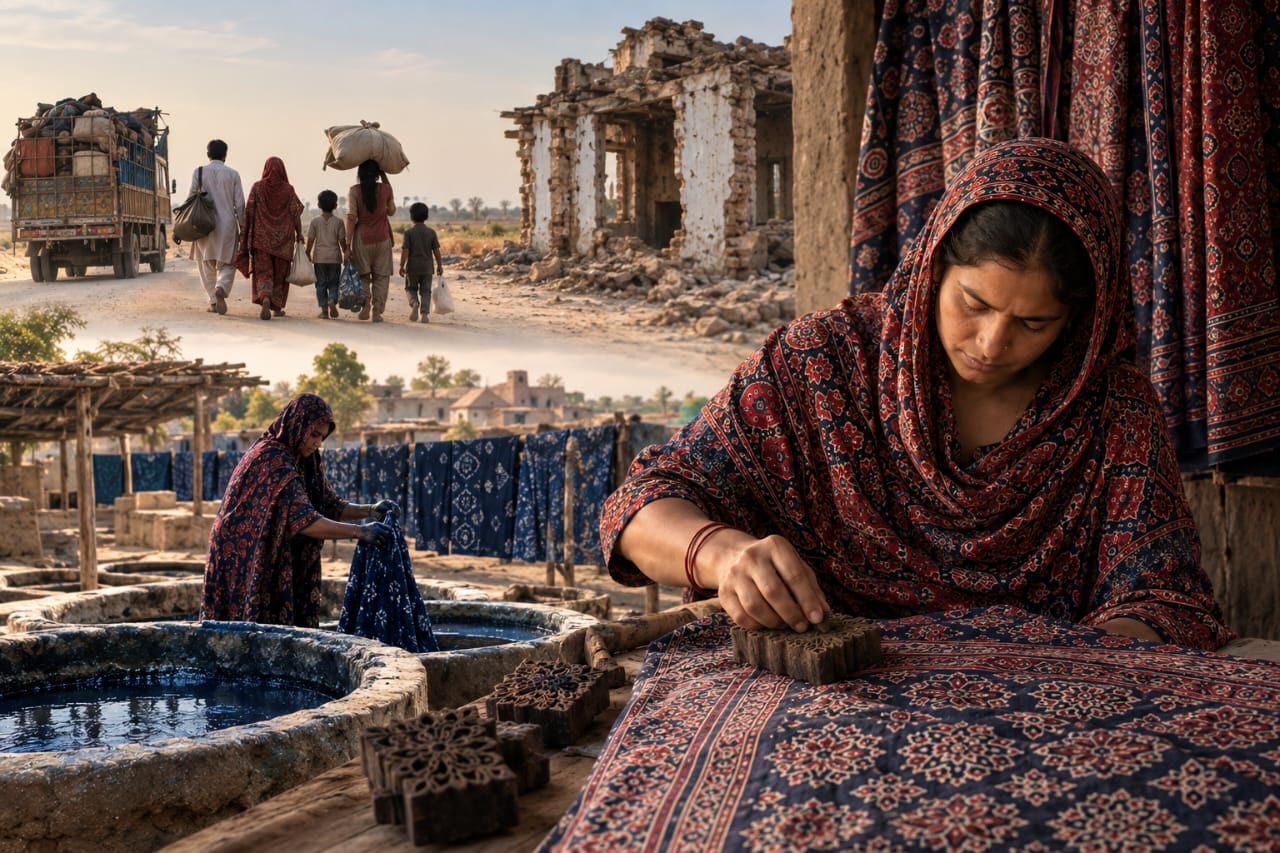
- The earthquake severely damaged Dhamadka, and many families had to reconsider whether they could continue living and working there.
- For artisan communities, rebuilding a house was only one part of the challenge.
- Artisans also needed to rebuild their workshops.
- Artisans had to replace their printing equipment.
- Artisans had to find raw materials.
- Artisans needed suitable water for the process.
- Artisans had to reach customers and market.
- Artisans had to restart the production cycle.
- For a craft that requires many stages and considerable manual labor, restarting production after such destruction was not an easy process.
- The earthquake therefore created a chain of difficulties that extended far beyond the initial collapse of buildings.
A Change in Water That Changed Everything
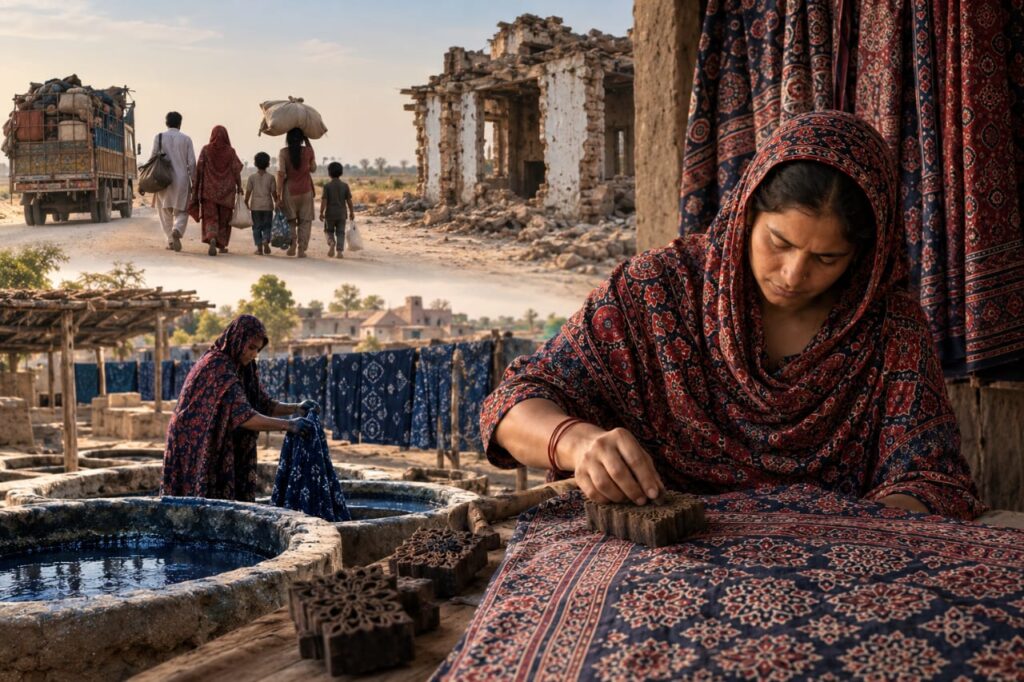
- One of the most important and often overlooked parts of Ajrakh post-earthquake story concerns water.
- The earthquake altered the local environment, and sources documenting Ajrakh production in Dhamadka describe changes in water conditions that affected the craft. In particular, increased iron content in local water became a problem for printing and dyeing.
- For someone unfamiliar with textile printing, this might sound like a small technical inconvenience.
- For an Ajrakh artisan, it was much more serious.
- Water is not simply something used to wash cloth.
- Its quality can influence colors, washing, dyeing and the overall appearance of the finished textile.
- When the water source becomes unsuitable, an artisan cannot simply continue the process exactly as before.
- The craft depends on a relationship between material and environment.
- That relationship had been disturbed.
- The earthquake had therefore created a challenge that could not be solved only by reconstructing buildings.
- The community needed to think about place itself.
Dhamadka and the Difficult Decision to Move
- For generations, Dhamadka had been home.
- Moving away from it was not an easy decision.
- A village is more than houses.
- It contains memories, family relationships, religious spaces, work spaces, neighborhoods and the physical landscape that people know intimately.
- For artisans, it also contains the places where knowledge was practiced.
- Yet continuing in Dhamadka became increasingly difficult.
- The earthquake had caused severe physical destruction, while water-related challenges created additional pressure on Ajrakh production. Accounts of the craft’s history describe how these circumstances contributed to the movement of Khatri artisans toward a new settlement.
- The move was not simply an escape.
- It was an attempt to protect a livelihood.
- The artisans were looking for a place where they could rebuild their homes and continue their craft at the same time.
- Eventually, a new settlement began to take shape.
- Its name carried the memory of the craft itself.
- Ajrakhpur.
A Village Named After a Craft
- There is something deeply meaningful about the name Ajrakhpur.
- The community could have chosen a name based on geography, a person, or another local reference.
- Instead, the new settlement became associated directly with the craft that had sustained generations.
- Ajrakhpur represented a new beginning, but it was not a complete break from the past.
- The artisans carried their knowledge with them.
- They carried their printing blocks.
- They carried their color knowledge.
- They carried family traditions.
- They carried memories of Dhamadka.
- Most importantly, they carried the skills that could not be destroyed by a collapsed building.
- That became one of the community’s greatest strengths.
- A workshop could be rebuilt.
- A printing table could be replaced.
- A house could be reconstructed.
- But the knowledge inside an experienced artisan’s hands could not be easily replaced.
The Things That Survived Were Not Always Visible
- After a disaster, attention naturally turns toward what has been lost.
- Buildings.
- Money.
- Possessions.
- Infrastructure.
- But traditional craft communities possess another kind of wealth.
- Knowledge.
- An experienced Ajrakh artisan knows how much pressure to apply to a block. They understand how colors behave. They know how fabric should be prepared. They recognize subtle differences in materials. They understand the rhythm of washing, printing, drying and dyeing.
- Much of this knowledge is not written in manuals.
- It is learned through observation and repetition.
- A child watches a parent.
- A younger artisan works beside an elder.
- Mistakes become lessons.
- Years of practice become instinct.
- This kind of knowledge travelled with the Khatri community to Ajrakhpur.
- That is why the earthquake disrupted Ajrakh, but did not end it.
Rebuilding Was More Than Constructing Houses
- The recovery of an artisan community cannot be measured only by the number of buildings reconstructed.
- A craft-based village needs an entire working ecosystem.
- There must be space for workshops.
- There must be access to water.
- Raw materials need to reach the artisans.
- Finished textiles need to reach markets.
- Families need schools and basic services.
- Artisans need customers.
- And the younger generation needs to believe that continuing the craft is possible.
- The creation and development of Ajrakhpur gradually brought these different requirements together.
- The settlement became a new home for artisans who had been displaced from Dhamadka, and craft production became an important part of its identity. Later accounts describe Ajrakhpur as a community where many families continued to be closely connected with Ajrakh printing.
- In this sense, rebuilding the village also meant rebuilding a craft economy.
The Craft Had to Earn Its Way Back
- There is a romantic idea that traditional crafts automatically survive because they are beautiful.
- Reality is more complicated.
- A craft survives when artisans can earn enough from it to support their families.
- After a disaster, this becomes even more important.
- The artisan needs to recover the cost of fabric, dyes, labor, equipment and time.
- Ajrakh is particularly demanding because a finished textile can pass through numerous stages before it is ready for sale.
- This means production requires patience and investment.
- Some artisans therefore had to consider other forms of work while recovering economically. Later accounts of the community describe people temporarily leaving craft work or taking up other occupations as they dealt with financial pressures.
- This part of the story is important because craft revival was not immediate.
- There was no magical moment when everything suddenly returned to normal.
- Recovery happened gradually.
- One workshop at a time.
- One order at a time.
- One family at a time.
From Survival to a New Identity
- Over time, Ajrakhpur became much more than a temporary settlement.
- It developed into an important center for Ajrakh production.
- The very name of the village connected place and craft.
- The lanes, workshops, drying areas, printing tables and dyeing spaces created a new environment in which the tradition could continue.
- The story of Ajrakhpur is therefore unusual.
- The earthquake displaced a craft community, but the displacement also resulted in the creation of a new place whose identity became inseparable from that craft.
- The community did not simply reproduce the old village somewhere else.
- It created a new chapter.
- That distinction matters.
- Ajrakhpur represents both loss and reconstruction.
- It remembers Dhamadka while looking forward.
Water Remained Part of the Story
- Even after relocation, water did not disappear from the conversation.
- Ajrakh requires water at multiple stages, so access to suitable water remains central to the craft’s future.
- Sources documenting Ajrakh describe efforts around water management and harvesting as part of the community’s continuing response to this challenge.
- This teaches us something important about traditional crafts.
- Sustainability is not only about using natural dyes or handmade techniques.
- It also involves the environment in which a craft exists.
- If the water becomes unavailable, polluted or chemically unsuitable, the craft is affected.
- If natural materials become harder to obtain, production changes.
- If climate conditions shift, drying and washing processes may also be affected.
- The story of Ajrakh therefore connects craft heritage with environmental responsibility.
The Earthquake Changed More Than a Location
- It would be easy to describe the 2001 earthquake as the event that moved Ajrakh from Dhamadka to Ajrakhpur.
- But the impact was broader.
- It changed how artisans thought about settlement.
- It changed the relationship between craft and infrastructure.
- It highlighted the importance of water quality.
- It interrupted family livelihoods.
- It forced some artisans to explore other sources of income.
- And it eventually encouraged the creation of a new craft-centered community.
- In this sense, the earthquake became a dividing line in the modern history of Ajrakh.
- There was an Ajrakh before the earthquake.
- And there was an Ajrakh after it.
- The printing techniques remained rooted in tradition, but the social and geographical setting around them had changed.
A Heritage That Refused to Become a Memory
- Disasters can turn living traditions into historical memories.
- A workshop disappears.
- An artisan moves away.
- A generation stops practicing.
- A local market disappears.
- Gradually, the craft becomes something people remember rather than something people do.
- That did not happen to Ajrakh in Kutch.
- The community continued.
- The workshops returned.
- Artisans used the printing blocks again.
- New generations learned the process.
- And the craft gradually reached wider audiences.
- Over the years, Ajrakh moved beyond its traditional local uses and found new forms in contemporary fashion, including sarees, dupattas, clothing and home textiles. Contemporary demand has brought both opportunities and new challenges for artisans.
- This growth does not erase the difficult years after the earthquake.
- Instead, it shows what happened when a community was able to rebuild around its knowledge.
The Hands That Carried the Tradition Forward
- It is tempting to give all the credit to a village.
- But villages do not preserve crafts.
- People do.
- Every Ajrakh textile carries the labor of individuals.
- The person who prepares the fabric.
- The person who mixes the dye.
- The person who positions the block.
- The person who applies pressure.
- The person who washes the fabric.
- The person who checks the color.
- The person who dries it.
- The person who repeats the process.
- Artisans make Ajrakh through a chain of human decisions.
- The earthquake forced families to reconsider where and how they could live.
- That is perhaps the most human part of the story.
- The community was not simply rebuilding a traditional industry.
- People were rebuilding their lives.
A Small Block With a Long Story
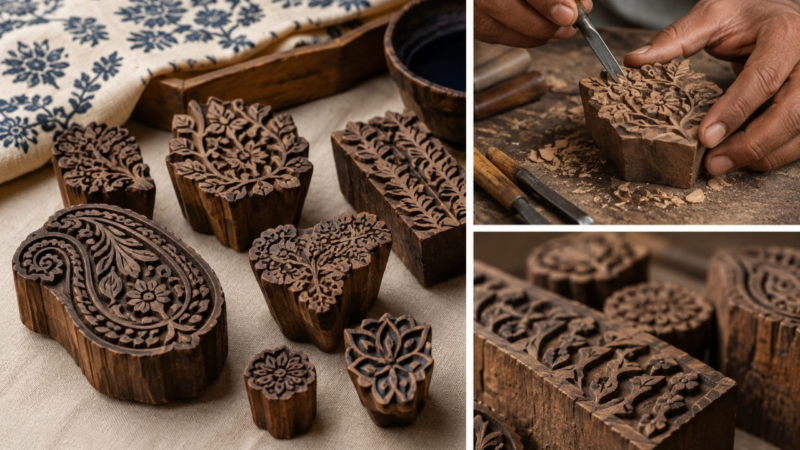
- A wooden block may look like a simple object.
- For an Ajrakh artisan, it can carry years of knowledge.
- The carved lines have to meet precisely.
- Patterns need to align.
- The printing must be repeated carefully.
- One small mistake can affect the appearance of the design.
- After the earthquake, these blocks represented continuity.
- Buildings had fallen.
- Landscapes had changed.
- Families had suffered.
- But the knowledge represented by the blocks could continue.
- They could be placed onto new fabric, in a new workshop, in a new settlement.
- The design could move forward.
- In that sense, the wooden block became more than a printing tool.
- It became a quiet reminder that craftsmanship could survive physical destruction.
Ajrakh in the World Beyond Kutch
- As Ajrakh recovered and demand for handcrafted textiles grew, the craft increasingly reached audiences outside Kutch.
- Designers became interested in its geometric patterns, natural colors and labor-intensive production.
- Customers began to appreciate the differences between handmade and machine-produced textiles.
- Ajrakh appeared in contemporary wardrobes and interiors.
- The craft’s visual language became recognizable far beyond the villages where it had been practiced.
- This wider recognition created opportunities for artisans.
- But it also introduced new questions.
- How can production grow without losing the handmade character?
- How can artisans earn fairly?
- How can younger generations remain interested?
- How can traditional knowledge survive when markets change?
- These are not questions created by the earthquake alone.
- But the earthquake had already taught the community an important lesson:
- survival requires adaptation.
A New Generation Inherits an Old Story
- For younger artisans, the earthquake may be remembered differently depending on their age and family history.
- Some experienced it directly.
- Others know it through stories told by parents and grandparents.
- For a younger generation working in Ajrakhpur today, the village itself can become a living reminder of that history.
- They are not simply learning how to print fabric.
- They are inheriting a story of displacement and rebuilding.
- They learn that their community once lived in Dhamadka.
- They learn that the earthquake changed their environment.
- They learn why their families moved.
- They learn how Ajrakh became connected with their new home.
- And then they take the craft forward in their own way.
- That is how living heritage works.
- It is not copied perfectly from one generation to the next.
- It is remembered, practiced and gradually reinterpreted.
The Beauty Behind the Resilience
- The word “resilience” is often used when discussing communities after disasters.
- But resilience can sound abstract.
- In Ajrakh case, it can be seen in very ordinary things.
- A workshop opening in the morning.
- Fabric being washed.
- Blocks being prepared.
- Indigo being mixed.
- Cloth being spread out to dry.
- An artisan teaching a younger family member.
- A customer placing an order.
- A new textile being finished.
- These simple actions represent recovery.
- They show that rebuilding is not always dramatic.
- Sometimes recovery is simply the decision to continue doing meaningful work.
Dhamadka Still Lives in the Story
- Moving to Ajrakhpur did not erase Dhamadka.
- For many families, the old village remains an important part of their history and emotional connection to the craft.
- Some accounts of Ajrakhpur describe artisans who continue to feel a strong connection to Dhamadka, even as Ajrakhpur has become associated with the market and commercial side of the craft.
- This emotional connection is significant.
- A craft can have more than one home.
- Dhamadka represents ancestry.
- Ajrakhpur represents reconstruction.
- Together, they tell a larger story.
- One place holds the memory of where the tradition lived.
- The other represents how the tradition found a way to continue.
The Earthquake Was Not the End of Ajrakh
- The 2001 Gujarat earthquake left an enormous mark on Kutch.
- Its impact was measured in lives lost, homes destroyed and communities disrupted. The physical and economic consequences were immense.
- For Ajrakh artisans, the disaster also damaged the conditions under which their craft had been practiced for generations.
- But the story did not end with destruction.
- The Khatri community moved.
- They rebuilt.
- They adapted to new environmental conditions.
- They established Ajrakhpur.
- They restarted workshops.
- They continued teaching the craft.
- And over time, Ajrakh reached new audiences.
- The earthquake changed the geography of the craft, but it did not erase its knowledge.
A Textile That Carries the Memory of a Place
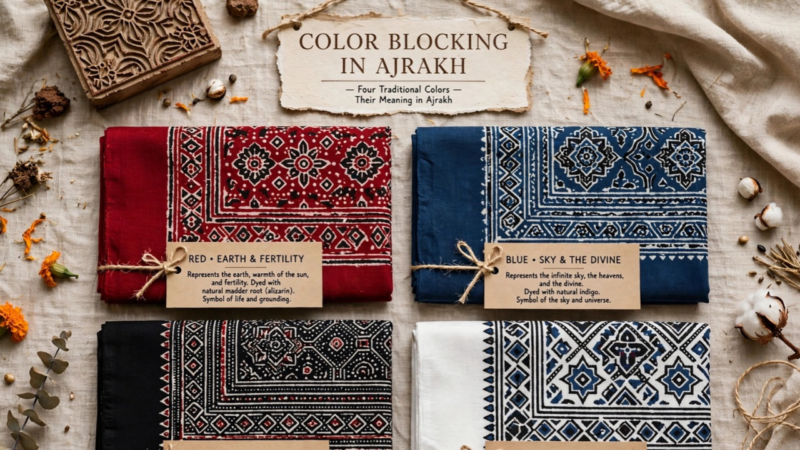
- Today, when we look at an Ajrakh sarees, dupatta or piece of printed cloth, it is easy to focus on its colors.
- The deep indigo.
- The earthy red.
- The black.
- The white.
- The geometric patterns.
- The carefully repeated motifs.
- But behind those visual details is a much larger history.
- There is Dhamadka.
- There is the Khatri community.
- There are generations of printing knowledge.
- There is the struggle with water.
- There is the destruction of 2001.
- There is the decision to move.
- There is Ajrakhpur.
- There are artisans who rebuilt their livelihoods.
- And there are younger generations continuing to work with the same basic idea that has carried the craft forward for centuries: fabric can become a carrier of memory.
The Story Written After the Ruins
- The most powerful part of Ajrakh post-earthquake story may not be the fact that a new village was created.
- It may be the reason that village exists.
- Ajrakhpur was born from necessity, but it became a place of continuity.
- The earthquake destroyed physical structures, yet the community carried something much harder to destroy—the knowledge of how to make Ajrakh.
- That knowledge travelled from Dhamadka to a new landscape.
- It survived changes in water.
- It survived financial difficulties.
- It survived uncertainty.
- And eventually, it found new audiences.
- This is why the history of Ajrakh after the 2001 earthquake cannot be told only as a disaster story.
- It is a story about people deciding that a tradition was worth carrying forward.
From Earthquake to Endurance
- More than two decades after the earthquake, Ajrakh continues to be closely associated with Kutch.
- Its patterns have entered modern fashion.
- Its textiles have travelled far beyond Gujarat.
- Its artisans have gained wider recognition.
- And Ajrakhpur has become a significant center for the craft.
- Yet the story behind the textile remains deeply local.
- It begins with a community.
- It passes through the hands of artisans.
- It depends on water, land and natural resources.
- It carries the memory of Dhamadka.
- And it continues through the generations living and working in Ajrakhpur.
- The 2001 earthquake changed the course of that story.
- But it did not write its final chapter.
- Perhaps that is the most meaningful way to understand Ajrakh today.
- Not simply as an ancient printing tradition.
- Not merely as a beautiful textile.
- And not only as a symbol of Kutch.
- Ajrakh is also evidence of what happens when human knowledge survives a changing world.
- The earth moved.
- Homes fell.
- A village was damaged.
- The earthquake forced families to reconsider where and how they could live.
- Yet the craft continued.
- The blocks were carved again.
- The colors returned.
- Artisans washed and printed the fabrics again.
- And a new village rose with the name of an old craft.
- Ajrakhpur became more than a place on the map.
- It became a reminder that heritage is not preserved only in museums or old books.
- Sometimes, heritage survives because people carry it with their hands.
- And sometimes, after everything around them has changed, those hands begin again.