
A piece of fabric can catch your eye before you even notice what it is made from.
Maybe it is the rhythm of repeated flowers running across the surface. Perhaps it is a geometric border that frames the fabric like an architectural detail. Or it could be a single familiar motif that instantly reminds you of a particular region, craft tradition, or cultural story.
That is the power of design language and motifs.
Design is not simply about making a textile look beautiful. Every line, shape, color, repetition and symbol can contribute to the personality of a fabric. Together, these elements create a visual language that helps us recognize, understand and connect with a textile.
What Is Design Language in Ajrakh Textiles?
Design language is the visual system through which a textile communicates its character.
It can be created through:
- Color combinations
- Lines and curves
- Geometric shapes
- Floral elements
- Animal and bird forms
- Repeated patterns
- Borders and panels
- Scale of motifs
- Spacing between elements
- Texture and surface treatment
- Placement of decorative details
- Traditional symbols
Think about looking at a fabric from a distance.
Before touching it, you can often sense whether it feels formal, festive, minimal, traditional or contemporary.
That first impression comes largely from its design language.
A textile with delicate floral motifs and soft colors can create a very different mood from one dominated by bold geometric shapes and contrasting tones.
The fabric speaks before we know its story.
Why Do Motifs Matter in Textile Design?
A motif is a visual element that is repeated, adapted or positioned within a larger design.
It can be simple or highly detailed.
A motif may represent:
- Nature
- Flowers
- Leaves
- Birds
- Animals
- Architecture
- Geometry
- Cultural symbols
- Religious ideas
- Everyday objects
- Abstract forms
But a motif is more than decoration.
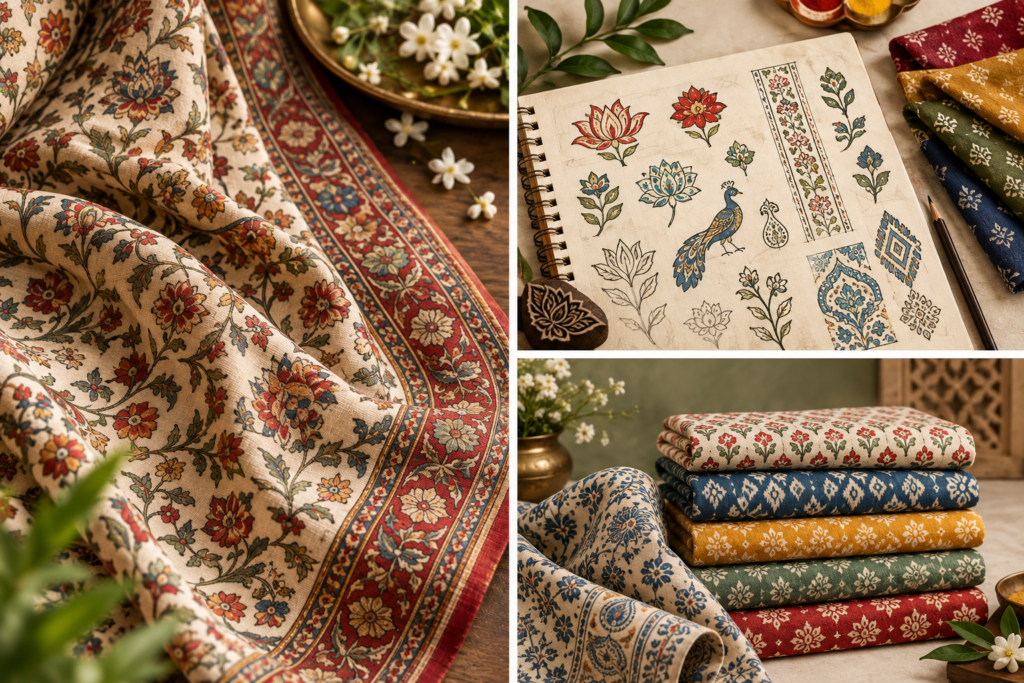
It can become the visual signature of a textile.
Imagine seeing a familiar floral arrangement on a fabric. You may recognize the style even before someone tells you where it came from.
That recognition is what makes motifs so important.
Motifs can help create:
- Identity
- Visual rhythm
- Cultural connection
- Recognition
- Decorative balance
- Emotional appeal
- Historical continuity
- A sense of craftsmanship
The Language of Repetition
One of the most interesting aspects of textile design is repetition.
A single flower may look ordinary.
Place that flower repeatedly across a fabric and something changes.
The eye begins to follow the movement.
The spaces between the motifs become important. The direction of the pattern starts creating rhythm. A border can guide the eye around the edge of a garment.
This is where pattern becomes visual language.
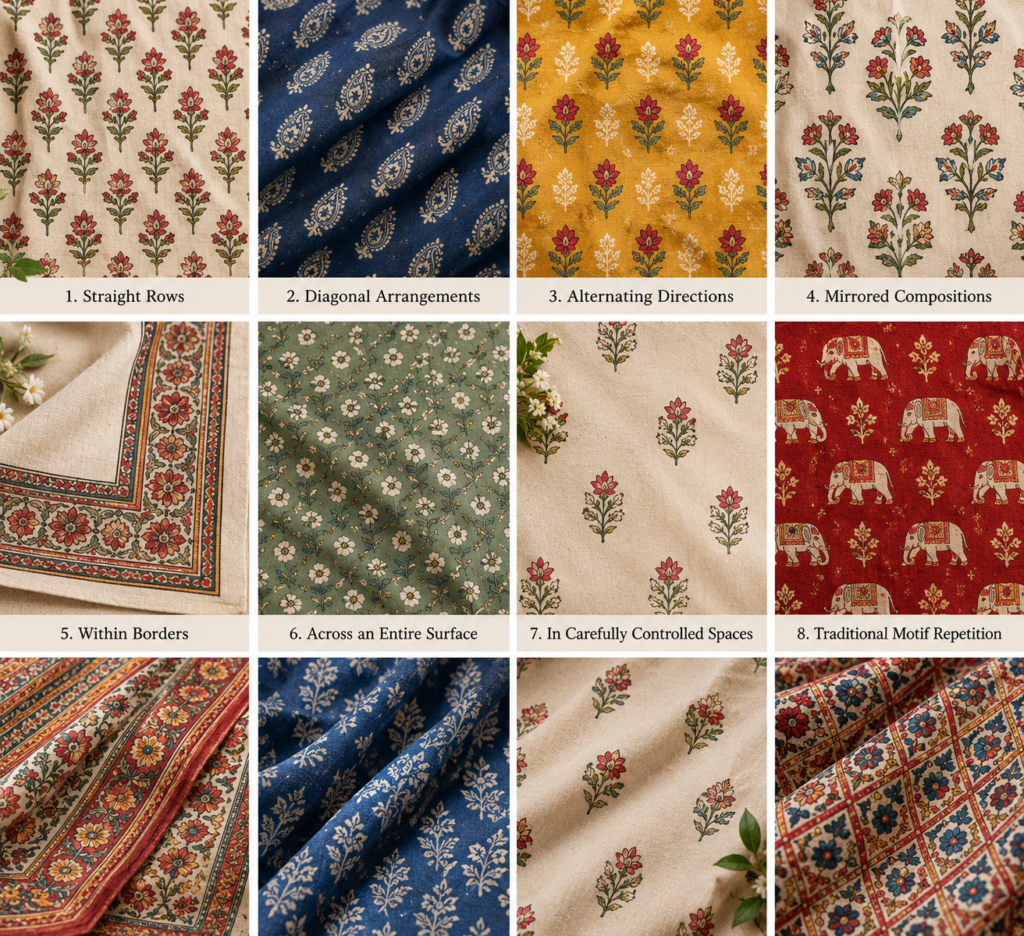
Designers may repeat a motif:
- In straight rows
- In diagonal arrangements
- In alternating directions
- In mirrored compositions
- Within borders
- Across an entire surface
- In carefully controlled spaces
The result can feel orderly, playful, traditional or contemporary depending on how those elements are arranged.
Nature as a Source of Textile Motifs
Look closely at traditional textile designs and nature appears again and again.
Flowers
Leaves.
Vines.
Birds.
Peacocks.
Trees.
Buds.
Fruits.
The reason is quite simple: nature offers an almost endless collection of shapes.
A designer does not necessarily copy a flower exactly as it appears in real life. Instead, its shape may be simplified, elongated, repeated or transformed into a decorative form.
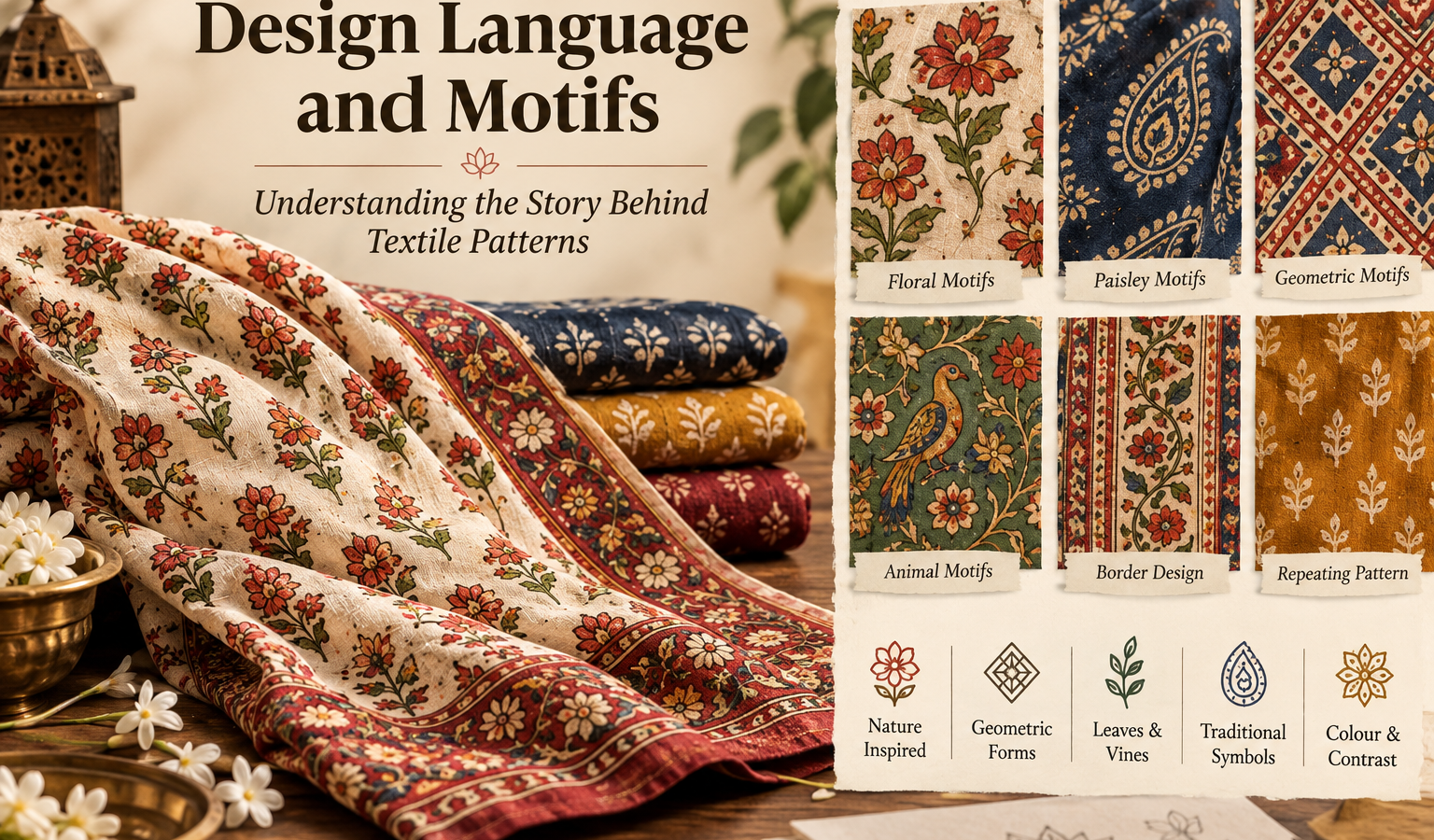
Common nature-inspired motifs include:
- Lotus flowers
- Roses
- Leaves
- Vines
- Blossoms
- Peacocks
- Birds
- Trees
- Fruits
- Creepers
The interesting part is the transformation.
A real leaf has irregular edges and natural variation. A textile motif may reduce that leaf to a few elegant curves.
Reality becomes pattern.
Geometric Motifs: When Structure Becomes Design
Not every textile story begins with flowers.
Some begin with lines.
Circles, squares, diamonds, triangles and grids can create powerful visual compositions.
Geometric motifs can communicate:
- Order
- Balance
- Precision
- Repetition
- Movement
- Symmetry
- Modernity
A simple diamond repeated across a fabric can create a completely different visual experience when compared with a scattered floral pattern.
The designer’s decision is not only about what shape to use.
It is also about:
How large should it be?
How often should it repeat?
How much space should surround it?
What happens when two shapes meet?
Those small decisions can completely change the personality of a textile.
The Importance of Scale
Here is something easy to overlook: the same motif can create different impressions at different sizes.
A tiny floral motif repeated closely can create a delicate overall texture.
Make that same flower much larger and it suddenly becomes the main visual statement.
This is why scale matters.
Designers can use:
- Small motifs for subtle detail
- Medium motifs for balanced visual interest
- Large motifs for statement pieces
- Mixed-scale motifs for layered compositions
The relationship between motif size and fabric surface is part of the overall design language.
Color Is Part of the Design Language
A motif does not exist independently from color.
Take a simple floral design.
Put it in soft neutrals and the result may feel understated.
Use strong contrasting colors and the same motif can feel energetic.
This is why color selection should be considered alongside motif development.
Color can influence:
- Mood
- Visual hierarchy
- Seasonal appeal
- Cultural association
- Perceived richness
- Contemporary or traditional character
A thoughtful textile design therefore considers motif + color + placement + repetition as connected elements.
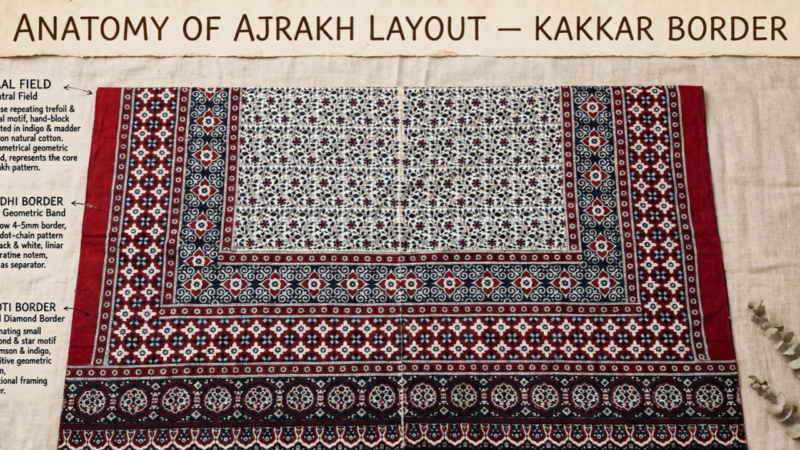
Borders: The Frame Around the Story
Sometimes the most memorable part of a textile is not its central pattern.
It is the border.
A border creates a visual boundary and can give the fabric a finished appearance.
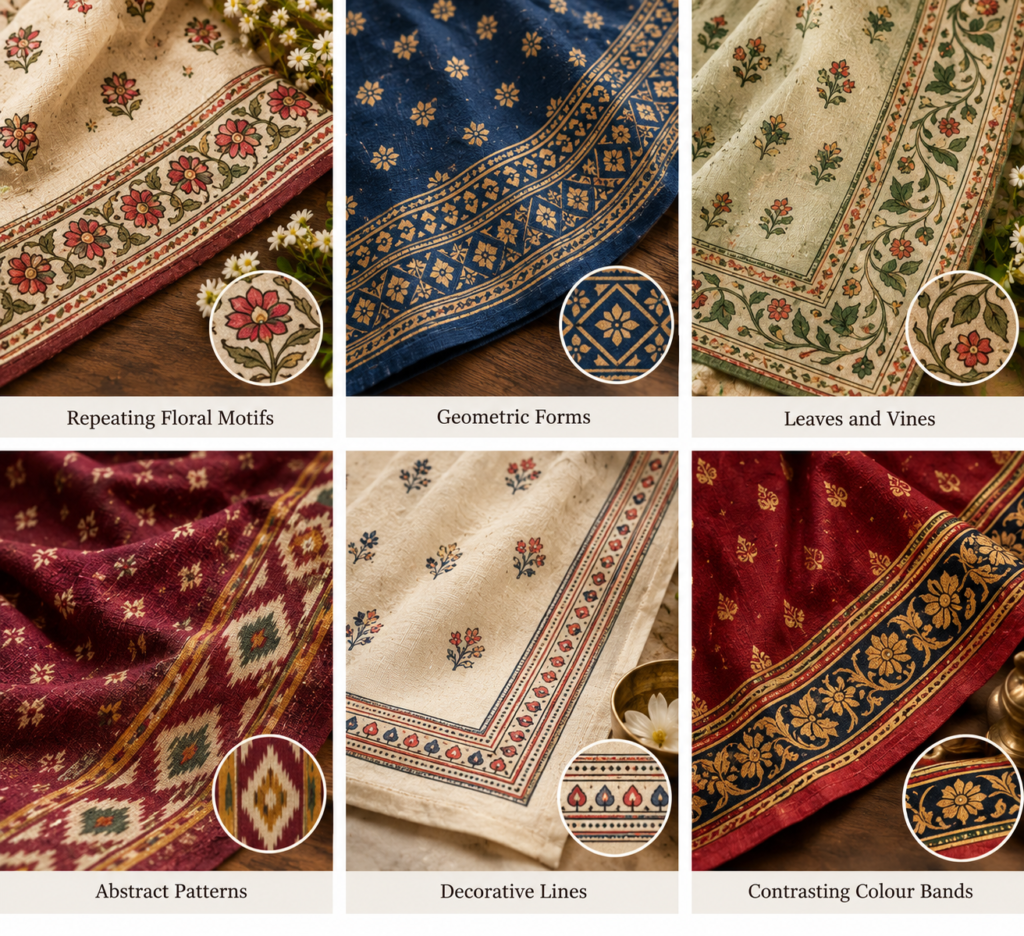
Borders may contain:
- Repeating floral motifs
- Geometric forms
- Leaves and vines
- Abstract patterns
- Decorative lines
- Contrasting color bands
There is something satisfying about a border.
It tells the eye:
“This is where the composition begins and ends.”
In garments, borders can also guide attention toward the hem, neckline, sleeve or drape.
Traditional Motifs and Contemporary Design
Traditional motifs do not have to remain frozen in the past.
Designers often reinterpret familiar visual elements through:
- New color combinations
- Different scales
- Simplified shapes
- Modern layouts
- Minimal compositions
- Digital design techniques
- Contemporary garment silhouettes
This creates an interesting relationship between heritage and modern design.
The original visual idea remains recognizable, while its presentation changes.
That is where traditional design can continue to feel relevant without simply reproducing an old pattern exactly.
A Small Design Decision Can Change Everything
Imagine two fabrics using the same leaf motif.
In the first, the leaves are arranged closely together with almost no empty space.
In the second, the leaves are separated by generous areas of plain fabric.
The motif has not changed.
The design language has.
The first may feel dense and decorative.
The second may feel lighter and more restrained.
This is why good textile design is not only about creating beautiful motifs. It is also about understanding the relationship between positive and negative space.
The Human Side of Motif Design
Behind every finished pattern is a series of decisions.
Someone decides whether a curve should be softer.
Someone adjusts the spacing.
Someone notices that one element feels too heavy.
Someone changes the color.
Someone repeats the design until the rhythm feels right.
And sometimes the best decision is to remove something.
That human judgment is difficult to reduce to a formula.
Design grows through observation, experimentation and refinement.
A motif may begin as a simple sketch and eventually become part of a fabric that someone chooses for a special occasion.
That journey is what gives design its character.
How to Read the Design Language of a Textile
The next time you look at a patterned fabric, pause before judging whether you like it.
Instead, ask a few questions.
Look at the motifs
- What shapes do you notice first?
- Are they inspired by nature or geometry?
- Are they detailed or simplified?
- Is one motif more important than the others?
Look at the arrangement
- Are motifs evenly repeated?
- Are they scattered?
- Is there symmetry?
- Is there a visible direction?
- Is there a border?
Look at the color
- Which color dominates?
- Which color creates contrast?
- Are the colors subtle or dramatic?
- Does the color change the mood of the pattern?
Look at the empty space
- Is the fabric densely decorated?
- Are there large areas of plain space?
- Does the empty space make certain motifs stand out?
These questions help you move from simply looking at a textile to actually reading its design language.
Design Language Is More Than Decoration
A beautiful motif can attract attention.
But a well-developed design language can create recognition.
It tells us something about:
- The visual identity of a textile
- The designer’s choices
- The relationship between pattern and space
- The influence of nature or geometry
- The connection between traditional and contemporary aesthetics
- The mood a fabric is intended to create
That is why motifs deserve more attention than they usually receive.
They may look like small decorative elements, but collectively they can shape the entire personality of a textile.
From Motif to Identity
A textile becomes memorable when its individual elements work together.
The motif provides the visual vocabulary.
The color gives it mood.
The repetition creates rhythm.
The spacing gives it breathing room.
The border provides structure.
And the overall composition creates identity.
That is the real power of design language and motifs.
They transform individual shapes into a visual story.
Whether inspired by flowers, geometry, architecture, animals or abstract forms, motifs give textiles a way to communicate without using words.
And perhaps that is why we remember certain patterns long after we have forgotten where we first saw them.
Key Takeaways
- Design language is the overall visual system of a textile.
- Motifs are individual decorative elements within that system.
- Repetition creates rhythm and visual continuity.
- Nature provides many important sources of textile motifs.
- Geometric motifs can introduce structure and balance.
- Color influences how motifs are perceived.
- Scale can change the entire character of a pattern.
- Borders help frame and organize textile compositions.
- Traditional motifs can be reinterpreted for contemporary design.
- Negative space is as important as the motif itself.
- A strong design language helps create textile identity.
- Good design combines creativity with observation and refinement.
Suggested Internal Linking Opportunities
For an actual website, I would naturally place 2–3 internal links around relevant sections, for example:
- Traditional Textile Techniques → link from the heritage/design-language section
- Indian Textile Patterns → link from the motif section
- Handcrafted Textiles / Sarees Collection → link naturally in the conclusion or commercial section
Recommended H2 Structure
- What Is Design Language in Textiles?
- Why Do Motifs Matter in Textile Design?
- The Language of Repetition
- Nature as a Source of Textile Motifs
- Geometric Motifs: When Structure Becomes Design
- The Importance of Scale
- Color Is Part of the Design Language
- Borders: The Frame Around the Story
- Traditional Motifs and Contemporary Design
- A Small Design Decision Can Change Everything
- The Human Side of Motif Design
- How to Read the Design Language of a Textile
- Design Language Is More Than Decoration
- From Motif to Identity