
There is something fascinating about clothing: the same piece of fabric can look completely different on two people. The difference is not always the fabric, its price, or even its design. Sometimes, it is simply the way it is worn.
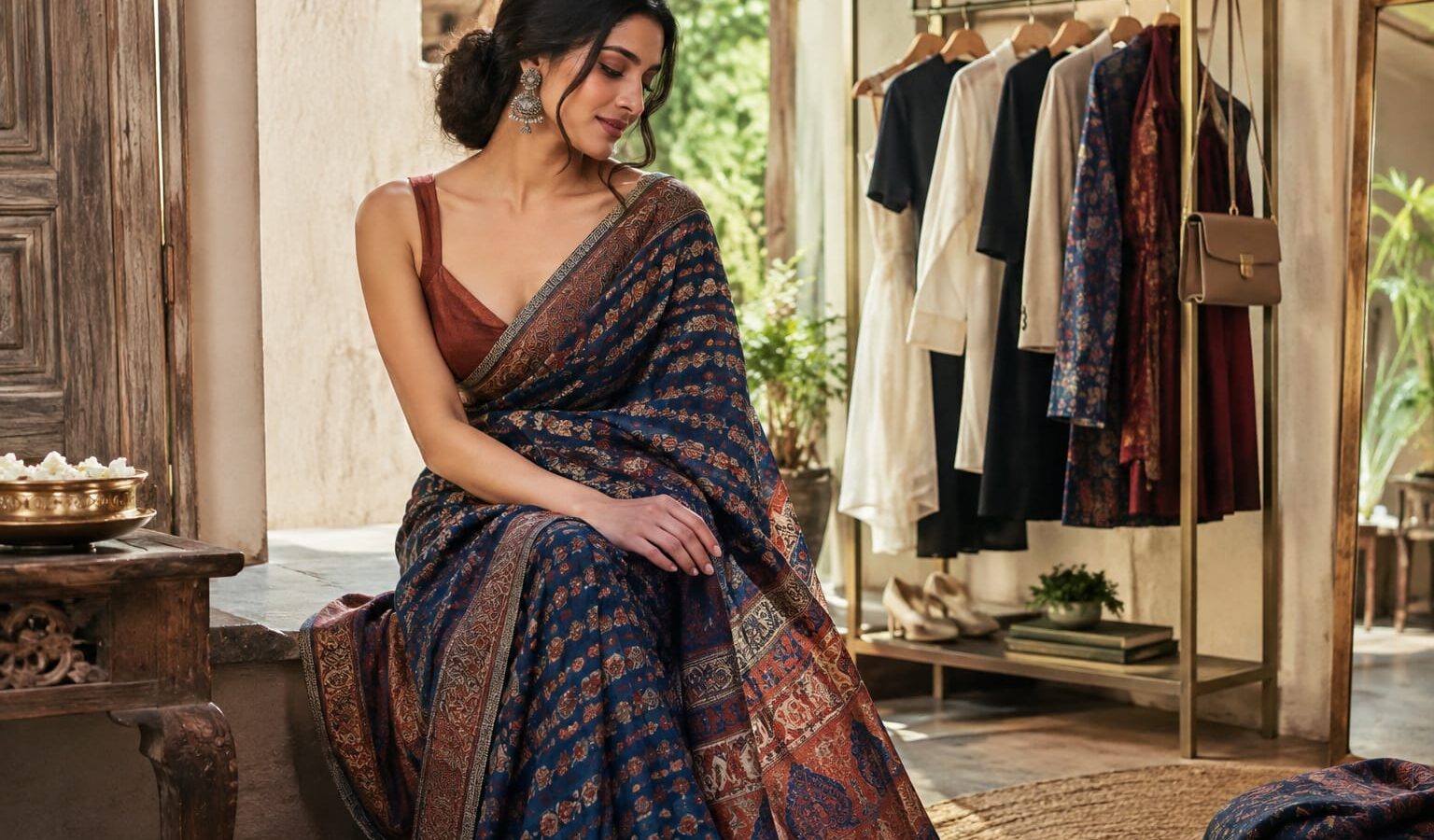
A saree folded neatly inside a wardrobe may look like a finished garment in Traditional Fashion Styling. However, once it is draped, pinned, pleated, layered, or paired with something unexpected, it becomes an entirely different visual experience.
The same fabric can look formal in the morning. Additionally, it may feel relaxed in the afternoon and striking at an evening gathering simply because its styling has changed.
The Fabric Decides Where the Styling Begins
- Before thinking about jewelry, footwear, or accessories, it is worth looking at the fabric itself.
- Every textile has a different behavior.
- Some materials create firm pleats and hold their shape throughout the day. Others fall close to the body and create a softer outline. Textured fabrics can add depth even when the design is simple, while printed textiles may need enough space for their patterns to remain visible.
- This matters particularly when working with handcrafted fabrics.
- A handmade textile may contain tiny variations in color, weave, thickness, or print placement. These characteristics can make the fabric feel distinctive. Trying to make such a textile look perfectly uniform can sometimes take away from what makes it special.
- Instead, styling can work with those natural qualities.
- A textured fabric may look beautiful in a simple drape. A detailed print may need fewer accessories. A heavier textile may work better with a structured blouse or jacket.
- In other words, styling does not always begin with the question, “What is fashionable?”
- Sometimes it begins with a much simpler question:
Draping Changes the Shape of an Outfit
- Draping is one of the easiest ways to alter the visual structure of traditional clothing.
- The position of the pleats, the length of the pallu, the placement of the fabric on the shoulder, and the way the material falls around the waist can all change the appearance of a saree.
- A longer, relaxed pallu can create movement. A carefully arranged pleat structure can give a sharper appearance. A different shoulder arrangement can change the balance between the upper and lower parts of the outfit.
- This is why learning about draping can make a wardrobe feel much larger than it actually is.
- You do not necessarily need another garment.
- You may simply need another way to wear the garment you already have.
- Draping can also be adapted according to daily needs. Someone traveling may prefer a secure and practical arrangement. Someone attending a formal event may choose a more structured style. Someone creating an editorial or artistic look may deliberately experiment with unusual proportions.
- The textile remains the same.
The Saree Does Not Have to Stay in One Category
One reason the saree continues to work within changing fashion is its flexibility.
It can be ceremonial, professional, casual, artistic, minimal, dramatic, or experimental depending on how it is styled.
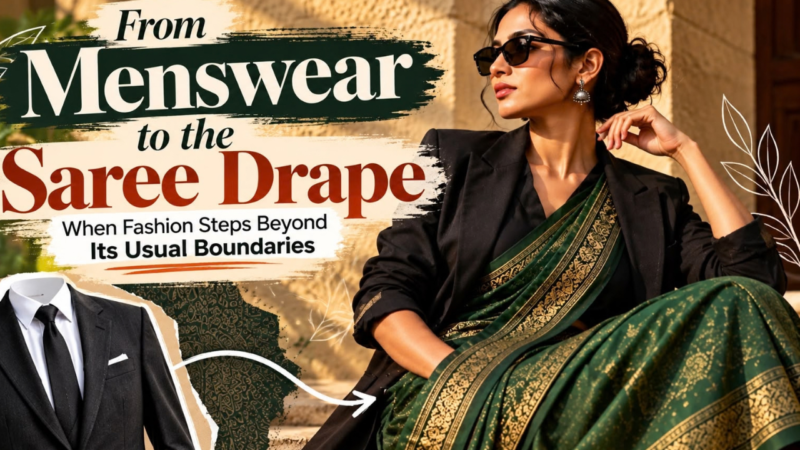
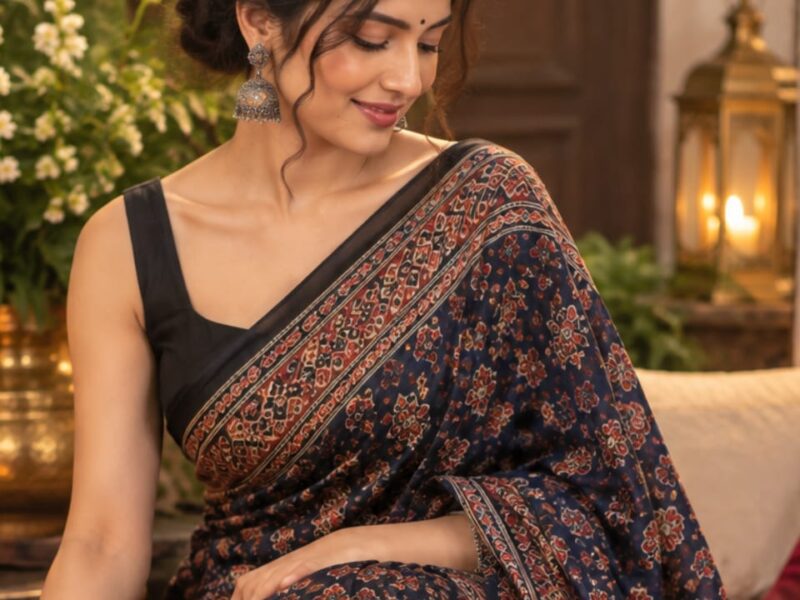
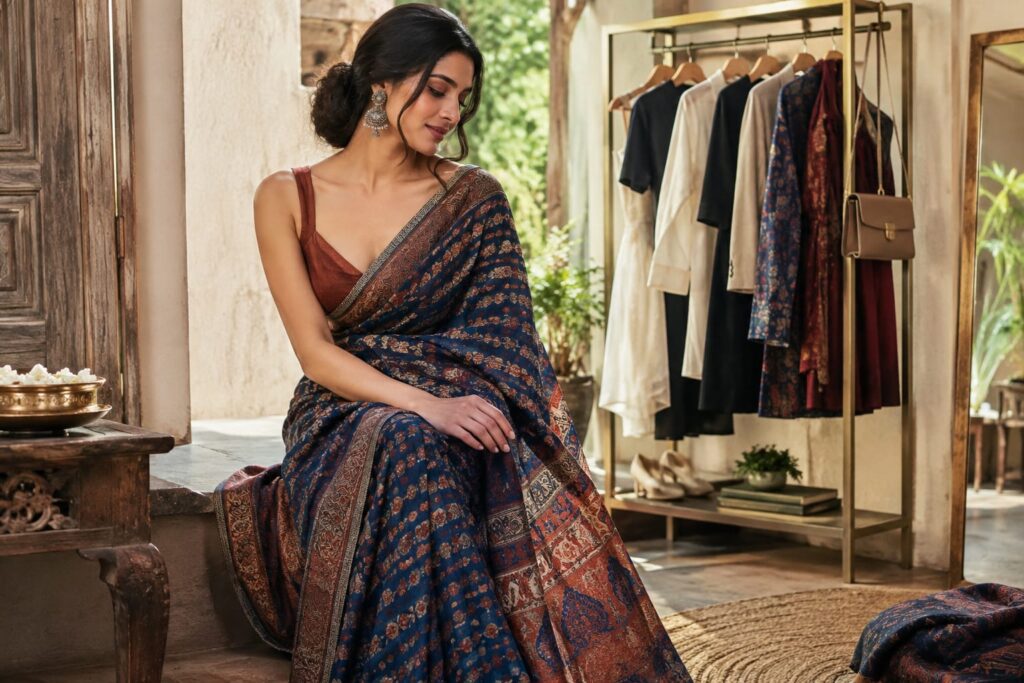
A hand printed saree with a plain blouse can create a quiet, textile-focused look. Pairing the same saree with a sharply tailored jacket introduces structure. A shirt-style blouse can make it feel more contemporary, while traditional jewelry can bring the focus back toward heritage.
This does not mean that one style is more authentic than another.
Different ways of wearing a saree simply reflect different purposes.
The important thing is to understand what the garment already offers and then decide which elements should be highlighted.
If the print is the main attraction, the rest of the outfit can remain restrained. If the saree is relatively simple, the blouse or jewelry can become the visual focus.
Styling is therefore less about adding more and more elements and more about deciding what deserves attention.
The Blouse Is a Second Conversation
- A blouse is not merely a supporting piece.
- It can completely redirect the mood of a saree.
- A high neckline can create a more structured appearance. A simple sleeveless design can make the outfit feel lighter. A long-sleeved blouse can introduce a formal quality. A contrasting color can bring out a shade hidden inside the textile.
- Fabric choice matters here too.
- Pairing similar textures can create a quiet, coordinated appearance. Mixing contrasting materials can make the outfit more visually interesting.
- For example, a soft textile with a crisp blouse creates a difference in structure. A richly textured saree with a very simple blouse allows the textile to remain dominant.
- This is particularly useful when working with heritage fabrics because the blouse can connect the traditional textile with the rest of a modern wardrobe.
From a Traditional Garment to a Wardrobe Piece
- The most useful traditional garments are often the ones that can move beyond one occasion.
- Instead of thinking of a saree, dupatta, or handcrafted skirt as “occasion wear,” consider it as a wardrobe component.
- A traditional dupatta can be paired with a plain kurtas, jeans, trousers, or a simple dress.
- A saree blouse can sometimes be styled separately with another skirt or pair of trousers.
- A textile skirt can work with a simple shirt instead of another traditional piece.
- A handcrafted jacket can be layered over both Indian and contemporary clothing.
- This approach changes the way a wardrobe is planned. Rather than buying complete outfits, individual pieces can be selected because they work with several things already owned.
- The result is a wardrobe with more combinations and fewer unnecessary purchases.
The Power of Contrast
- Some of the most interesting outfits are created through contrast.
- A traditional print with a modern silhouette.
- A soft textile with structured tailoring.
- A colorful saree with understated accessories.
- A heritage blouse with contemporary trousers.
- An old textile with a new styling idea.
- Contrast prevents an outfit from feeling predictable.
- But contrast does not have to mean something dramatic. Even a small difference in texture, shape, or color can be enough.
- For example, a traditional textile with modern footwear may create a subtle contemporary shift. A belt around a saree can change its silhouette without changing the textile itself.
- These small adjustments are often more useful than completely redesigning the garment.
Building a Wardrobe Around Real Life
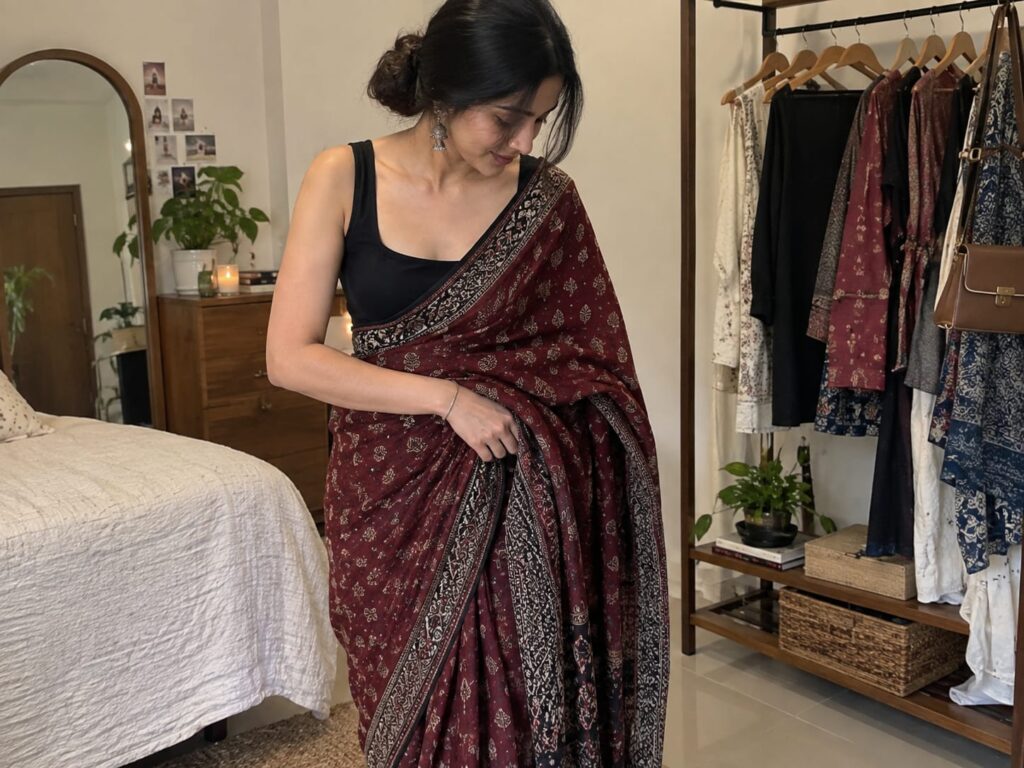
- A wardrobe should work outside photographs.
- This sounds obvious, but it is an important part of modern styling.
- Clothing has to survive ordinary activities—walking, sitting, traveling, working, attending events, and spending long hours away from home.
- That means styling decisions should include practical questions.
- Will the drape stay secure?
- Is the fabric comfortable for the weather?
- Can the outfit be worn for several hours?
- Does the footwear suit the amount of walking involved?
- Can the garment be maintained easily?
- These considerations do not make fashion less creative. They make it more realistic.
- A beautiful outfit that works comfortably in real life is often more valuable than something that looks impressive for only a few minutes.
A Smaller Wardrobe Can Still Create More Looks
- One of the simplest ways to make a wardrobe more versatile is to stop thinking of garments as fixed outfits.
- A saree does not necessarily belong to one blouse.
- A blouse does not necessarily belong to one saree.
- A dupatta does not necessarily belong to one suit.
- A jacket does not necessarily belong to one style of clothing.
- Once these boundaries are removed, combinations multiply.
- Imagine having five traditional pieces and several everyday basics. If each traditional piece can be paired with multiple modern garments, the wardrobe immediately offers many more possibilities.
- This way of styling also makes it easier to rediscover clothes that have been sitting unused.
- Sometimes a garment does not need to be replaced.
Styling Handmade Textiles Without Overdoing Them
Handmade fabrics already contain visual information.
Their weave, texture, printing, dye variations, borders, or motifs may be enough to create a complete look.
This is why minimal styling can work particularly well with them.
Instead of covering the textile with multiple statement elements, choose accessories that support it.
A simple metal earring, a clean handbag, natural footwear, or a restrained hairstyle can allow the textile to remain visible.
On the other hand, there are moments when bold styling is appropriate. A festive occasion may call for stronger jewelry or a more elaborate drape.
The point is not to follow a permanent rule.
The point is to understand the visual weight of the textile before adding anything else.
The Relationship Between Color and Mood
- Color can change the entire direction of an outfit.
- A deep indigo textile may create a different impression from the same design in a warm earthy shade. A neutral blouse can quiet a colorful saree, while a contrasting blouse can make its colors appear stronger.
- Instead of matching every color exactly, styling can use relationships between colors.
- A shade can be repeated in a small accessory. A contrasting color can be introduced through the blouse. A neutral can provide space between two strong colors.
- This creates a wardrobe where traditional textiles do not have to be worn exactly as they were originally presented.
- They can become part of a broader color story.
Jewelry: A Question of Balance
- Jewelry has a special place in traditional styling, but more jewelry does not automatically create a stronger look.
- Sometimes one carefully chosen piece can have greater impact than several competing accessories.
- With a heavily patterned textile, earrings may be enough. With a simple saree, a necklace can become the central detail. Bangles, rings, nose pins, or hair accessories can each create a different emphasis.
- There is also room for mixing styles.
- Traditional jewelry with modern clothing can create an interesting contrast. Contemporary jewelry with heritage textiles can move the outfit in the opposite direction.
- This makes accessories useful for people who want to experiment without completely changing their wardrobe.
Re wearing Gives Clothing a Longer Story
A garment does not become less special because it is worn again.
In fact, repeated styling can reveal more about it.
The first time, a saree might be worn traditionally. Later, it may be paired with a different blouse. Another time, its pallu may be styled differently. A jacket may introduce an entirely new silhouette.
Each version becomes another interpretation of the same textile.
This is especially meaningful for garments that have emotional or cultural value.
Instead of keeping them untouched for years, styling allows them to participate in everyday life.
The garment becomes part of new memories rather than remaining connected only to the moment when it was first purchased or received.
Modern Styling Does Not Mean Forgetting Tradition
- There is sometimes an assumption that making traditional clothing modern means changing it until its original identity disappears.
- That is not necessary.
- Modern styling can be much more subtle.
- It can mean changing the blouse.
- It can mean adjusting the drape.
- It can mean wearing traditional jewelry with contemporary clothing.
- It can mean pairing an old textile with a new silhouette.
- It can even mean simply wearing a traditional garment in a setting where it was not previously considered an everyday option.
- The textile does not have to become something else.
- It can simply become part of another context.
Developing a Personal Way of Dressing
- Personal style rarely appears overnight.
- It develops through observation and experimentation.
- One person may discover that they prefer loose drapes. Another may feel more comfortable with structured pleats. Someone may love contrasting colors, while another person may prefer neutral combinations.
- There is no reason every wardrobe needs to look the same.
- The useful thing is to notice patterns in your own choices.
- Which fabrics do you reach for repeatedly?
- Which colors make you feel comfortable?
- Do you prefer statement accessories or minimal details?
- Do you like traditional silhouettes or contemporary combinations?
- Do you value comfort above everything else?
- These answers gradually create a personal styling vocabulary.
- Once that vocabulary develops, shopping can become easier because there is a clearer understanding of what actually belongs in the wardrobe.
When Heritage Becomes Part of Everyday Life
- Traditional fashion survives not only through preservation but also through use.
- A textile that is worn, styled, washed, repaired, re-worn, and passed forward becomes part of living culture.
- That is why modern styling can play an important role in keeping traditional fabrics relevant.
- A young person may not wear a conventional traditional outfit every day, but they may happily wear a handcrafted scarf with jeans. Someone may not choose a classic saree drape but may wear a heritage saree with a modern blouse.
- These small choices allow traditional materials to enter new spaces.
- They also show that heritage does not have to remain frozen in time.
The Wardrobe as a Meeting Pointing
- A modern wardrobe can contain many timelines at once.
- There may be an old saree, a recently bought shirt, inherited jewelry, handmade footwear, a contemporary jacket, and a favorite pair of trousers sitting together.
- They do not need to belong to the same fashion era.
- Styling creates the connection.
- That is perhaps the most interesting part of modern dressing. A wardrobe can become a meeting point between things that came from different places, periods, and influences.
- The result does not have to be perfectly coordinated.
- It simply needs to feel intentional.
The New Meaning of Wearing Well
Wearing well is not necessarily about wearing more.
It can mean understanding fabric, respecting craftsmanship, choosing useful combinations, caring for garments, and knowing how to adapt clothing to real life.
Draping teaches us that one textile can take many forms.
Styling teaches us that small changes can completely alter an outfit.
A modern wardrobe teaches us that versatility can be more valuable than quantity.
Together, they create a different approach to fashion—one where clothing is not treated as disposable or fixed, but as something that can evolve with the person wearing it.
Let the Textile Continue Its Journey
A textile begins its journey long before it reaches a wardrobe. It may pass through the hands of spinners, dyers, weavers, printers, embroiderers, tailors, and many others before becoming a finished garment.
But its journey does not end there.
The wearer becomes part of its story.
Every new drape, every different blouse, every unexpected pairing, and every occasion gives the textile another interpretation.
That is why modern styling is not about replacing tradition with something new. It is about allowing tradition to move.
A heritage textile can remain connected to its origins while becoming part of a contemporary wardrobe. A familiar saree can acquire a completely different character through styling. A garment that once seemed suitable for one occasion can become useful throughout the year.
The most interesting wardrobe may therefore be the one that does not divide clothing into “old” and “new.”
Instead, it allows both to exist together.
Because when we change the way we wear a garment, we are not changing its history—we are adding another chapter to it.