
There are some textiles that look beautiful.
And then there are textiles that feel as if they have travelled through time.
Ajrakh belongs to the second kind.
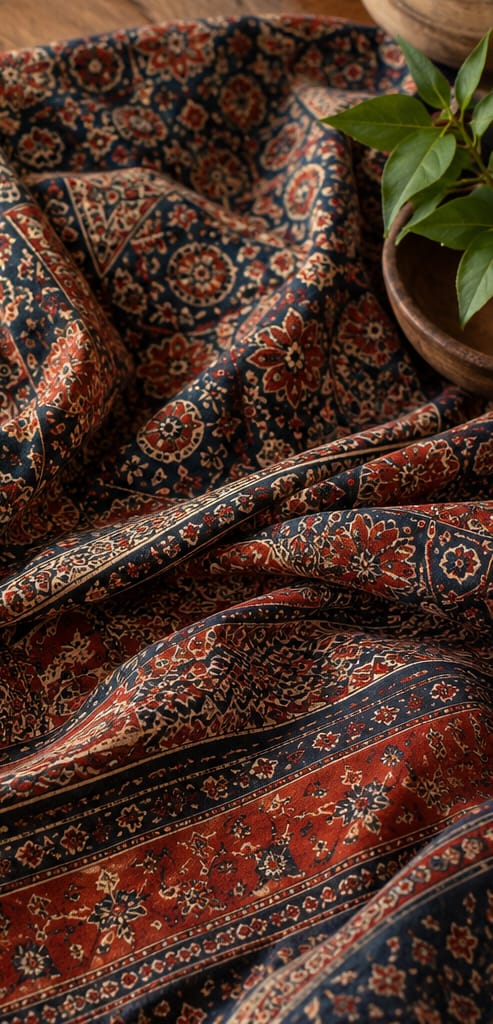
When you look closely at an Ajrakh textile, you notice much more than repeated blocks, deep indigo, earthy red, black, and carefully balanced geometric patterns. You notice a certain sense of order. Nothing appears accidental. The colors feel grounded, the patterns feel measured, and the entire textile carries a quiet connection with the earth.
This is one reason Ajrakh is often discussed alongside the ancient cultural world of the Indus Valley.
The connection should not be understood as a simple statement that “Ajrakh was made in the Indus Valley exactly as it is today.” There is no continuous written record proving that modern Ajrakh is unchanged from an Indus Valley textile. Instead, the relationship is better understood through place, craft traditions, natural dyes, geometric thinking, trade routes, and the long textile history of the Sindh–Kutch region.
Ajrakh has its own much later documented craft history, especially associated with Sindh and the Kutch region of Gujarat. Yet when we explore its visual language and the ancient textile culture of the northwestern Indian subcontinent, an interesting story begins to appear.
It is a story about rivers, soil, color, craftsmanship, migration, and the human desire to turn ordinary fabric into something meaningful.
A River Civilization and a Textile Tradition
- The story begins with the Indus.
- Thousands of years ago, settlements developed around the Indus River and its surrounding regions. Cities such as Harappa and Mohegan became part of one of the world’s earliest urban civilizations, generally dated to roughly the 3rd millennium BCE.
- The people of this civilization built planned settlements, worked with metals and pottery, traded across long distances, and developed sophisticated systems of production.
- Textiles were also part of this world.
- Although cloth itself rarely survives in the hot and often challenging archaeological environment of South Asia, archaeologists have found indirect evidence connected with textile production, including spindle whorls and impressions or traces associated with fibers and woven materials.
- This matters because textiles are rarely just about clothing.
- In an ancient settlement, the ability to spin fiber, weave cloth, dye materials, and exchange finished goods represents knowledge. It requires raw materials, tools, skilled hands, time, and systems of production.
- In that sense, the ancient textile world was already a sophisticated craft environment.
- Ajrakh belongs to a much later period, but it comes from a broader region where textile traditions developed over generations.
And that geographical relationship makes the story fascinating.
The Land Between Sindh and Kutch
- Modern Ajrakh is strongly associated with the Khatri communities of Sindh and Kutch, who developed and preserved the craft through generations.
- Historically, Ajrakh has been closely connected with Sindh, while the craft also became deeply established in Kutch after migrations of artisan families.
- This movement is important because traditional crafts do not always remain in one place.
- People move.
- Families move.
- Skills move with them.
- A printing technique that begins in one region can gradually change as artisans encounter new materials, customers, climates, markets, and cultural influences.
- The Kutch region, with its distinctive landscape and proximity to Sindh, became an important home for Ajrakh printing.
- This is where the ancient geographical story and the living craft story begin to sit beside each other.
- The Indus civilization was shaped by river systems and trade networks.
- Ajrakh developed within a cultural landscape that also connected Sindh, Kutch, and other parts of the Indian subcontinent.
- The connection is therefore less about claiming an unbroken line and more about understanding the shared cultural landscape of northwestern South Asia.
What Makes Ajrakh Look So Ancient?
Perhaps one reason people naturally associate Ajrakh with ancient cultures is its visual language.
Ajrakh does not usually depend on loud or random decoration.
Its beauty comes from repetition and balance.
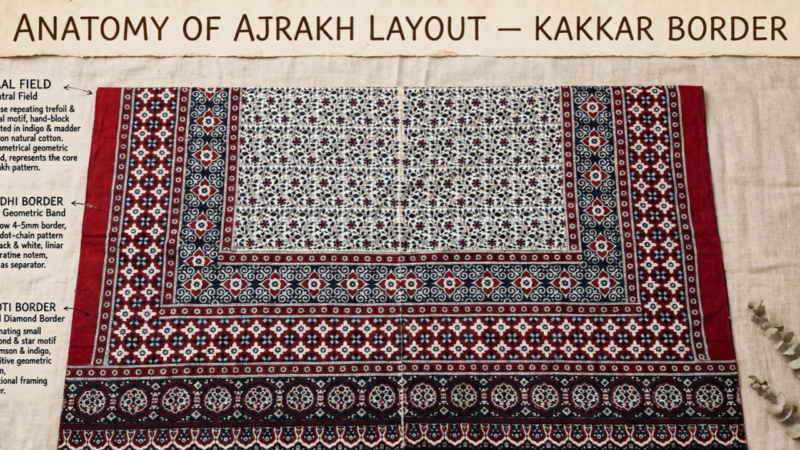
Geometric forms are carefully arranged. Floral elements appear in structured compositions. Borders frame the central design. Small motifs repeat across the surface like a visual rhythm.
There is something almost architectural about it.
A traditional Ajrakh textile can have several layers of pattern working together. A central field may be surrounded by borders, while smaller motifs fill spaces between larger forms.
The result is not simply decoration.
It is rhythm.
This emphasis on geometry and repetition can remind viewers of the organized visual systems found in many ancient artistic traditions. But it is important not to assume that a similar geometric appearance automatically proves direct historical continuity.
Human beings across different cultures have always used circles, grids, flowers, stars, dots, lines, and repeated patterns.
What makes Ajrakh special is how these elements are brought together through a particular printing tradition.
Indigo: The Color That Connects Earth and Water
- If Ajrakh had a personality, indigo would probably be part of it.
- The deep blue associated with traditional Ajrakh is one of its most recognizable features.
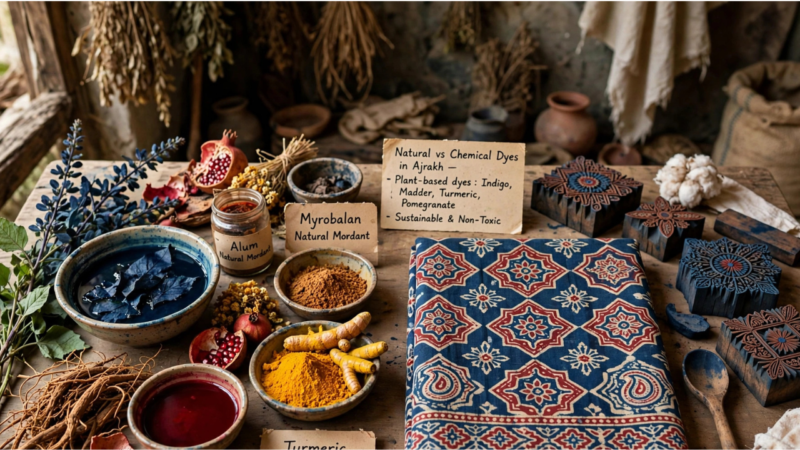
- Natural indigo has a long history in South Asia and other parts of the world. It comes from plants of the Indigofera genus, and producing a usable dye from the plant requires knowledge and patience.
- The color does not simply appear on cloth.
- It is developed through a process.
- The dye bath, oxidation, repeated dipping, drying, and careful handling all contribute to the final shade.
- A freshly treated textile can change dramatically as it meets air.
- The blue deepens.
- The surface develops character.
- And this is one of the things that makes naturally dyed textiles feel alive.
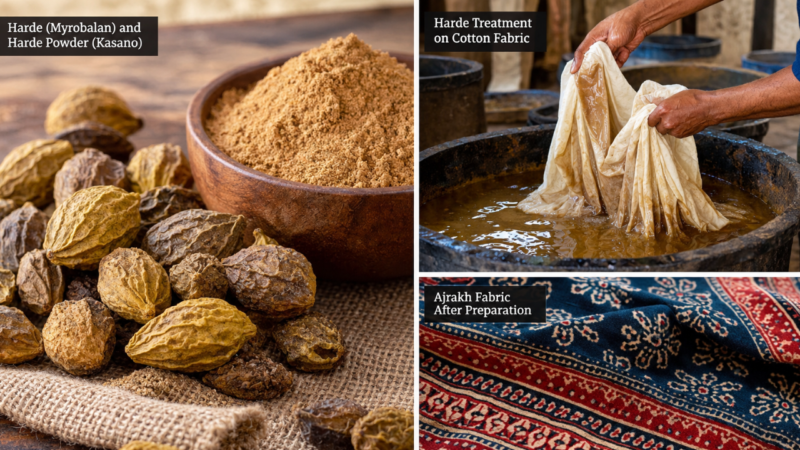
- Ajrakh also traditionally uses other natural dye sources, including materials that can produce red, black, and earthy tones. Alum and other mordants help prepare fibers and develop colors, while natural substances such as madder and local materials have historically been used within the dyeing process.
- This is where textile science and traditional knowledge meet.
- An Ajrakh artisan does not simply “color fabric.”
- The artisan understands how a material reacts.
- How long it should be treated.
- How a dye behaves.
- How a block should be printed.
- How much pressure is needed.
- When the fabric is ready for the next stage.
- This knowledge is not written in a simple instruction manual.
- It is learned through practice.
The Secret Language of the Wooden Block
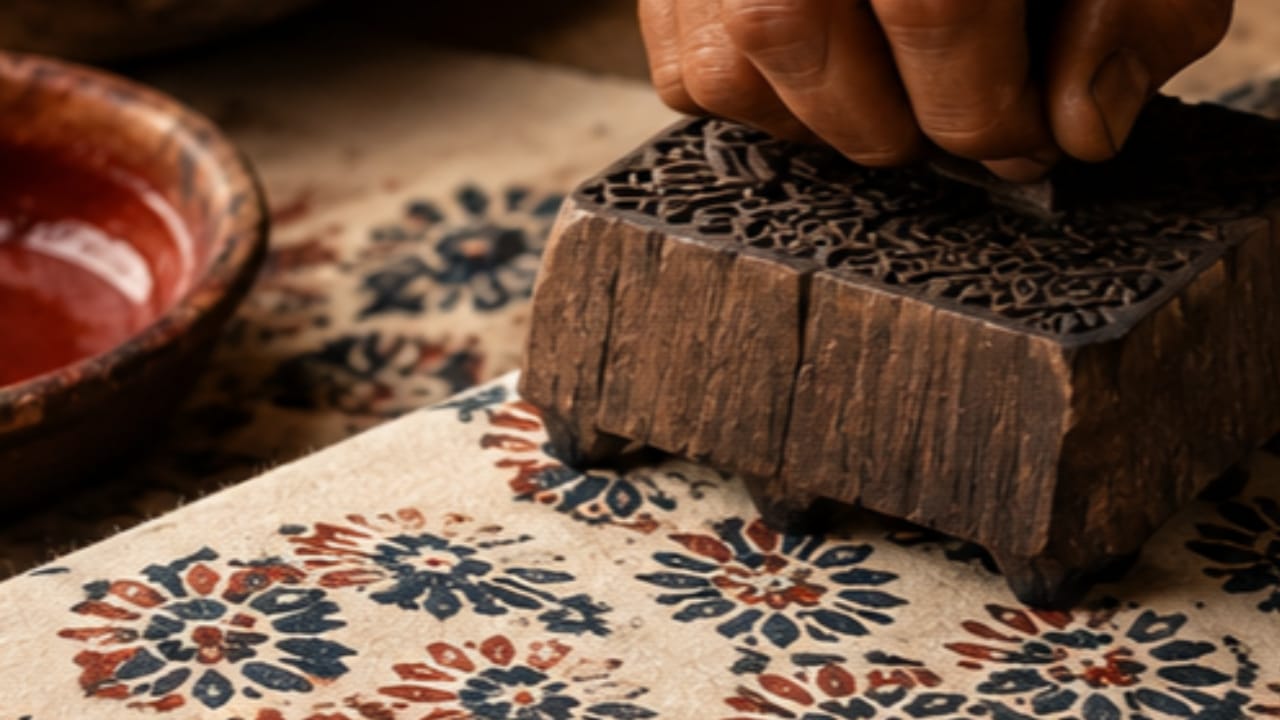
- One of the most beautiful parts of Ajrakh is its wooden blocks.
- At first glance, a block may look like a small carved piece of wood.
- In reality, it is a tool carrying a design language.
- A single Ajrakh textile may require different blocks for different parts of the pattern. Some blocks create outlines. Others add color. Additional blocks may create details or borders.
- The artisan must understand how the blocks fit together.
- If the alignment is slightly wrong, the pattern can lose its rhythm.
- If the pressure changes, the print may look different.
- If the dye is too wet or too dry, the result changes.
- This is why hand-block printing can never be completely identical to industrial printing.
- Small variations remain.
- And those variations are not necessarily flaws.
- They are evidence that a human being made the textile.
Ajrakh and the Idea of Slow Craft
Today, people often use the phrase “slow fashion.”
- It refers to a way of thinking about clothing that gives importance to durability, thoughtful production, craftsmanship, and responsible consumption.
- Ajrakh naturally fits into many of these conversations.
- Traditional Ajrakh printing is not a one-step process.
- The fabric may go through washing, preparing, dyeing, printing, drying, and repeated treatments. Depending on the design and technique, multiple printing and dyeing stages may be involved.
- Every stage requires attention.
- There is no realistic shortcut that can reproduce centuries of accumulated craft knowledge overnight.
- This makes Ajrakh almost the opposite of disposable fashion.
- A mass-produced garment can be designed, manufactured, photographed, advertised, sold, and replaced within a short period.
- A traditional Ajrakh textile asks for something different.
- Time.
- Attention.
- Care.
- And respect for the process.
The Ancient World of Trade
- The Indus Valley civilization was not isolated.
- Archaeological evidence shows that communities associated with the Indus civilization participated in long-distance exchange networks. Materials and objects moved between regions, connecting South Asia with areas farther west.
- This is important when thinking about textiles because cloth has always been part of trade.
- Textiles are portable.
- They can be folded, transported, exchanged, gifted, sold, and worn.
- They also carry cultural information.
- A pattern can tell someone where a textile comes from.
- A dye can reveal what natural resources were available.
- A weaving or printing technique can point toward a particular community of artisans.
- Ajrakh similarly developed within a world of movement and exchange.
- Sindh and Kutch have historically been connected through geography, commerce, communities, and cultural interaction.
- The textile therefore belongs to a larger regional story rather than existing as an isolated craft.
Why the Indus Connection Still Matters
- If Ajrakh is not simply an unchanged textile from the Indus Valley Civilization, why do people continue to connect the two?
- Because the connection helps us ask better questions.
- How long have people in this region worked with natural materials?
- How did textile knowledge travel between communities?
- How did artisans transform local resources into color?
- Why do geometric patterns appear so strongly in traditional decorative arts?
- How do craft traditions survive when political boundaries change?
- And perhaps most importantly:
- How much history can be carried by something as ordinary as a piece of cloth?
- A textile can travel where written documents cannot.
- It can survive as a family object.
- A design can be remembered by an artisan.
- A technique can pass from parent to child.
- A color recipe can be protected within a community.
- In this way, craft traditions become a different kind of historical record.
From Sindh to Kutch: A Tradition Finds a New Home
- The history of Ajrakh cannot be separated from the movement of artisan communities.
- Khatri printers became closely associated with the craft, and Ajrakh developed into an important textile tradition in regions of Kutch, including Ajrakhpur, which is now widely recognized for the craft.
- Migration did not mean the tradition simply disappeared from its original cultural environment.
- Instead, it created new chapters.
- The techniques adapted to local circumstances.
- The craft interacted with changing markets.
- New generations learned old methods.
- At the same time, artisans had to respond to modern realities.
- This is one of the most important lessons from Ajrakh.
- Tradition does not always survive by remaining frozen.
- Sometimes it survives because people allow it to breathe.
Why Every Ajrakh Textile Feels Slightly Different
- There is a temptation to think that handmade textiles should look perfectly identical.
- Ajrakh challenges that idea.
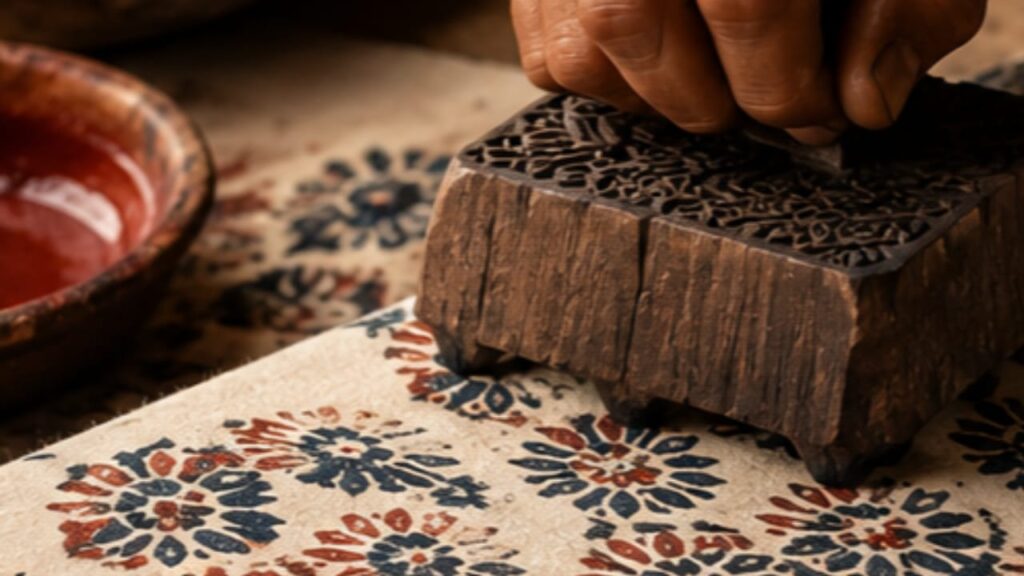
- When blocks are printed by hand, tiny differences can occur.
- The pressure may vary.
- The dye may settle differently.
- The fabric may respond differently.
- The alignment may shift by a fraction.
- Two pieces made using the same design can therefore have subtle differences.
- For a machine-made product, variation may be treated as inconsistency.
- For a handmade textile, variation can become part of its identity.
- This does not mean that every imperfect print is automatically valuable or historically significant.
- It simply means that the human process remains visible.
- And that visibility is one of the reasons traditional crafts continue to attract people in an age of automated production.
Ajrakh Is More Than a Pattern
- It is easy to reduce Ajrakh to its appearance.
- Blue fabric.
- Red details.
- Geometric borders.
- Floral motifs.
- Block printing.
- But that description misses the deeper story.
- Ajrakh is a relationship between material and maker.
- The cloth must cooperate with the process.
- The dye must behave correctly.
- The block must meet the fabric at the right pressure.
- The artisan must understand the sequence.
- And the final textile must survive washing, wearing, folding, and time.
- This is why describing Ajrakh only as a “beautiful print” does not do justice to it.
- It is a craft system.
- A knowledge system.
- And, for many artisan families, a livelihood carried across generations.
What Ancient Civilizations Can Teach Modern Fashion
- Modern fashion moves quickly.
- Trends appear online and disappear within months.
- Colors change every season.
- Consumers are encouraged to constantly refresh their wardrobes.
- Ajrakh offers a different rhythm.
- Its story asks us to slow down and notice what goes into an object before deciding what it is worth.
- A handmade textile can take considerable time.
- A natural dye can require patience.
- A wooden block can represent hours of carving and years of accumulated design knowledge.
- A traditional craft can depend on a community rather than a single machine.
- This does not mean handmade textiles are automatically more sustainable in every situation. Sustainability depends on many factors, including materials, production methods, transport, labor conditions, product longevity, and how a garment is used and cared for.
- But Ajrakh provides an important example of how fashion can be connected to craftsmanship rather than speed alone.
The Human Hands Behind the Heritage
- Perhaps the most important part of the Ajrakh story is not the ancient city, the river, the dye, or even the block.
- It is the person holding the block.
- A heritage craft survives only when someone continues to practice it.
- Behind every printed textile is an artisan making decisions that may look simple from the outside but are based on years of experience.
- The artisan knows how the fabric feels.
- They understand the printing surface.
- They recognize when the color is behaving differently.
- They know how much pressure to use.
- And they learn these things through repetition.
- This kind of knowledge is difficult to measure.
- It does not always appear on a label.
- But without it, the textile would not exist.
A Bridge Between the Past and the Present
- The relationship between the Indus Valley world and Ajrakh should therefore be viewed as a cultural conversation rather than a simple historical equation.
- The Indus Valley civilization belongs to the deep archaeological past.
- Modern Ajrakh is a living craft tradition with its own documented history, communities, techniques, and evolution.
- There are meaningful regional and cultural connections, but the evidence does not justify presenting modern Ajrakh as an unchanged Indus Valley textile.
- That distinction actually makes the story more interesting.
- Because Ajrakh does not need to be thousands of years old in exactly the same form to be historically important.
- Its value comes from the fact that people continued to develop, protect, teach, and wear the tradition.
- It is living heritage.
- And living heritage is never completely still.
When a Piece of Cloth Becomes a Story
- Imagine holding an Ajrakh textile in your hands.
- You see a repeated border.
- You see deep blue.
- You notice a small variation in the print.
- You feel the texture of the fabric.
- It might look like a simple piece of clothing.
- But behind it are many layers.
- There is the land where the fiber was grown.
- There is the water used during processing.
- There are plants and minerals connected with color.
- There is the person who carved the block.
- There is the artisan who printed it.
- There are techniques learned from another generation.
- There are communities connected through movement and trade.
- And somewhere in the background is the long history of the northwestern Indian subcontinent, where rivers supported cities, craftspeople created objects, and people exchanged materials across considerable distances.
- The textile becomes a small meeting point between all these histories.
Keeping the Story Alive
- The future of Ajrakh will not depend only on museums or historical books.
- It will depend on whether artisans can continue practicing the craft.
- It will depend on whether younger generations see value in learning it.
- It will depend on whether consumers understand why handmade production takes time.
- It will depend on whether traditional techniques can find a meaningful place in contemporary wardrobes without losing their identity.
- And it will depend on whether the story behind the textile is told accurately.
- That last point matters.
- Heritage becomes stronger when it is respected, not exaggerated.
- Ajrakh does not need an invented history to be fascinating.
- Its real story is already rich enough.
A Heritage That Continues to Evolve
- The most beautiful thing about Ajrakh may be that it belongs to both history and the present.
- It carries old techniques but appears in modern wardrobes.
- It uses traditional blocks but can be adapted to contemporary clothing.
- Its patterns have deep regional roots but can be appreciated by people far beyond the communities where the craft developed.
- This is how heritage survives.
- Not by remaining locked in the past, but by continuing to have meaning in the present.
- The Indus Valley reminds us of the extraordinary creativity of ancient communities.
- Ajrakh reminds us that creativity did not end with those ancient cities.
- It continued through generations of craftspeople who worked with cloth, color, wood, water, and their own hands.
A Story Still Being Printed
- The story of Ajrakh is not finished.
- Every new textile adds another small chapter.
- A new artisan learns an old technique.
- A familiar block creates a new composition.
- A traditional color appears on a contemporary garment.
- A young person discovers the craft and decides to continue it.
- That is what makes Ajrakh more than a historical reference.
- It is a living tradition.
- Its connection with the cultural landscape of the Indus region gives it a fascinating historical context, while its continuing practice gives it a future.
- And perhaps that is the most meaningful way to look at Ajrakh—not simply as something inherited from the past, but as something that people are still creating today.
- The river may have changed its course.
- Cities may have disappeared.
- Borders may have shifted.
- Markets may have transformed.
- But the human desire to create, preserve, and give meaning to beautiful things remains.
- In every carefully placed block, every layer of color, and every patiently finished piece of fabric, Ajrakh carries a reminder that heritage is not only what we inherit.
- Heritage is also what we choose to keep alive.