
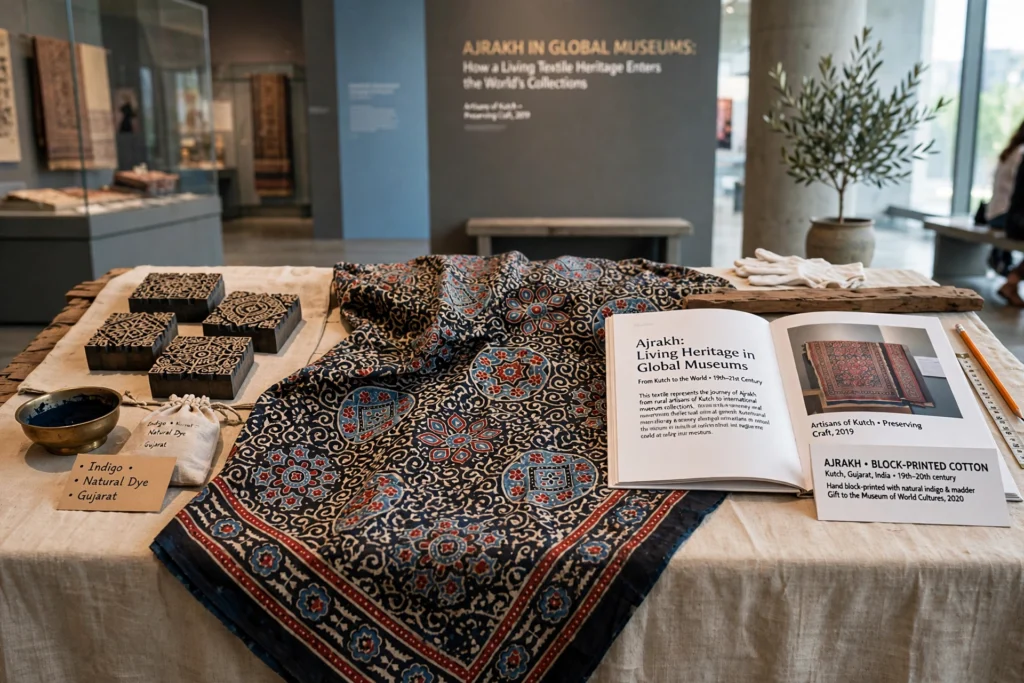
Ajrakh is not simply a beautiful printed fabric. It is a textile language shaped by color, geometry, natural dyes, skilled hands, patient craftsmanship, and generations of cultural memory. Traditionally associated with Sindh and Kutch, Ajrakh has travelled far beyond the communities where it was made. Today, its patterns, printing blocks, textiles, tools, and stories can be encountered in museums and cultural collections that help audiences understand the depth of Indian and South Asian textile traditions.
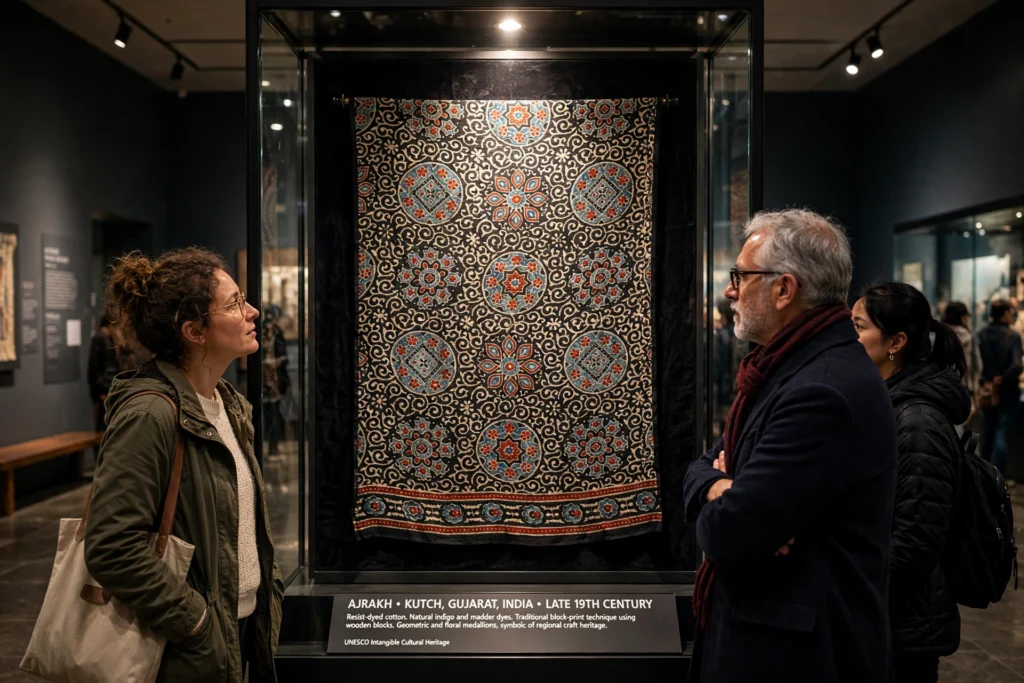
When Ajrakh enters a museum, it does not become just an old piece of cloth behind glass. It becomes evidence of a living craft system. A museum can preserve the physical textile, but the real story includes the artisan who carved the block, the dyer who prepared the color, the printer who aligned the design, the family that carried the knowledge, and the communities that gave the fabric meaning.
The presence of Ajrakh-related objects in international museum collections is therefore important for another reason: it shows how a regional craft can become part of a global conversation about design, sustainability, heritage, craftsmanship, and cultural identity.
Step 1: Understanding Why
Matters to Museums
Museums collect objects that can tell meaningful stories about people and cultures. Ajrakh fits naturally into this world because one textile can reveal several layers of history.
Ajrakh represents:
- Traditional hand block printing.
- Natural dyeing techniques.
- Resist-dyeing knowledge.
- Geometric design systems.
- Regional cultural identity.
- Artisan knowledge passed between generations.
- Historic connections between Sindh and Kutch.
- The movement of textiles through trade networks.
- Relationships between people, land, water, color, and craft.
- The survival of handmade production in a changing world.
The cloth may look visually simple from a distance, but closer inspection reveals repeated motifs, carefully balanced borders, layered colors, and the remarkable precision of hand printing.
This combination of beauty and technical complexity makes Ajrakh valuable for textile museums, design museums, cultural institutions, and collections focusing on South Asian heritage.
Step 2: From Local Cloth to Global Cultural Object
Ajrakh has historically been connected with communities in Sindh and Kutch and with wider regional textile traditions.
Its story also reflects movement.
People moved. Artisans moved. Techniques moved. Designs travelled through trade. Textiles crossed geographical boundaries.
The result was that Ajrakh was never completely isolated within one village or one community.
Its wider journey can be understood through:
- Sindh and its textile traditions.
- Migration of artisan communities.
- The development of Ajrakh printing in Kutch.
- Connections with pastoral communities.
- Trade across regional markets.
- Demand from communities beyond the place of production.
- Modern interest in handmade textiles.
- International exhibitions and museum collections.
The museum therefore becomes another chapter in Ajrakh’s journey.
The cloth that once served an everyday or cultural purpose can later become a historical document studied by curators, researchers, designers, students, and visitors.
Step 3: Looking Closely at the Craft Behind the Museum Piece
One of the strongest reasons museums preserve Ajrakh is its complex production process.
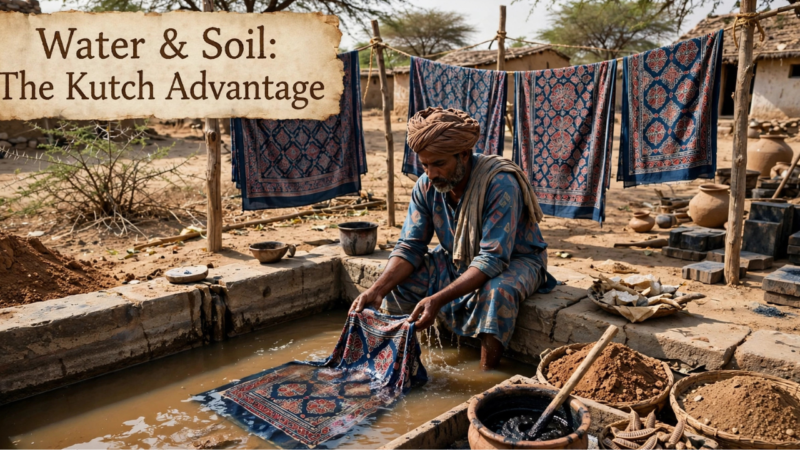
Ajrakh combines hand block printing and resist dyeing, often using natural colors such as indigo and red. The Crafts Museum’s documentation describes Ajrakh as a multi-layered process involving resist techniques, dyeing and double-sided printing.
A simplified journey of an Ajrakh textile includes:
- Preparing the fabric
- The cotton cloth is washed and treated.
- The aim is to remove unwanted substances and prepare the fibers.
- Treating the cloth
- Traditional materials are used to prepare the fabric for dyeing and printing.
- Myrobalan, also known as Hadar, has an important role in the process.
- Preparing the printing surface
- The fabric is placed carefully on the printing table.
- Alignment becomes extremely important.
- Preparing wooden blocks
- Designs are carved into wooden blocks.
- Different blocks may be required for different parts of the design.
- Applying resist
- Areas that should resist a particular dye are protected using traditional resist materials.
- Printing the pattern
- The artisan presses the carved block onto the fabric.
- Precision is essential because repeated motifs must remain aligned.
- Dyeing
- The fabric is exposed to natural dye baths.
- Indigo is especially important to Ajrakh’s visual identity.
- Drying and washing
- The fabric goes through repeated drying and washing stages.
- Repeating the process
- Different colors and layers require additional stages.
- Final finishing
- The textile is washed, dried and inspected before it becomes a finished Ajrakh piece.
The number of stages can vary according to the particular process and documentation, but the central idea remains the same: Ajrakh is created through patience rather than speed.
Step 4: Why Museums Preserve More Than the Finished Cloth
A museum collection does not always need to contain only a complete garment or large textile.
Sometimes the most valuable object can be something much smaller.
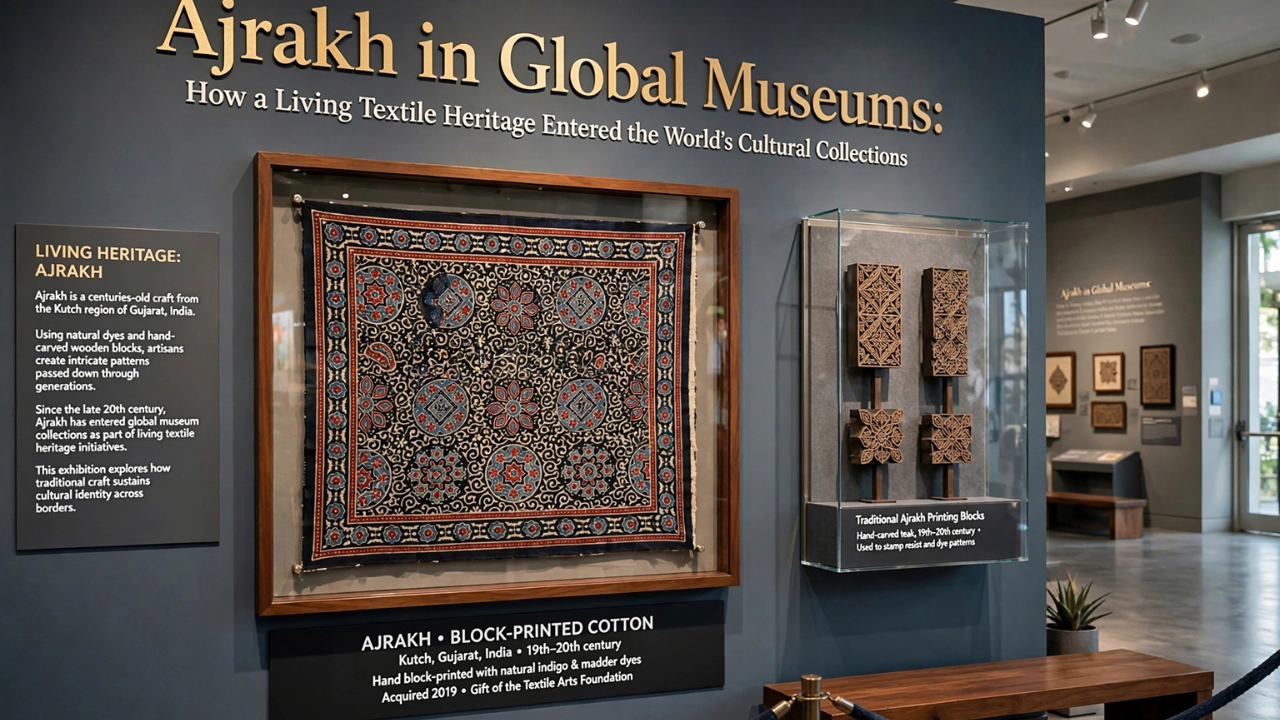
For example, the British Museum holds a carved wooden printing block used to make resist-dyed Ajrakh textiles. The object is identified as having been made in Dhamadka village in Kutch and is part of the museum’s Asia collection.
This is significant because the block represents the technology behind the textile.
A museum may preserve:
- Finished Ajrakh textiles.
- Printing blocks.
- Samples of fabric.
- Process samples.
- Natural dye materials.
- Tools.
- Contemporary fashion pieces.
- Photographs and documentation.
- Videos of the making process.
- Stories of artisan communities.
This changes how visitors understand the craft.
Instead of seeing Ajrakh simply as a patterned fabric, they can begin to understand the system of knowledge behind the pattern.
Step 5: Ajrakh and the Victoria and Albert Museum
The Victoria and Albert Museum in London has one of the world’s major collections of Indian textiles. Its Indian textile resources document the enormous variety of materials, techniques and traditions found across the subcontinent.
The VIA has also documented Ajrakh in connection with contemporary Indian design.
One notable example is a women’s Ajrakh jacket designed by Rajahs Pratap Singh in 2010. The museum describes it as digitally printed linen, showing how Ajrakh-inspired visual language can move into contemporary fashion.
This is an important development.
It demonstrates that Ajrakh can move between:
- Traditional textiles.
- Contemporary fashion.
- Museum collections.
- Design experimentation.
- Digital technology.
- Global audiences.
The museum does not only preserve the past. It can also show how traditional craft influences the present.
Step 6: The Museum Can Show the Making, Not Just the Result
A major challenge in textile heritage is explaining how much work exists behind a finished object.
If a visitor sees a beautifully printed cloth, they may appreciate the color and pattern but not understand how long it took to make.
This is where museum interpretation becomes powerful.
The Vials documentation of Ajrakh process samples associated with artisan Ismail Mohammad Khatri helped visitors understand the stages involved in creating the textile. Research into Ajrakh also contributed to the display of process samples and videos during the museum’s Fabric of India exhibition.
Process-based displays can help visitors understand:
- How raw fabric becomes finished cloth.
- Why natural dyes require patience.
- How blocks are aligned.
- Why repeated patterns are difficult to create.
- How resist printing works.
- Why artisans need technical knowledge.
- How traditional skills survive over time.
This makes the museum experience more human.
Visitors are no longer looking only at an object.
They are looking at someone’s knowledge and labor preserved in material form.
Step 7: The Crafts Museum Brings Ajrakh’s Process to Life
The Crafts Museum in Delhi provides another important example of how Ajrakh can be interpreted through cultural collections.
Its Ajrakh documentation presents the process through multiple stages, including fabric preparation, Hadar treatment, printing, dyeing and final washing. It also explains the importance of double-sided printing, one of Ajrakh’s distinctive characteristics.
The museum’s documentation makes something very clear:
Ajrakh is not created in one moment.
It develops layer by layer.
Think of the process like building a visual story:
- The first stage prepares the cloth.
- The next stage prepares the surface.
- The block introduces the design.
- Resist protects selected areas.
- Dye introduces color.
- Washing reveals the result.
- Additional printing builds complexity.
- Repetition creates visual harmony.
By the end, dozens of decisions have become one piece of cloth.
Step 8: The Beauty of Ajrakh’s Geometry
One reason Ajrakh attracts museum attention is its visual language.
Ajrakh frequently uses:
- Geometric shapes.
- Stars.
- Floral forms.
- Repeating borders.
- Dots.
- Symmetrical arrangements.
- Interlocking patterns.
- Deep indigo.
- Rich reds.
- Black and white contrasts.
The Government of Kachchh describes Ajrakh patterns as complex geometric compositions and connects their visual vocabulary with architectural forms such as jail windows and trefoil arches.
For museum visitors, these patterns offer a fascinating lesson in design.
A single motif can be repeated again and again, yet the overall composition does not feel monotonous.
Instead, repetition creates rhythm.
This is one reason Ajrakh can be appreciated not only as textile heritage but also as design heritage.
Step 9: Ajrakh as a Record of Natural Color Knowledge
Modern consumers often encounter color through industrial dyes and factory production.
Ajrakh offers a very different relationship with color.
Traditional Ajrakh processes use natural dye materials, with indigo playing an especially important role.
The color story can include:
- Indigo for blue.
- Madder and related materials for red tones.
- Myrobalan for fabric preparation.
- Plant materials for yellow and other shades.
- Iron-based preparations for black tones in some traditional processes.
The Crafts Museum’s documented process specifically records materials used for different colors, including indigo, madder, Mazarin and other plant-based dye materials.
This makes Ajrakh relevant to today’s conversations about:
- Natural dyes.
- Sustainable fashion.
- Slow production.
- Handmade textiles.
- Local resources.
- Traditional ecological knowledge.
A museum display can therefore connect an old craft with a very modern question:
How can we create beautiful things without losing our relationship with nature?
Step 10: Ajrakh and the Story of Artisan Communities
A textile cannot be separated from the people who make it.
For generations, artisan families have carried knowledge about blocks, dyes, resist materials, printing methods, color balance and fabric treatment.
This knowledge is often learned through observation and practice.
An artisan may learn:
- How much pressure to apply to a block.
- How to recognize the right consistency of a printing mixture.
- How to align repeated motifs.
- How to judge color development.
- How long fabric should remain in a dye bath.
- How to work with weather and drying conditions.
- How to correct small mistakes.
- How to maintain traditional motifs while experimenting with new designs.
Much of this knowledge cannot be understood completely from a written instruction manual.
It lives in the hands.
That is why preserving only the textile is not enough.
The maker’s story matters just as much as the object.
Step 11: Museums Turn Ajrakh into a Conversation Between Past and Present
Museums sometimes create the impression that traditional crafts belong entirely to the past.
Ajrakh challenges that idea.
The craft continues to evolve.
Contemporary designers have experimented with Ajrakh-inspired designs, new garments and modern production methods. The VIA, for example, has documented contemporary fashion that adapts Ajrakh visual language.
This creates an interesting bridge.
Traditional Ajrakh can meet:
- Modern clothing.
- Contemporary art.
- Interior design.
- Digital printing.
- Sustainable fashion.
- Museum education.
- Global fashion markets.
- New generations of consumers.
The goal does not have to be choosing between tradition and modernity.
The more interesting question is:
How can tradition remain meaningful while the world around it changes?
Step 12: From Kutch to International Audiences
Kutch is one of the important contemporary centers associated with Ajrakh.
The craft’s connection with the region gives it a strong geographical identity, but museum collections allow audiences far away from Kutch to encounter its visual and technical heritage.
A visitor in London, Delhi, or another international cultural institution may never have visited an Ajrakh workshop.
Yet through a museum display, they can still see:
- The wooden block.
- The printed textile.
- The dye process.
- The geometric design.
- The artisan’s method.
- The history behind the cloth.
This is one of the most powerful roles of museums.
They create a meeting place between people who made the object and people who may live thousands of kilometers away from where it was made.
Step 13: The Colonial History Behind Textile Collections
The global museum story also needs to be approached honestly.
Many South Asian textile collections in European institutions were formed during periods of colonial expansion and international trade.
The Vials Indian textile collections have historical links to institutions and collecting systems connected with the British Empire and commercial interests in Indian textiles.
This history matters.
When an Indian textile is displayed in a European museum, the question is not only:
“What is this object?”
There is another question:
“How did this object reach this museum?”
Understanding acquisition histories can make museum interpretation more responsible.
Modern museum discussions increasingly need to consider:
- Provenance.
- Colonial collecting practices.
- Community participation.
- Artisan recognition.
- Cultural ownership.
- Accurate historical interpretation.
- Collaboration with source communities.
This does not reduce the value of the textile.
Instead, it gives the textile a fuller story.
Step 14: Why Ajrakh Belongs in the Global Textile Conversation
Ajrakh’s museum presence shows that handmade Indian textiles are not simply regional crafts.
They are part of global design history.
Indian textiles have travelled internationally for centuries, influencing markets, clothing traditions, decorative arts and visual culture. The Vials Indian textile resources describe the importance of Indian textiles in global trade and their continuing relevance today.
Ajrakh adds its own distinctive chapter to this larger story.
Its importance comes from the combination of:
- Heritage.
- Craftsmanship.
- Natural materials.
- Design.
- Cultural identity.
- Community knowledge.
- Trade.
- Adaptability.
That combination makes Ajrakh relevant far beyond the textile market.
Step 15: What Museum Visitors Can Learn from Ajrakh
A museum visitor may walk into a gallery expecting to see an attractive textile.
But Ajrakh can teach much more.
It can teach us about:
- The value of handmade work.
- The patience required for traditional craft.
- The importance of natural materials.
- The relationship between people and landscapes.
- The role of artisans in cultural preservation.
- The history of textile trade.
- The influence of migration.
- The evolution of design.
- The impact of technology.
- The importance of documenting intangible heritage.
In this way, Ajrakh becomes an educational object.
It speaks not only to textile specialists but also to students, designers, historians, artists and anyone interested in culture.
Step 16: Ajrakh and the Future of Museum Collections
The future of Ajrakh in museums should not be limited to collecting old textiles.
Museums can also document the living craft.
Future collections could include:
- Interviews with contemporary artisans.
- Videos of printing processes.
- Digital records of traditional blocks.
- Documentation of natural dye recipes.
- Oral histories.
- Contemporary Ajrakh garments.
- Photographs of workshops.
- Stories of artisan families.
- Collaborations between designers and printers.
- Educational material for younger generations.
This approach would preserve not only what Ajrakh looks like, but also how Ajrakh knowledge survives.
That distinction is extremely important.
A textile can survive inside a climate-controlled storage room.
But a craft survives only when people continue to practice it.
Step 17: The Role of Digital Museums and Online Collections
Technology has changed how people experience museums.
Someone living far away from London or Delhi can now explore museum collections online.
Digital platforms can provide:
- High-resolution textile images.
- Object descriptions.
- Process photography.
- Videos.
- Interactive stories.
- Artisan interviews.
- Historical timelines.
- Educational resources.
The Crafts Museum’s Ajrakh stories available through Google Arts & Culture are an example of how digital storytelling can document the process and make it accessible to wider audiences.
This is especially useful for younger audiences.
They may discover Ajrakh online first and later become interested in visiting museums, learning about crafts, or supporting artisans.
Step 18: Why Preserving Ajrakh Is About More Than Saving Fabric
A piece of cloth can eventually become fragile.
Colors can fade.
Fibers can weaken.
Wooden blocks can crack.
But cultural knowledge can disappear even faster if it is not passed on.
Therefore, preserving Ajrakh requires a broader approach.
True preservation means protecting:
- The physical textile.
- The printing blocks.
- The techniques.
- The natural dye knowledge.
- The design vocabulary.
- The stories.
- The artisan communities.
- The cultural context.
- The connection between craft and place.
This is why museums, archives, researchers, designers and artisan communities all have an important role.
Step 19: From Museum Display to Living Heritage
There is a beautiful contradiction in Ajrakh’s museum journey.
A museum traditionally preserves objects by keeping them safe and stable.
Ajrakh survives differently.
It survives through use.
It survives when someone wears the fabric.
It survives when an artisan carves another block.
It survives when a younger family member learns the printing process.
It survives when natural dyes are prepared again.
It survives when a designer finds a new way to use its patterns.
Therefore, Ajrakh should never be understood only as a historical object.
It is a living textile heritage.
Step 20: Why Ajrakh’s Global Museum Journey Matters
Ajrakh’s presence in museum collections around the world is meaningful because it changes the scale of its story.
What began as a regional textile tradition can now be studied through the wider themes of:
- Global textile history.
- Cultural exchange.
- Traditional craftsmanship.
- Sustainable design.
- Natural dye technology.
- Fashion history.
- Migration.
- Trade.
- Museum studies.
- Community heritage.
The British Museum’s preservation of an Ajrakh printing block, the Vials documentation of Ajrakh and Ajrakh-inspired contemporary fashion, and the Crafts Museum’s detailed process documentation each show different sides of the same heritage.
Together, these examples remind us that Ajrakh is much more than a pattern.
The Cloth That Carries a Larger Story
Ajrakh’s journey into global museums is ultimately a journey from workshop to archive, from local tradition to international recognition, and from everyday cloth to cultural history.
But perhaps the most important thing is that Ajrakh has not stopped evolving.
Its story continues in Kutch workshops, in artisan hands, in contemporary fashion, in museums, in classrooms and increasingly on digital platforms.
A museum can preserve a piece of Ajrakh.
It can document a block.
It can record a process.
It can tell the story of an artisan.
But the real preservation happens when the knowledge continues to move from one generation to another.
That is what makes Ajrakh extraordinary.
Its patterns may repeat, but its story never truly stays the same.
From the deep blue of indigo to the warmth of madder red, from carefully carved wooden blocks to perfectly aligned borders, every piece carries evidence of time, patience and human skill.
And when that piece enters a global museum, it carries Kutch with it.
It carries the memory of artisans.
It carries the history of South Asian textiles.
It carries the relationship between color and land.
Most importantly, it reminds the world that traditional craftsmanship is not simply something to remember.
It is something worth keeping alive.