
Introduction: When Nature Inspires Textile Design
Nature has always inspired Indian artists, from painters and sculptors to weavers and block printers. Flowers, leaves, birds, animals, and geometric shapes appear in many traditional Indian crafts. These elements do more than decorate a surface. They connect art with everyday life, regional culture, and the natural world. In textile design, an animal can represent beauty, strength, grace, or celebration, depending on the cultural context and the way an artist uses it.
Ajrakh printing offers an interesting way to explore this relationship between nature and textile art. Known for its rich indigo, deep red, black, and white patterns, Ajrakh uses carefully arranged motifs to create balanced designs. Artisans build these patterns through repeated block printing, resist techniques, dyeing, and detailed planning. The final fabric often combines geometric borders, intricate fields, and repeating shapes that create a distinctive visual rhythm.
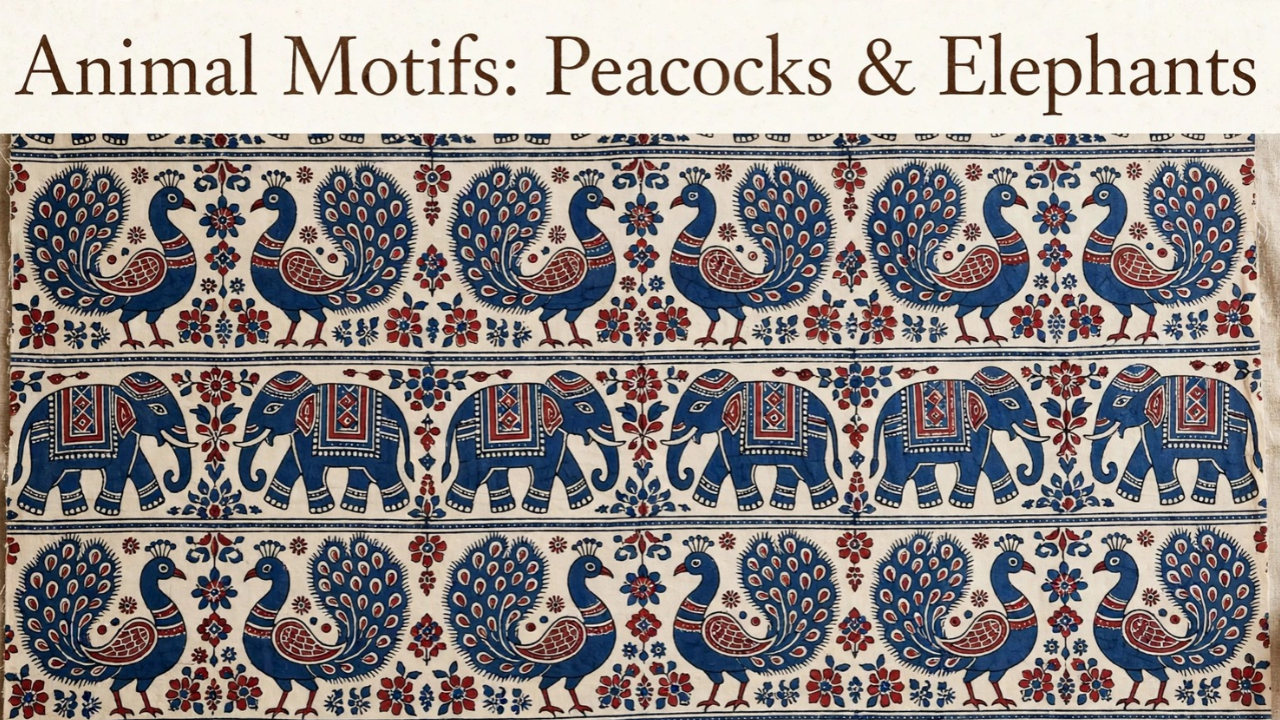
Animal motifs, such as peacocks and elephants, also appear in the wider world of Indian textile and decorative arts. The peacock, known as mor in Hindi, often represents grace, beauty, and the natural world. The elephant commonly appears in Indian art as a symbol associated with strength, wisdom, prosperity, and ceremonial traditions. Artists interpret these animals in many different ways, depending on the region, craft, period, and intended use of the design.
However, it is important to distinguish between traditional Ajrakh patterns and animal-inspired designs created for contemporary markets. Ajrakh artisans have developed a strong visual language through geometric arrangements, repeated motifs, borders, and intricate pattern structures. Not every peacock or elephant print belongs to an established Ajrakh tradition. Some contemporary designers combine animal imagery with Ajrakh-inspired layouts to create new interpretations.
Understanding animal motifs in Ajrakh therefore requires more than identifying a bird or an elephant in a printed fabric. We also need to examine the motif’s shape, its cultural associations, the printing techniques involved, and the relationship between the animal and the surrounding pattern.
Understanding Animal Motifs in Textile Art
Artists use motifs as recurring visual elements in a design. A motif may represent a flower, leaf, star, animal, or abstract shape. When an artisan repeats a motif across a piece of fabric, it creates a pattern that gives the textile structure and character.
Animal motifs belong to a design category known as zoomorphic art. The term describes artistic forms inspired by animals or shaped to resemble them. In textiles, zoomorphic designs can show a recognizable animal, such as a peacock, or simplify its features into an abstract pattern.
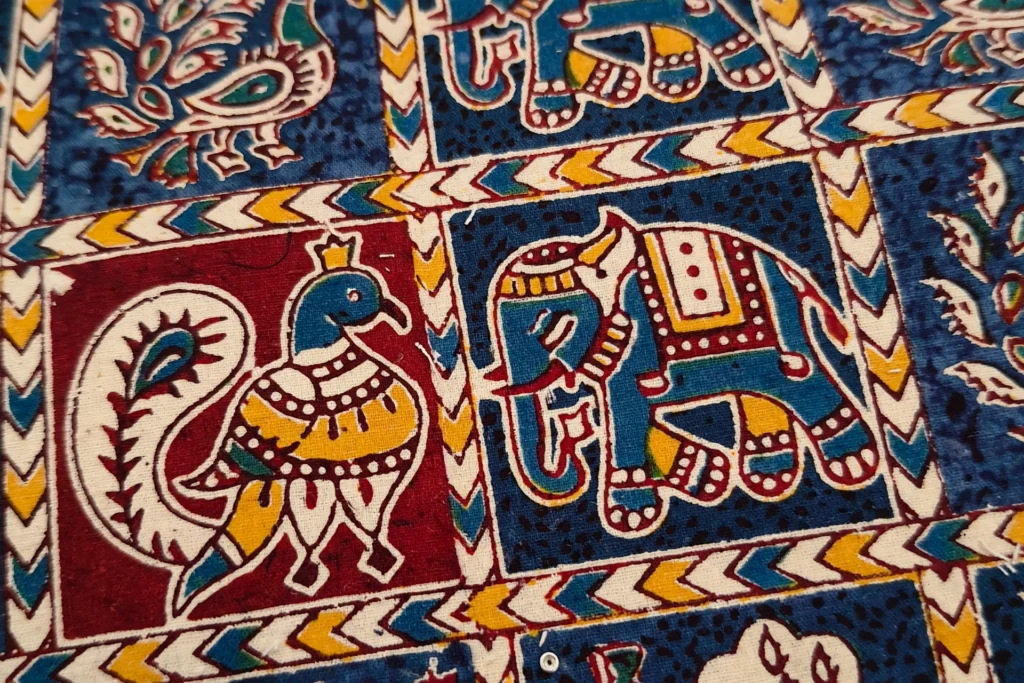
An artisan might emphasize a peacock’s curved neck, decorative feathers, or spreading tail. Another designer might focus on the elephant’s rounded body, broad ears, and trunk. These details help viewers recognize the animal even when the artist simplifies its shape.
Textile designers often adapt animal forms to suit the limitations and possibilities of their craft. A painter can add fine lines and small details with a brush, while a block printer must consider the carved block, the fabric surface, and the printing process. A complicated animal illustration may lose clarity when reduced to a small wooden block. For this reason, artisans often simplify the outline and remove details that would make the pattern difficult to print.
Repeated animal motifs can also create movement across the fabric. A row of peacocks may suggest a flowing rhythm, while a series of elephants may produce a bold, structured appearance. Spacing, direction, scale, and repetition all influence the final result.
In Ajrakh-inspired textiles, designers can combine animal forms with the symmetry and repetition associated with block printing. They may place a small animal motif inside a geometric framework, surround it with floral details, or arrange several motifs in a repeating field. These choices help the design feel organized rather than crowded.
Zoomorphic Designs in Ajrakh
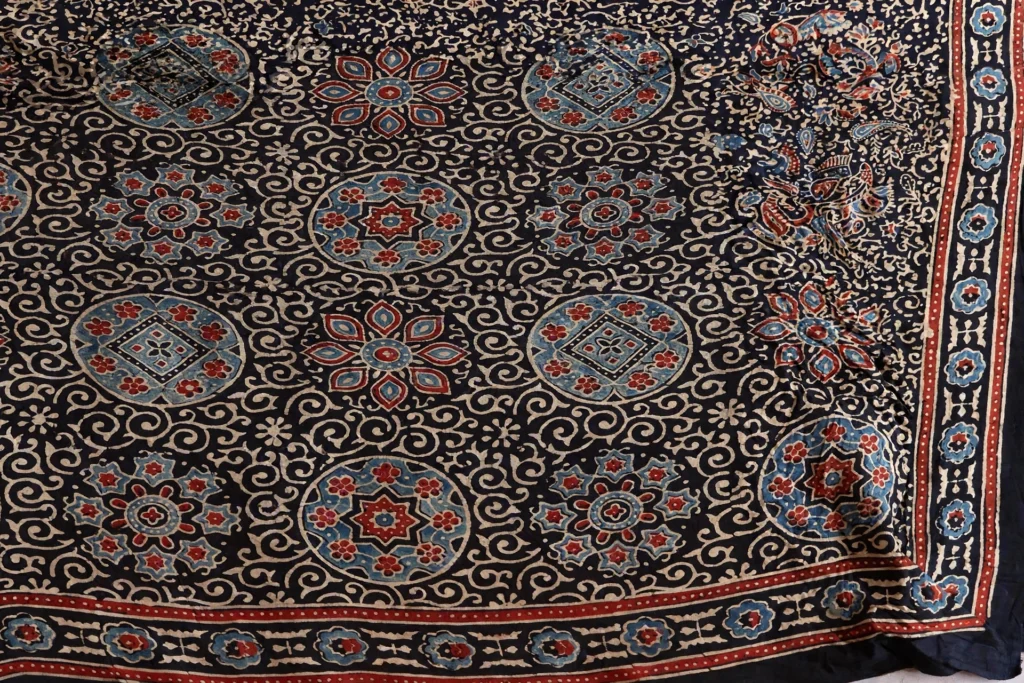
Ajrakh stands out for its complex patterns, rich natural-looking colours, and carefully coordinated design elements. Traditional examples often feature geometric grids, stars, floral forms, repeated dots, and intricate borders. Artisans use multiple printing and dyeing stages to create layers of colour and detail.
The craft has strong historical connections with Kutch in Gujarat and Sindh, now in Pakistan. Artisan communities have developed and preserved Ajrakh printing traditions across generations. Their work reflects local knowledge of dyes, fabric preparation, block carving, water, resist materials, and pattern construction.
When animal motifs enter an Ajrakh-inspired design, they must work with this existing visual structure. A peacock or elephant cannot simply sit on the fabric without consideration for scale, spacing, and surrounding elements. The designer must decide how the animal relates to the geometric field and the border.
For example, a contemporary designer might create a small peacock motif and repeat it within a regular grid. The artisan could use a dark outline against a red or indigo ground, then surround the motif with smaller geometric details. This approach connects the animal’s shape with the fabric’s overall rhythm.
An elephant motif might occupy a larger space because its body requires a broader silhouette. The designer could place elephants in alternating directions to create a repeating arrangement. A border might frame the pattern and separate it from the rest of the fabric.
These examples describe possible design approaches rather than universal rules for traditional Ajrakh. Specific motifs vary by artisan, region, workshop, and design period. When a textile uses animal imagery, its origin and technique matter. A hand-block-printed textile made by an Ajrakh artisan may use a contemporary motif without making that motif an ancient or universal part of Ajrakh’s visual history.
This distinction helps buyers and textile enthusiasts appreciate both heritage and innovation. Traditional craftsmanship can continue to evolve while artisans maintain the techniques and knowledge that give the craft its identity.
Peacock Motifs: The Beauty of the Mor
The peacock holds a recognizable place in Indian art and visual culture. Its colorful feathers, graceful neck, and distinctive tail offer artists many opportunities to create decorative patterns. In Hindi, people commonly call the peacock mor. Artists use peacock imagery in painting, architecture, jewelry, embroidery, decorative objects, and various textile traditions.
The bird’s appearance naturally lends itself to Stylisation. A designer can create a peacock motif with only a few curved lines and a compact body. Alternatively, the designer can emphasize the tail and use repeated feather shapes to form a larger decorative element.
Peacock motifs often carry associations with beauty, grace, nature, and celebration. In some Indian artistic contexts, peacocks also connect with rain, seasonal change, and romantic imagery. These meanings depend on the surrounding cultural context; no single interpretation applies to every design.
How Artisans Simplify Peacock Designs
A peacock contains several recognizable features: its curved neck, small head, body, legs, and distinctive feathers. A textile designer selects the features that matter most for the intended design.
For a small block-printed motif, the artisan may reduce the bird to a curved outline and a fan-shaped tail. The designer might represent feathers with tiny circles, teardrops, or repeated marks. This simplified approach makes the bird easier to recognize while keeping the pattern manageable.
A larger design can include more detail. The artist might separate individual feathers, introduce decorative lines, or add floral shapes around the body. However, excessive detail can make a block difficult to carve and print cleanly. The designer must balance visual interest with practical limitations.
Peacock Patterns and Repetition
Repetition helps a textile design feel connected from one end to the other. A designer can repeat the same peacock at regular intervals, alternate the direction of each bird, or arrange pairs of birds around a central shape.
A repeated arrangement creates a different visual effect from a single large peacock. Small motifs can produce a subtle, all-over pattern suitable for a scarf, dupatta, or garment. Larger motifs can become the main feature of a saree panel, cushion cover, or decorative textile.
Designers may also combine peacocks with leaves, flowers, vines, and geometric shapes. These supporting elements can fill empty spaces and connect the bird motif with the rest of the pattern.
When a contemporary designer places peacocks within an Ajrakh-inspired layout, the surrounding structure becomes particularly important. Repeated geometry, carefully controlled spacing, and coordinated colours can help the animal motif sit comfortably within the overall composition.
The Role of Colour
Colour changes how viewers experience a peacock motif. Blue and green may emphasize the bird’s association with its natural appearance, while red, black, white, and indigo can create a more stylized effect.
Ajrakh’s characteristic colour combinations can offer a restrained alternative to a realistic, multicolored peacock illustration. A designer might use an indigo outline with a contrasting red background, or simplify the bird into black and white shapes. The result can feel connected to Ajrakh-inspired textile design without attempting to reproduce every colour of a real peacock.
The key lies in the relationship between colour and form. A well-planned motif remains recognizable and visually balanced even when the designer uses a limited palette.
Elephant Motifs in Traditional Textile Art
The elephant has a long-standing presence in Indian art and decorative traditions. Artists have depicted elephants in sculpture, painting, architecture, ceremonial objects, jewelry, and textiles. Its powerful body, broad ears, curved trunk, and distinctive silhouette make it an effective subject for decorative design.
In many Indian cultural contexts, elephants carry associations with strength, wisdom, good fortune, prosperity, and royal or ceremonial imagery. These meanings can influence how designers use elephant motifs, although their interpretation varies across traditions.
Textile artists may portray elephants as individual figures, pairs, processions, or repeating silhouettes. Some designs emphasize a simple outline, while others add decorative blankets, ornaments, floral details, or patterned bodies.
Creating an Elephant Motif for Block Printing
The elephant’s shape offers a useful starting point for block-printing design. The body provides a broad area, while the trunk and ears help viewers identify the animal. An artisan can simplify these features into a solid silhouette or use negative space to separate the trunk from the face.
A small elephant motif requires careful planning. If the designer makes the trunk too narrow or the spaces between the legs too small, the printed details may lose clarity. The artisan must consider the scale of the wooden block and the way the fabric accepts the printing medium.
A larger elephant design allows more room for decorative details. The designer might include small dots, lines, or floral elements on the body. However, these details should support the animal’s outline instead of making it difficult to recognize.
Elephant Repetition and Textile Layout
Elephant motifs can create a bold pattern when designers repeat them across a fabric. The designer might place the figures in a straight row, alternate their direction, or arrange them within separate panels.
A repeated row of elephants can give a textile a structured appearance. Alternating the direction of the figures can introduce movement and prevent the pattern from looking too uniform. A designer can also vary the space between the animals to create a more open composition.
For Ajrakh-inspired designs, the artisan may place elephant motifs inside a repeating grid or combine them with geometric borders. This arrangement brings the animal forms into conversation with the surrounding shapes.
Designers should still distinguish these creative combinations from verified historical examples. Elephant imagery appears in many Indian decorative traditions, but its presence alone does not establish that a textile follows a traditional Ajrakh pattern. The production method, artisan background, provenance, and documented design history provide stronger evidence.
Choosing Elephant Motifs for Different Textiles
The scale and complexity of an elephant motif influence its suitability for different products. A small, simplified design may work well on a scarf or a lightweight dupatta. A larger motif may suit a saree panel, wall hanging, cushion cover, or statement garment.
Designers should consider how the fabric will move and how people will view the finished textile. A motif intended for a flowing garment needs a layout that looks balanced when the fabric folds. A motif intended for a wall hanging can use a more concentrated arrangement because the viewer sees the textile in a relatively fixed position.
The designer’s goal should remain clear: create an animal motif that complements the fabric instead of overpowering it.
Are Animal Motifs Traditional or Modern Additions to Ajrakh?
This question requires a careful answer because Indian textile traditions include many regional styles, and artisans often exchange ideas across communities and generations.
Animal imagery has a long history in Indian art and textile decoration. Peacock and elephant motifs appear in various craft traditions, and contemporary designers continue to reinterpret them. However, this broader history does not mean that every animal motif belongs to the established vocabulary of Ajrakh printing.
Ajrakh has a recognizable design language built around geometric arrangements, repeated shapes, detailed borders, and carefully layered printing techniques. Particular patterns may vary among artisan families, workshops, regions, and periods. Some designs draw on older patterns, while others reflect contemporary preferences.
A modern textile designer may combine a peacock or elephant with Ajrakh colours and geometric borders. This combination can produce an attractive design that respects the visual qualities of Ajrakh while introducing a new subject. The design may be contemporary even when the artisan uses traditional hand-block-printing techniques.
To evaluate a claim about a traditional animal motif, look for evidence. Does the artisan identify the pattern as part of a family or regional tradition? Can the maker explain its history? Do photographs, museum records, textile studies, or reliable craft documentation support the claim? These questions help distinguish a documented traditional design from a recent interpretation.
Buyers should also separate the printing technique from the motif’s history. A textile can use hand-carved wooden blocks and traditional resist-dyeing methods while carrying a newly developed design. Likewise, a machine-printed textile can reproduce an old-looking animal pattern without using traditional Ajrakh techniques.
Neither heritage nor innovation needs to diminish the other. Artisans can preserve established methods and experiment with new motifs at the same time. Clear descriptions help customers understand what makes each textile special.
How Artisans Adapt Animal Motifs for Block Printing
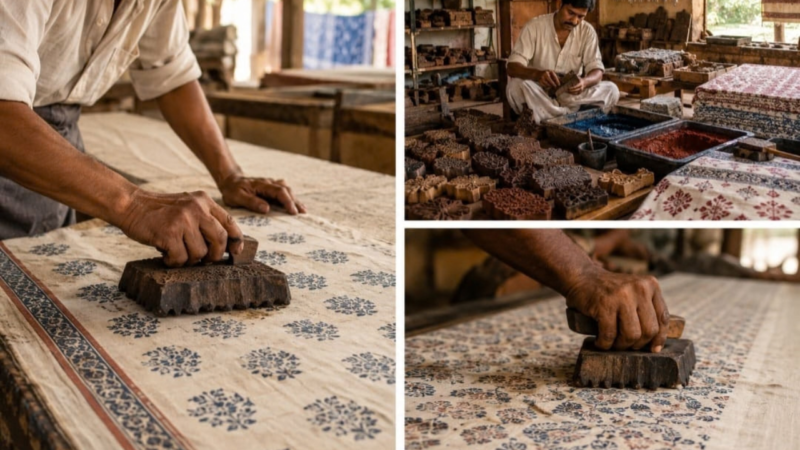
Block printing requires the artisan to translate a design into a form that a carved block can transfer onto fabric. This process demands planning, precision, and an understanding of materials.
1. Start With a Clear Outline
The artisan first identifies the animal’s essential features. For a peacock, the outline may emphasize the curved neck and tail. For an elephant, it may highlight the body, ears, and trunk.
The designer removes unnecessary details and creates a recognizable silhouette. A clear outline gives the motif a stronger visual identity and helps it remain legible when the artisan repeats it across the fabric.
2. Adapt the Design to the Block
The block carver must preserve the important lines and shapes while considering the limits of the material. Very thin lines, tiny gaps, and fragile projections can create problems during carving or printing.
The artisan may widen narrow features, simplify decorative elements, or separate complicated details into different blocks. The final design must work as a practical printing tool, not just as an attractive drawing.
3. Plan Spacing and Repetition
A repeating motif needs consistent spacing. If the artisan leaves too little room between animals, the pattern may look crowded. If the gaps become too large, the design may lose its sense of continuity.
Designers often consider the motif’s direction, alignment, and relationship to the fabric’s edges. A well-planned repeat makes the entire textile look intentional.
4. Coordinate the Colours
Ajrakh printing can involve multiple stages, with different blocks and dye processes contributing to the final design. The artisan must plan how the colours will interact and how each printed element will align with the others.
A contemporary animal motif may require careful coordination between the animal’s outline and the surrounding geometric or floral elements. Clear separation between shapes helps preserve the design.
5. Test the Print
A test print helps the artisan evaluate the motif before applying it across a larger piece of fabric. The artisan can check whether the outline appears clearly, whether the details print correctly, and whether the repeated pattern aligns as intended.
If the print loses important features, the artisan may adjust the block, printing pressure, colour application, or design. This practical testing helps improve consistency without removing the character of hand production.
Combining Animal Motifs With Ajrakh Borders and Geometric Patterns
Borders play an important role in many Ajrakh textiles. They frame the main design and help connect the fabric’s different sections. When designers introduce animal motifs, borders can create a visual boundary that keeps the composition organized.
A peacock motif might appear in the central field, with a repeating geometric border around it. The border can provide structure while the bird introduces a more organic shape. The contrast between curved animal forms and precise geometry creates visual interest.
Elephant motifs can work in a similar way. A designer may arrange a row of elephants between two patterned borders or place individual elephants inside geometric panels. The borders separate the figures and give the design a clear rhythm.
The designer must also consider scale. A large animal motif may need a simpler border so the composition does not feel crowded. A small repeating animal can work alongside a more detailed border because both elements occupy less visual space.
Colour also affects the relationship between the central motif and the border. Strong contrast can make the animal stand out, while related shades can create a quieter, more unified appearance.
These principles apply to contemporary Ajrakh-inspired designs as well as to other block-printed textiles. They show how an artist can combine natural forms with a structured pattern without losing visual balance.
Animal-Inspired Ajrakh Textiles in Contemporary Fashion
Contemporary fashion often brings traditional crafts into new contexts. Designers use heritage-inspired prints on modern garments, accessories, and home products. Animal motifs offer another way to explore this creative exchange.
A peacock-inspired pattern may suit a dupatta, scarf, blouse panel, or statement saree. Its curved lines and feather shapes can add movement without requiring a large illustration. A simplified elephant pattern may create a bolder look on a jacket, tote bag, cushion cover, or decorative textile.
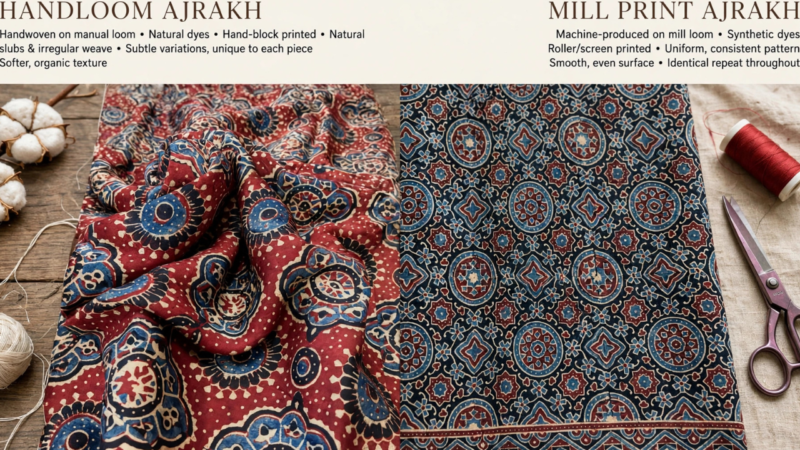
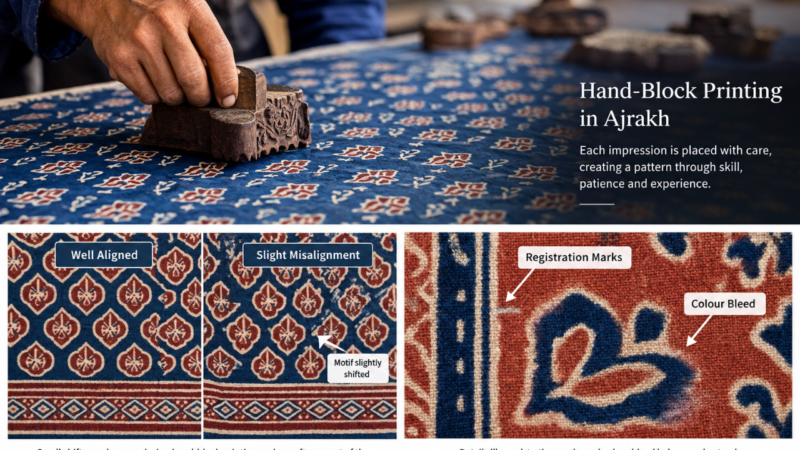
The fabric and printing method matter as much as the motif. A hand-block-printed textile may show slight variations in alignment, colour, or print density. These characteristics can reflect the process of hand production. However, buyers should not assume that every uneven print proves authenticity; they should also consider the maker’s information and the documented production method.
When choosing an animal-inspired textile, consider the size of the motif, the contrast between colours, the fabric’s weight, and the intended use. Small repeating motifs often work well when the wearer wants a subtle pattern. Larger motifs can create a focal point.
Designers should also provide honest descriptions. If a product uses an original contemporary design printed with Ajrakh techniques, the description should explain both facts. This approach gives credit to the craft without making unsupported claims about the motif’s age or origin.
Caring for Animal-Motif Block-Printed Textiles
Proper care helps preserve the appearance of printed fabric. The exact instructions depend on the fibre, dyes, finishing process, and manufacturer’s recommendations, so buyers should always check the care label first.
For many delicate hand-printed textiles, gentle handling offers a sensible starting point. Avoid harsh washing methods unless the maker confirms that the fabric can tolerate them. Strong detergents, prolonged soaking, and excessive friction may affect some dyes or damage delicate fibers.
Store garments in a clean, dry place and avoid leaving them in direct sunlight for long periods. Sunlight can fade many colored textiles over time. Fold or hang the fabric according to its weight and construction to reduce unnecessary stress.
Animal motifs with fine printed details may become less distinct if the fabric suffers excessive abrasion. Gentle use and appropriate care help maintain the design’s clarity.
Care instructions should remain specific to the actual textile. A cotton Ajrakh-inspired scarf and a silk garment may require different treatment. Buyers should follow the artisan’s or seller’s guidance rather than applying one care method to every printed fabric.
Conclusion: Respecting Tradition While Exploring New Motifs
Peacocks and elephants provide rich sources of inspiration for Indian textile design. The peacock offers graceful curves, feather patterns, and associations with beauty and nature. The elephant brings a strong silhouette and cultural associations with strength, wisdom, prosperity, and ceremonial art.
These motifs can complement Ajrakh-inspired layouts when designers consider their scale, spacing, colour, and relationship to geometric patterns. Skilled artisans can simplify animal forms for block printing and repeat them across a textile while maintaining visual balance.
However, an animal motif does not automatically establish a textile’s historical connection to Ajrakh. Designers and sellers should distinguish documented traditional patterns from contemporary interpretations that use Ajrakh colours, layouts, or printing techniques. This distinction helps protect the craft’s heritage while leaving room for creative experimentation.
Ultimately, animal motifs show how textile art can connect nature, culture, and craftsmanship. When artisans explain their methods and designers describe their work accurately, customers can appreciate both the beauty of the finished fabric and the knowledge behind its creation.