
Introduction: The Story Behind the Three-Leaf Motif
A small motif can carry a long visual history. Across textiles, buildings, manuscripts and decorative objects, artists have repeatedly used plant-inspired shapes to organize patterns and give surfaces a recognizable character. The trefoil is one such form. Its name refers to a shape with three lobes or leaf-like sections, and artists have adapted it across different periods and artistic traditions.
When exploring trefoil motif Ajrakh history, it is important to separate the broad history of the symbol from the specific history of Ajrakh printing. The three-part form appears in many cultural settings, but its presence alone does not prove that one tradition directly influenced another. To understand the motif properly, we need to examine its structure, its use in architecture and ornament, and the ways geometric and botanical forms can enter textile design.
Ajrakh, associated especially with Kutch in Gujarat and parts of Sindh, has a distinctive visual language built around repeating geometry, carefully arranged borders and complex printing processes. Trefoil-like forms may fit naturally within this visual vocabulary because they can repeat, mirror and combine with other motifs. However, identifying a particular trefoil in an Ajrakh textile requires looking at the actual pattern rather than assuming that every three-lobed shape has the same origin.
Understanding the Trefoil: What Does the Three-Leaf Shape Mean?
The word trefoil comes from roots meaning “three leaves.” In botanical language, a three-leaf arrangement may resemble the leaves of clover, a plant in the genus Trifolium. In art and architecture, however, a trefoil usually describes a decorative form with three rounded lobes or leaf-like sections.
These meanings overlap visually, but they are not identical. A botanical clover has a recognizable leaf structure, while an ornamental trefoil may use stylized curves, pointed tips or a framework of intersecting lines. Artists can simplify a natural form until it becomes a repeatable geometric unit.
The three-part structure makes the motif adaptable. A designer can place three lobes around a central point, connect them through curved outlines or arrange them inside a circular frame. The resulting shape can look botanical, geometric or architectural, depending on its proportions and surrounding details.
The trefoil also works at different scales. A small version can fill the space between larger motifs, while a larger version can become the central feature of a decorative panel. In a textile, repeating three-lobed shapes can create rhythm across the fabric. In a building, the same broad principle can help organize a carved or framed opening.
It is important not to assign one universal meaning to the trefoil. Some examples may carry religious or symbolic associations within a specific tradition, while others function mainly as decorative forms. The historical context determines how confidently we can interpret a particular example.
Architectural Origins: Where the Trefoil Appears in Buildings
Architecture provides an important context for understanding the trefoil as a decorative shape. Builders and artisans have used curved, lobed and plant-inspired forms to finish openings, frame surfaces and create visual patterns. In some architectural traditions, the trefoil appears as a recognizable three-lobed arch or ornamental outline.
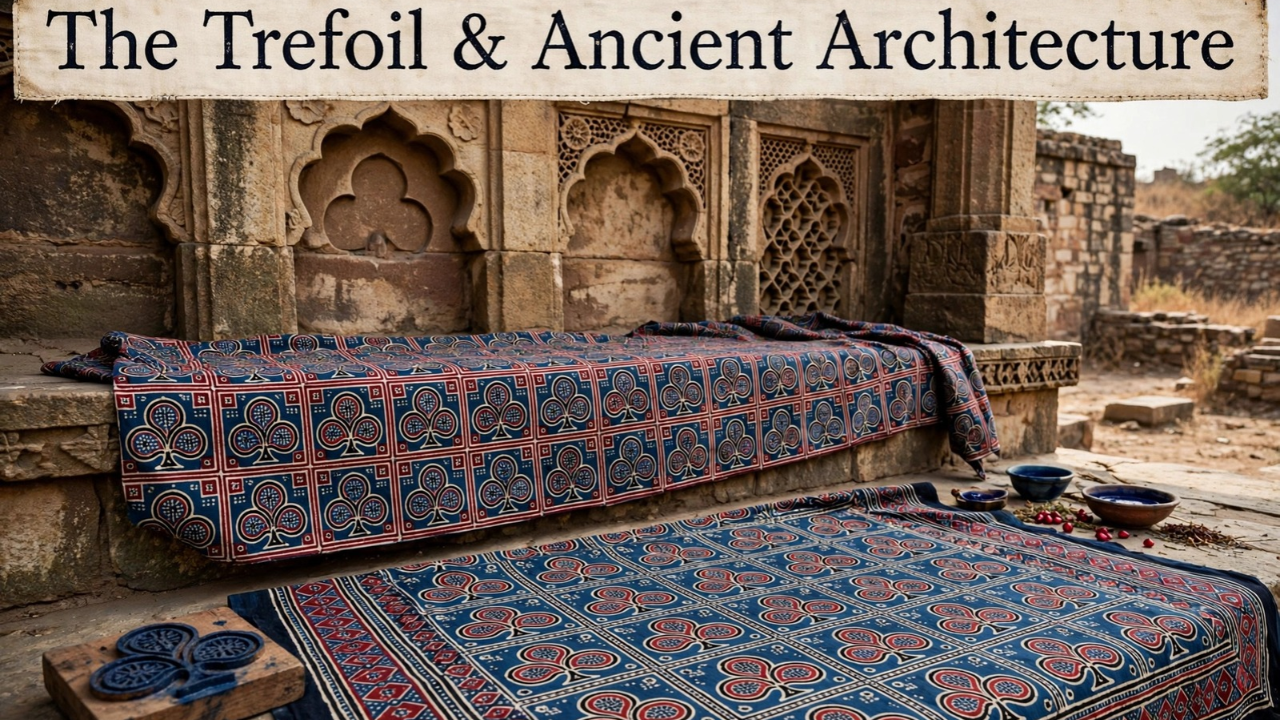
The trefoil arch is particularly associated with Gothic architecture in Europe. Its outline incorporates three rounded lobes within an arch-like form, and builders used related shapes in windows, niches, tracery and other decorative elements. The motif became part of a larger architectural vocabulary that included pointed arches, cusps and intricate stonework.
Yet the broader idea of dividing a shape into three lobes is not exclusive to Gothic buildings. Plant-like forms and three-part ornaments appear across different artistic traditions. Similar outlines can emerge independently because artists draw inspiration from leaves, flowers, symmetry and basic geometric construction.
This distinction matters when studying Ajrakh. The appearance of a three-lobed motif on a textile does not automatically establish a connection to a European Gothic building. A meaningful historical connection requires evidence such as documented exchange, a traceable design lineage or a specific regional example that supports the claim.
A more careful approach is to study architectural ornament as part of the wider history of decorative pattern-making. Across cultures, craftspeople have transformed natural forms into repeatable visual units. Ajrakh’s structured patterns can be examined within that broad history without assigning an unsupported origin to an individual motif.
From Stone Ornament to Textile Pattern: Understanding the Design Connection
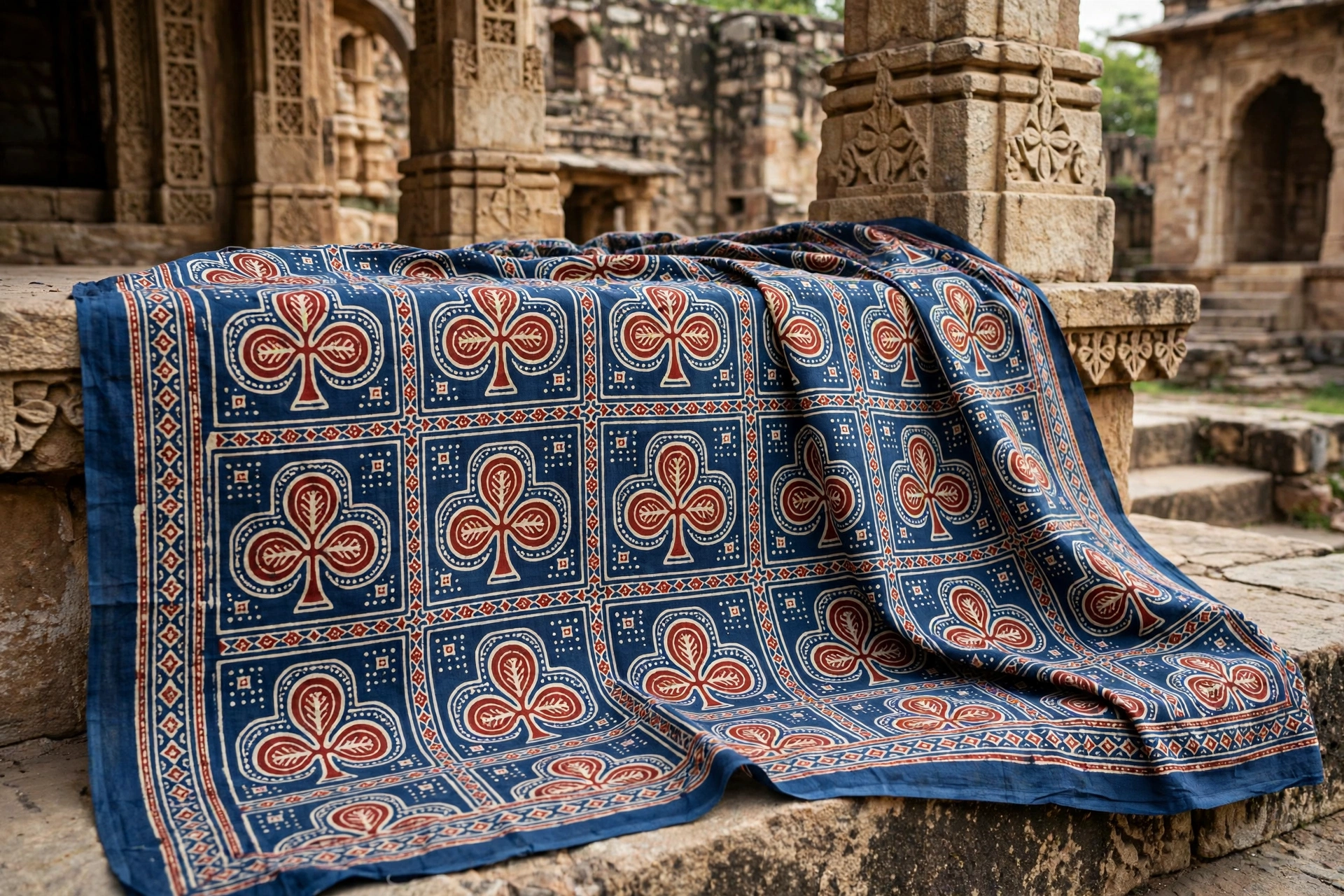
Architecture and textiles use different materials, but both can rely on repetition, symmetry and carefully organized shapes. A stone carver works with the surface and structure of a building. A textile printer arranges motifs across fabric, often using blocks and repeated printing stages. Each craft demands attention to proportion and spacing.
An architectural trefoil may fit inside a window opening or decorative frame. A textile designer can use a similar three-lobed outline as a repeating unit, a border element or part of a larger arrangement. The visual principle remains comparable, even when the two designs do not share a direct historical relationship.
The movement from a natural form to a decorative pattern often involves simplification. An artist may reduce a leaf to three rounded sections, remove small details and create a clear outer contour. That simplified form becomes easier to repeat and combine with other shapes.
On fabric, the designer must also consider the space between motifs. If the three-lobed forms sit too close together, they may merge visually. If they sit too far apart, the pattern may lose its rhythm. Borders, connecting lines and background shapes can help create a balanced arrangement.
This comparison offers a useful way to discuss architectural influence without overstating it. Architecture and textile design share visual strategies, but similarity alone does not establish that one specific motif travelled directly from a building into Ajrakh printing.
Trefoil, Trifolium and the Natural World
The connection between trefoil ornament and the plant genus Trifolium begins with shape. Clover plants typically display leaves made up of three leaflets, and artists have often stylized plant forms into decorative designs. The three-part arrangement provides a simple structure that can be recognized even after considerable abstraction.
However, a decorative trefoil does not necessarily depict a clover plant. Artists may create three-lobed patterns without intending to represent a specific species. A motif can borrow the general appearance of a leaf while becoming an independent ornamental shape.
This distinction is especially important when examining historic textiles. A printed form may resemble a clover, a flower or a three-part architectural ornament. Without a clear historical description or a detailed comparison with known examples, it is safer to describe the visible structure rather than assign a precise botanical identity.
Natural forms also offer practical design advantages. Three-part arrangements can create balance around a central point, fit into circular frames and combine with repeated borders. A designer can rotate or mirror the form to develop a larger pattern without losing its recognizable outline.
In Ajrakh-inspired designs, the relationship between botanical and geometric shapes can be particularly interesting. The overall pattern may use a strict repeat, while individual motifs retain a plant-like quality. This combination shows how natural inspiration and mathematical organization can work together in decorative textiles.
How to Recognize a Trefoil-Like Motif in Ajrakh
Recognizing a trefoil begins with looking closely at the shape. The clearest examples have three distinct lobes arranged around a shared base or central point. The outline may be rounded, pointed or simplified into a more geometric form.
A useful first step is to count the lobes. A design with three clearly defined sections may qualify as trefoil-like, while a four-lobed flower or a many-petaled rosette has a different structure. Still, the number of lobes alone may not settle the identification because stylized motifs can overlap in appearance.
Next, examine the outline. Does the motif look like three leaves joined together, three rounded arches, or three points created by intersecting curves? The contour can help describe the design accurately, even when its historical identity remains uncertain.
Then look at the surrounding pattern. A three-lobed shape might sit inside a medallion, appear between larger geometric motifs or repeat along a border. Its placement may help explain its role in the composition, but it cannot by itself establish where the form originated.
Finally, examine the textile’s provenance and description. If a seller or museum identifies a motif as a trefoil, check whether that identification comes with a clear explanation. A reliable description should distinguish between an observable shape and a documented historical interpretation.
This method helps readers appreciate the motif without treating every three-part design as proof of a single cultural origin.
Repetition and Symmetry in Ajrakh Design
Ajrakh patterns depend heavily on the relationship between individual motifs and the larger fabric layout. Repetition creates continuity, while symmetry can make a design feel stable and ordered. A trefoil-like shape can participate in both systems.
A designer may repeat the motif in straight rows, alternate its direction or place it inside a larger geometric unit. Each choice changes the pattern’s movement. Straight rows create a regular rhythm, while alternating directions can make the surface feel more dynamic.
Symmetry offers another design option. A trefoil can be balanced around a vertical axis, or three lobes can radiate from a shared center. The designer may then surround the form with additional shapes to create a larger unit. When that unit repeats across fabric, the individual motif becomes part of a more complex arrangement.
Spacing is just as important as the motif itself. Empty areas allow the shape to remain distinct, while tightly packed forms create a dense visual texture. The contrast between printed areas and background fabric helps determine whether the pattern appears delicate, bold or intricate.
These design principles are not unique to Ajrakh. Artists across many crafts use repetition, symmetry and spacing to create organized surfaces. Their relevance to Ajrakh lies in how they interact with the textile’s particular printing methods, pattern vocabulary and layout.
How Block Printing Shapes the Appearance of a Motif
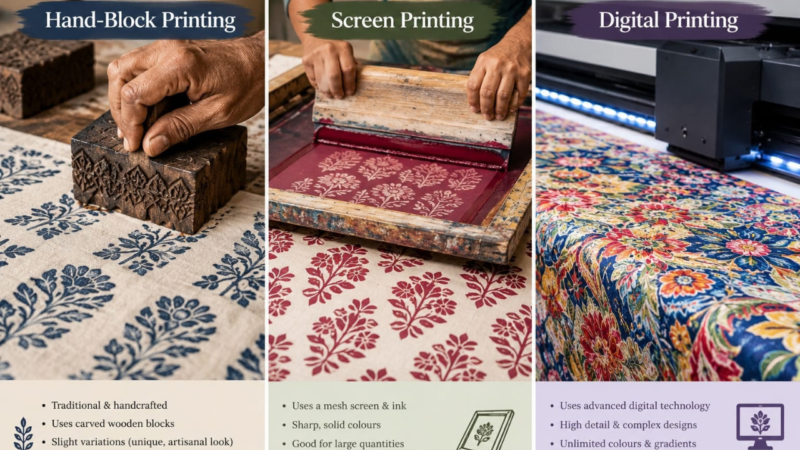
Ajrakh printing traditionally involves a carefully planned sequence of processes, which may include preparing the fabric, applying resist materials, printing patterns and using dyes. The precise method varies with the maker, materials and intended result.
In hand-block printing, a carved wooden block transfers a design onto the fabric. A trefoil-like motif would need a block or pattern arrangement that preserves its three-part outline. The clarity of the printed shape depends on several factors, including the block’s carving, the fabric’s preparation, the application of colour and the printer’s handling of the process.
Complex designs may require more than one block or printing stage. In such cases, alignment becomes important because each printed element must sit in the intended position. Small differences can affect the relationship between the motif’s outline and any surrounding shapes.
A repeated motif also needs to work within the overall layout. The printer follows the planned arrangement across the fabric, while the designer considers how individual units connect or remain separate. The process combines practical craft skills with an understanding of visual rhythm.
Not every three-lobed pattern on an Ajrakh-style textile proves that the maker intended a trefoil symbol. A similar form may arise from a different decorative source or simply resemble a three-leaf shape. Careful identification depends on the actual design and reliable information about its production.
Regional Craft and the Question of Historical Influence
Ajrakh has strong associations with Kutch in Gujarat and with Sindh, where related traditions of resist printing and patterned textiles have developed over generations. Its history reflects craft knowledge, material choices, regional exchange and the work of artisan communities.
When studying a motif, it is tempting to connect every visual similarity to a historical journey. A three-lobed shape in a textile may resemble a carved architectural feature from another region, but resemblance alone cannot tell us when, where or how the design travelled.
A sound historical interpretation asks several questions. Is there a dated textile or architectural example? Does a museum catalog or specialist study identify the motif? Can researchers trace similar forms through a sequence of objects or documented exchanges? Does the proposed connection fit the known history of the region?
These questions do not reduce the value of visual comparison. Instead, they make the comparison more useful. Researchers can identify similarities between architectural ornament and textile pattern while clearly stating whether the relationship is documented, plausible or simply visual.
For Ajrakh, this approach is particularly important because its design language includes many repeating geometric and nature-inspired forms. The presence of a trefoil-like shape may invite comparison with other traditions, but the textile’s own regional context deserves equal attention.
Traditional Motifs in Contemporary Textile Design
Contemporary textile designers often revisit traditional visual forms and adapt them for new products. A three-lobed motif can be simplified, enlarged, repeated in a new arrangement or combined with other geometric elements. These changes can make an old-looking form feel modern without proving that the design itself has ancient roots.
A designer might use a trefoil-like shape as a small repeating element across a fabric, place it within a bold border or combine it with a more contemporary colour palette. The resulting textile can preserve the visual appeal of repetition while offering a different overall appearance.
When brands describe a design as “inspired by ancient architecture,” buyers should look for an explanation of that claim. Does the brand identify a specific building, period or ornamental tradition? Or does it use the phrase to describe a general resemblance? Clear wording helps readers distinguish a documented reference from a creative interpretation.
The same principle applies to Ajrakh-inspired products. A contemporary design may draw on Ajrakh’s repeating patterns or printing aesthetics without reproducing a historically documented motif. Both traditional craft and modern experimentation deserve accurate descriptions.
Understanding the difference allows buyers to appreciate the design on its own terms and helps protect the historical context of the craft.
Frequently Asked Questions
1. What is a trefoil motif?
A trefoil is a decorative form with three lobes or leaf-like sections. It may resemble a three-leaf plant arrangement, but an ornamental trefoil does not always represent a specific plant.
2. What does Trifolium mean?
Trifolium is the botanical genus that includes clover plants, which commonly have leaves made up of three leaflets. The term describes a plant group, whereas trefoil can describe a three-lobed decorative shape.
3. Did the trefoil originate in Gothic architecture?
The trefoil arch became a recognizable feature of Gothic architectural ornament in Europe. However, three-part plant-like and lobed forms appear in wider decorative traditions, so it would be inaccurate to assign every trefoil-shaped design to a single origin.
4. Is the trefoil a traditional Ajrakh motif?
A three-lobed form may appear in an Ajrakh or Ajrakh-inspired design, but its specific historical status needs evidence. The shape alone does not establish that the motif belongs to a documented Ajrakh tradition.
5. How are architecture and textile patterns related?
Both crafts can use symmetry, repetition, borders and simplified natural forms. These shared principles allow useful visual comparisons, but they do not automatically prove direct influence between a building and a textile.
6. How can I identify a trefoil in printed fabric?
Look for three distinct lobes arranged around a common base or center. Then examine the outline, surrounding motifs and the textile’s documentation before assigning a specific historical identity.
7. Why do designers use three-part motifs?
Three-part forms can create visual balance, repeat easily and fit into larger geometric layouts. Designers may use them for their shape and decorative effect rather than for a particular symbolic meaning.
8. Does every Ajrakh-inspired design follow traditional methods?
No. Products described as Ajrakh-inspired may vary in their fabric, printing process, dyes and design approach. Check the maker’s description to understand how a particular textile was produced.
Conclusion: Reading the Trefoil with Historical Care
The trefoil offers a useful example of how a simple shape can appear across different areas of art and design. Its three-lobed outline connects naturally with plant forms, architectural ornament and repeating textile patterns. Yet each appearance belongs to its own historical setting.
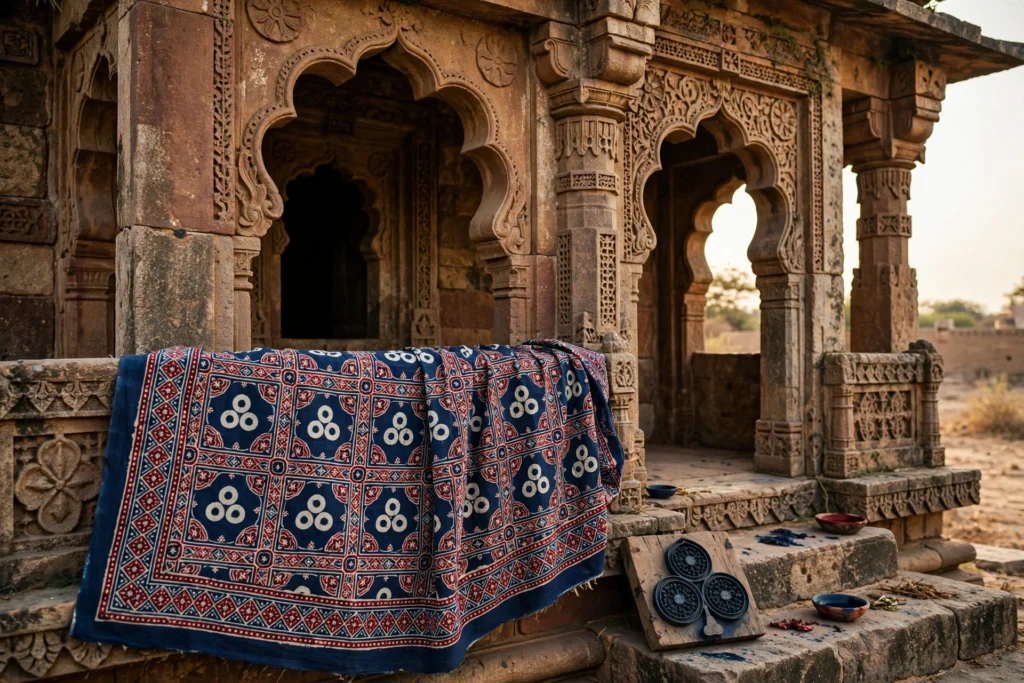
In the context of Ajrakh, the most useful approach is to examine the actual motif, its position within the pattern and the textile’s documented background. Repetition, symmetry and careful spacing help explain how a three-part shape can work within a larger printed composition.
Architectural examples provide a wider perspective on decorative design, while the history of Ajrakh keeps the discussion grounded in the craft’s own regional traditions. By distinguishing visual similarity from proven historical influence, we can explore the trefoil’s design possibilities without making claims that the available evidence cannot support.