
Introduction
Unfold an Ajrakh saree or shawl, and your eyes follow a familiar journey. They sweep across the jaal — the patterned field that covers the body of the cloth — and then they stop. They always stop at the end-piece. Master artisans call this terminal panel the Mohra, and you probably know it as the pallu. The Mohra carries the boldest motifs, the richest colors, and the most intricate borders in the entire textile. Artisans do not treat it as an afterthought; they design it as the crown of the cloth.
The word “Mohra” itself hints at this importance. In the workshops of Ajrakhpur in Kutch, artisans use the term to describe the face of the textile — the part that announces itself first. When you drape an Ajrakh saree, the Mohra falls over your shoulder and frames your presence. When you spread an Ajrakh shawl across a table, the Mohra forms the visible edge that guests admire first.
This guide walks you through the Mohra in depth. You will learn exactly how the end-piece differs from the body, meet the classic Mohra variations, understand how artisans create them, and discover how to choose the right Mohra for your own collection. Whether you collect Ajrakh or buy your first piece, this knowledge will sharpen your eye and deepen your appreciation.
The Focal Point
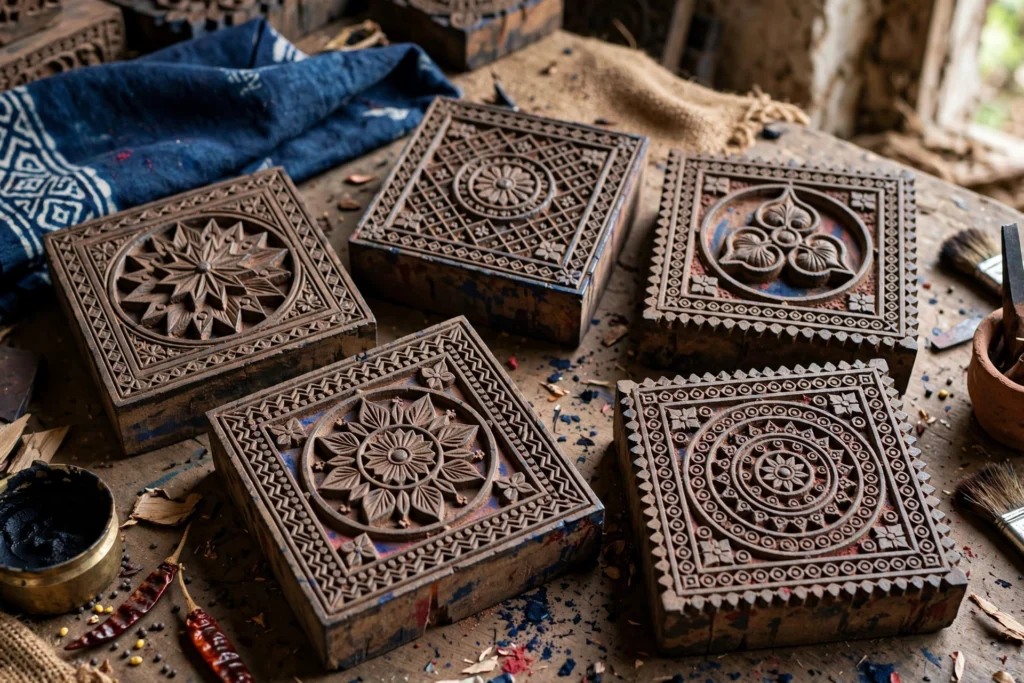
Every Ajrakh textile follows a deliberate architecture. Artisans divide the cloth into three zones: the kakkar (border), the jaal (field), and the mohra (end-piece or pallu). The body — the jaal — covers most of the cloth with repeating motifs in a disciplined rhythm. The Mohra breaks that rhythm on purpose, and artisans engineer this break with great care.
Artisans scale up the motifs in the Mohra. Where the body carries small, repeating stars or flowers in neat rows, the end-piece displays the same motifs at two or three times the size. This shift in scale creates visual weight. Your eye reads the larger motifs as more important, and artisans exploit this instinct with precision.
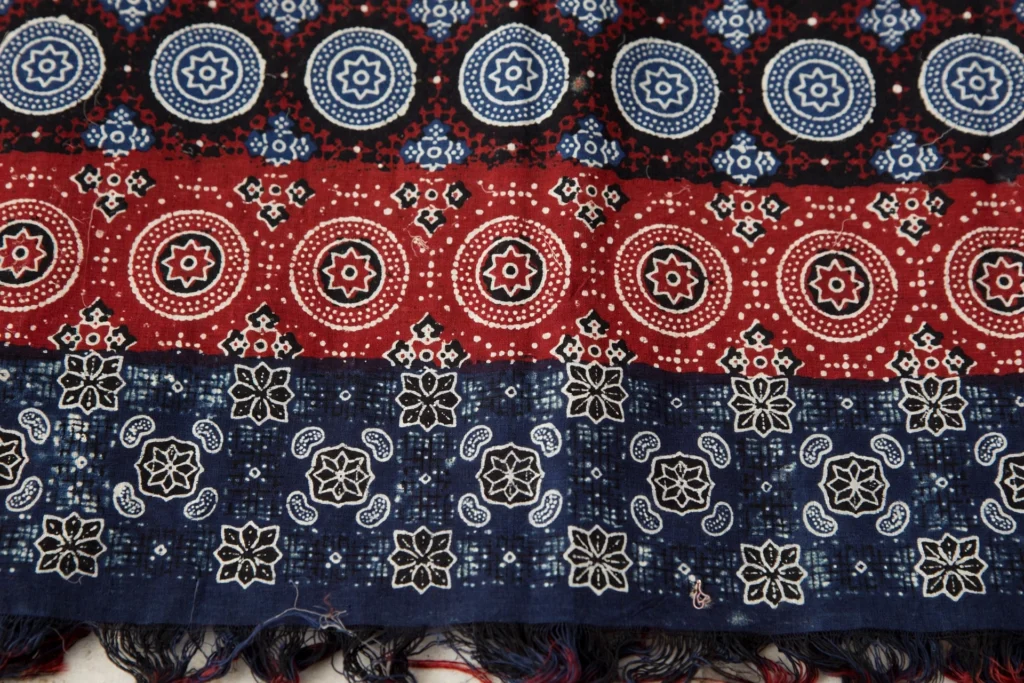
Artisans also concentrate color in the Mohra. The body of an Ajrakh typically balances its four classic colors — deep indigo blue, madder red, black, and white — in even proportions. In the Mohra, artisans push the reds and blacks forward. They print denser patterns, layer more colors into the same space, and let the deep tones dominate. The result glows against the quieter body of the cloth.
The border treatment differs too. The kakkar frames the entire textile, but artisans give the Mohra its own inner borders — sometimes two or three nested bands that the body never receives. These bands act like a picture frame. They tell your eye that this panel matters most.
Direction matters as well. Artisans orient the body motifs in a continuous repeat that flows in every direction. In the Mohra, artisans turn the motifs toward the edge of the cloth and create a sense of procession — the pattern marches toward the fringe. When you wear the saree, this procession draws the viewer’s gaze along your shoulder and down your arm in one elegant movement.
Finally, artisans invest the most labor in the Mohra. A single Mohra can demand five to seven separate block impressions, each carrying its own dye, while a section of the body needs only three or four. Artisans wash, mordant, and dye the end-piece with extra care because they know every flaw will show here. The Mohra carries the artisan’s signature skill, and experienced buyers read it first when they judge a textile’s quality.
Anatomy of a Mohra
Look closely at a Mohra, and you will find it has its own internal structure. Artisans build it in layers, and each layer serves a purpose.
The outermost layer meets the kakkar, the main border of the textile. Artisans print a transitional band here — a narrow strip of small motifs that eases your eye from the border into the end-piece. Without this band, the jump from border to Mohra would feel abrupt.
Inside the transitional band sits the central panel. This panel holds the largest, most elaborate motifs in the entire cloth. Artisans often place a medallion here — a symmetrical star, flower, or geometric rosette that anchors the whole composition. The medallion acts as the visual heart of the textile.
Around the medallion, artisans arrange supporting motifs in mirror symmetry. They carve these blocks as pairs, and they print the left side as a perfect reflection of the right. This symmetry gives the Mohra its formal, ceremonial feeling. The body of the cloth repeats freely; the Mohra composes itself like architecture.
At the very edge, artisans finish the Mohra with a terminal band and often add hand-knotted tassels or a woven fringe. These tassels do more than decorate. They protect the edge from fraying, and they add movement — when you walk, the tassels sway and catch the light, drawing attention to the end-piece with every step.
Classic Mohra Variations
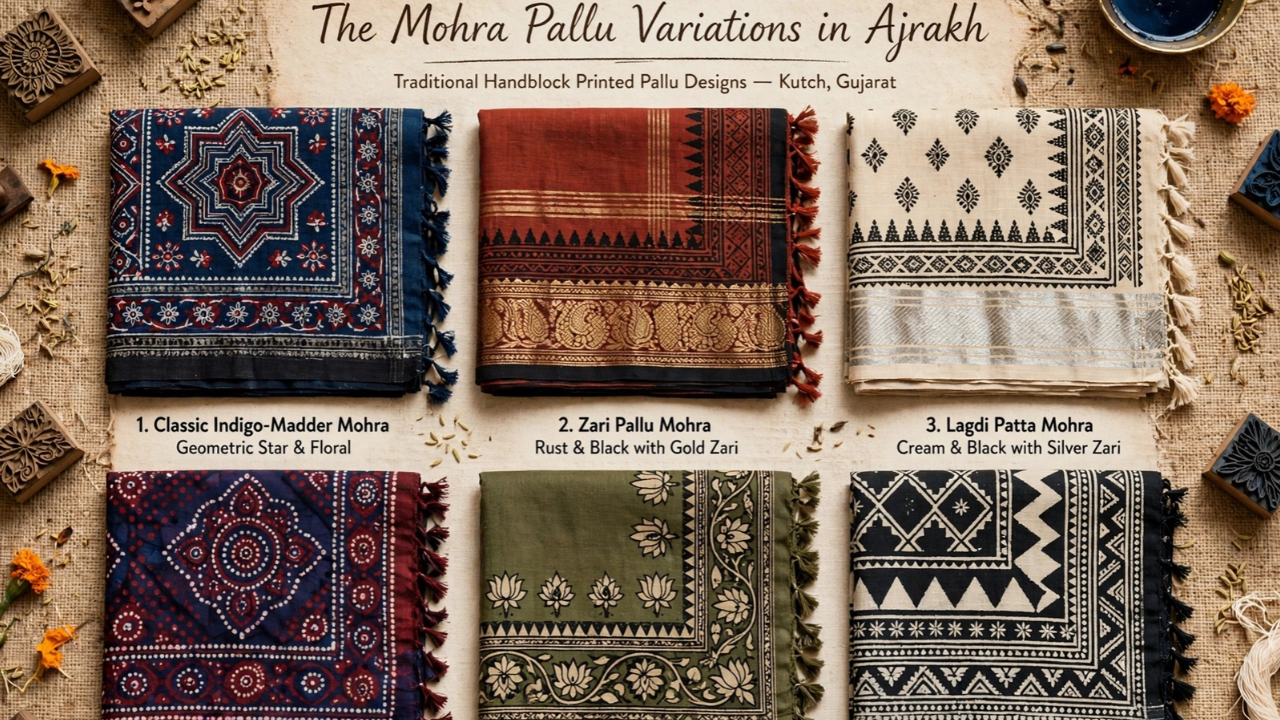
Artisans have developed distinct Mohra styles over generations. Each variation changes the mood of the textile completely. Learn to recognize them, and you will read Ajrakh like a language.
The Medallion Mohra. Artisans place one large central medallion — often an eight-pointed star or a layered rosette — at the heart of the end-piece. They surround it with radiating motifs that echo its geometry. This variation suits formal occasions. It gives the textile a regal, centered presence, and it pairs beautifully with plain blouses that let the medallion speak.
The Banded Mohra. Instead of one centerpiece, artisans stack horizontal bands of different patterns across the end-piece. Each band carries its own motif family — stars in one band, flowers in the next, geometric borders between them. This variation feels rhythmic and musical. It works wonderfully on everyday sarees because the eye travels across the bands instead of fixing on one point.
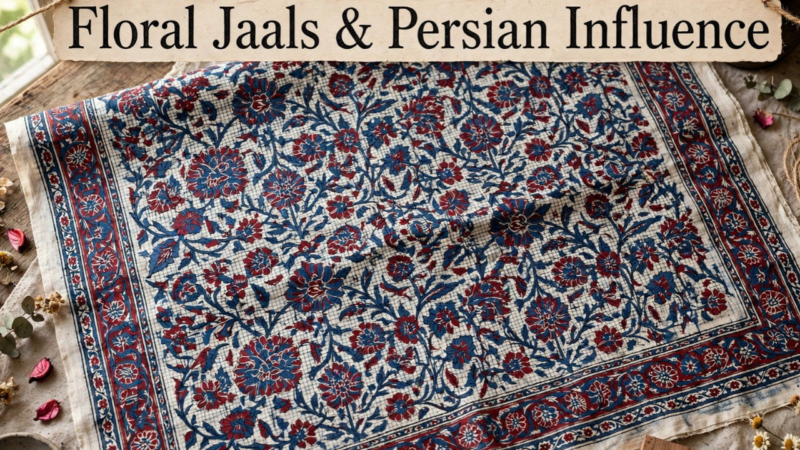
The Floral Cascade Mohra. Artisans let Persian-influenced floral jaals flow across the end-piece like a garden in motion. They enlarge the flowers, intertwine the vines, and allow the pattern to spill toward the edge. This variation brings softness to Ajrakh’s normally geometric discipline. Brides and festive wearers often choose it for its romantic, abundant feeling.
The Geometric Grid Mohra. Here artisans celebrate mathematics. They build the end-piece from pure geometry — interlocking squares, diamonds, and lattices in strict symmetry. This variation showcases the artisan’s drafting skill most openly. Collectors prize it because any misalignment would scream from the rigid grid, so a perfect geometric Mohra proves master-level craftsmanship.
The Figurative Mohra. Artisans introduce peacocks, elephants, or stylized animals into the end-piece. They keep these creatures small in the body of the cloth but enlarge them in the Mohra, where they process toward the edge like a royal parade. This variation tells a story, and it connects the textile to the living culture of Kutch — its festivals, its wildlife, its celebrations.
How Master Artisans Create the Mohra
The Mohra demands more planning than any other part of the textile. Artisans begin with the design long before they touch the cloth.
First, the master artisan sketches the Mohra on paper. He maps the medallion or bands, calculates the symmetry, and decides how many blocks the design needs. A complex Mohra can require a dozen carved wooden blocks, and the artisan commissions each one from a block-maker who carves sheesham wood with chisels no wider than a fingernail.
Next, artisans prepare the cloth. They wash it in the mineral-rich water of Kutch, treat it with mordants that fix the dyes, and stretch it on long tables. They mark the Mohra zone with chalk lines so every printer knows exactly where the end-piece begins and the body ends.
Then the printing begins, and artisans work from the center outward. They print the medallion first, aligning it with absolute precision, because every other element refers to this center. They build the surrounding symmetry one impression at a time, checking the mirror alignment after each block. A single slip would ruin the formal balance, so senior artisans print the Mohra themselves and leave the repetitive body work to junior printers.
Dyeing follows the same hierarchy. Artisans dip and wash the textile through multiple stages — indigo vats for the blues, madder baths for the reds, iron solutions for the blacks. They give the Mohra extra dips to deepen its colors beyond the body’s tones. They know the end-piece must glow, so they feed it more dye and more time.
Finally, artisans finish the edge by hand. They knot the tassels one by one, trim the fringe evenly, and inspect the Mohra under strong light. They reject any piece where the symmetry breaks or a color bleeds. This strict quality control explains why authentic Mohra work commands higher prices — you pay for the hours and the judgment, not just the cloth.
Choosing the Right Mohra for You
Now that you understand the Mohra, use this knowledge when you shop. The end-piece tells you more about a textile’s quality and character than any other part.
Match the Mohra to the occasion. Choose a Medallion Mohra for weddings and formal events, where its centered formality shines. Pick a Banded Mohra for daily wear and office settings, where its rhythm feels lively without demanding attention. Select a Floral Cascade Mohra for festive gatherings, where its abundance matches the mood.
Read the symmetry before you buy. Hold the textile up and compare the left and right halves of the Mohra. In genuine hand-blocked Ajrakh, you will find tiny human variations — a slightly deeper impression here, a softer edge there. These small irregularities prove human hands made the piece. But the overall mirror symmetry should hold. If one side clearly mismatches the other, the printer rushed the work.
Check the color depth. Compare the Mohra’s reds and blacks with the body’s tones. In a well-made piece, the end-piece colors run visibly deeper and richer. If the Mohra looks washed out or matches the body exactly, the artisan skipped the extra dyeing stages, and the textile will not age with the beautiful patina that defines fine Ajrakh.
Feel the edge. Run your fingers along the tassels or fringe. Artisans knot quality tassels tightly and evenly. Loose, uneven, or machine-finished edges signal mass production. The Mohra’s finishing reveals how much care went into the whole textile.
Consider the scale. Petite wearers often suit smaller, Banded Mohra designs that do not overwhelm their frame. Taller wearers can carry the grand Medallion Mohra with ease. There is no strict rule, but proportion matters — the end-piece should frame you, not swallow you.
The History of the Mohra
The Mohra carries centuries of history in its patterns. Artisans did not invent the end-piece yesterday; they inherited it from a long lineage of textile makers who understood that a cloth needs a face.
Historians trace Ajrakh’s roots to the Indus Valley Civilization. Archaeologists have found fabric fragments at Mohegan-daro bearing resist-dyed patterns that resemble modern Ajrakh. The craftspeople of that ancient city already divided their cloth into fields and end-pieces. They understood the same principle today’s artisans follow: the eye needs a destination.
Persian traders brought new influences when they crossed the region centuries later. They carried textiles decorated with elaborate end-panels — the ancestors of today’s Mohra. Local artisans studied these foreign cloths, borrowed the idea of the grand terminal panel, and fused it with their own geometric vocabulary. This fusion gave the Mohra its distinctive character: Persian abundance disciplined by Indian geometry.
The Mughal era refined the Mohra further. Royal workshops demanded ever more elaborate end-pieces, and artisans responded with larger medallions, finer symmetry, and richer color layering. The Mohra became a status symbol. Nobles judged a textile’s worth by its end-piece alone, and artisans competed to outdo each other in Mohra design.
When artisan communities settled in Kutch, they brought this heritage with them. The Khatri community, which still practices Ajrakh in Ajrakhpur today, preserved the Mohra tradition through generations of political upheaval and economic hardship. Fathers taught sons the exact proportions of the end-piece. Mothers taught daughters how to read a Mohra’s quality at a glance. This living transmission kept the Mohra authentic while allowing slow, careful evolution.
Mohra Across Regions
Ajrakh artisans work in several regions, and each region shapes the Mohra differently. Knowing these regional signatures helps you identify where a textile comes from.
In Ajrakhpur, Kutch, artisans create the classic Mohra most buyers recognize. They build large central medallions, use the full four-color palette boldly, and finish with hand-knotted tassels. Their Mohra designs feel grand and ceremonial. The symmetry runs strict, and the color contrast runs high.
Across the border in Sindh, artisans make Ajrakh with a different Mohra temperament. They favor denser, smaller motifs even in the end-piece. Their Mohra feels more textile-like and less architectural — the pattern flows rather than composes itself. Sindhi artisans also use a slightly different red, pushing it toward crimson, which gives their Mohra a warmer glow.
In Barter, Rajasthan, artisans blend Ajrakh techniques with local Rajasthani taste. Their Mohra designs often include more figurative elements — stylized flowers, birds, and border patterns borrowed from neighboring crafts. The end-pieces feel playful compared to the solemn Kutch Mohra.
These regional differences matter when you buy. A Kutch Mohra suits formal, statement dressing. A Sindhi Mohra works beautifully for those who love rich, all-over pattern. A Barter Mohra appeals to buyers who want Ajrakh with a folk-art spirit. None is superior; each carries its region’s soul.
Styling Your Mohra
A beautiful Mohra deserves thoughtful styling. How you drape and pair the end-piece determines whether it sings or disappears.
Drape the saree so the Mohra falls fully over your shoulder. Many wearers tuck the end-piece too tightly, hiding half the design. Let it fall freely instead. The Mohra needs air and movement to display its medallion and borders. When you walk, the end-piece should sway gently and catch the light.
Pair the Mohra with a quiet blouse. Artisans design the end-piece as the star of the outfit, so a plain blouse in indigo, black, or white lets it shine. Avoid blouses with competing prints — they fight the Mohra for attention and both lose. A solid silk or cotton blouse with a simple neckline frames the end-piece perfectly.
Pin the Mohra strategically for events. A single decorative pin at the shoulder keeps the end-piece in place during long ceremonies without crushing the tassels. Place the pin through the transitional band rather than the central medallion, so you never pierce the most important motif.
For shawls and dupattas, spread the Mohra deliberately. When you sit, arrange the end-piece across your lap where guests can see it. When you stand for photographs, hold the textile so the Mohra faces the camera. These small gestures honor the artisan’s work and ensure the focal point does its job.
Modern Mohra Innovations
Contemporary designers have begun re imagining the Mohra, and these experiments deserve your attention.
Some designers scale the Mohra to over-sized proportions, letting the end-piece cover half the textile. They create dramatic, gallery-like pieces that function as wearable art. Collectors buy these as investment pieces, and they photograph beautifully for social media.
Other designers strip the Mohra back to minimalism. They reduce the end-piece to a single band of geometric pattern — a whisper of the traditional Mohra. This restrained approach appeals to younger buyers who love Ajrakh’s heritage but prefer quieter dressing.
A third movement plays with color. Designers keep the traditional Mohra architecture but dye it in unexpected palettes — teal and rust, plum and gold, charcoal and ivory. These pieces honor the structure while refreshing the mood. They prove that the Mohra’s power lies in its design logic, not just its classic colors.
Sustainable fashion labels have embraced the Mohra as well. They commission artisans to create end-pieces from organic cotton and natural dyes, then build entire collections around the textile’s focal point. This commercial attention brings better prices to artisan families and keeps the craft alive.
Frequently Asked Questions
How do I tell a hand-blocked Mohra from a printed imitation?
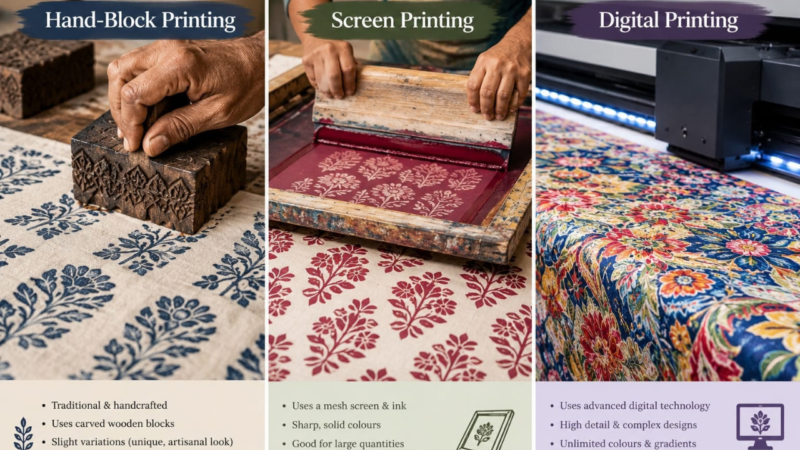
Look for tiny irregularities in the symmetry. Human hands create slight variations in pressure and alignment. Machine prints repeat with mechanical perfection. Also check the reverse side — hand-blocked Ajrakh shows the pattern clearly on both sides, while screen prints look flat and pale on the back.
Why does the Mohra cost more than the rest of the textile?
Artisans invest the most skilled labor, the most blocks, and the most dyeing stages in the end-piece. You pay for the master artisan’s hours, not just the material. A cheap Mohra usually signals rushed work or machine production.
Can I wash Ajrakh at home?
Yes, with care. Use cold water, mild soap, and wash the textile separately for the first few washes. Dry it in shade and never wring the end-piece. With proper care, natural dyes develop a beautiful patina over years.
What is the difference between Mohra and pallu?
Artisans use “Mohra” to describe the designed end-piece panel, while “pallu” is the common term wearers use for the same part of a saree. They refer to the same physical section. “Mohra” emphasizes the artisan’s design; “pallu” emphasizes the wearer’s experience.
How long does it take to create one Mohra?
A master artisan spends several days on a single complex Mohra, from sketching and block preparation through printing, dyeing, and finishing. The entire textile can take two to three weeks. This timeline explains why authentic Ajrakh commands its price.
Caring for Your Ajrakh Pallu
The Mohra deserves special attention in your care routine because it carries the densest dyes and the most delicate finishing.
Wash the textile gently and separately for the first few washes. Artisans use natural dyes, and these dyes release some excess color initially. Cold water and mild soap protect the deep reds and blacks of the Mohra from fading. Never wring the end-piece; press the water out softly so the tassels keep their shape.
Dry the textile in shade. Direct sunlight bleaches natural dyes over time, and the Mohra — with its concentrated colors — shows sun damage first. Hang the saree or shawl so the end-piece drapes freely without folding, which prevents crease lines from cutting across the medallion.
Store the textile with the Mohra folded inward. This simple habit shields the end-piece from dust and light during the months it waits in your cupboard. Place a soft muslin cloth between folds to prevent the tassels from snagging on neighboring garments.
Conclusion
The Mohra transforms an Ajrakh textile from beautiful cloth into a statement. Artisans pour their finest skill into this end-piece — they enlarge the motifs, deepen the colors, engineer the symmetry, and finish the edge by hand. The body of the cloth provides the rhythm, but the Mohra provides the meaning.
When you next unfold an Ajrakh, go straight to the end-piece. Read its symmetry, feel its color depth, and check its finishing. You now know what master artisans know: the Mohra reveals the soul of the textile. Choose yours with confidence, wear it with pride, and let the focal point do what artisans designed it to do — stop every eye in the room.