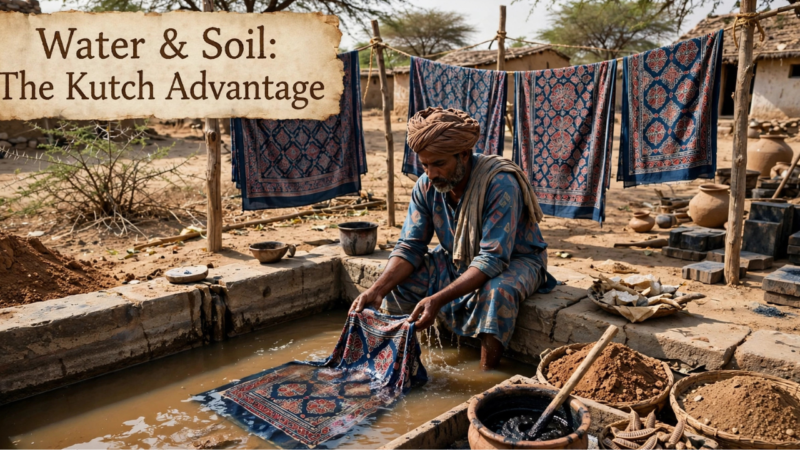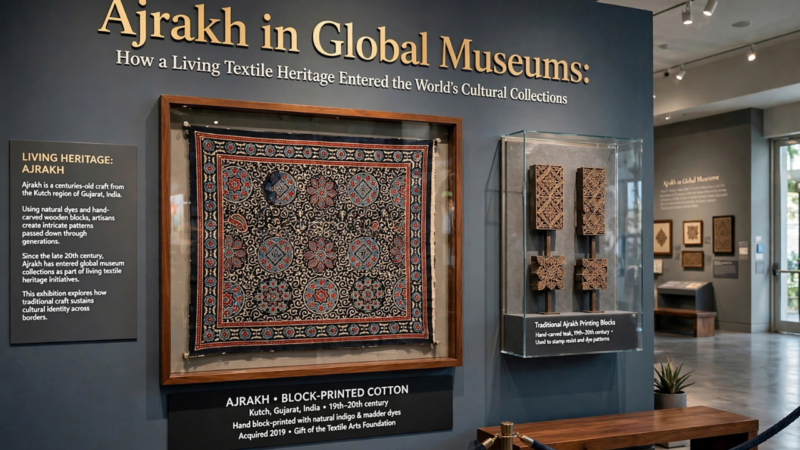

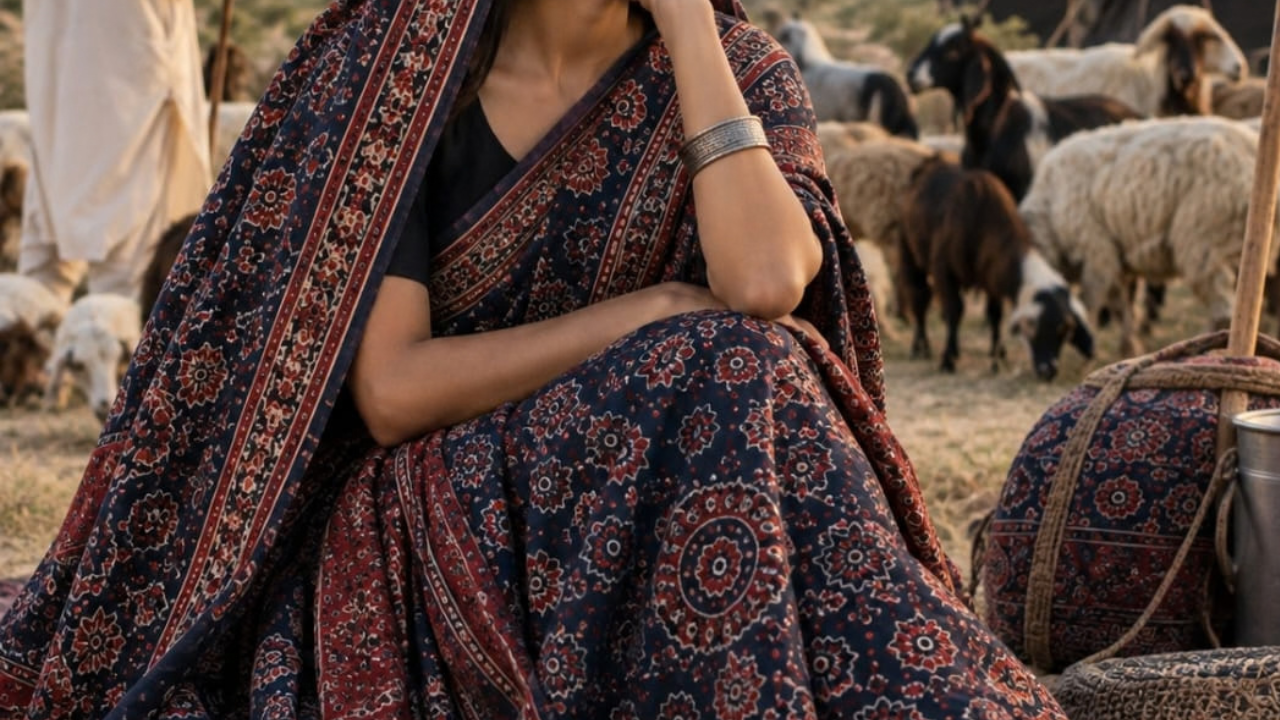
There is a different way to look at a piece of Ajrakh.
You can look at its color first.
You can notice the deep indigo, the earthy red, the black borders and the repeated geometric patterns. You can admire the careful block printing and wonder how an artisan managed to make one small wooden block meet another with such precision.
But there is another way to look at it.
Think about the person who wore it.
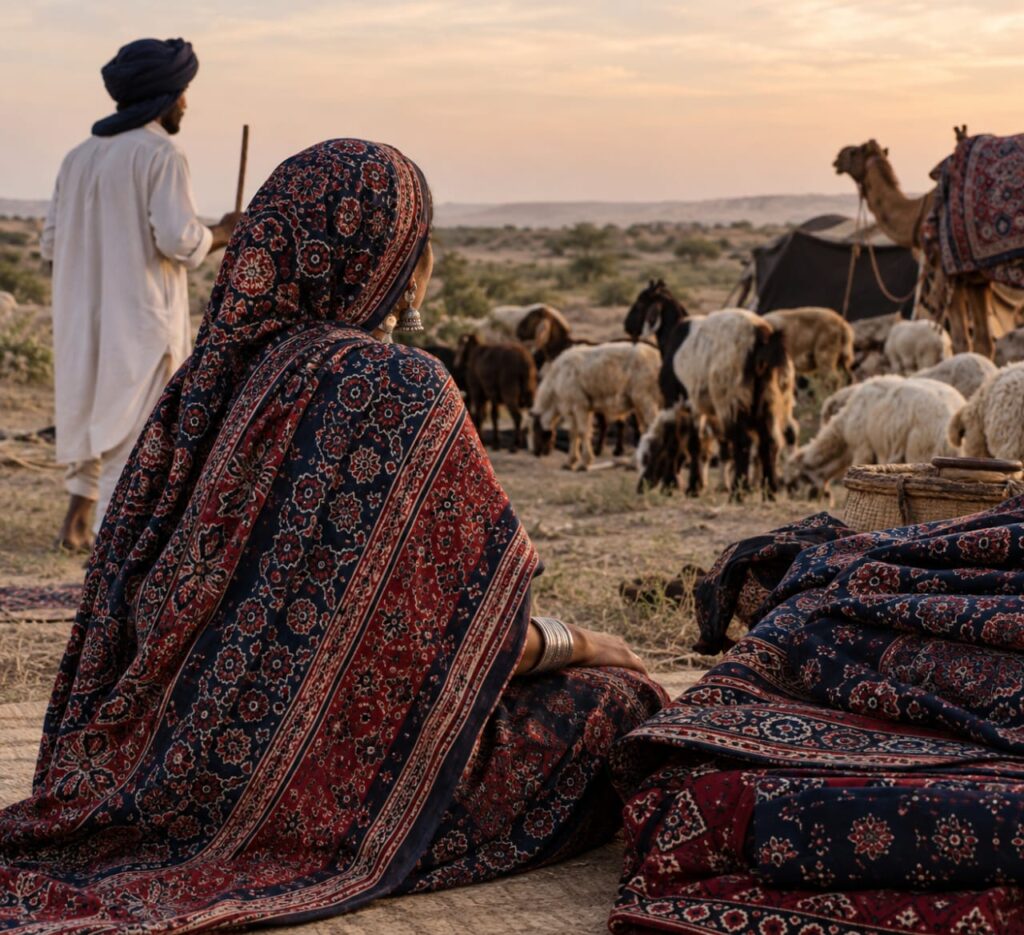
Imagine someone leaving home before sunrise, walking across the dry landscape of Kutch with a herd of animals. There may be no permanent road ahead, no fixed timetable and no guarantee about where the next good patch of grass or water will be found.
For pastoral communities, movement has historically been part of life.
And somewhere within that moving life, Ajrakh found an important place.
The relationship between Ajrakh and pastoral communities is one of the most meaningful chapters in the history of the textile. In Kutch, Ajrakh became particularly associated with Maldharis communities, while pastoral groups such as Rabaris also form an important part of the wider cultural landscape of Kutch. Government and craft sources document the use of Ajrakh by Rabaris, Maldharis and Ahirs as turbans, lunges and stoles, while historical research identifies Muslim nomadic animal-keepers as traditional purchasers of Ajrakh.
This was never simply a relationship between a fabric and a customer.
It was a relationship between cloth and lifestyle.
Between the artisan and the wearer.
Between a settled workshop and people whose lives could be shaped by the movement of animals, seasons, water and pasture.
And once that relationship is understood, Ajrakh begins to look very different.
When Home Was Not Always One Place
To understand why Ajrakh mattered to pastoral communities, we first need to understand something about pastoral life itself.
Pastoral-ism is not simply “keeping animals.”
It is a way of organizing life around animals, land, seasons and available resources.
In Kutch, pastoral communities have historically depended on animals such as sheep, goats, cattle and camels. Barbara communities, for example, have long been associated with animal husbandry and seasonal migration. Research on Barbara migration describes movements within Kutch and longer journeys toward other parts of Gujarat, Rajasthan and Sindh, depending on conditions such as rainfall, grazing opportunities and water availability.
For a family living this way, the landscape itself becomes a kind of calendar.
The beginning of the dry season means something.
The arrival of rain means something.
A drying water source matters.
Fresh grass changes the direction of movement.
A harvested field may become useful grazing land.
A drought can force an entire group to travel farther.
Life is therefore closely connected with the environment.
And clothing has to exist within that reality.
Ajrakh became part of that world.
A Cloth Made for People on the Move
A traditional Ajrakh was not designed only to be displayed.
It was worn.
It was wrapped.
It was carried.
It travelled.
In Kutch, Ajrakh was traditionally used by Maldharis communities as clothing such as turbans and lunges, and it was also used on special occasions. The Government of Gujarat describes Ajrakh as part of the clothing traditions of Rabaris, Maldharis and Ahirs.
This makes perfect sense when we think about pastoral life.
A person who spends much of their time outdoors needs clothing that is practical.
But practical does not mean plain.
For communities with strong cultural traditions, clothing can also communicate identity.
A particular pattern can belong to a particular community.
A particular color combination can carry familiarity.
A particular garment can be connected with age, celebration or marriage.
In other words, clothing becomes part of social language.
Ajrakh was not simply something a pastoralist put on.
It could tell others something about who they were.
More Than a Customer and a Printer
One of the most interesting aspects of the Ajrakh tradition is the relationship between Khatri printers and their pastoral customers.
Khamir documentation of Khatri communities describes a highly specific system in which artisans produced textiles according to the needs of particular communities. Different clients could have their own designs, colors and preferences, and the cloth was not simply interchangeable from one community to another.
This meant the artisan had to know the customer.
Not just the customer as a buyer.
The customer as a community.
The printer knew which design belonged to whom.
Which colors were expected.
Which garments were required.
When marriages were taking place.
When festivals were approaching.
And when pastoral families would return from their seasonal movements.
That is very different from modern retail.
Today, a person may walk into a shop and choose a printed fabric from dozens of designs.
Historically, the relationship could be much more personal.
The artisan already knew what a community needed.
The Maldharis Connection
Among the pastoral communities connected most strongly with traditional Ajrakh in Kutch were the Maldharis.
The term Maldharis broadly refers to animal-keeping communities, and in the Kutch context the term encompasses different pastoral groups. Historical and craft sources specifically describe Muslim Maldharis as traditional users of Ajrakh.
For these communities, Ajrakh was not simply a decorative textile.
It belonged to their everyday visual world.
Khamir oral-history material records that Ajrakh was traditionally used in different forms and that particular types could be associated with different ages. It also documents the importance of Ajrakh turbans as gifts for Maldharis bridegrooms.
This tells us something important.
The cloth could move between everyday life and special occasions.
It could be practical and symbolic at the same time.
A person could wear it while living a demanding pastoral life and also receive it as part of a marriage tradition.
That combination is one of the reasons Ajrakh became so deeply connected with community identity.
When Clothing Becomes a Sign of Belonging
- Think about what identity means to a community that moves.
- If you are constantly traveling, your surroundings change.
- The village behind you disappears.
- A new grazing ground becomes your temporary home.
- You meet farmers, traders, other pluralists and villagers along the route.
- You cross different landscapes.
- In such a life, certain things become especially important because they travel with you.
- Family knowledge.
- Language.
- Food.
- Stories.
- Tools.
- And clothing.
- Ajrakh could become one of those portable signs of belonging.
- You did not have to leave your identity behind when you left the village.
- You carried part of it with you.
- This is one reason a textile can be much more important than its material value.
- It can act as a reminder of where someone belongs even while they are physically somewhere else.
The Colors Had a Life of Their Own
- Ajrakh color palette also mattered.
- Traditional Ajrakh is strongly recognized through deep indigo, red, black and white. Its natural dyeing and resist-printing processes created layers of color that gave the cloth its distinctive appearance.
- Khamir oral-history documentation records a local understanding that different color balances could be preferred according to seasonal conditions, with more indigo associated with summer and more red with winter. This should be understood as an artisan/community account rather than a universal rule for every Ajrakh textile.
- Whether every pastoral family followed exactly the same practice is another matter.
- But the idea itself is revealing.
- It shows that people could understand their clothing through the landscape around them.
- Clothing was not completely separated from climate.
- It was part of the way people experienced the desert.
- And that makes Ajrakh feel less like an ornamental textile and more like something woven into everyday life.
A Textile Designed for the Desert
- Kutch is not an easy landscape.
- It can be intensely hot.
- Water availability can change.
- The land can be dry for long periods.
- Pastoral communities have traditionally had to make decisions around grazing and water.
- Barbara migration research shows how seasonal and yearly variations in rainfall, access to pasture and water have shaped movement patterns.
- Ajrakh existed within this environment.
- The textile’s colors, form and use were shaped by the people who lived there.
- The cloth also had a practical advantage in that it could be used in several ways.
- A piece could become a turban.
- Another could serve as a wrapped lower garment.
- It could be carried during travel.
- It could be worn during a celebration.
- The same textile tradition could therefore move between work and ceremony.
- That flexibility suited a mobile way of life.
The Journey of a Maldharis Family
- Imagine a pastoral family preparing to leave.
- The animals are gathered.
- Supplies are packed.
- Water is carried.
- Clothing is folded.
- The family begins its journey.
- There is no need to imagine this as a romantic picture. Pastoral migration could be physically demanding, and research on Barbara communities shows that decisions about migration were shaped by very practical concerns: water, fodder, land access, seasonal conditions and relationships with farmers.
- Yet among the belongings that travel with the family, clothing has a special place.
- It protects the body.
- It serves daily needs.
- And it can carry identity.
- An Ajrakh cloth folded among other belongings is therefore more than fabric.
- It is something made for a person whose life is already connected with movement.
- The textile moves because the wearer moves.
The Printer Also Had to Move
- The relationship was not one-sided.
- The Khatri artisan also travelled.
- Khamir oral-history documentation describes printers traveling from village to village to sell cloth, a practice known locally as pheriya. Sales were connected with particular times of the year, especially before festivals.
- Imagine the old workshop system.
- The artisan spends part of the year printing.
- Then comes the time to travel.
- Cloth is packed.
- A camel cart may be used.
- The artisan follows familiar routes.
- He knows which family lives in which village.
- He knows which customers are waiting.
- He may stay with families along the way.
- The journey is not simply commercial.
- It is social.
- Khamir records artisan memories of Khatri traveling to the Bani region with camel carts and staying with Maldharis families, with relationships based on trust and friendship as well as business.
- That detail changes the way we understand textile trade.
- The cloth was not simply sold.
- It was delivered through relationships.
A Marriage Could Bring the Textile Home
- Marriage is another important part of the story.
- In many traditional societies, clothing becomes particularly meaningful during marriage because it can represent family, status, celebration and continuity.
- For Maldharis communities, Ajrakh could be part of this world.
- Khamir documents the tradition of an Ajrakh turban being given as a gift to a Maldharis groom.
- This makes the textile part of a life event rather than simply a purchase.
- The cloth enters the family story.
- It may be remembered as the piece worn at a wedding.
- It may be associated with a particular person.
- It may later be kept, reused or passed on.
- A textile becomes a memory.
- This is one of the quiet powers of handmade clothing.
- It can outlive the moment for which it was originally purchased.
When Every Community Had Its Own Visual Language
- Traditional Khatri printers did not necessarily produce one universal Ajrakh design for everyone.
- Khamir documentation describes community-specific designs, colors and preferences. It records that different Maldharis groups could have distinct styles and that artisans understood these differences.
- This is fascinating because it tells us that Ajrakh was not one fixed pattern.
- It was a family of traditions.
- A particular design could mean something in one community and something different in another.
- The artisan’s skill therefore included more than technical printing.
- They needed social knowledge.
- They had to remember clients.
- They had to understand local tastes.
- They had to maintain relationships.
- In a way, the printer was also a keeper of community visual memory.
The Double-Sided Cloth and the Early Morning Story
- One of the most memorable features of traditional Ajrakh is that it could be printed on both sides.
- This requires exceptional skill.
- The design has to remain coherent across the cloth.
- The colors need to work properly.
- The printing must be precise.
- A Khamir source records a local explanation that double-sided Ajrakh was useful because Maldharis men needed to dress before sunrise to begin herding livestock, reducing the problem of accidentally wearing the cloth the wrong way around in the darkness. This is best understood as a community legend or oral explanation rather than a universally established historical reason.
- Whether or not that was the original reason, the story is revealing.
- It connects the technical design of the textile with the practical routine of pastoral life.
- The cloth had two sides.
- The wearer had somewhere to go.
- The animals had to be moved.
- The day began early.
- The textile had to work within that life.
Ajrakh and the Pastoral Calendar
- Pastoral life follows seasons differently from a fixed urban routine.
- For Barbara pluralists, migration can depend on rainfall, availability of grass and water, land access and relationships with farming communities. Different groups have developed different migration patterns, including movements within Kutch and journeys toward other regions.
- Ajrakh existed within this seasonal rhythm.
- Khamir records two important traditional sales periods associated with pastoral movement, including a period after the rains and another during winter. During parts of summer, Maldharis could be away with their cattle searching for pasture.
- This means the textile economy itself had a calendar.
- The artisan knew when customers would be available.
- The customer knew when the artisan would arrive.
- A festival created demand.
- A marriage created demand.
- Seasonal movement changed demand.
- The craft was therefore connected to the rhythm of pastoral life.
Pasture and Market Were Connected
- It is easy to separate the environment from the economy.
- Pastoral life shows us why that separation does not work.
- If pasture disappears, animals suffer.
- If animals suffer, income changes.
- If income changes, spending on clothing changes.
- If pastoral families move differently, artisans may lose access to traditional customers.
- Khamir records show that changes in Maldharis practices and mobility eventually affected the market for traditional Ajrakh.
- This is a powerful reminder that craft traditions depend on living communities.
- A textile cannot remain economically healthy simply because people admire it historically.
- The people who traditionally wore it need to be able to continue buying and using it.
- When their livelihood changes, the textile’s market changes too.
Partition Changed the Relationship
- The connection between pastoral communities and Ajrakh also became more complicated after Partition in 1947.
- Historically, some pastoral groups moved across wider regions, including between Kutch and Sindh. Research on Barbara migration records earlier movements toward Sindh, while historical accounts of Ajrakh describe Sindh as an important part of its cultural geography.
- After Partition, an international border divided regions that had previously been connected through movement and exchange.
- For pastoral communities, this could mean that familiar routes were no longer available in the same way.
- For artisans, it could mean losing traditional customers or sources of materials.
- For Ajrakh, it meant that an old cultural network had been interrupted.
- The cloth remained.
- But the world around it had changed.
Industrial Fabric Changed the Market Again
- Partition was not the only challenge.
- Industrial textile production brought another major shift.
- Screen-printed fabrics and chemically dyed materials could be produced more cheaply and quickly. Shaped notes that such alternatives became popular among traditional Ajrakh customers, and Khatri artisans in Kutch almost stopped producing the traditional form for some Maldharis customers.
- This created a difficult situation.
- Traditional Ajrakh could require many stages of washing, dyeing, printing and drying.
- Industrial alternatives could imitate some of the appearance at a lower price.
- For pastoral communities whose livelihoods were themselves under pressure from changing land use, water availability and market conditions, the cheaper option could become attractive.
- This is an important part of the story because it reminds us that handmade traditions do not survive simply through admiration.
- They survive when people can actually use and afford them.
Yet the Connection Never Completely Disappeared
- Even as traditional demand changed, Ajrakh did not vanish from pastoral culture.
- Government sources continue to document Ajrakh among Rabaris, Maldharis and Ahirs as turbans, lunges and stoles, while craft documentation records that Maldharis continue to wear Ajrakh even though traditional hand-block printed natural-dyed versions are no longer affordable for many and alternatives may be used.
- That distinction matters.
- The cultural connection can survive even when the economic system changes.
- A community may still value the textile.
- A traditional form may become reserved for special occasions.
- A less expensive substitute may be used for everyday clothing.
- The meaning of the textile does not necessarily disappear just because the production system has changed.
From Pastoral Dress to Contemporary Fashion
- Over the last several decades, Ajrakh has travelled into a completely different market.
- It has become popular in contemporary fashion.
- Designers have experimented with the textile.
- Traditional motifs have appeared on modern garments.
- Ajrakh has moved from rural clothing into urban wardrobes and fashion spaces. Academic research describes this transformation from a traditional dress associated with cattle herders in Kutch, Thar and Sindh into a popular fashion fabric.
- This transition has helped create new markets for artisans.
- But it also creates a responsibility for people who wear Ajrakh today.
- When we buy the textile, it is useful to remember that the design did not begin as a fashion trend.
- It emerged from a living relationship between artisans and communities.
- The patterns were connected to people who wore them while working, traveling, celebrating and living with their animals.
- Understanding that history gives the modern garment another layer of meaning.
What Pastoral Communities Gave to the Story of Ajrakh
- It would be wrong to describe pastoral communities only as customers.
- They were part of the development of the textile’s cultural identity.
- Their clothing needs influenced what artisans produced.
- Their community identities shaped patterns and colors.
- Their movement influenced when and where textiles were sold.
- Their ceremonies created demand for special garments.
- Their everyday life gave the textile a practical purpose.
- In other words, the wearer helped shape the craft.
- This is an important lesson in textile history.
- A craft is created by both hands: the hand of the maker and the life of the wearer.
- Without the artisan, the cloth would not exist.
- Without the community that valued and used it, the tradition would not have developed in the same way.
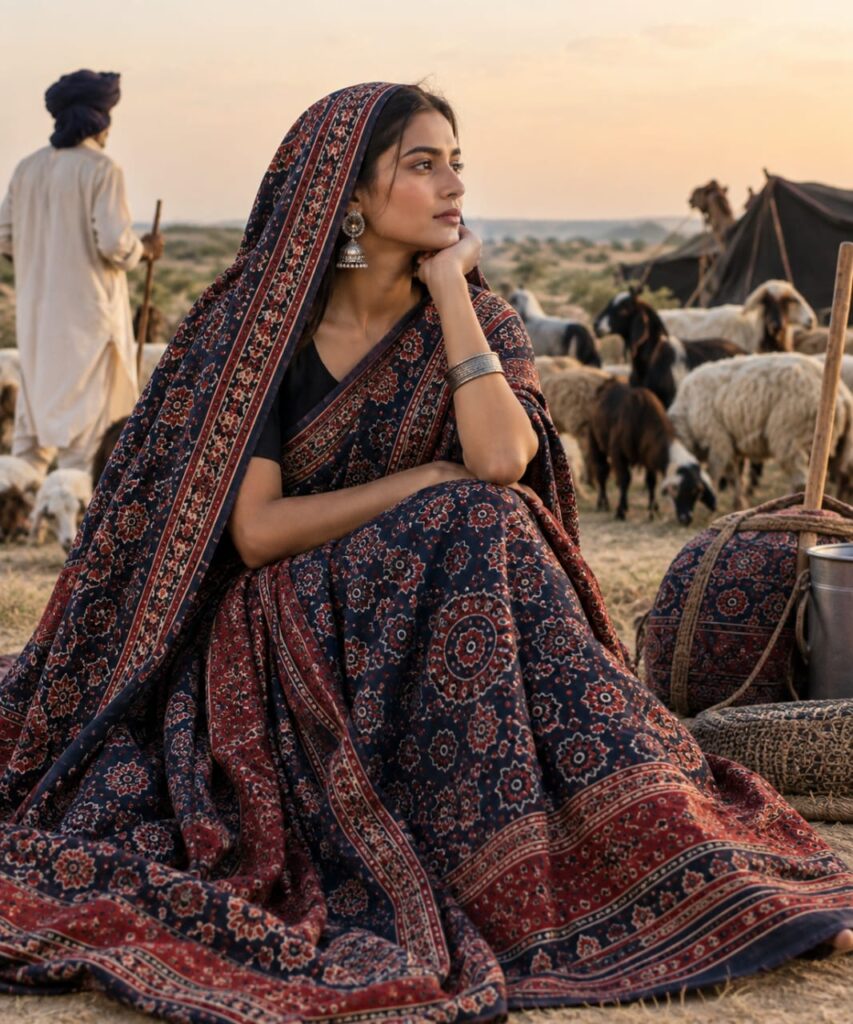
Ajrakh Tells Us About Pastoral Life
- Ajrakh gives us a small window into a much larger world.
- Through the textile, we can understand something about mobility.
- We can see how communities adapted to dry landscapes.
- We can see how artisans created long-term relationships with customers.
- We can understand how clothing could carry identity.
- We can see how seasonal movement influenced markets.
- And we can see how environmental and economic changes eventually affected traditional crafts.
- This is why textiles are such valuable historical sources.
- A written document may tell us that a community moved.
- A textile can show us what that community carried with them.
- A map can show us a route.
- A piece of Ajrakh can show us something about the people who travelled along it.
A Cloth That Belonged to a Moving World
- Perhaps the deepest connection between pastoral communities and Ajrakh is this:
- both are shaped by movement.
- The pastoralist follows water and pasture.
- The artisan follows customers.
- The cloth follows the wearer.
- The design follows generations of knowledge.
- And the tradition follows changing circumstances.
- Nothing remains completely still.
- That is what makes the history so human.
- Ajrakh was not created in a world where people stayed in one place forever.
- It developed among communities that knew how to adapt.
- When the grass changed, they moved.
- When water became scarce, they moved.
- When markets changed, artisans adapted.
- When traditional customers became harder to reach, the textile found new markets.
- When Dhamadka suffered devastating damage in 2001, Khatri artisans established Ajrakhpur and continued their work in a new setting. Research on Ajrakh documents this wider process of adaptation from traditional community dress to contemporary textile culture.
The Story Is Still Being Worn
Today, someone may wear an Ajrakh sarees in a city without ever having seen a Maldharis herd crossing the landscape of Kutch.
They may admire the indigo.
They may appreciate the handmade quality.
They may simply love the pattern.
There is nothing wrong with that.
But knowing the history adds something.
The blue begins to feel connected with a landscape.
The geometric pattern begins to feel connected with community identity.
The cloth begins to feel connected with people who travelled with animals across difficult terrain.
And the artisan’s work becomes more than decoration.
It becomes a continuation of a relationship that existed long before Ajrakh entered modern fashion.
Where the Herds and the Blocks Meet
- The story of Ajrakh and pastoral communities is ultimately not a story about one group simply buying cloth from another.
- It is a story of interdependence.
- Pastoral communities needed textiles that belonged to their lives.
- Artisans needed communities who valued their work.
- The landscape shaped both.
- Water influenced migration.
- Migration influenced markets.
- Markets influenced production.
- Production preserved knowledge.
- And knowledge kept Ajrakh alive.
- That is why the textile deserves to be looked at slowly.
- Not only for its beautiful colors.
- Not only for its geometric patterns.
- But for the life that once moved beneath those patterns.
- Ajrakh travelled with people.
- It travelled on the shoulders of pluralists, around their heads as turbans, around their bodies as wrapped garments, and through the landscapes where herds searched for water and grass.
- It travelled from artisan workshops to village homes.
- It travelled through marriages and festivals.
- It travelled across Sindh and Kutch.
- And eventually, it travelled into the modern world of fashion.
- Yet somewhere inside every traditional pattern remains a memory of the communities that gave the cloth its purpose.
- The next time you see an Ajrakh textile, imagine it not hanging silently in a shop.
- Imagine it moving.
- A camel carrying supplies.
- A herd crossing dry land.
- A family setting up camp.
- An artisan arriving with folded cloth.
- A customer recognizing a familiar pattern.
- A wedding where a new turban is given.
- A piece of indigo fabric traveling from one generation to the next.
- That is the deeper history of Ajrakh.
- It was never only made for people who stayed in one place.
- It became meaningful because it travelled with people whose lives were already written around movement, memory and belonging.
- And perhaps that is why Ajrakh still feels alive today.
- Because even after the old routes changed, the cloth kept moving.
- From the pastoral landscape to the modern wardrobe, Ajrakh continues to carry the people, places and memories that shaped it.