
Ajrakh is often admired for its deep indigo, earthy reds, balanced geometry, and beautiful hand-blocked patterns. From a distance, it can look like a beautifully arranged piece of fabric. But when you look closer, another story begins to appear. Behind every repeated motif, every carefully placed block, every layer of color, and every patiently washed piece of cloth, there is a person.
There is the artisan who knows exactly how much pressure a wooden block needs. There is the dyer who understands how color behaves in natural materials. There is the person who can look at a piece of fabric and notice a small difference that an untrained eye might never see. There are families who have spent generations learning the craft, not from textbooks, but from watching, practicing, correcting, and trying again.
This is the human side of Ajrakh.
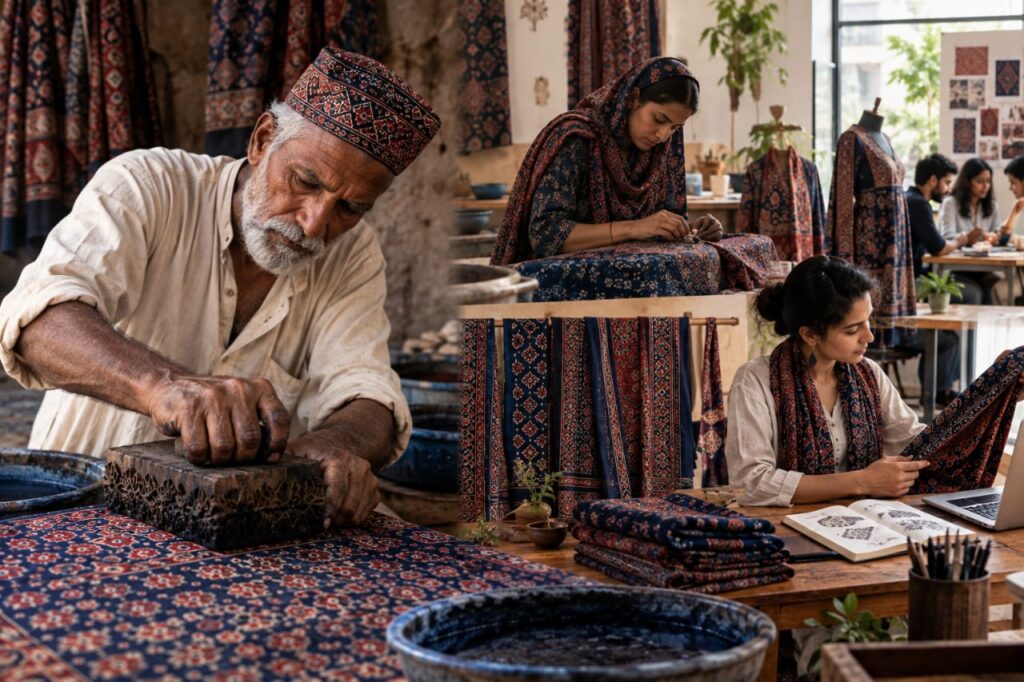
For centuries, the craft was closely connected with the Khatri artisan communities of Kutch and with the clothing traditions of pastoral communities. Ajrakh was not originally created simply as a decorative fashion textile. It had a social and cultural place in everyday life. Its distinctive double-sided printing, natural dyes, geometric designs, and lengthy production process made it different from ordinary printed cloth.
Today, Ajrakh has travelled far beyond its traditional setting. It appears in sarees, stoles, shirts, dresses, jackets, home textiles, accessories, and contemporary fashion collections. Designers have introduced new color combinations, layouts, silhouettes, and applications. Yet the most interesting part of this modern revival is that the artisans themselves have not simply stood in the background.
They have become part of the change.
The Hands Behind the Pattern
A finished Ajrakh textile can make the process look effortless. The pattern appears neat, balanced, and almost perfectly repeated. In reality, traditional Ajrakh is built through a long sequence of preparation, resist printing, dyeing, washing, drying, and printing again.
Some descriptions of the traditional process identify around 14 to 16 individual stages, and the complete work can take many days.
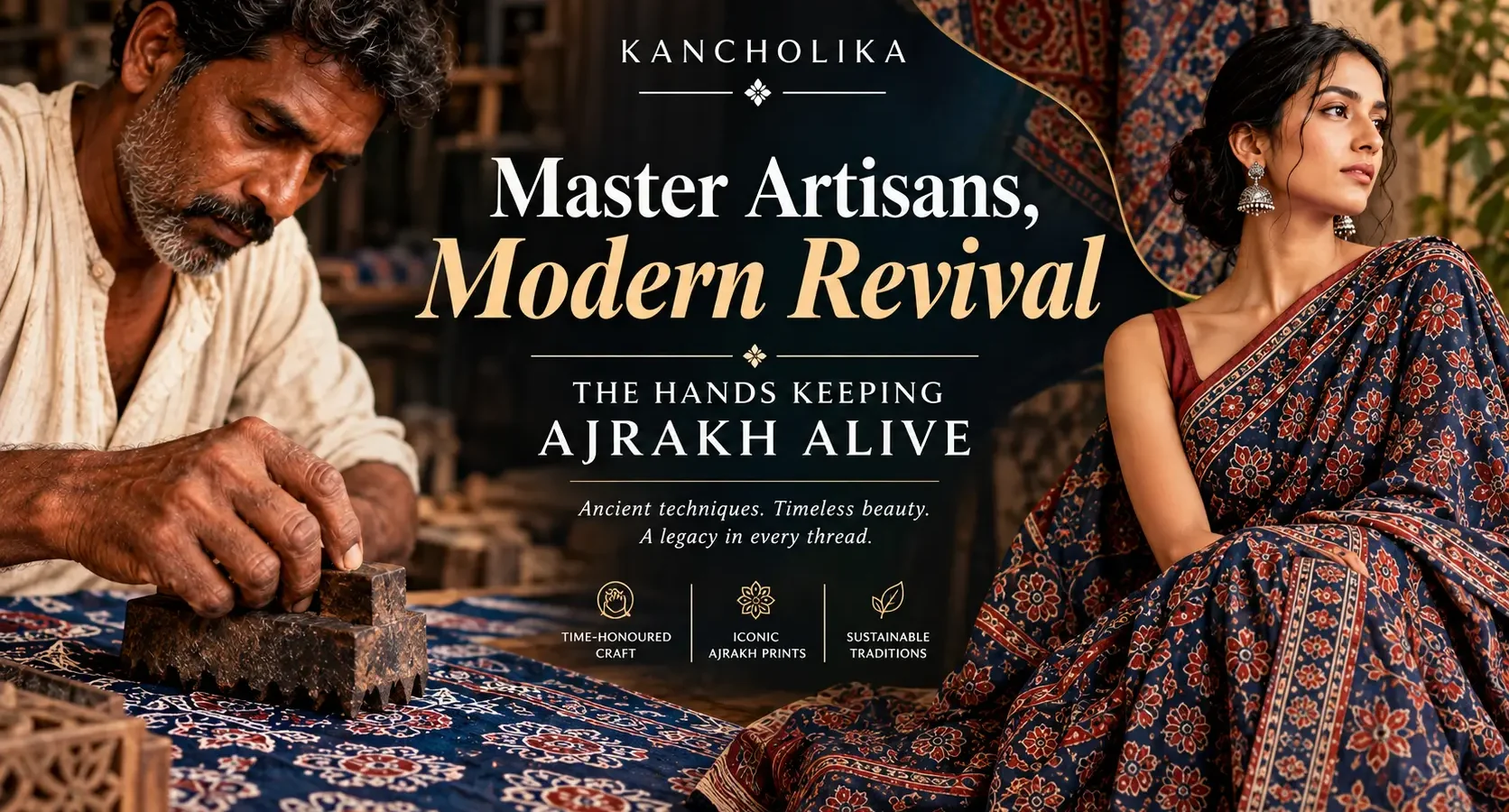
This is why an Ajrakh artisan is much more than someone who simply stamps a block onto fabric.
The work requires patience and physical understanding. The cloth must be prepared properly before printing begins. Natural dyes have their own behaviour. Water quality matters. The wooden blocks have to be aligned carefully. Resist material needs to cover the right areas. Each stage affects the next one.
A mistake made early in the process may become visible much later.
This creates a special kind of craftsmanship. The artisan learns to think several steps ahead.
That knowledge is difficult to capture in a simple instruction manual because much of it comes from experience. An experienced maker develops an instinct for the cloth, the dye, the block, the weather, and the timing.
The hands learn things that the mind cannot always explain.
A Craft Learned by Watching
One of the most beautiful parts of traditional craft communities is the way knowledge moves between generations.
A young person may begin by watching an elder work. At first, the movements may seem ordinary. A block is picked up. Color is applied. Fabric is placed down. The block is pressed. The cloth is lifted.
Then the same movement is repeated.
Slowly, the learner begins to understand that every movement has a reason.
The pressure of the hand matters. The angle of the block matters. The amount of dye matters. Even the way the fabric is handled between stages can affect the final result.
This kind of learning cannot be rushed.
Many Khatri artisan families have maintained Ajrakh-making knowledge through generations, helping preserve techniques that might otherwise have disappeared under pressure from cheaper and faster forms of textile production.
The result is not simply a textile tradition.
It is a living classroom.
Every generation receives something from the previous one, but it also adds something of its own.
When Handmade Craft Faced a Faster World
The modern revival of Ajrakh becomes easier to understand when we remember the challenges that came before it.
Industrial production changed the textile market dramatically. Machine-made fabrics could be produced faster and sold at lower prices. Chemical dyes and screen printing offered quicker alternatives to lengthy traditional processes.
For artisans, this created a difficult choice.
Should they continue making a complicated textile that required enormous amounts of time and effort, even when cheaper alternatives were available?
Or should they change their methods to survive economically?
Ajrakh artisans were not working in isolation from the market. They had families to support and livelihoods to protect.
As cheaper printed fabrics became available, traditional Ajrakh faced pressure. Some makers began using chemical dyes or adapting their processes because the market demanded lower prices and faster production.
This period is important because revival did not happen simply because people suddenly became interested in traditional crafts.
Revival became necessary because the craft itself was under pressure.
The People Who Chose to Bring It Back
Among the important figures associated with the revival of Ajrakh are members of the Khatri artisan community who worked to preserve traditional techniques while finding ways for the craft to survive in a changing economy.
The revival was not only about returning to an old method.
It was also about asking a modern question:
How can an old craft remain meaningful when the world around it has changed?
Artisan families and craft practitioners began looking for ways to reconnect traditional techniques with new markets. Government initiatives, designers, voluntary organizations, craft institutions, and entrepreneurs also played roles in helping Ajrakh enter contemporary design spaces. Research on Ajrakh modern development notes that artisan-designer collaborations began receiving attention as early as the 1970s, followed by later collaborations that helped move Ajrakh into wider fashion markets.
This collaboration created a new possibility.
The artisan did not have to choose between tradition and survival.
There could be a conversation between the two.
A Village Rebuilt Around a Craft
The story of Ajrakh cannot be separated from the 2001 earthquake in Gujarat.
The earthquake severely damaged Kutch, including Dhamadka, one of the important centers associated with Ajrakh printing. The disaster affected homes, workshops, livelihoods, and the physical environment in which artisans worked.
The challenge became even more complicated because water is essential to Ajrakh production.
The quality of water can influence washing, dyeing, and the appearance of the final textile. Following the earthquake, changes in the local water conditions, including increased iron content reported in the Saran River, created serious difficulties for traditional printing.
For artisans whose work depended so heavily on water, this was not a small inconvenience.
It affected the craft at its foundation.
A group of artisans eventually moved and helped establish Ajrakhpur, creating a new center where the craft could continue. The rebuilding of Ajrakhpur became more than physical relocation. It represented an attempt to rebuild a community and its livelihood around its traditional knowledge.
The story of Ajrakhpur is therefore also a story about artisans refusing to allow a disaster to become the end of their craft.
When Tradition Met the Designer’s Imagination
The modern revival of Ajrakh gained another dimension when designers began looking at the textile differently.
Traditionally, Ajrakh had specific cultural uses and recognizable motifs. Modern designers saw possibilities beyond those boundaries.
A traditional Ajrakh fabric could become a contemporary sarees.
It could become a shirt.
It could be transformed into a jacket, a dress, a bag, a cushion, or another object for modern living.
The important point is that the textile did not necessarily need to lose its identity to enter a new product category.
Designers and artisans began experimenting with scale, color, composition, and application. Research on Ajrakh development describes its movement from a regional textile associated with particular communities toward a much broader fashion fabric.
This movement changed the audience for Ajrakh.
Someone living far away from Kutch could now discover the textile without having any connection to its original community.
That created new opportunities for artisans.
The Artisan Is No Longer Just a Maker
One of the most interesting changes in contemporary craft is the growing recognition of artisans as creative thinkers.
For a long time, handmade production was often described as if an artisan simply followed instructions created somewhere else.
But Ajrakh tells a different story.
Artisans understand the craft from the inside. They know the limitations of materials. They understand traditional motifs. They know how colors behave. They recognize the difference between a technically correct print and one that feels balanced.
Modern craft education and design collaborations have helped some artisans explore their own creative ideas. Khamir, for example, documents Khatri artisans working with designers and experimenting with new expressions while continuing to draw from Ajrakh traditional language.
This shift is important.
Revival does not have to mean freezing a craft exactly as it was in the past.
Sometimes revival means giving the people who carry the tradition enough freedom to explore it.
New Ideas Without Losing the Old Soul
There is always a delicate balance in traditional craft.
If artisans never experiment, the craft can become disconnected from changing lifestyles.
If the craft changes too much, people may question whether it is still the same tradition.
Ajrakh has been navigating this space for years.
Traditional geometric patterns continue to appear. Indigo, madder-inspired reds, earthy tones, and resist-dyeing techniques remain strongly associated with the craft. At the same time, artisans and designers have explored new motifs, color combinations, products, and visual arrangements.
The result is not one single version of Ajrakh.
There are many.
Some pieces remain close to traditional forms.
Others feel unmistakably contemporary.
Both can exist within the same larger story.
That may be one of the strongest signs that a craft is alive.
The Quiet Power of Natural Color
Natural dyeing is another area where master artisans carry knowledge that is difficult to replace.
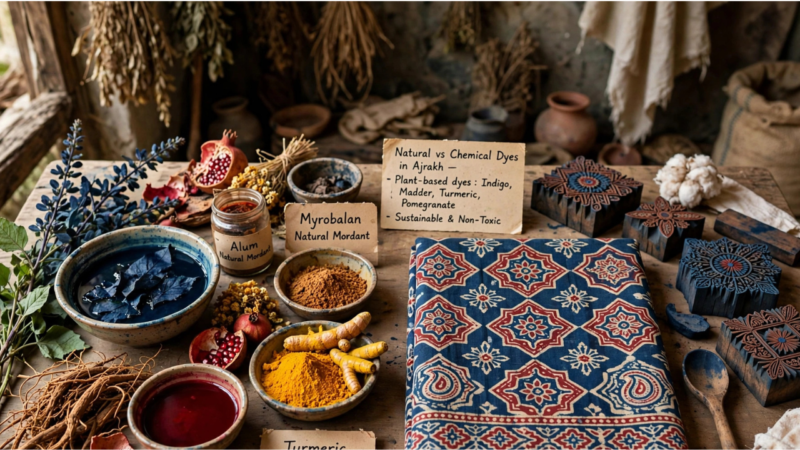
Traditional Ajrakh is associated with dyes such as indigo and madder, along with resist techniques that allow different colors and patterns to emerge through a carefully controlled sequence.
Natural color is not always predictable in the same way as industrial color.
It can respond to materials, water, temperature, timing, and preparation.
That unpredictability can sometimes be challenging.
But it is also part of the beauty.
Two pieces made using similar techniques may not look completely identical. Small variations can become evidence that the textile passed through human hands.
In a world filled with perfectly repeated machine prints, those small differences can feel meaningful.
They remind us that the object was made rather than simply manufactured.
From Village Workshops to Contemporary Fashion
Ajrakh journey into modern fashion has changed the way people see the textile.
What was once closely connected to regional dress traditions is now seen in contemporary wardrobes and design collections. Academic research has documented this movement from rural western India to major fashion centers and wider markets.
This transition has given artisans access to customers who may never have encountered traditional Ajrakh before.
But popularity also brings responsibility.
When a craft becomes fashionable, there is a risk that its history gets reduced to a surface pattern.
People may see the colors and motifs without knowing the process behind them.
They may appreciate the design without understanding how long it took to make.
They may call something “Ajrakh-inspired” without knowing what makes traditional Ajrakh distinctive.
This is why the role of master artisans remains so important.
They connect the modern product to the deeper knowledge behind it.
Younger Hands, New Questions
For Ajrakh to survive, young people must see a future in it.
Tradition alone cannot guarantee continuity.
A craft needs livelihoods.
Young artisans need opportunities to learn, experiment, earn, and build independent identities.
This is where modern design education can make a difference.
Programs connected with craft communities have encouraged artisans to think about design, markets, product development, and new applications. Khamir notes that design education has helped artisans explore new artistic expressions rather than simply reproducing inherited forms.
This can change the relationship between the younger generation and the craft.
Instead of thinking, “This is something my family does,” a young artisan can begin thinking, “This is something I can create with.”
That small change in thinking can shape the future of an entire tradition.
Modern Revival Is More Than a Fashion Trend
It is tempting to describe the current popularity of Ajrakh as simply another fashion trend.
But the story is deeper.
A fashion trend may last for a season.
Ajrakh has survived for generations.
Its modern revival is connected to craft preservation, artisan livelihoods, design innovation, cultural identity, and changing consumer interest.
The rise of contemporary Ajrakh has also shown that heritage does not have to remain locked inside museums.
A traditional textile can be part of everyday life.
It can be worn with jeans.
It can be draped as a sarees.
It can become a modern jacket.
It can decorate a home.
It can be styled in a way that feels completely personal.
The craft remains connected to its history while becoming part of new stories.
The Beauty of Imperfect Perfection
Perhaps the most human quality of Ajrakh is that it does not need to look factory-perfect.
A tiny variation in a print can reveal the movement of a hand.
A slight difference in color can show the behaviour of a natural dye.
A small shift in alignment can remind us that a person, rather than a machine, stood behind the fabric.
These details are not necessarily flaws.
They are traces of the maker.
In a culture increasingly surrounded by automated production, handmade textiles offer something different.
They carry time.
They carry touch.
They carry memory.
And in Ajrakh, these qualities are especially visible because the process itself is so demanding.
When Heritage Becomes a Living Conversation
The strongest form of revival does not treat tradition as something fragile that must be kept untouched.
Instead, it allows tradition to have a conversation with the present.
Master artisans bring inherited knowledge.
Designers bring new perspectives.
Younger generations bring different ambitions.
Customers bring new ways of wearing and using the textile.
Craft organizations create spaces for learning and experimentation.
Together, these influences shape the next chapter of Ajrakh.
The craft is not simply moving from the past to the present.
It is being interpreted again and again.
That is why the modern revival of Ajrakh feels so interesting. It is not a single event. It is an ongoing process.
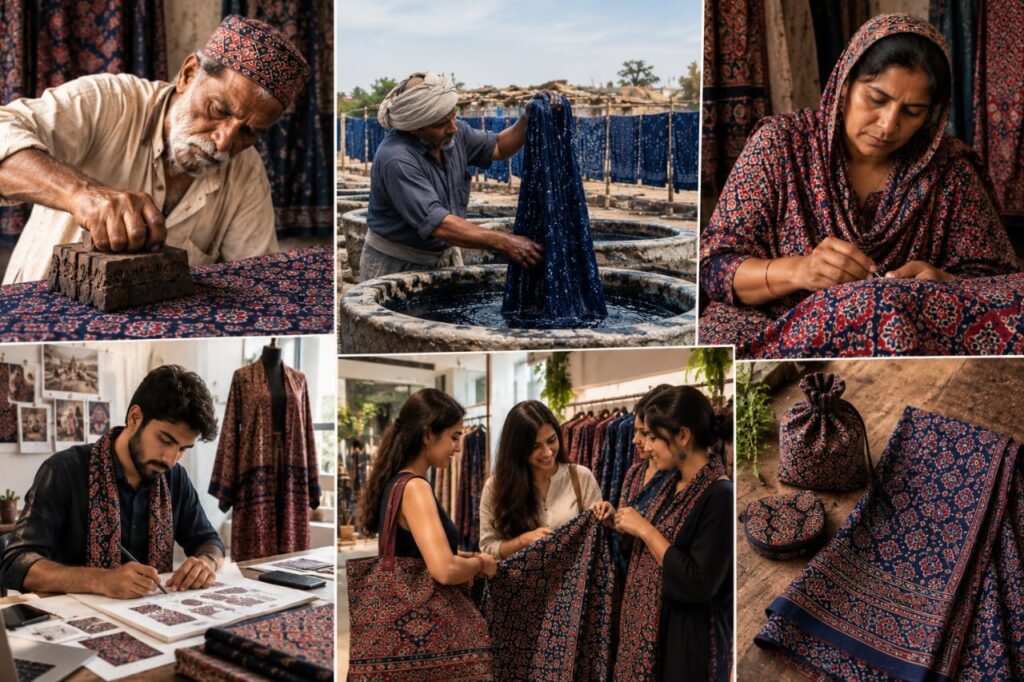
The Future Still Begins With the Hands
Technology can help a craft reach new customers.
Social media can introduce Ajrakh to people across the world.
E-commerce can make traditional textiles easier to discover.
Design collaborations can create new markets.
Modern fashion can give an old textile a new audience.
But none of these things can replace the artisan.
The future of Ajrakh still depends on people who understand the craft deeply enough to carry it forward.
It depends on young hands learning from experienced ones.
It depends on artisans being valued not only for their labor but also for their knowledge and creativity.
It depends on customers understanding that handmade textiles have a different relationship with time and price.
And it depends on allowing the craft to evolve without losing the knowledge that gives it meaning.
The story of Ajrakh revival is therefore not simply a story about an old textile becoming fashionable again.
It is a story about people.
People who continued working when cheaper alternatives appeared.
People who rebuilt after disaster.
People who adapted when water and markets changed.
People who experimented with new ideas without abandoning the foundation of their craft.
And people who continue to teach the next generation through something as simple, and as powerful, as showing them how to place a block on cloth.
A Tradition Still Being Written
Ajrakh has travelled a remarkable distance.
From traditional communities in the desert regions of Kutch and Sindh to contemporary wardrobes, design studios, exhibitions, and international markets, its visual language has found new audiences.
But its journey is not finished.
Every new artisan who learns the craft adds another page.
Every new motif adds another possibility.
Every young designer who works respectfully with the tradition opens another door.
Every person who chooses a genuine handmade textile becomes part of its continuing story.
That is the real meaning of modern revival.
It is not about bringing the past back exactly as it was.
It is about making sure the knowledge of the past still has a place in the future.
Ajrakh survives because its artisans have allowed it to change without allowing it to disappear.
The blocks are still carved.
The colors are still layered.
The fabric is still washed, dried, printed, and handled with patience.
And behind every pattern, there are still human hands carrying forward a story that began long before today’s fashion cycles.
That is why Ajrakh is more than a print.
It is a living craft.
And its greatest revival may not be the fact that the world has discovered it again.
It may be that the artisans who carried it through difficult times are still here to shape what it becomes next.