
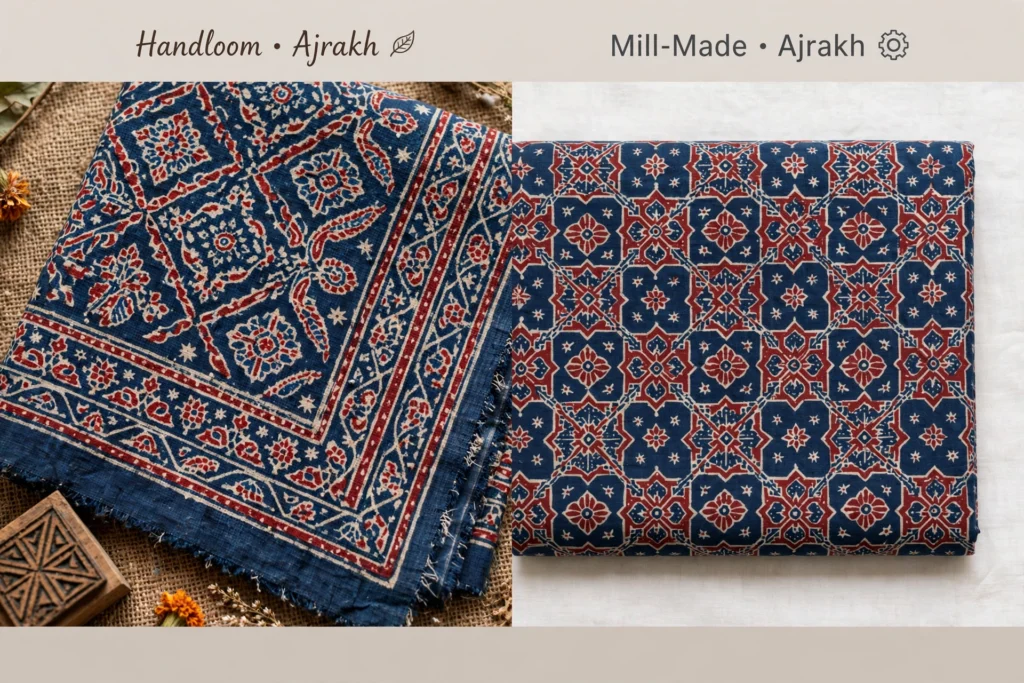
Two Ajrakh fabrics can display almost identical patterns yet feel noticeably different when you hold them. One may feel airy, textured, and slightly irregular, while the other may feel smoother, more uniform, or more tightly constructed. These differences often make shoppers pause when choosing an Ajrakh saree, dupatta, kurtas fabric, or dress material.
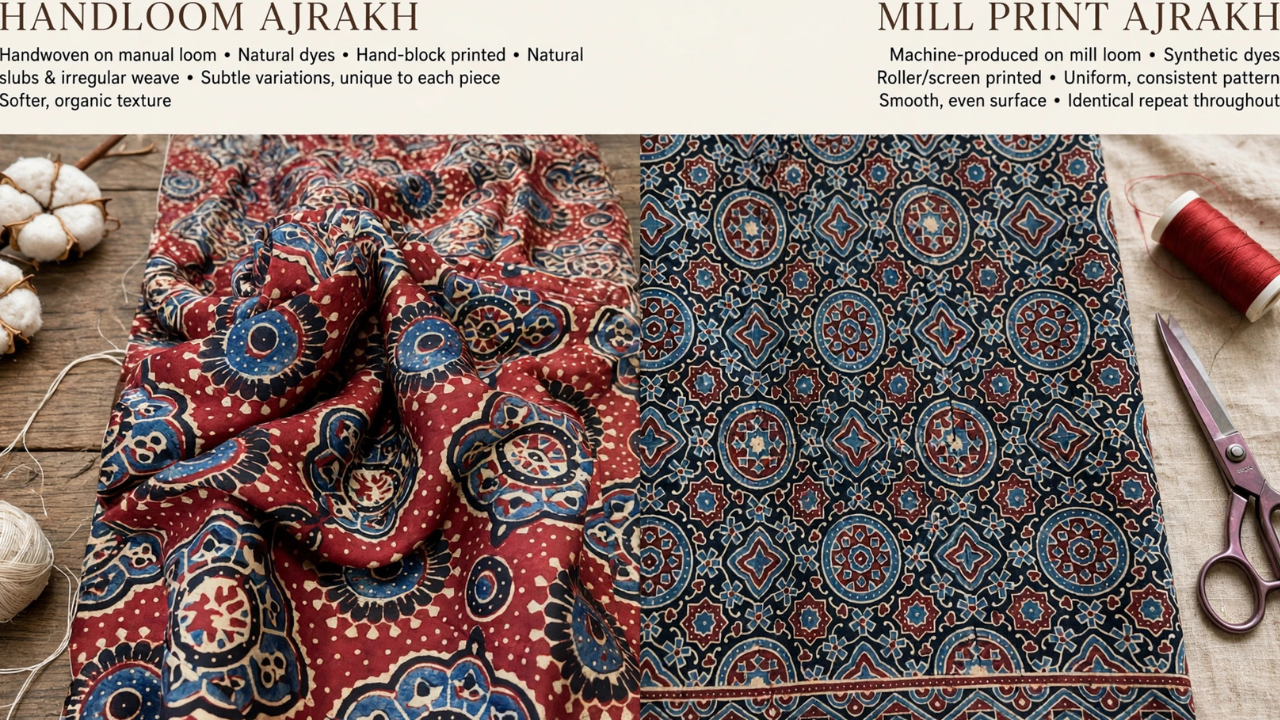
The difference does not always come from the print. The yarn, fiber, weaving method, fabric density, finishing treatment, and printing process all influence the final feel. A textile woven by hand may show small variations that reflect the yarn and the weaving process. A fabric produced on a power loom may offer a more consistent structure, although modern machinery can produce a wide variety of textures and finishes.
Understanding handloom vs powerloom Ajrakh fabric helps buyers look beyond the surface design. The aim is not to label one fabric as automatically superior. Instead, it is to understand what your hands can tell you, which details need closer inspection, and how to select fabric that suits your comfort, styling preferences, and intended use.
Why the Weave Matters in Ajrakh
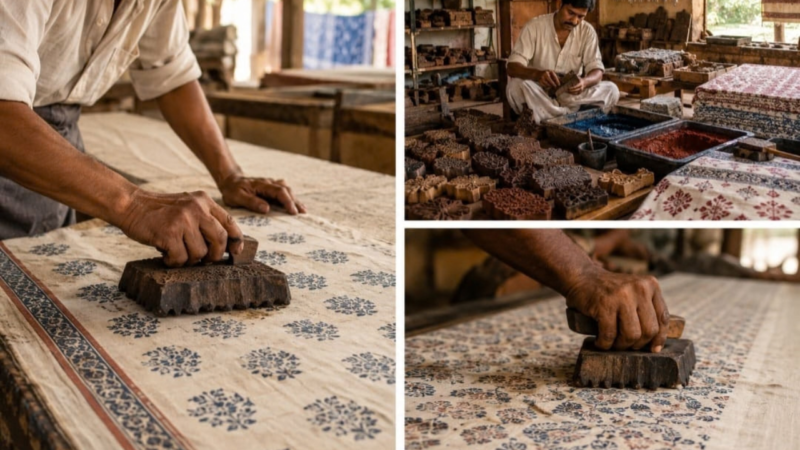
Ajrakh is known for its intricate printed patterns, repeated motifs, and carefully arranged colours. Artisans may use carved wooden blocks, resist materials, dyeing, and washing to build the design. However, the base fabric provides the foundation on which the entire process depends.
Weaving creates the structure of the cloth by interlacing lengthwise yarns, known as the warp, with crosswise yarns, known as the weft. The way the loom handles these yarns influences the fabric’s construction, consistency, and potential texture.
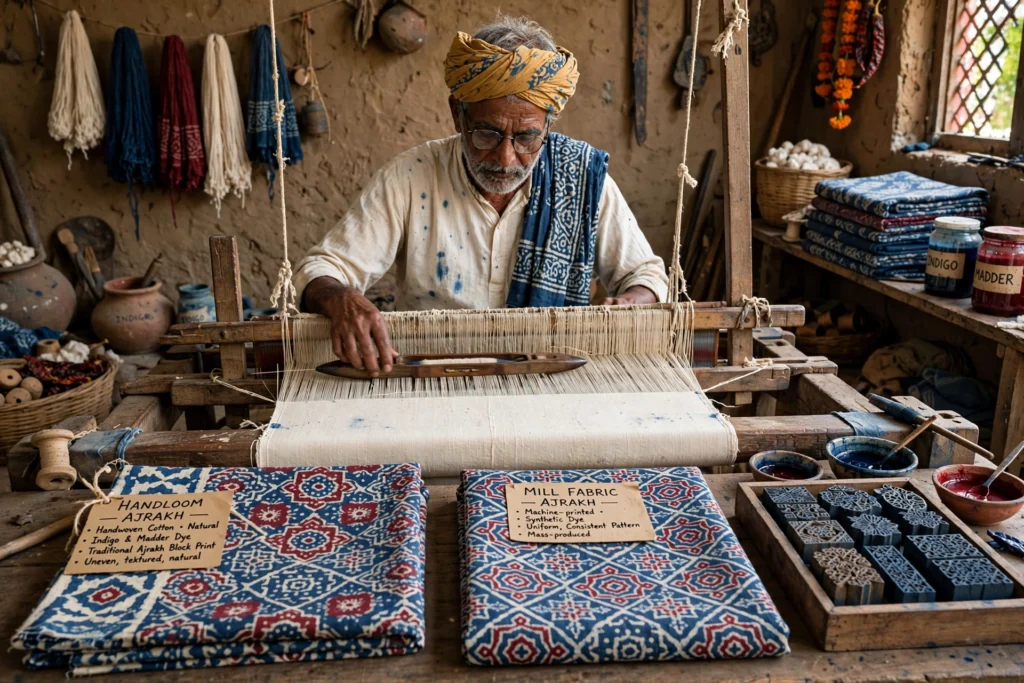
A handloom uses human operation to control the weaving process. Depending on the loom and the artisan’s technique, the fabric may contain subtle variations in yarn placement, tension, or surface appearance. These variations can contribute to the textile’s individual character.
A powerloom uses mechanical power to operate the weaving process. It can produce fabric efficiently and consistently, depending on the machine, settings, yarn quality, and production standards. Powerloom fabric can feel soft, crisp, lightweight, heavy, or textured; the machinery alone does not determine its hand-feel.
Mill fabric is a broader commercial term that can refer to fabric produced in a mill, often using machinery. It does not always mean the same thing as powerloom fabric, and not every mill-produced textile has identical characteristics.
For Ajrakh buyers, the important distinction is between the actual construction and feel of the fabric—not just the label attached to it.
Fabric Hand-Feel
Hand-feel describes the way a textile feels when you touch, hold, fold, or move it. Textile professionals may also use the term handle to describe characteristics such as softness, stiffness, thickness, flexibility, and surface texture.
When comparing handloom and powerloom Ajrakh, focus on several qualities rather than relying on one quick touch.
1. Softness and Surface Texture
Run your fingertips lightly across the fabric. Does the surface feel smooth, slightly grainy, crisp, or textured? Does it glide over your fingers, or can you feel small differences in the yarn?
Some handloom fabrics contain visible and tactile irregularities because the yarns or weaving tension vary slightly. These details may create a lively surface rather than a perfectly uniform one. However, handloom textiles can also feel smooth, fine, and even.
Powerloom fabric often offers a consistent surface, particularly when the producer uses uniform yarn and controlled settings. Yet power looms can also create textured weaves, and finishing treatments can make machine-woven fabric feel exceptionally soft.
The useful test is to assess the particular piece in front of you. Do not assume that roughness proves handloom production or that smoothness proves powerloom production.
2. Flexibility and Drape
Hold the fabric by one edge and allow it to fall naturally. Observe how it folds and moves.
A lightweight fabric may flow easily, while a heavier or more tightly woven fabric may hold its shape. Some textiles drape close to the body; others create defined folds and a more structured silhouette.
Handloom fabric can have a distinctive drape because of its yarn choice, weave structure, and finishing. Powerloom fabric can produce similar effects when manufacturers select comparable yarns and weave constructions.
For an Ajrakh saree, consider whether the fabric forms the kind of pleats you prefer. For a dupatta, check whether it falls comfortably around the shoulders. For a kurtas, think about the balance between movement and structure.
The weaving method offers context, but the fabric’s actual weight, weave, and finishing give you more direct information about how it will wear.
3. Weight and Thickness
Place the fabric across your palm and compare its weight with another textile of a similar fiber and size. Notice whether it feels airy, substantial, dense, or unusually stiff.
Weight affects more than comfort. It can influence how a saree drapes, how a garment holds its shape, and how the fabric behaves in warm weather. A lightweight fabric may suit flowing silhouettes, while a heavier textile may work well for structured garments or accessories.
Neither handloom nor powerloom automatically means lightweight or heavyweight. The yarn count, fiber type, weave density, and finishing determine much of the final result.
When possible, compare fabrics made from similar fibers. Comparing cotton handloom with synthetic powerloom fabric, for example, will not tell you much about the weaving method because the fiber difference can strongly influence the feel.
Slub: The Small Irregularity You Can Feel
One feature that shoppers may notice on a handwoven textile is a slub. A slub is a thicker or more irregular section of yarn that creates a small variation in the fabric’s surface. It may appear as a subtle line, raised area, or thicker segment within the weave.
Slubs can occur in yarns made through different spinning methods. Some arise naturally from the yarn structure, while manufacturers can also create slub effects deliberately to give fabric a textured appearance.
In hand-spun yarn, differences in fiber thickness and spinning tension may produce visible irregularities. When artisans weave such yarn, those variations can become part of the textile’s character.
However, a slub is not proof that a fabric is handloom. Machine-woven textiles can use slub yarn too. Likewise, a handloom fabric made with carefully controlled, even yarn may show very few visible slubs.
How to Examine Slubs
Hold the cloth near a window or under soft lighting. Look along the warp and weft for small changes in yarn thickness. Then run your fingertips gently across the surface to see whether the variations are tactile or mainly visual.
Ask yourself three questions:
- Do the irregularities appear to follow the yarn structure?
- Do they look consistent with the overall fabric rather than like isolated defects?
- Does the seller explain the yarn and weaving method clearly?
A few slubs can contribute to the visual richness of a textile, but large weak spots, broken yarns, or unexpected holes may indicate a quality problem. Buyers should distinguish a natural yarn variation from damage or poor construction.
The Touch Test: A Practical Comparison
A simple touch test helps you compare two Ajrakh fabrics before buying. It cannot prove the production method on its own, but it can help you identify the qualities you prefer.
Step One: Compare Similar Fabrics
Choose two textiles with similar fiber content, thickness, and intended use. If one is cotton and the other is silk, their different feel may come mainly from the fiber rather than the loom.
Ask the seller whether the fabric is handloom, powerloom, or another type of construction. If the label says only “mill fabric,” ask what that means for the specific product.
Step Two: Feel the Surface
Place both fabrics on a flat surface. Move your fingertips across each one without pressing too hard.
Notice whether the yarns feel even, whether the surface has small variations, and whether either fabric feels rough or slippery. Record what you actually feel instead of immediately deciding which method produced it.
Step Three: Fold and Release
Fold a small section of each textile and release it. Watch how the folds form and how the fabric falls back into place.
One fabric may create soft, rounded folds, while another may hold sharper creases. Neither result confirms the weaving method, but it tells you something about the fabric’s construction and finishing.
Step Four: Check the Reverse Side
Turn the fabric over and examine the back. Look at the weave structure, the regularity of the yarns, and the printed pattern.
Ajrakh printing can involve multiple stages, so the reverse side may show characteristics of the printing process. However, print appearance alone cannot reliably establish whether the base fabric came from a handloom or a powerloom.
Step Five: Ask About the Fabric’s Origin
A touch test should support—not replace—clear product information. Ask who produced the fabric, whether the yarn was hand-spun, whether the cloth was handwoven, and whether the Ajrakh printing used hand-carved blocks.
These are separate questions. A textile can combine machine-spun yarn, handloom weaving, and hand-block printing. Another textile can use mill-produced cloth with traditional hand-block printing. Accurate descriptions help buyers understand what makes each product distinctive.
Handloom vs Powerloom Ajrakh Fabric: Key Differences
| Feature | Handloom fabric | Powerloom fabric |
|---|---|---|
| Weaving method | Human-operated loom | Mechanically powered loom |
| Surface consistency | May show subtle variations | Often consistent, depending on setup |
| Slubs | May occur, depending on yarn | Can also occur when slub yarn is used |
| Texture | Ranges from smooth to textured | Ranges from smooth to textured |
| Drape | Depends on fibre, weave, and finishing | Depends on fibre, weave, and finishing |
| Production scale | Often suited to smaller or specialised production | Often suited to efficient larger-scale production |
| Price | Can reflect labour, material, and production time | Can reflect scale, materials, finishing, and brand |
| Ajrakh printing | Can support hand-block printing | Can also support hand-block or other printing methods |
This comparison describes common tendencies rather than strict rules. A carefully woven powerloom textile may feel more comfortable than a poorly finished handloom fabric. A handloom textile may offer a distinctive texture, but that quality depends on the materials and the maker’s skill.
Does Handloom Always Feel Better?
Not necessarily. “Better” depends on what you want from the fabric.
Someone who enjoys subtle irregularities and the feel of textured yarn may prefer a particular handloom textile. Another buyer may prefer a smooth, consistent surface that works well for daily wear. Both preferences can make sense.
Handloom production can involve specialized skill and considerable manual effort, but the method alone does not guarantee softness, durability, or comfort. Yarn quality, weave density, finishing, and care all influence performance.
Likewise, powerloom production does not automatically indicate low quality. Modern mechanical weaving can create excellent fabrics with precise construction and a wide range of textures.
When shopping for Ajrakh, evaluate the fabric according to its intended use. A saree for frequent wear may need a different balance of softness, weight, and durability from a decorative textile or a special-occasion garment.
The Relationship Between Weaving and Ajrakh Printing
Weaving and printing create different aspects of a textile. Weaving establishes the fabric structure, while Ajrakh printing adds colour and pattern through processes that may include resist printing, dyeing, washing, and repeated block application.
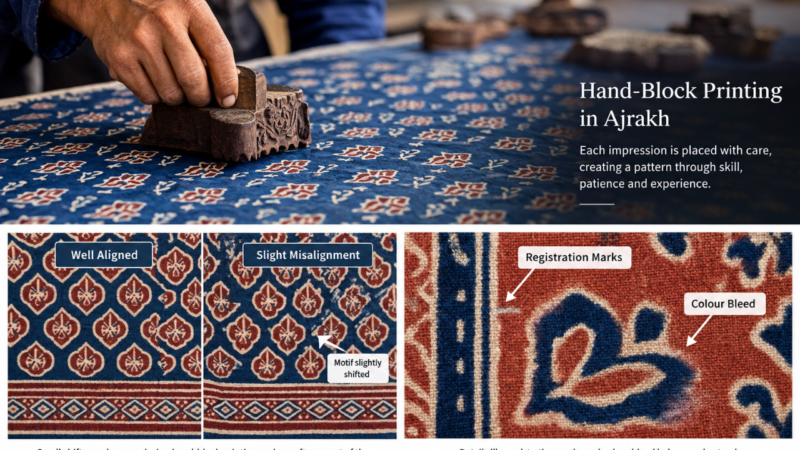
A hand-block-printed design does not automatically mean that the underlying fabric is handloom. An artisan can print on mill-produced fabric, just as a handwoven textile can receive a different kind of print or finish.
This distinction matters when a product description uses terms such as “handcrafted,” “traditional,” or “handloom.” These words can refer to different parts of production, and a clear description should identify the actual method.
If handloom weaving is important to you, ask the seller to confirm the base fabric’s construction. If hand-block printing matters more, ask how the pattern was applied. If both matter, check both details rather than treating one as proof of the other.
Comfort, Durability, and Everyday Use
The feel of a textile affects how often you reach for it. A fabric that feels pleasant against the skin, moves comfortably, and suits your routine may become a favorite far beyond its first wear.
For warm weather, you may prefer a breathable fabric with a weight and weave that suit your climate. For a structured garment, you may want more body and a firmer drape. For a flowing saree, flexibility and fall may matter more than perfectly uniform surface texture.
Durability depends on fiber strength, yarn construction, weave density, finishing, and how you care for the fabric. A handloom textile is not automatically more durable, and a powerloom textile is not automatically less durable.
Inspect the cloth for loose yarns, weak areas, broken threads, and uneven finishing. Check the care label, especially if the fabric uses natural dyes or contains delicate fibers. Gentle washing and appropriate storage can help preserve the textile’s appearance.
For a valuable or delicate Ajrakh piece, follow the maker’s care advice instead of assuming that every printed cotton fabric can tolerate the same cleaning method.
What to Ask Before Buying Ajrakh Fabric
If you want to buy Ajrakh with confidence, ask the seller questions that separate the fabric’s construction from its printed design.
- What is the fiber content? Cotton, silk, and blended fibers can feel very different.
- Was the fabric woven by hand or by machine? Ask for a specific answer rather than relying on a general label.
- Was the yarn hand-spun? Hand-spun yarn and handloom weaving describe different stages.
- Is the design hand-block printed? Confirm the printing method separately from the weaving method.
- What kind of finish does the fabric have? Finishing can affect softness, stiffness, and drape.
- How should I care for it? Clear instructions help you preserve colour and texture.
A trustworthy seller should describe the product as accurately as possible. If the seller cannot verify a production detail, treat that information as unconfirmed rather than assuming the fabric meets your expectations.
Choosing the Fabric That Feels Right for You
The best Ajrakh fabric is not simply the one with the most irregular texture or the smoothest surface. It is the one whose construction, feel, appearance, and care requirements match your needs.
If you love the character of small yarn variations, look for a fabric whose texture appeals to you and ask whether the yarn contains slubs. If you prefer a more uniform surface, compare the weave and finishing of different fabrics instead of ruling out handloom textiles altogether.
Pay attention to how the fabric falls, how it feels against your fingers, and whether its weight suits the garment you have in mind. Check the reverse side, ask about the base fabric, and confirm the printing method separately.
Handloom and powerloom describe ways of producing cloth, not a simple ranking of quality. Each method can produce textiles with different characteristics, and both can serve as the foundation for beautiful Ajrakh designs.
A thoughtful purchase begins with observation and clear information. Once you understand the fabric’s feel and construction, you can choose an Ajrakh textile for its actual qualities—not just the name on its label.