
Ajrakh: The Ancient Art of Printing That Still Belongs in the Modern Wardrobe
What if a saree could tell you how much patience went into making it?
You will see deep indigo, earthy reds, geometric patterns and intricate borders. But beneath those colors is something much more remarkable—a traditional craft built through hand-carved wooden blocks, natural dyes, resist printing and repeated washing.
It is not a print that happens in minutes.It is a process that unfolds over time.
And behind that process are artisans whose knowledge has been passed from one generation to another.
So, what exactly makes Ajrakh special ?
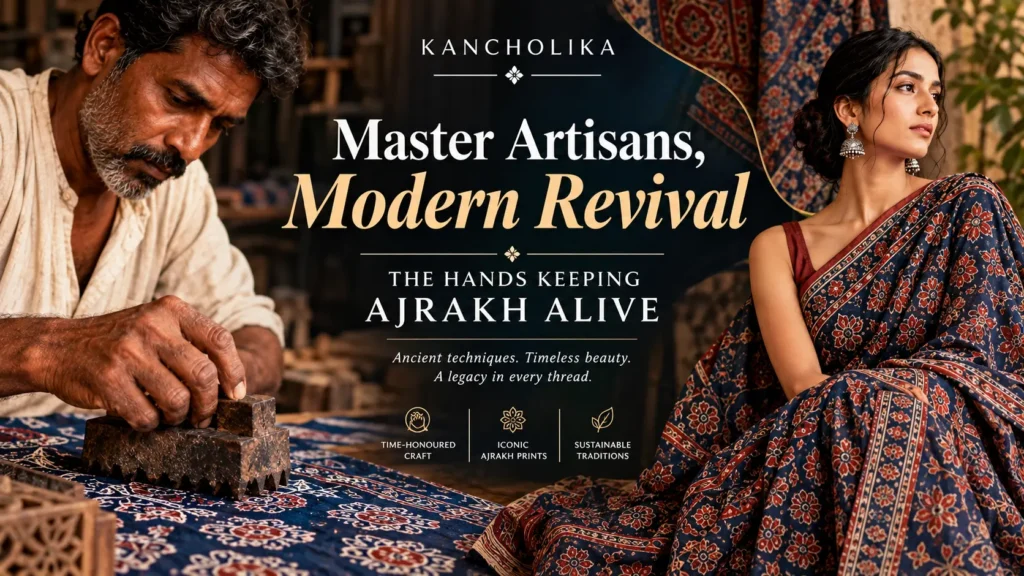
What Is Ajrakh?
Ajrakh is a traditional hand-block printing craft strongly associated with the Kutch region of Gujarat and historically connected with the wider Sindh–Indus region.
The craft uses a combination of:
- Hand-carved wooden blocks
- Resist printing
- Mordant printing
- Dyeing
- Repeated washing
- Drying and careful preparation of fabric
The result is a textile recognized for its rich colors, geometric compositions and highly detailed repeating patterns.
But Ajrakh is not simply about the finished pattern.
The process is the craft.
Where Did Ajrakh Come From?
Ajrakh has a long history associated with the traditional Khatri printing community.
The craft developed across the Sindh and Kutch regions, where textile printing became closely connected with local communities and everyday clothing.
Over generations, artisans refined the techniques used to prepare, print, dye and finish the fabric.
This is one reason Ajrakh feels different from an ordinary printed textile.
It carries not just a visual style, but a living tradition of making.
A craft shaped by generations
The knowledge required to create Ajrakh is traditionally learned through practice.
A young artisan does not simply learn which block goes where.
They learn:
- How to prepare the fabric
- How to handle printing blocks
- How much pressure to apply
- How colors interact with the fabric
- How resist areas behave during dyeing
- How to maintain alignment
- How to judge the fabric at different stages
Much of this knowledge cannot be learned from a written instruction manual.
It is learned by watching, practicing and repeating.
Why Is Ajrakh So Recognizable?
There are three things that immediately draw attention to Ajrakh:
1. Its Color Palette
Traditional Ajrakh is particularly known for rich shades such as:
- Indigo
- Deep red
- Black
- White
- Earthy tones
Indigo gives the textile its depth, while reds and darker tones create contrast.
The result is often bold without looking excessive.
2. Its Geometric Pattern
Ajrakh is famous for its structured visual language.
You may find:
- Repeating geometric shapes
- Floral motifs
- Borders
- Grids
- Stars
- Dots
- Symmetrical compositions
The designs often create a sense of rhythm.
Look from a distance and you see the overall pattern.
Look closely and you begin discovering the smaller details.
That is part of Ajrakh’s charm.
3. Its Borders
The border is often one of the most visually important parts of an Ajrakh textile.
Instead of simply finishing the edge, it helps frame the entire design.
A carefully arranged border can create:
Structure → Contrast → Rhythm → Balance
This is why Ajrakh sarees can look equally striking from a distance and up close.
How Is Ajrakh Made?
This is where Ajrakh becomes truly fascinating.
A finished textile can look simple.
The process behind it is not.
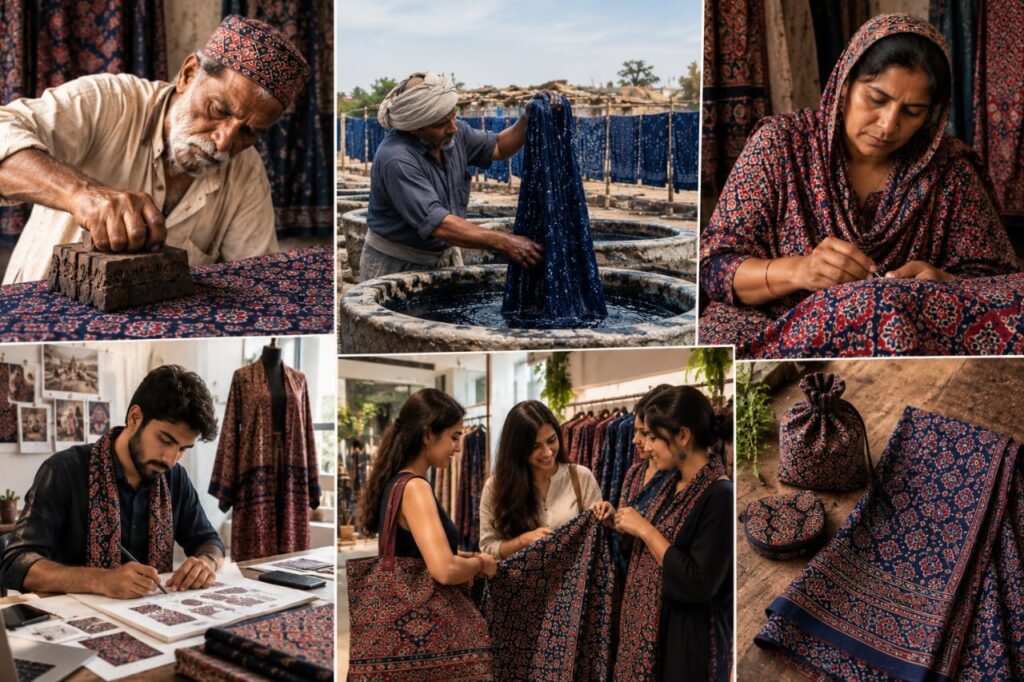
Traditional Ajrakh involves multiple stages of fabric preparation, printing, dyeing and washing.
Step 1: Preparing the Fabric
Before printing begins, the fabric needs to be properly prepared.
It is washed and treated so that the surface is suitable for receiving dyes and prints.
This stage may not be visible in the final saree.
But it is essential.
A beautiful print begins with properly prepared fabric.
Step 2: Preparing the Blocks
The designs are transferred onto wooden blocks that are carefully carved by hand.
Different blocks can be used for different parts of the design.
One block may create a particular motif.
Another may create a border.
Another may help build the next layer.
The artisan must understand how these blocks will work together.
Step 3: Resist Printing
Certain areas of the fabric are protected using a resist material.
The resist prevents dye from reaching selected areas.
This allows artisans to create the characteristic contrast and layered appearance associated with Ajrakh.
In simple terms:
Some areas are designed to receive color.
Others are deliberately protected from it.
That controlled contrast is fundamental to the craft.
Step 4: Dyeing
The prepared fabric is then dyed.
Traditional Ajrakh is particularly associated with natural and traditional dyeing techniques, including indigo and other plant- or mineral-derived color sources.
But the color does not simply appear after one dip.
The fabric may go through repeated stages of:
Printing → Dyeing → Washing → Drying
The process is repeated as different colors and patterns are built.
Step 5: Washing and Drying
This is one of the reasons Ajrakh requires patience.
The fabric needs to be washed and dried between stages.
Historically, artisans have used water extensively during the preparation and finishing of the textile.
The washing helps remove unwanted material and allows the colors and patterns to develop.
It is a slow process.
And that slowness is part of what makes the finished textile special.
Step 6: Building the Final Design
The final design is not created in one single step.
It is built layer by layer.
A motif is added.
A color develops.
Another area is printed.
The fabric is washed.
Another color is introduced.
Gradually, the individual stages come together.
The finished Ajrakh is the result of many small decisions made correctly.
The Wooden Block: A Small Tool With a Big Role
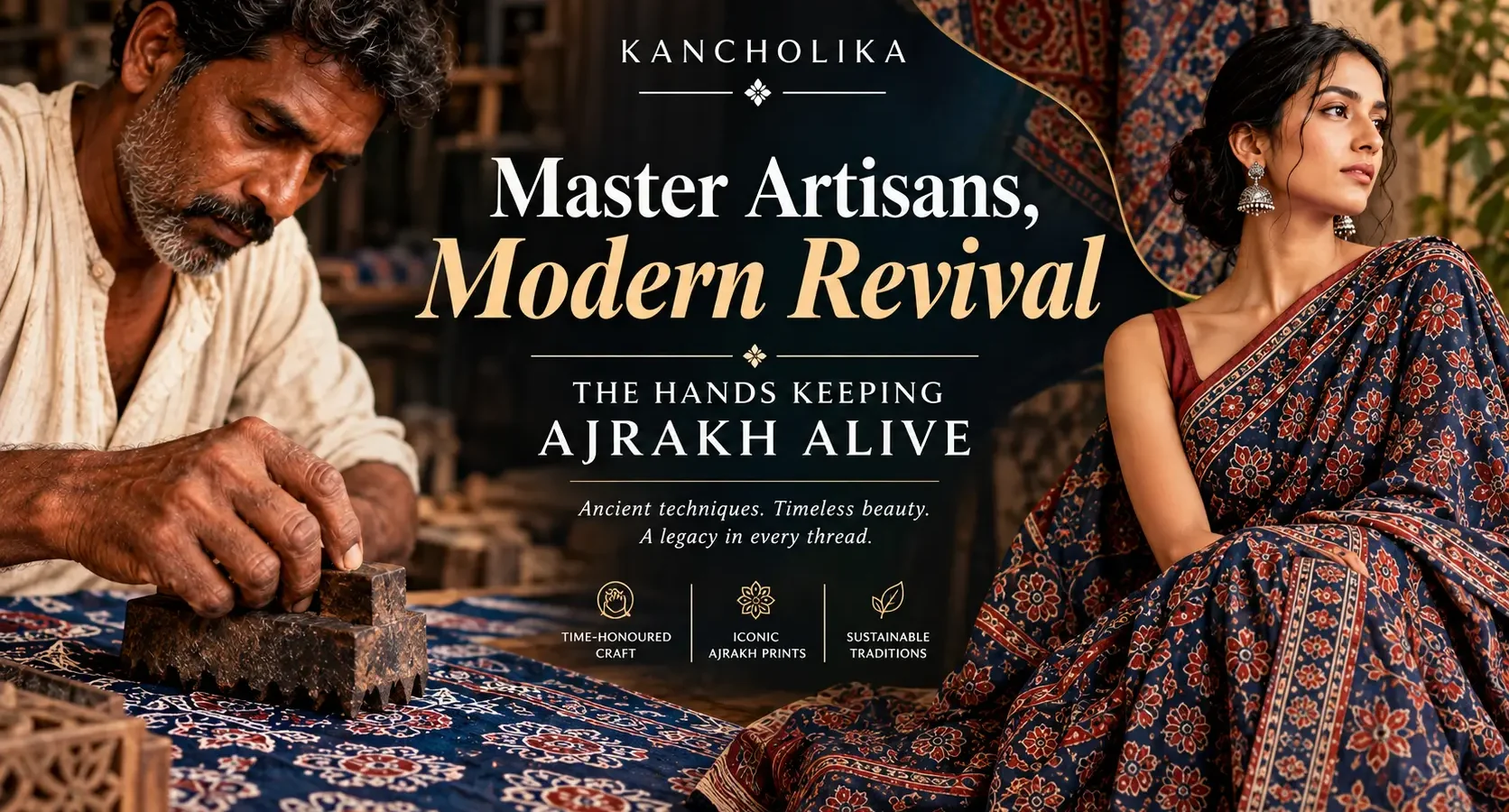
One of the most fascinating tools in Ajrakh is the humble wooden printing block.
It may look simple.
But the precision required to carve and use one is considerable.
The block needs to:
- Hold the design accurately
- Transfer the print consistently
- Align with neighboring impressions
- Work with the fabric surface
- Be handled with controlled pressure
A small error can become visible when the design is repeated across a large piece of fabric.
This is why experience matters so much.
The block may be made of wood.
The precision comes from the artisan.
The Artisan’s Hands Are the Real Technology
We often associate technology with machines.
Ajrakh offers a different perspective.
An experienced artisan knows things that are difficult to describe mathematically.
They know how the fabric feels.
They understand the behaviour of the dye.
They know how the block should meet the cloth.
They can recognize when something does not look right.
And they have learned these skills through years of practice.
This is knowledge that lives in the hands.
That is why handmade textiles should not be viewed simply as products.
They are also repositories of human knowledge.
Why Does Ajrakh Take So Much Time?
Because several stages need to work together.
Imagine trying to create a design where:
- The pattern must align
- Colors must remain balanced
- Resist areas must work correctly
- Dye must develop properly
- Fabric must survive repeated washing
- Multiple layers must eventually form one composition
There is very little room for carelessness.
A machine can repeat an instruction.
An artisan constantly responds to the material.
That interaction is one of the defining qualities of handmade craft.
What Do Ajrakh Motifs Represent?
Ajrakh designs are not limited to one single visual language.
Traditional patterns may draw inspiration from:
- Geometry
- Flowers
- Leaves
- Stars
- Natural forms
- Repeating grids
- Cultural influences
The motifs are often arranged symmetrically and repeated across the textile.
This repetition creates visual rhythm.
And that rhythm is one of the reasons Ajrakh feels both traditional and contemporary.
Ajrakh and the Idea of Balance
Perhaps the most interesting thing about Ajrakh is its balance.
It can be:
Bold—but controlled.
Detailed—but organized.
Traditional—but contemporary.
Geometric—but inspired by nature.
This balance makes Ajrakh surprisingly versatile.
It can work beautifully in traditional clothing while also fitting into a modern wardrobe.
From Traditional Textile to Modern Fashion
Ajrakh is no longer restricted to traditional applications.
Today, its visual language can be seen across contemporary fashion and lifestyle products.
It can appear in:
- Sarees
- Dupattas
- Kurtas
- Stoles
- Dresses
- Jackets
- Home textiles
- Contemporary accessories
The silhouette can change.
The styling can change.
The colors can evolve.
But the underlying craft can remain connected to its heritage.
This is what a living craft looks like.
It does not remain frozen in time.
It adapts.
Why Ajrakh Works So Beautifully on a Saree
A saree gives Ajrakh something particularly interesting:
space.
The fabric allows the pattern to unfold across the body.
The border frames the silhouette.
The pallu can become a visual focal point.
And the repeated motifs create movement as the saree is draped.
This is why Ajrakh can look completely different depending on how it is styled.
For a minimal look
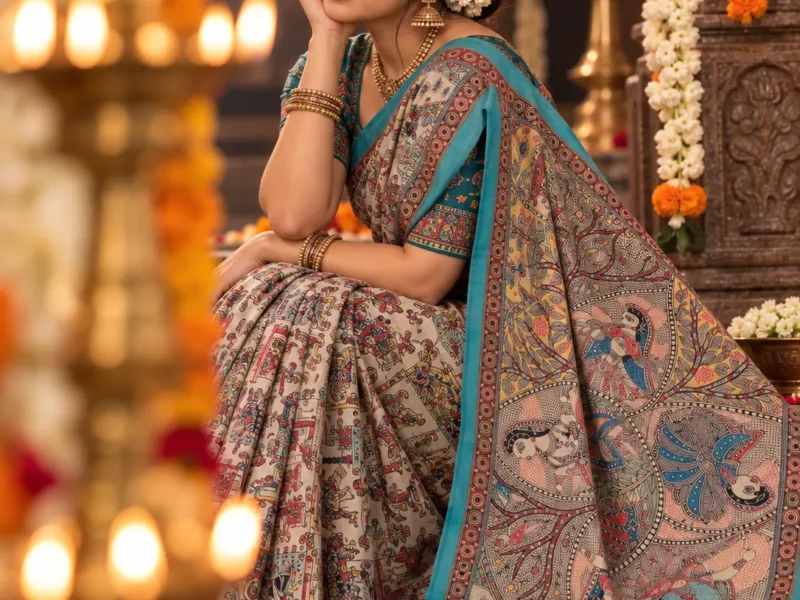
Pair an Ajrakh saree with a simple blouse and understated jewelry.
For a festive look
Add statement earrings, bangles and a more defined makeup look.
For a contemporary look
Try a structured blouse, minimal accessories and a clean drape.
The craft remains traditional.
The styling makes it yours.
How Can You Recognize the Character of Ajrakh?
When looking at an Ajrakh textile, don’t only look at the color.
Look closer.
Notice the pattern
Is the design highly structured and repetitive?
Look at the borders
Do the borders feel integrated into the overall composition?
Examine the details
Can you see layers of motifs and color?
Look at the surface
Does the textile have the visual character associated with hand printing rather than an overly uniform industrial print?
Most importantly: ask about the craft
- Where was it made ?
- Who made it ?
- What printing technique was used?
- What dyes were used ?
- A beautiful pattern is only the beginning of the story.
Handmade Does Not Mean “Perfect”
This is something worth remembering.
A handmade textile may contain tiny variations.
A print may not look mechanically identical from one section to another.
A color may have subtle differences.
These variations can be part of the handmade process.
In a world where mass production aims for identical repetition, handmade craft offers something different.
Evidence of the human hand.
Why Preserving Ajrakh Matters
A traditional craft survives when it remains economically and culturally relevant.
That means artisans need an audience.
They need customers who appreciate the work.
They need designers who understand the craft.
And they need brands that communicate the story honestly.
Buying a handcrafted textile does not automatically solve every challenge faced by artisan communities.
But creating sustained demand for skilled craft can help keep traditional techniques commercially relevant.
And that matters.
Because when a craft disappears, we do not lose only a pattern.
We can lose:
- Traditional knowledge
- Techniques
- Artisan skills
- Cultural history
- A connection between generations
The Modern Revival of Ajrakh
The revival of Ajrakh is not simply about bringing an old print back into fashion.
It is about giving traditional knowledge a place in contemporary life.
A younger customer may discover Ajrakh through a saree.
A designer may reinterpret its motifs.
An artisan may introduce a new color combination.
A brand may present it in a modern silhouette.
And suddenly, something centuries old becomes relevant to someone experiencing it for the first time.
That is how heritage continues.
Not by staying exactly the same.
But by continuing to be meaningful.
At Kancholika, We See More Than a Print
For us, an Ajrakh saree is not simply a combination of colors and motifs.
It represents the relationship between:
Artisan + Material + Technique + Time + Design
When you wear it, you are wearing the final chapter of a much longer process.
The printing happened before you saw it.
The colors developed before you chose it.
The artisan’s hands shaped it before it became part of your wardrobe.
And that is what makes traditional textiles worth looking at a little more closely.
The Next Time You See an Ajrakh Saree…
Don’t just ask:
“Do I like the print?”
Ask:
“How was this made?”
Look at the border.
Look at the repeated motifs.
Look at the colors.
Look at the tiny details.
Think about the hands behind them.
Because the most beautiful part of Ajrakh may not be the pattern you see.
It may be the human story hidden inside it.
Ajrakh, in One Look
| Element | What Makes It Special |
|---|---|
| Craft | Traditional hand-block printing |
| Region | Strongly associated with Kutch, Gujarat |
| Technique | Resist printing, mordant printing and dyeing |
| Colours | Indigo, red, black, white and earthy tones |
| Patterns | Geometric, floral and repeating motifs |
| Tools | Hand-carved wooden blocks |
| Process | Multiple stages of printing, dyeing, washing and drying |
| Skill | Built through years of artisan practice |
| Modern Use | Sarees, apparel, accessories and home textiles |
Frequently Asked Questions
Is Ajrakh hand printed?
Traditional Ajrakh is a hand-block printing craft in which artisans use carved wooden blocks along with resist and dyeing techniques.
Where is Ajrakh made?
Ajrakh is strongly associated with Kutch in Gujarat and has historical connections with the wider Sindh–Indus region.
What colors are commonly associated with Ajrakh?
Traditional Ajrakh is particularly known for indigo, red, black and white, along with earthy shades.
Is every Ajrakh textile exactly the same?
Handmade printing can contain subtle variations. These differences can be part of the character of a handcrafted textile.
Is Ajrakh suitable for modern fashion?
Yes. Its structured patterns and rich colors work well across traditional and contemporary silhouettes, including sarees.
Why is Ajrakh considered a heritage craft?
Because its techniques, motifs and knowledge have been developed and passed through generations of artisan practice.
A Craft That Still Has a Future
Ajrakh has already travelled a long way.
Across regions.
Across generations.
From traditional clothing to contemporary fashion.
And its journey is not over.
Every artisan who continues the technique adds another chapter.
Every designer who thoughtfully reinterprets it gives it another context.
And every person who chooses to wear it gives the craft another place in everyday life.
The blocks may be old.
The hands are human.
But the story of Ajrakh is still being written.