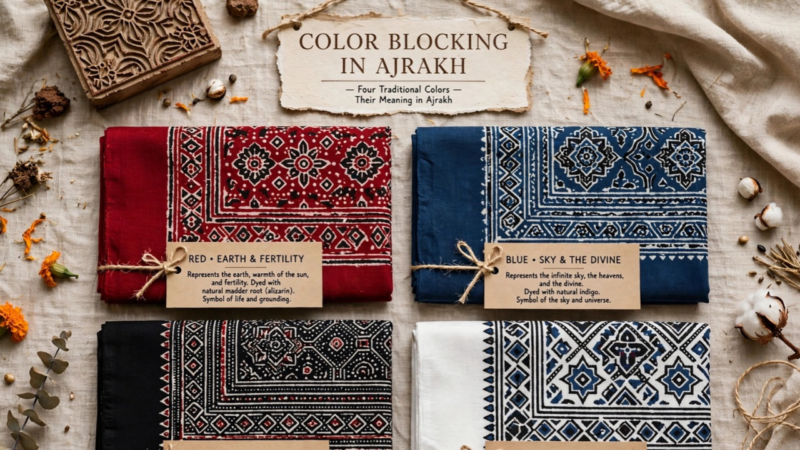

When people look at an Ajrakh saree, their eyes usually go straight to the colors. The deep indigo, earthy red, black, white and carefully arranged geometric motifs immediately catch attention. The fabric looks finished, balanced and almost effortless.
But an Ajrakh textile does not begin with a beautiful block.
It begins much earlier—with a piece of cotton that still needs to be prepared.
Before the artisan creates patterns, before natural dyes develop their rich shades, and before the famous indigo enters the story, the fabric goes through an important preparation stage known as Saaj.
Saaj is often described simply as the first wash, but that description does not fully capture its importance. It is a traditional method of preparing the fabric so that it can respond properly to the stages that follow.
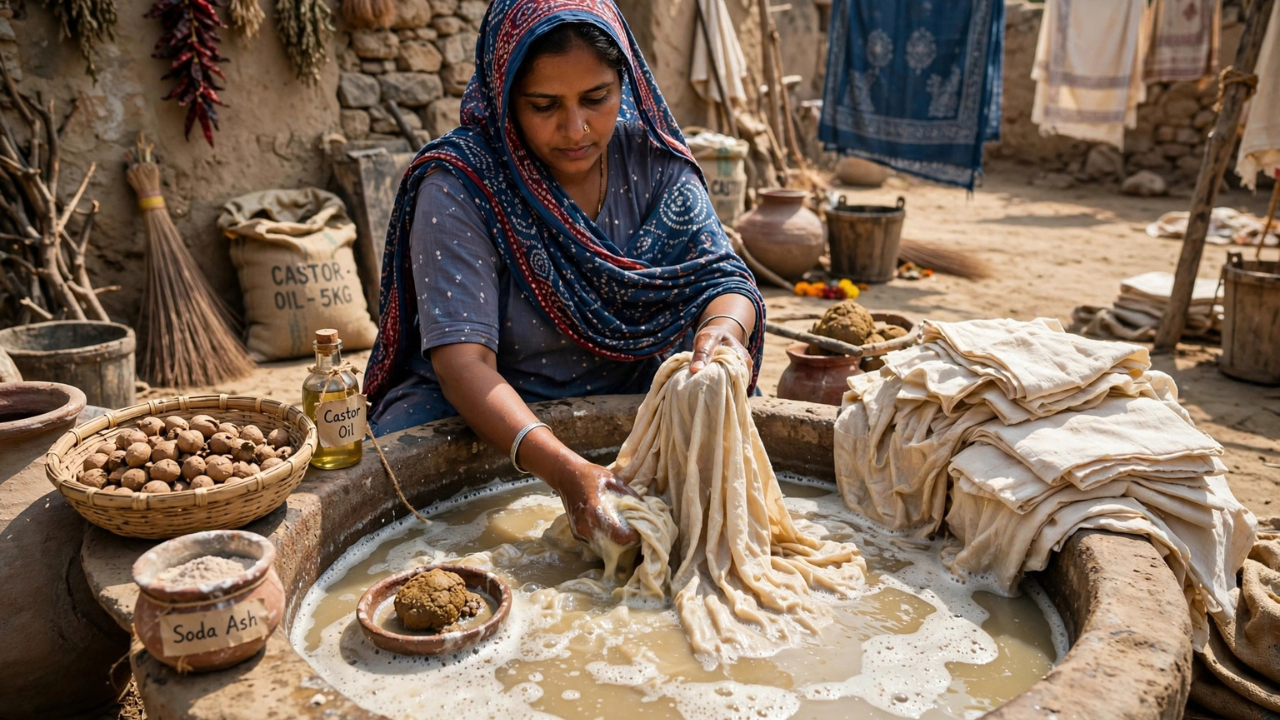
This preparation may involve traditional materials such as camel dung, castor oil and soda ash, followed by repeated washing and drying. Later, hard a or myrobalan and mordant-based treatments can prepare the cloth for specific natural-dye reactions.
The exact process can differ between artisan families and workshops. That variation is part of the living nature of Ajrakh.
So, rather than looking at Saaj as just one wash, it is better to follow the cloth through its journey.
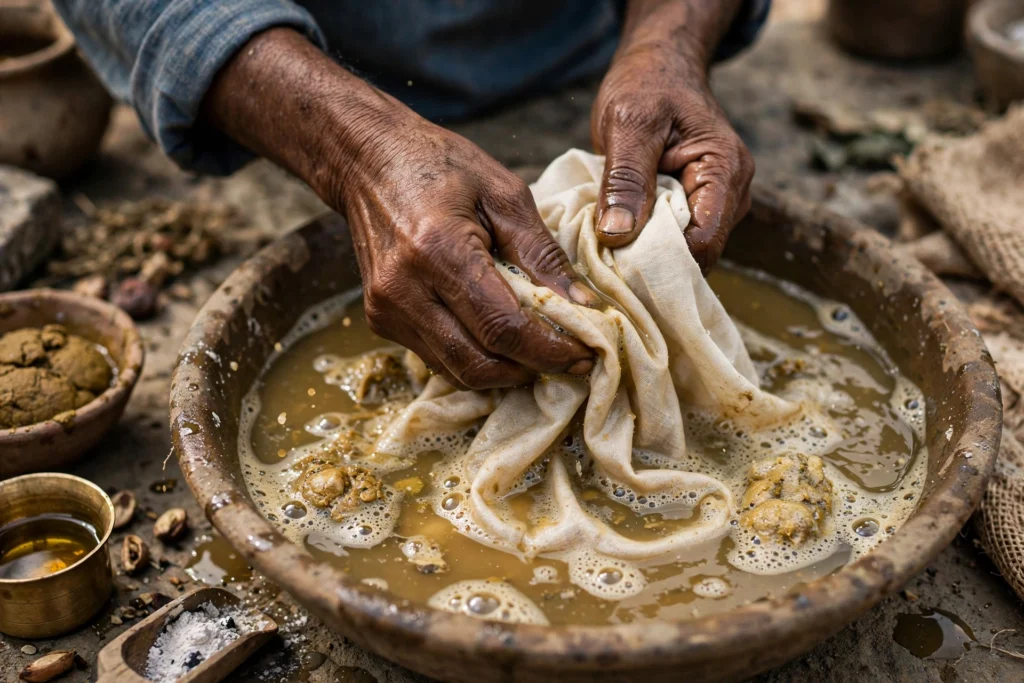
Step 1: The Cloth Arrives Before It Becomes Ajrakh
The fabric that enters an Ajrakh workshop does not immediately look like the textile we eventually see in a shop.
It is usually plain cotton fabric, waiting to be transformed.
At this stage, the cloth may carry substances from earlier stages of textile production, including:
- Natural oils present in the fiber
- Dust and surface impurities
- Starch or sizing materials
- Residues from handling and weaving
- Other substances that can affect dye absorption
For an artisan, this means the fabric is not yet ready for detailed printing.
The first job is preparation.
The cloth needs to become receptive to the treatments and colors that will eventually create Ajrakh.
This is where the quietest part of the process begins.
Step 2: Saaj Begins With a Simple Idea—Prepare Before You Print
The word Saaj is closely associated with the preparation of Ajrakh fabric.
It is tempting to think of it as ordinary washing, but traditional textile preparation is much more deliberate.
The purpose is to help remove unwanted substances and prepare the cotton surface for later processes.
In simple terms:
Saaj prepares the cloth to receive the next chapter of color.
The preparation can involve:
- Soaking the fabric
- Treating it with a traditional mixture
- Washing and rinsing
- Repeated handling
- Drying
- Checking the condition of the cloth
The exact recipe and number of cycles may vary.
This is important because Ajrakh is a living craft rather than a factory recipe where every workshop follows precisely the same formula.
Step 3: Camel Dung Enters the Story
This is probably the part of Saaj that surprises modern readers the most.
Why would camel dung be used to prepare beautiful textile?
The answer lies in traditional material knowledge.
In some traditional Ajrakh practices, camel dung is included in the Saaj preparation mixture. It is not used because the artisan is simply looking for an unusual cleaning material. It contributes organic and alkaline properties to a larger preparation system.
The important thing is to understand the ingredient in context.
The artisan is not thinking:
“One ingredient will magically clean the fabric.”
Instead, the process works through the interaction of:
- Camel dung
- Castor oil
- Soda ash
- Water
- Repeated washing
- Time
- Drying
- Artisan judgment
Together, these create a traditional method of preparing the cotton.
This is one of the most fascinating aspects of Ajrakh: materials that appear ordinary or unusual to us can have very specific roles within an old craft system.
Step 4: Castor Oil Adds Another Layer to the Preparation
The next unusual ingredient associated with traditional Saaj is castor oil.
Castor oil has a long history of use in traditional practices and material preparation.
Within the Saaj system, it should not be confused with a mordant.
Its role is part of the broader preparation mixture that helps condition and treat the fabric before later stages.
This tells us something important about traditional craft chemistry.
Not every ingredient is responsible for creating color.
Some ingredients prepare the material so that color can work later.
That distinction is easy to miss when we only look at the finished saree.
The beautiful red or indigo that we admire may depend on several earlier steps that never remain visible in the final design.
Step 5: Soda Brings Alkalinity Into the Process
Now comes another important part of the preparation: soda ash.
Soda ash, chemically known as sodium carbonate, is an alkaline substance.
Alkaline conditions can help in textile preparation by assisting in the removal or loosening of certain unwanted materials from fibers.
In the Saaj context, soda works as part of a larger traditional preparation system.
Its purpose is not to create the final Ajrakh color.
Instead, it helps prepare the fabric for what comes next.
This is where traditional craft begins to sound surprisingly scientific.
The artisan may not describe the process using modern chemical terminology, but the underlying logic is still about how materials interact.
Step 6: The Ingredients Work Together
It would be misleading to look at Saaj as a recipe where every ingredient has one isolated function.
The real story is the combination.
Think of it as a team:
- Camel dung contributes organic and alkaline material in certain traditional practices.
- Castor oil forms part of the traditional oil-based component.
- Soda ash provides alkalinity.
- Water allows the materials to interact with the cloth.
- Washing removes loosened substances.
- Sunlight and drying continue the preparation rhythm.
The artisan’s knowledge lies in understanding the entire system.
This knowledge is built through experience.
A traditional artisan learns not only what materials to use, but also:
- How much treatment is appropriate
- How the fabric should be handled
- When washing should happen
- How the cloth should be dried
- How the prepared fabric should feel
- Whether it is ready for the next stage
That is craftsmanship beyond simply following instructions.
Step 7: Washing Is More Important Than It Looks
Once the cloth has gone through its preparation treatment, washing becomes essential.
The purpose is to remove unwanted substances released during the treatment.
The fabric may go through:
- Thorough rinsing
- Repeated washing
- Manual handling
- Removal of remaining residues
- Drying
This stage might sound routine, but it has a major purpose.
A textile meant for natural dyeing cannot be treated like an ordinary piece of fabric.
Its surface needs to be properly prepared so that later color and printing stages can behave as intended.
The better the foundation, the more predictable the later work can become.
Step 8: Sunlight Becomes Part of the Workshop
After washing, the fabric is dried.
This is where the natural environment becomes part of the craft.
Ajrakh developed within regions where sunlight, water and locally available materials were important parts of textile production.
The cloth is spread out and allowed to dry, often under natural sunlight.
This creates a beautiful relationship between craft and environment.
The workshop is not completely separated from nature.
Instead, the process depends partly on:
- Sunlight
- Temperature
- Water
- Weather
- Drying conditions
- Seasonal changes
This is one reason handmade textile production cannot always be reduced to a fixed number of hours.
Nature becomes part of the timetable.
Step 9: The Artisan Checks the Cloth
A machine can follow a fixed program.
A skilled artisan does something different: they observe the material.
After preparation and washing, the artisan may look at the fabric’s:
- Surface
- Texture
- Feel
- Cleanliness
- Absorbency
- Overall condition
The cloth has to be ready for the next stage.
This is where generations of experience become visible.
An artisan may understand the condition of the fabric through touch and observation in ways that cannot easily be written down in a simple instruction manual.
This is one of the hidden forms of knowledge behind Ajrakh.
Step 10: Saaj Ends, But the Color Story Has Not Yet Begun
At this point, it is important to understand one distinction.
Saaj is not the same thing as mordanting.
Saaj is primarily associated with preparing and cleaning the fabric.
Mordanting belongs to a later part of the textile process.
This distinction matters because the two stages are often combined when Ajrakh is explained in simplified terms.
A clearer sequence is:
Fabric preparation → Saaj → Washing → Drying → Further preparation → Mordant/resist printing → Natural dyeing
The exact order can vary according to the artisan tradition and design.
But the basic principle remains:
First prepare the cloth. Then begin building the color.
Step 11: Hard Opens the Next Chemical Chapter
After the initial preparation, Ajrakh traditions may use hard a, also known as myrobalan.
Hard comes from the fruit of Terminal chebula and is valued for its tannin content.
This introduces another important relationship between plant material and textile chemistry.
The cloth is no longer simply being cleaned.
It is being prepared to participate in later color reactions.
Hard can help create a suitable foundation for mordant printing and natural dye processes.
This is a good example of how Ajrakh combines:
- Botanical knowledge
- Textile knowledge
- Material knowledge
- Color knowledge
- Artisan experience
The process is traditional, but the principles behind it are deeply practical.
Step 12: Now Mordanting Enters the Story
This is where the second half of the topic—mordanting—becomes important.
A mordant is a substance used to help establish a relationship between a dye and a fiber.
In traditional Ajrakh printing, mordant-based preparations can be applied to selected areas of the design.
Commonly discussed mordant materials include:
- Alum-based preparations
- Iron-based preparations
These can produce different color reactions with natural dyes.
The important idea is that the artisan is not simply painting color onto the cloth.
Instead, the cloth is being prepared so that certain areas respond differently when they meet particular dyes.
That is one reason Ajrakh patterns can develop such depth.
Step 13: The Block Finally Touches the Prepared Fabric
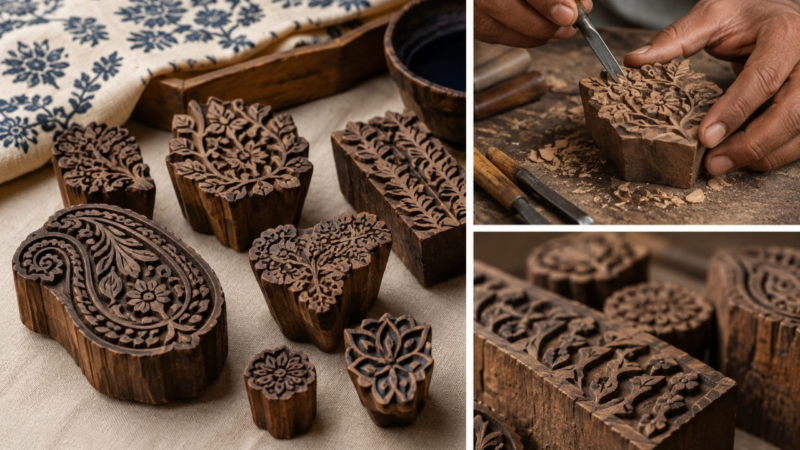
Only now does the famous wooden block become the star.
The artisan carefully positions the carved block and presses it onto the fabric.
One impression has to relate correctly to the next.
The block may carry:
- Mordant
- Resist material
- Dye-related preparation
- Other printing pastes
The process requires concentration.
A tiny shift in alignment can affect:
- Borders
- Repeating motifs
- Geometric symmetry
- Pattern continuity
The famous Ajrakh appearance is therefore not created by the block alone.
It is the result of everything that happened before the block arrived.
Step 14: Natural Dyes Begin to Reveal the Design
After printing, the fabric enters the world of natural color.
Ajrakh is traditionally associated with a rich palette created from natural and mineral-based materials.
Depending on the tradition and color required, materials may contribute shades of:
- Indigo blue
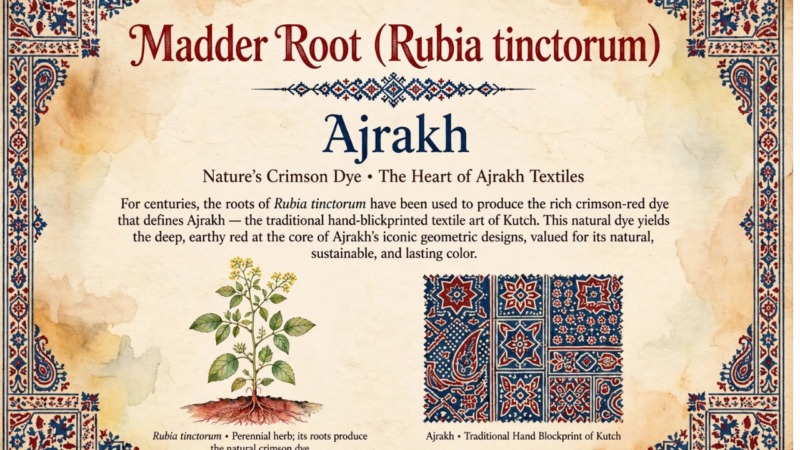
- Madder-related reds
- Yellow and earthy tones
- Black
- Brown
- Rust
- Deep maroon
The color does not simply sit on top of the fabric like paint.
The earlier preparation stages influence how the textile responds.
That is why Saaj, hard a, mordanting and dyeing should be seen as connected parts of one larger story.
Step 15: Indigo Arrives After a Long Beginning
The deep blue associated with Ajrakh often receives the most attention.
But by the time indigo enters the process, the fabric has already travelled a long way.
It has experienced:
- Initial preparation
- Saaj
- Washing
- Drying
- Further preparation
- Printing
- Mordant-related treatments
- Natural color stages
The indigo therefore represents not the beginning, but one of the later chapters.
This is what makes Ajrakh so fascinating.
The color we notice first is often the result of work we never see.
Step 16: Washing Happens Again and Again
Ajrakh is a layered textile tradition.
The cloth may be washed repeatedly between stages.
This helps remove unwanted material and allows the next stage to reveal itself.
The repeated cycle can feel almost endless:
Print → Dye → Wash → Dry → Print again
Then another layer may be added.
And another.
This repetition is one reason traditional Ajrakh requires patience.
The artisan cannot simply complete every stage in a single afternoon.
Each layer has to work with the ones beneath it.
Step 17: The Pattern Is Built One Decision at a Time
The final design may look perfectly planned, but its creation involves countless small decisions.
The artisan has to consider:
- Block placement
- Fabric condition
- Color sequence
- Printing pressure
- Alignment
- Drying
- Washing
- Color development
- Timing
This is where human skill becomes impossible to separate from the textile.
The fabric carries not only a pattern but also evidence of the person who made it.
Small variations do not necessarily mean something went wrong.
They can be signs that the textile was genuinely made by hand.
Step 18: Why the Entire Process Takes Time
People often ask why a handmade Ajrakh textile can take days or even weeks.
The answer is simple:
There are many stages between plain cotton and finished Ajrakh.
Time is required for:
- Preparation
- Washing
- Drying
- Hard treatment
- Printing
- Natural dyeing
- Repeated washing
- Indigo processes
- Drying between stages
- Final finishing
Weather can also influence the pace.
A process involving natural materials cannot always be rushed simply by increasing labor.
Some stages need time to happen properly.
Step 19: Saaj Is the Invisible Foundation
When we finally see an Ajrakh saree, Saaj has disappeared.
There is no label saying:
“Camel dung was used here.”
There is no visible mark saying:
“This fabric went through an alkaline preparation.”
The finished textile simply looks beautiful.
But that invisible work remains part of its history.
This is one of the most powerful lessons of traditional craftsmanship:
Some of the most important work is the work nobody sees.
Saaj may never become the most photographed part of Ajrakh, but without proper preparation, the later stages would not have the same foundation.
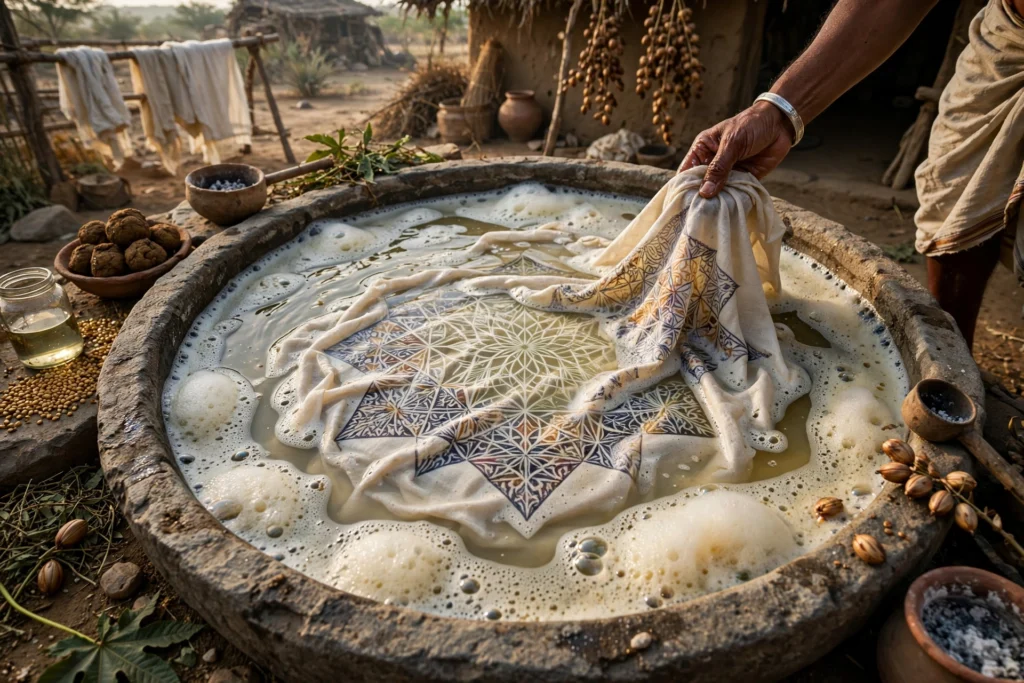
Step 20: From Traditional Ingredients to Traditional Intelligence
It is easy to focus on the unusual ingredients of Saaj.
Camel dung sounds surprising.
Castor oil sounds unexpected.
Soda ash sounds scientific.
But the bigger story is not the ingredients themselves.
The bigger story is the knowledge of how to use them.
Generations of artisans have learned through observation:
- How cotton behaves
- How water affects the fabric
- How natural materials interact
- How dyes respond
- How weather changes drying
- How long different stages may take
- When the fabric is ready
This is traditional intelligence built through practice.
It may not always be written in laboratory language, but it represents a sophisticated understanding of materials.
Step 21: The Complete Journey in One Flow
The entire story can be simplified into one sequence:
Raw Cotton
↓
Initial Fabric Preparation
↓
Saaj Treatment
↓
Camel Dung + Castor Oil + Soda in Traditional Preparation
↓
Washing and Rinsing
↓
Sun Drying
↓
Artisan Inspection
↓
Hard / Myrobalan Treatment
↓
Mordant or Resist Printing
↓
Natural Dyeing
↓
Indigo and Other Color Stages
↓
Repeated Washing and Drying
↓
Additional Printing
↓
Final Washing
↓
Finishing
↓
The Finished Ajrakh Textile
This flow is a simplified representation because actual practices vary among artisans, regions, designs and workshops.
Step 22: Why Saaj Still Matters in Modern Ajrakh
Ajrakh exists in a world where textiles can be produced extremely quickly.
So why does this slow preparation still matter?
Because Ajrakh represents a different relationship with clothing.
It values:
- Time over speed
- Skill over automation
- Natural materials over unnecessary complexity
- Repetition over shortcuts
- Craft knowledge over mass production
- Material understanding over surface decoration
The value of an Ajrakh textile is therefore not only in how it looks.
It is also in how it was made.
Step 23: The Cloth Was Never “Just Fabric”
By the end of the process, it becomes clear that the cotton cloth was never merely a blank surface.
It was part of a conversation between:
- Fiber
- Water
- Earth
- Plants
- Minerals
- Sunlight
- Human hands
- Time
Saaj begins that conversation.
Mordanting develops another part of it.
Natural dyes continue it.
The printing blocks give it visual language.
And the finished saree becomes the final expression of all these stages working together.
Step 24: Where Ajrakh’s Colors Really Begin
The next time you see a deep indigo Ajrakh saree, it is worth looking beyond the blue.
Think about the plain cotton that existed before the pattern.
Think about the first preparation.
Think about Saaj.
Think about the traditional mixture involving camel dung, castor oil and soda in certain Ajrakh practices.
Think about the washing and drying.
Think about hard a.
Think about the later mordant and resist stages.
Then think about the block finally touching the fabric.
Suddenly, the saree looks different.
The color is no longer just color.
It becomes the visible result of an invisible journey.
The Beauty That Begins Before the Pattern
Ajrakh is often celebrated for its finished appearance, but its real beauty begins long before the first geometric motif becomes visible.
Saaj teaches us that preparation is not a minor step.
It is the foundation.
The use of traditional materials such as camel dung, castor oil and soda reflects a practical knowledge of how different substances can work together. The later use of hard a and mordant-based treatments takes that preparation into another stage, where the fabric begins to interact with natural color in carefully controlled ways.
Most importantly, Saaj and mordanting remind us that Ajrakh is not created in one moment.
It is built gradually.
The cloth is prepared before it is printed.
The surface is prepared before it receives color.
And the color is built layer by layer before it becomes the Ajrakh we recognize.
That is the hidden journey behind the pattern—and perhaps the most beautiful part of the craft is that so much of it happens before the viewer ever sees the final design.